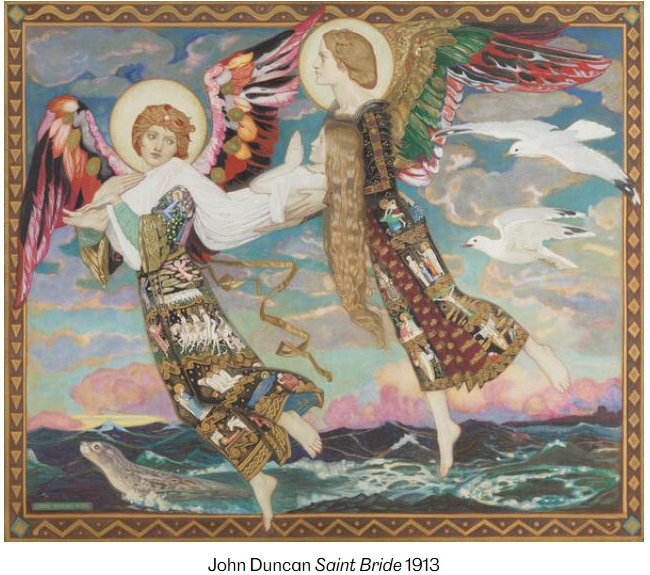
St Brigid and the Manger.
Last Saturday, February 1st, we remembered St. Brigid (sometimes spelt, Brigit).
Along with St. Patrick, she was Apostle to Ireland and is credited with him as one who proclaimed the Good News of Jesus Christ to the Irish people.
At that time the links between Ireland and what is now the southern part of Scotland were very strong. So Brigid(t) enjoys a special place in the hearts of both nations.
Her abbey was at Kildare in Ireland and, as in some parts of the Irish Christian tradition, it was a double monastery of both women and men. This practice was later transferred to Northumbria via the mission from Iona.
Many stories, traditions, myth and legends grew up around St Brigid, including one that suggests she was ordained Bishop to serve her Irish congregations. There is more evidence than not about this and if true, Brigid would have the honour of possibly being the first Woman Bishop in the Christian Church! That’s a thought for another time but one legend about her was brought to my attention by my dear friend, Heather Upfield, with whom I enjoyed a lovely friendship when we were both in Edinburgh. Her love of what we now call the Celtic spiritual tradition did much to feed and inspire my own love of it.
Earlier this week I received this note from her:
“In the Scottish tradition, St Bride was carried by angels from Iona to Bethlehem on Christmas Eve to be midwife to Mary at the Nativity. She then remained with the Holy Family till Mary and Joseph took the baby Jesus to the Temple. In the Candlemass mythology, she walked ahead of them carrying lighted candles, with a crown of lit candles on her head.”
The painting above by John Duncan, painted in 1913, which is in the National Gallery of Scotland, is inspired by this story. The two angels are carrying the saint between them to Bethlehem.
Wanting to know more, who better to turn to than my friend, Heather? I happened to find an article, by her, on St Brigid which was published in 2017. Here is the part of that which refers to this story.
“In the mythology, St Bride is carried from the Isle of Iona, in the Inner Hebrides, to Bethlehem on Christmas Eve, to be mid-wife to Mary at the birth of Jesus. In the Ghaidlíg, she was known as‘Ban-Chuideachaidh Muire’ ‘knee woman of Mary’, as in the Hebrides, women gave birth on one knee. Not only is she present at the birth of Jesus, but she also takes on the role of the Foster mother of Jesus – ‘Muime Chroisd’. In the Hebridean tradition, a Foster mother was considered more important than a natural mother. They took the view that any woman could become a mother – and be good or indifferent or bad. But the Foster mother took on the rearing of a child who was not her own, and this gave her greater status. In the eyes of the Hebrideans, therefore, St Bride is more important than St Mary and it is she who is considered the true Mary of the Gaels. A Hebridean prayer during labour was ‘Bride, Bride, Come in. Thy welcome is truly made. Give thou relief to the woman and give thou the conception to the Trinity’.
Following the Nativity, the Church celebrates Candlemas forty days after Christmas. St Bride is closely connected to this Festival. When Mary and Joseph carried the infant Jesus to the Temple, St Bride walked ahead of them. She wore a crown of candles and held a lighted candle in each hand. The flames stayed completely still and were not moved by the wind. In some traditions, Candlemas is known as Feast Day of St Bride of the Candles, and she herself is known as St Bride of Brightness. The legend of the flames also corresponds with what we know of Oimelc (or Imbolc) as a Fire Festival.”
[Brighid, St Brigid, St Bride, St Bride of the Isles and Scotland’
©Heather Upfield, www.brighid.org.uk/scotland_footprints.html, 16 April 2017.]
A certain caution must be exercised and possibly a suspension of belief in this story. It is part of a folklore which belongs to a people who understand the importance of myth as containing a kernel of truth rather than made-up fiction. Chronologically, of course, it can’t be an historical truth but there is more than one sort of truth, especially where angels are involved! Sometimes we have to move from the human realm to the heavenly to discover a new way of discovering the heart of God. Poetry, art, storytelling and music belong to this realm. Often words fail us in their bareness and logic but spring to life in a new way if we use our communication skills differently.
So the myth of St Brigid’s visit to Bethlehem and the echo of a Candlemass ceremony which is ascribed to St. Lucy in Scandinavia , are wonderful stories about new birth, tenderness, care and light. Bride’s visit to Bethlehem is also a delightful and fun story. Anything that brings a smile to our lives right now can only be good!
Thank you, Heather, for bringing this source of joy to my heart.
[If you wish to know more about the painting by John Duncan, go to the website of the National Gallery of Scotland.
Search for John Duncan and click on to the the very informative podcast]
 Mr G's Ponderings