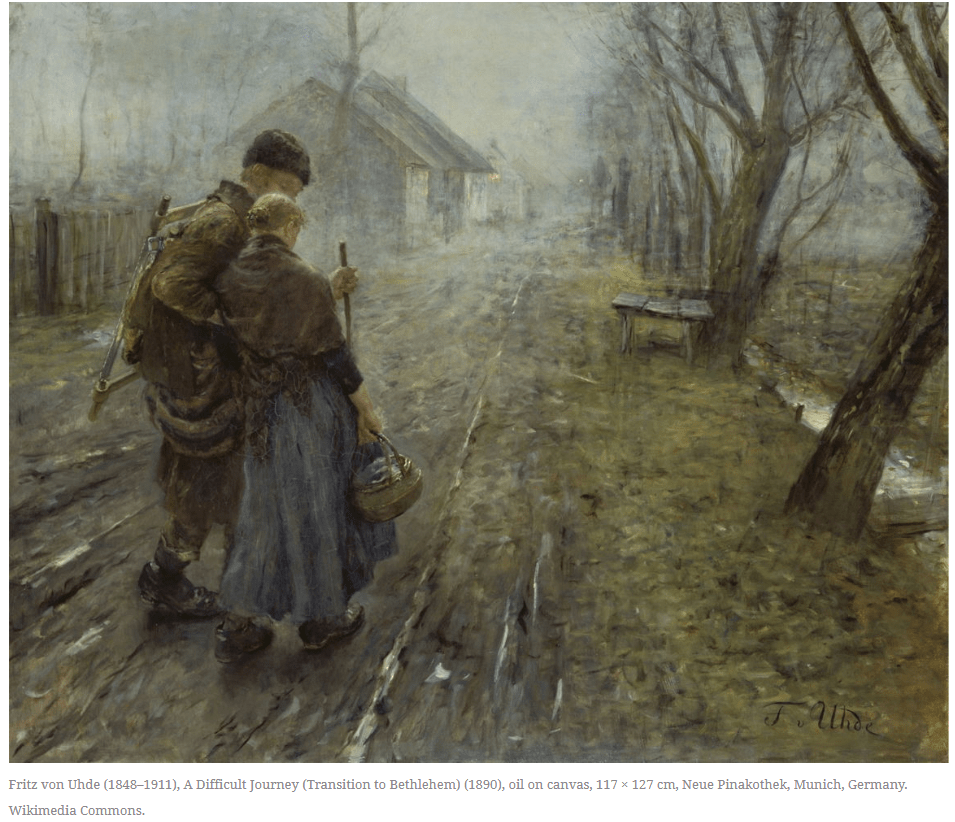
Fritz von Uhde was a German painter who lived between 1848 and 1911.
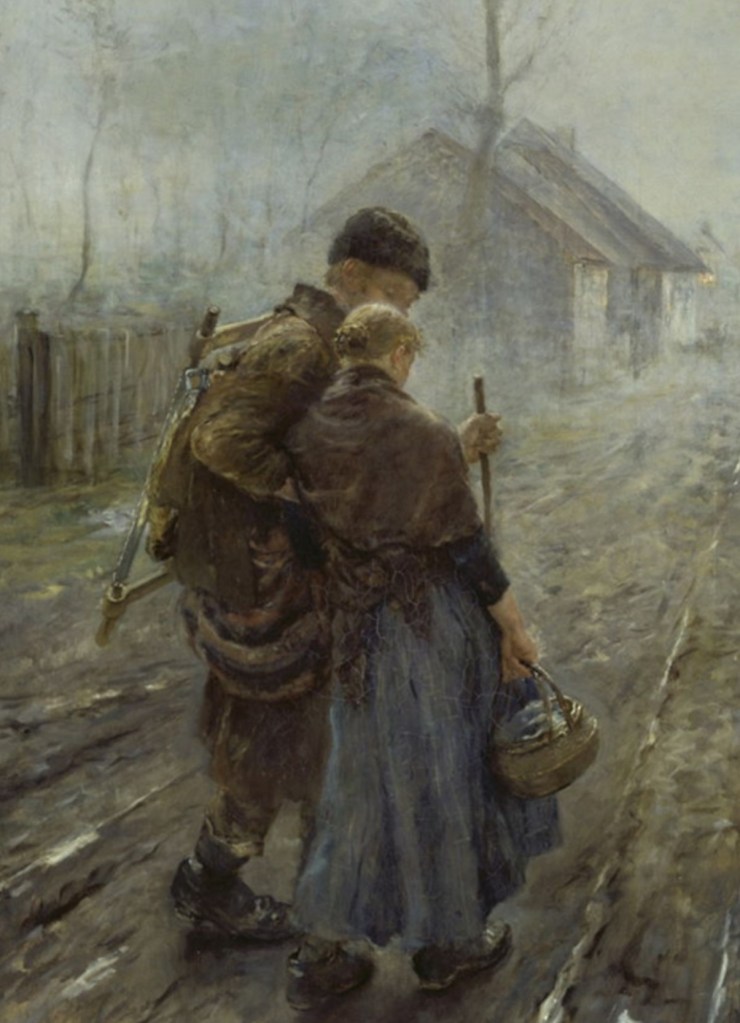
This particular painting belongs to his religious period and he painted it in oil on canvas in 1890. Originally it was titled Transition to Bethlehem’ but it was later come to be known as The Difficult Journey. It is about the journey of Joseph and Mary to Bethlehem for the Census. It depicts something of the difficulties they had in bringing Jesus into the world. Ever since I came across it, I have felt a draw to it, particularly when approaching the Christmas season. Last December I wrote about this in the Blog and I have come back to it again this year. If you are looking for more information on the artist, please look at my Blog entry for Christmas Eve 2022. As then, I have reflected on the scene Von Uhde painted and offer a different reflection / poem.
A winter journey.
It was a difficult journey.
She, carrying her pregnancy, leaning on him. He, with protective arm, enfolding her. Two needy people, both exhausted, longing for rest.
There is no welcome here. Villagers hide in their cottages, seeking heat and shelter from bitter wind. They are unaware of their visitors traipsing along mud-crowned lane.
Had they opened their doors what might they have made of the two young people seeking a respite from their weary way?
Yet the couple must travel on, sustained by love, he for her, she for him, the child already alive and eager within her. All loved by He who loves all.
Shuffling along the track, they pass unnoticed, to another place of uncertain welcome, where, in an outbuilding, strange things were destined to happen.
But of all this, the villagers were none-the-wiser. Not then. One day, in the future, they would hear the fuller story. The womb-enclosed child, now a grown man, would send signs of his presence.
The villagers would recall how they twitched their curtains, sensing a shadow of blessing pass by on that Winter’s day. Hearing of what they baby had become, they would fling open their windows with joy.
“He came amongst us”, they would cry. “He is with us still!”
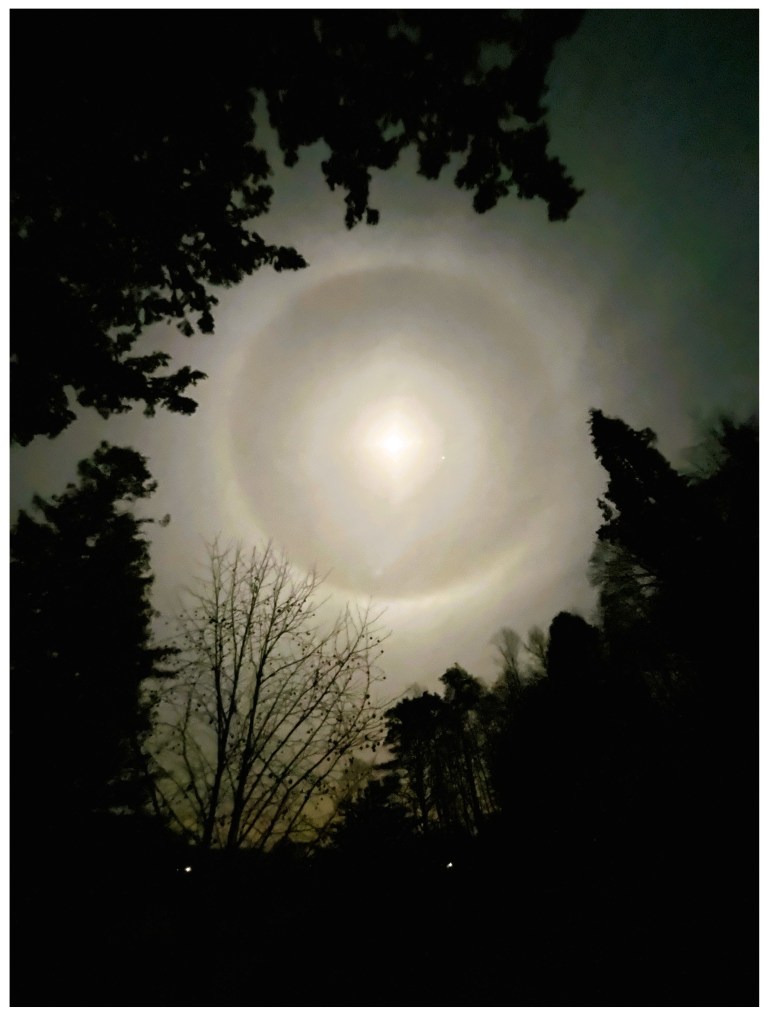
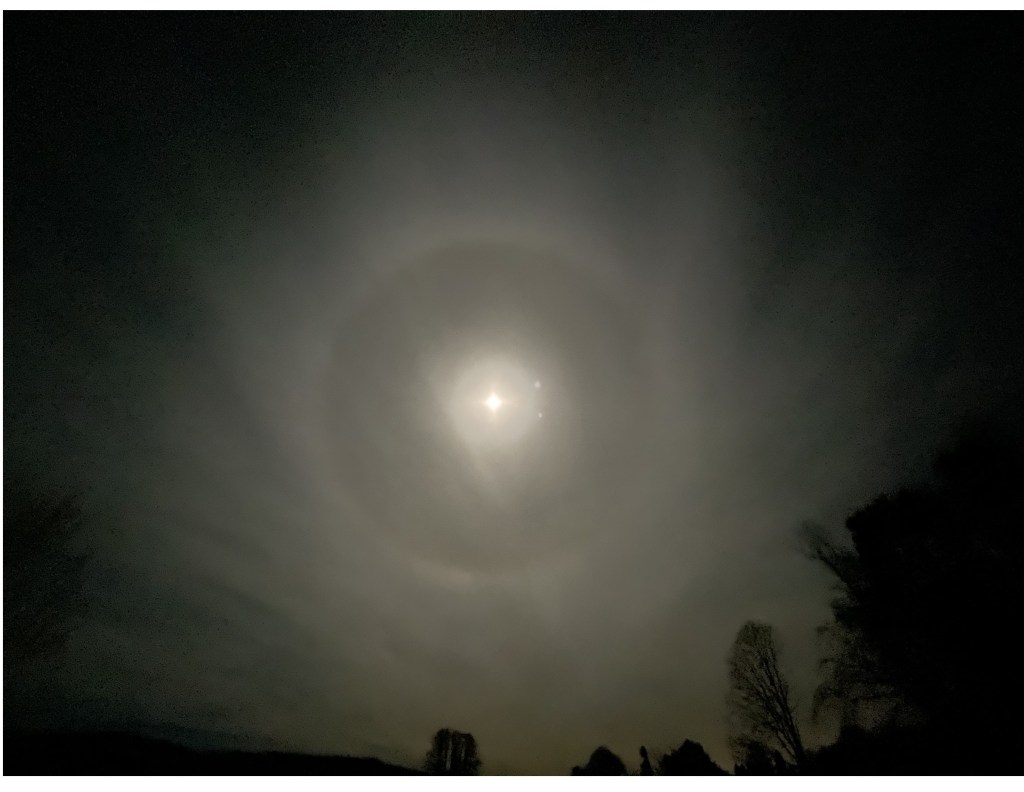
Lunar Halo A ring around the Moon was seen over the skies on Saturday evening The phenomenon is caused by the refraction of moonlight from ice crystals in the upper atmosphere. Gill Henwood took these photos of the moon over Cumbrian skies. Here, on the cusp of the Advent season, on the day which is sometimes called ‘Stir up’ Sunday, she offers this reflection to stir-up our thoughts towards the Christmas season ahead. It centres on the journey of the Magi who visited the infant Jesus, prompted by a bright portent in the night skies.
Pondering a moonbow The Eve of Stir-up Sunday.
Long ago, Magi mapped dark skies night by night accurate watchers. Travelling, through time seas, deserts, bringing wisdom to courts of power.
Stars, planets, moons their close companions familiar sky-marks leading, guiding. Magi knowing: interpreting heaven’s warnings, news for kings.
Waiting for a sign. recognizing the meaning. Following the sky-guide.
Organ Case by Charles Eamer Kempe Parish Church of St. John the Baptist, Epping, Essex.
It was St Augustine of Hippo who coined the phrase: “Those who sing pray twice”. The reference is mainly to hymns, spiritual songs and religious musical pieces. I was reminded of this saying on Wednesday when the Church kept the festival of St. Cecilia. (born in Rome about 2000, beheaded 230). She is the Patron Saint of Music.
Her claim to be so rests on quite flimsy evidence. She was called to be a martyr to the Christian faith when, as a young Christian, she opened her home for Christians to meet together. At this time she had married a pagan, Valerian, whom she converted to Christianity along with his brother. Unfortunately they took it upon themselves to bury the bodies of Christians who had been killed for their faith. When the Roman authorities came to hear of this, they were both arrested and put to death. Cecilia continued in her own witness, her life an example of fortitude, steadfastness and faith. The authorities, however, decided that it was time to act against her. On November 22nd, in the year 230, she was martyred. The chosen method was that she was burned in the fire but here, hagiography takes over. Her body remained intact and unburnt despite the ferocity of the flames and she is even said to have continued preaching the Gospel until it was decided to behead her. These are the main facts but her life was so inspirational to other Christians that more was said about her. As with many saints, particularly those who witnessed in the early centuries of the Christian Church, their ‘lives’ where written ‘up’, in which more was claimed than could be proved. That doesn’t mean that it was a pack of lies. There is a kind of Christian writing which is known as hagiography. It isn’t a straightforward biography but rather a piece of writing which introduces legends or stories that praises a particular saint and treats their life with reverence. It honours not just them but what their life stands for. Many hagiographies were written to encourage Christians, especially in times of darkness or persecution, to hold on and live deeply in love for Jesus Christ and His Good News for the world.
It is in this area of legend that the association of St Cecilia with music can be found.It is suggested that on her wedding day, as the musicians played, she sang with all her heart to the Lord. Similarly, as she was martyred in the fire, her soul again, sang to the Lord. This was enough to declare her to be the Patron Saint of Music and musicians. It was finally declared when, in 1584 the Academy of Music was founded in Rome. She was made the patroness of the Academy and this was enough to make sure her veneration became widespread throughout the world. Ever since, Cecilia has been an inspiration to musicians Musicians such as Handel and Benjamin Britten became inspired by her legend and even in literature she was recognized. Geoffrey Chaucer used her as the basis for his 2nd Nuns Tale in the Canterbury Tales. It is probably more about music that we relate to her less, these days, than martyrdom. Cecilia stands for that other kind of witness which comes through Music
The enquiry into the response to Covid-19 which is happening in England right now, will not be looking at the loss we experienced of not being able to be absorbed by the arts in all their fullness. Live Music became impossible to hear. For Christians, and many others the ban on singing hymns in Church was particularly hard. This was part of a huge loss for all who played and sang music and those who simply love to hear it. Our lives were diminished and our need unfulfilled through a loss of music, of hymns, of spiritual songs. It’s true, of course, that we rarely appreciate the value of something until we lose it and now, when we can freely sing, hear music, contemplate words of hymns and make them an essential part of our prayer and spirituality, we must not take it all for granted. Music and singing help to root our meditations and open poetry into our souls. Perhaps, like me, you catch yourself singing when you are still or in the shower or at odd timers of the day. That is when you use best the instrument God gives most of us, the human voice. Better to sing than to shout; better to lend your voice to the music of heaven which surrounds us; better to praise than destroy; better to let God use the music of the soul to enfold people in love.
Whatever the true story of St. Cecilia is, the legacy of her patronage continues to fill our hearts and minds with musical words that can inspire us, especially in this very dark world. We can be uplifted and affirm the great truth that music is a powerful force for good. It can celebrate and rediscover beauty in our world and, most of all, it pours out praise to God. In all our current global unrest, music has a special part to play.
Here’s a poem I wrote a little while ago. Play for me, Lord God. I wish to hear music the music of heaven. Play notes to calm my fears, Soothing my soul from anxiety. I live in a world ripped apart by sounds gurgling up from the bowels of hell. Bombs, missiles, bullets, Angry tanks, guttural sounds of soldiers. Many are far from home, tired too, hungry. bewildered.
Sucked in by masters whose only tune is hatred. Their words a cacophony of crashing disharmony mixed with disillusionment. Such cankered and disfigured hearts, no longer at one with the music that created them. Buildings shake and discard the rubble of their former life. Incessant noise, unceasing ruin. No symphony. No sympathy.
Wars begin in hearts crumpled by demonic blackness. Is this hell? Despair. The concerto of annihilation.
But, if you play music to us, We will find a way out of all this. Your sounds of note caressing note, sprinkles kindness over us, and love; showing us where we need to be.
As the music lifts our hearts, We hear it’s beautiful, clear tune – Telling us that there is more than hell on earth. There is earth raised up to heaven.
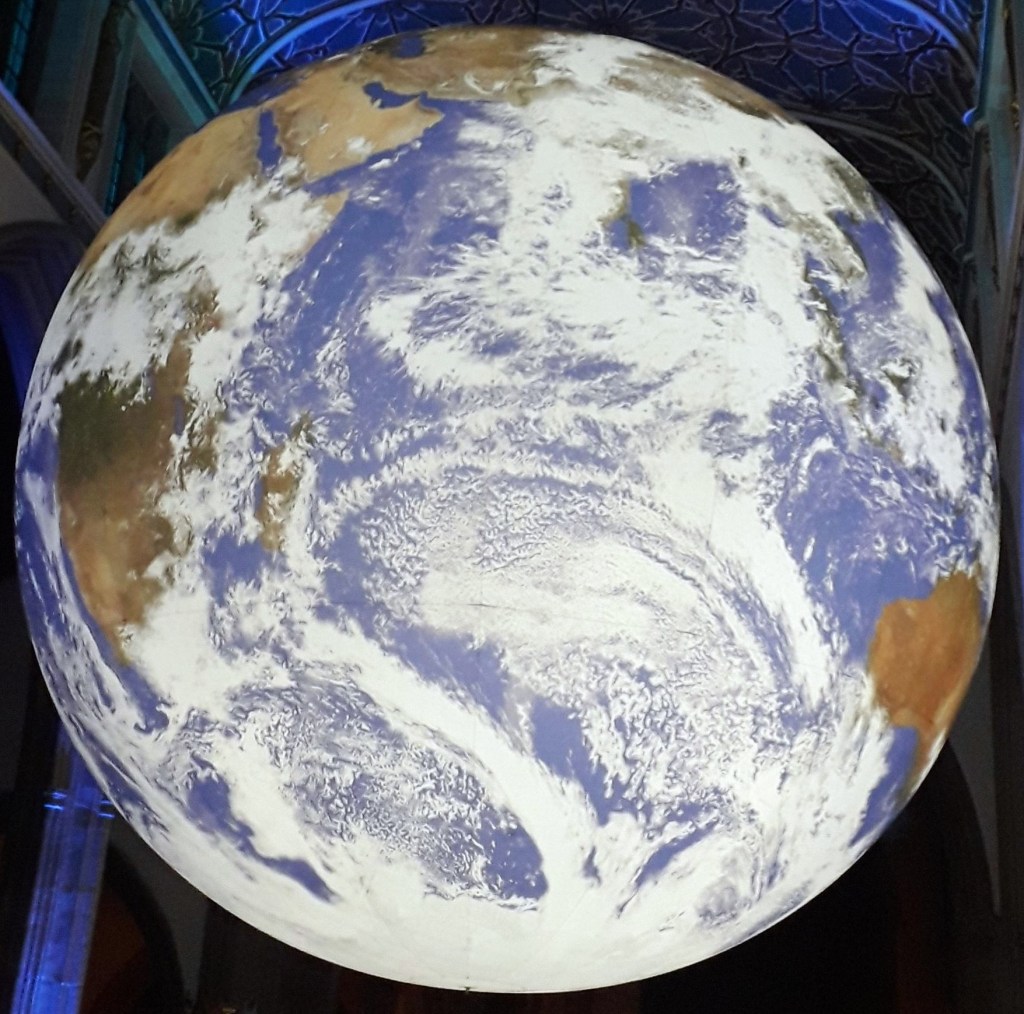
Photo by Mr G of the Gaia Globe exhibited at Chelmsford Cathedral.
AUTUMN EQUINOX
Today, September 23rd, is the Autumn Equinox in the Norther Hemisphere. It’s the Spring Equinox in the Southern Hemisphere
According to my sources, mainly the British Met. Office, the Equinox defines the transition between the seasons of the astronomical calendar. It is a key part of the earth’s orbit around the Sun. There are two each year – Autumn and Spring.
It occurs when the Sun crosses the path of the equator and is poised exactly between the Northern and Southern Hemispheres. During equinox, day and night are about the same length (12 hours each). The word Equinox means this. It is made up of two Latin words – ‘Equi’ meaning equal and ‘nox’ meaning night. From today, in the Northern Hemisphere the darkness of night becomes longer as winter approaches.
This balance and interaction of darkness and light affects our daily life but it also affects our spiritual and physical life. Physically many animals slow down or hibernate. Our daily life is affected by darkness. Nature goes into sleep mode. Shortly the trees will drop their leaves and the buds of next year’s foliage and plants will be dormant. Physically we may become more lethargic and as the weather becomes colder, staying indoors is more welcome. Though we follow our daily life, our bodies would love to hibernate. That is a generalization, but spiritually we become more aware of nature, of the creative change of the world around us. At the beginning of this cycle, we often celebrate Harvest and we give thanks for God’s goodness towards us in the provision of food. For our ancestors the curing and storing of food was vital to carry them through the harsh winter months. This thought can remind us of those without food and who are coping with disaster in places such as Morocco coping with its earthquake; Libya with the floods; Ukraine with the evil of the Russian invasion. These are but three of the needs we need to pray about and act upon. In the United Kingdom, poverty, financial hardship, and the need for Food Banks, remind us of our duty to those in need. We should add to that the plight of the world’s nomads, forced to flee their countries because of violence, imprisonment and the inhumanity meted out to them on a vast scale. It is at a time of Equinox that we are invited to pray and act for a better world. A world where all are equal and a remembrance that every one of us owes our existence to our Planet Earth, which sustains us, and to our Creator God. All has been planned to be held in a creative tension which ultimately is not about who gains what territory and power, but to a finely balanced Universe over which we have no control or power; except, of course, the power of destruction in which we are all engaged at present. We do and should have gratitude as the world turns and our life is altered for a time and a season. Thankfulness should be at the heart of everything we are and do. A thankfulness which must embrace everyone who are tenants of the earth.
EQUINOX
Sun poised over equator heralds the day of equal light; equal darkness.
Earth catches her breath in a moment of cosmic stillness, bringing to mind the delicate balance of solar existence, of which we are but a small part.
Seasons turn in an astronomical process in which our human participation is not required. We are the result of a divine plan, of an eternal equality over which we have no control. This global moment is our reminder that in our vast, unfathomable universe we are of little significance.
Yet, in the heart of our Creator God, we are loved and held because of another Equinox, not on the equator but on Calvary, where darkness became light and a new direction was shown to the world. It is called Love. Together, with all on earth we are invited to embrace it.


 Mr G's Ponderings