
Tag: Purim

The Dame of Laughter

Dame Edna Everage official photo

The death of Barry Humphries leaves many bereft of a special person in their lives, not least in his alter-ego, Dame Edna Everage. Many words are being said about both, as people mourn. Probably the most eloquent obituary is that of Barry Humphries by Dame Edna herself! To hear this read on Radio 3 on Sunday morning was certainly quite a departure from the sound of bells and birds!

What the death reminds us of is the importance of humour and laughter in our lives. As we hear yet more dreadful news from the Sudan it becomes increasingly hard not to despair about what we humans are doing to our planet, to nature and to ourselves. People might well think that there isn’t much to laugh about but even today as snippets of Dame Edna’s contributions to the funny side of life has lifted spirits.
Recently the Jewish people celebrated Purim, which I learned through the writings of the late Rabbi Jonathan Sacks, is the Jewish Festival of ‘happiness’.  In an article he wrote, I also learned a very important truth which drew its strength from the Holocaust.
The Jewish response to trauma is counter-intuitive and extraordinary. You defeat fear by joy. You conquer terror by collective celebration. You prepare a festive meal, invite guests, give gifts to friends and to the needy. While the story is being told, you make an unruly noise as if not only to blot out the memory but to make a joke out of the whole episode. You wear masks. You drink a little too much. You make a Purim spiel.
At the heart of the merrymaking is a challenge. Where a threat is serious there is a refusal to be serious but that leads to a paradox.
The refusal to be serious is a very serious action. As Jonathan Sacks puts it: You are denying your enemies a victory. You are declaring that you will not be intimidated. You face fear with its antidote – Joy! A striking message from the Holocaust is:
They tried to destroy us, We survived. Let’s eat.

Allowing laughter and humour is a way of defeating hate. What you laugh at, you cannot be held captive by.
Psalm  37 expresses  a similar view where we read that  
“the wicked plot against the righteous and gnash their teeth at them;
but the Lord laughs at the wicked, he knows their day is coming.” 
And the righteous can join in the joke.  

Similarly, when an audience laughs at a comedian’s jokes, they are participating  in the story and feel at one with each other. The popularity of performances by what are known as Stand-up Comics is a sign of how much humour has become a shared cultural experience.
For a short while, people are drawn towards each other, become open and perhaps vulnerable. It becomes a truly shared experience.In a brittle, divisive world, humour becomes a collective antidote and therefore a point and time of healing. Perhaps also of hope.

Not much of this may be obvious. The bottom line of having a good time and a bit of fun is itself a perfectly joyful activity but it has natural and love filled consequence.
Those who remember the magazine Reader’s Digest may recall that it had a maxim, Laughter is the best form of medicine.

Dame Edna knew this, I suspect, and whilst her humour played on the ridiculous and poked fun at the pompous, there was a sense of kindness and of gentle holding people in love. Her humour was never cruel even when it was close the bone. A safe haven was created which brought people closer together and which is why good humour, comedy and happiness are generated in a non-threatening way.
For a time there is a community creating the unity of the occasion.

This community, being in unity,  is also at the heart of groups who feel stronger in using humour to face together hatred, war, personal threat and tragedy, as in the response of Jews to the Holocaust, or the Ukrainian people to the evil of Putin.
Solidarity in the face of the world’s pain is also at the heart of the Christian message of hope and love. The foundation of the Christian Church is built on friendship which God, in Jesus, sacrificially showed through loving and sharing love which makes discipleship not a task to perform but a love to be shared. That is what Jesus showed and often it was done through wittiness, joy and sharing food, drink and storytelling. Many of the parables are wonderful, witty stories with punch lines that had people smiling, feeling changed and experiencing ‘penny dropping’ moments, like the show audiences.  Jesus, I suspect, was the master of stand-up!

The result of of all this changes people.
Whether it be at the level of what is known as the feel-good factor and which lasts but a short while or whether it be more permanent, life seems better somehow.
Perhaps this becomes more permanent when we recognize that we can become instruments of change.

Desmond Tutu, in his book ‘God has a Dream’, made the point that changed people are people who can be used to make things better. He wrote:
“All over this magnificent world God calls us to extend His kingdom of shalom – peace and wholeness – of justice, of goodness, of compassion, of caring, of sharing, of laughter, of joy, and of reconciliation. God is transfiguring the world right this very moment through us because God believes in us and because God loves us.”

Did Dame Edna or Barry Humphries seek to do that? I like to think so, or  if not directly, make it possible to make life not just bearable but enriched, cleansed, re-directed.Can laughter do that?

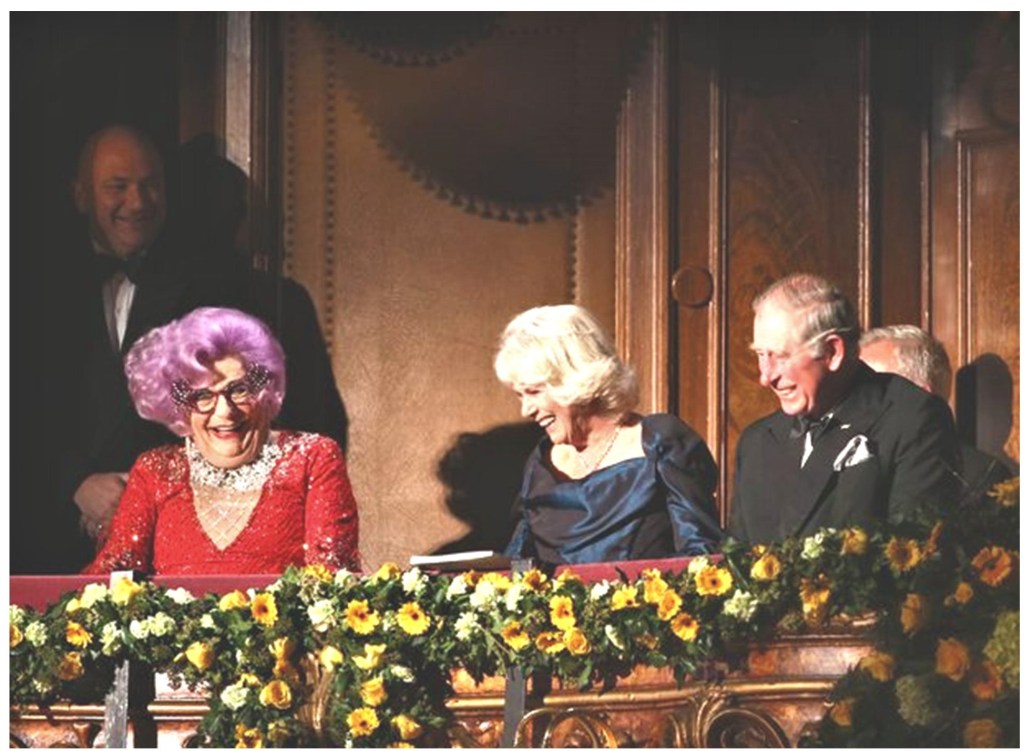
I think it can and I like to think that, as we say goodbye, we might focus on that wonderful sketch where Dame Edna enters the Royal Box where King (then Prince) Charles and dear Camilla are sitting. As ever she makes (creates?) a fuss but before she has time to settle, an usher arrives and pointedly shows her a ticket which suggests she’s in the wrong place. As she gets up, she turns to Camilla and says, “They’ve found me a better seat!”.

I’d like to think that is exactly what God has done now for Dame Edna and, of course for Barry.  I know that there will be laughter.
Here’s a reflective poem by the lovely John O’Donohue,
which says things I have been thinking about, in a very special way.

Like the joy of the sea coming home to shore,
May the relief of laughter rinse through your soul.

As the wind loves to call things to dance,
May your gravity be lightened by grace.

Like the dignity of moonlight restoring the earth,
May your thoughts incline with reverence and respect.

As water takes whatever shape it is in,
So free may you be about who you become.

As silence smiles on the other side of what’s said,
May your sense of irony bring perspective.

As time remains free of all that it frames,
May your mind stay clear of all it names.

May your prayer of listening deepen enough
to hear in the depths the laughter of god.

John O’Donohue
for Equilibrium. A Blessing.

[Mr. G]

Purim, Joy in the darkness

tradional food for Purim

Purim is the Jewish Festival, also known as a ‘Carnival of Happiness’ and it begins this evening (March 6th) until tomorrow evening (March 7th.)

It is based on the event in the Book of Esther and to understand it fully, a reading of that book would help you. There are only 10 chapters, none of them very long.It is set in the Persian Empire in the 4th century BCE. The Empire extended over 127 lands and Jewish people were spread across most of it.

The story goes that when King Achashverosh was disobeyed by his wife, Queen Vashti, he decided to replace her. He ordered that the beautiful girls of the Empire should parade before him. The new Queen he chose was Esther but she was a Jew so she had to hide her nationality.
At this time, the new Prime Minister of the Empire, Haman, began to exercise his power. All in the land bowed to him by order, except the Jewish Leader Mordechai. (He was the guardian of the new Queen, Esther but this wasn’t known.)
Haman was so furious and angry with Mordechai that he persuaded the King, on some pretence, to have all Jews in the Empire destroyed.He cast lots to decide the date and this became the origin of the feast because Purim means ‘lots’ in ancient Persian. (They cast lots)
In the face of widespread  destruction,  Mordechai persuaded Queen Esther to enlist the aid of the King.
It transpired that Mordechia   had already been influential in foiling a plot against the King by two rebels. So the King wanted to reward, rather than kill Mordechia. Esther told him to gather all the Jews in the city of Shushan, where the Royal Palace was, and spend three days together, repenting, fasting and praying to God. Then Esther invited the King and Hanam to a feast. During the festivities, she revealed that she was a Jew and accused Hanam of attempting to destroy her people. Mordechia was feted by the King and Hanam was hung on gallows he had built to get rid of Mordechia.
He was appointed Prime Minister in place of Hanam.

It’s a marvellous story and you can ‘read all about it’ in the Book of Esther.

Purim is the Festival at which the Jewish People celebrate this and they do it particularly in 4 ways.

  • The reading of the Book of Esther (the Megillah), once on the night of Purim and once the following day.
  • By giving money gifts to at least two poor people.
  • Sending gifts of two kinds of ready-to eat-foods to at least one person (who may be in need)
  • And to have a festive meal

The atmosphere is lively and full of fun. It is customary for children especially (but adults also if they desire) to dress up in costumes. This is because the role of God is hidden in the story of Purim (and in fact even the name of God is missing from the Megillah).’

There are special foods including a three-cornered pastry stuffed with sweetmeats and poppy seeds. It is called Hamantaschen after Haman’s favourite three-cornered hat though in Yiddish,it is called ‘Haman’s ears
Central to the feast is Joy. It is based on deliverance from death and evil intent and that is something to be joyful about.

The late Jonathan Sachs pondered on this. They had escaped an act of genoside, the first one of more to come. Was the appropriate emotion joy? Ought it to have been relief? How does this festivity sit with future persecutions of the Jewish people? How does Purim  seem against the background of the holocaust? This is what Jonathan Sacks has to say:

“We who live after the Holocaust, who have met survivors, heard their testimony, seen the photographs and documentaries and memorials, know the answer to that question. On Purim, the Final Solution was averted. But it had been pronounced. Ever afterward, Jews knew their vulnerability. The very existence of Purim in our historical memory is traumatic.
The Jewish response to trauma is counter-intuitive and extraordinary. You defeat fear by joy. You conquer terror by collective celebration. You prepare a festive meal, invite guests, give gifts to friends. While the story is being told, you make an unruly noise as if not only to blot out the memory but to make a joke out of the whole episode. You wear masks. You drink a little too much. You make a Purim spiel.
Precisely because the threat was so serious, you refuse to be serious – and in that refusal you are doing something very serious indeed. You are denying your enemies a victory. You are declaring that you will not be intimidated. As the date of the scheduled destruction approaches, you surround yourself with the single most effective antidote to fear: joy in life itself. As the three-sentence summary of Jewish history puts it: “They tried to destroy us. We survived. Let’s eat.”

Humour is the Jewish way of defeating hate. What you can laugh at, you cannot be held captive by.”

In our present world, where so much tragedy is befalling so many people, in Ukraine, Turkey, Syria, even the Holy Land, and so many other places, perhaps there is a vital message here for all of us.

Jonathan Sacks again:

How do joy and humour help us deal with tragedies, both in our personal and national life?

I learned this from a Holocaust survivor. Some years ago, I wrote a book called Celebrating Life. It was a cheer-you-up book, and it became a favourite of the Holocaust survivors. One of them, however, told me that a particular passage in the book was incorrect. Commenting on Roberto Begnini’s comedy film about the Holocaust, Life is Beautiful, I had said that though I agreed with his thesis – a sense of humour keeps you sane – that was not enough in Auschwitz to keep you alive.

“On that, you are wrong,” the survivor said, and then told me his story. He had been in Auschwitz, and he soon realised that if he failed to keep his spirits up, he would die. So he made a pact with another young man, that they would both look out, each day, for some occurrence they found amusing. At the end of each day they would tell one another their story and they would laugh together. “That sense of humour saved my life,” he said. I stood corrected. He was right.

How can humour be the ultimate defence against those who wish to take away our freedom and destroy us?
That is what we do on Purim. The joy, the merrymaking, the food, the drink, the whole carnival atmosphere, are there to allow us to live with the risks of being a Jew – in the past, and tragically in the present also – without being terrified, traumatised or intimidated. It is the most counter-intuitive response to terror, and the most effective. Terrorists aim to terrify. To be a Jew is to refuse to be terrified.

A people that can know the full darkness of history and yet rejoice is a people whose spirit no power on Earth can ever break.

Terror, hatred, and violence are always ultimately self-destructive. Those who use these tactics are always, as was Haman, destroyed by their very will to destruct. And yes, we as Jews must fight antisemitism, the demonisation of Israel, and the intimidation of Jewish students on campus. But we must never let ourselves be intimidated – and the Jewish way to avoid this is marbim be-simcha, to increase our joy. A people that can know the full darkness of history and yet rejoice is a people whose spirit no power on Earth can ever break.”

There is so much about this that we can learn to good and powerful effect. It touches so much on the events in our world today. It is also central to the Christian Lent and Holy Week journey . There, too, joy comes out of seeming destruction and yet love triumphs  through Cross & Resurrection which is itself the epitome of joy, deliverance and celebration. It reminds us that by whatever religion we pray to God,  the joke is always on Satan and those who follow evil.

[Mr G]