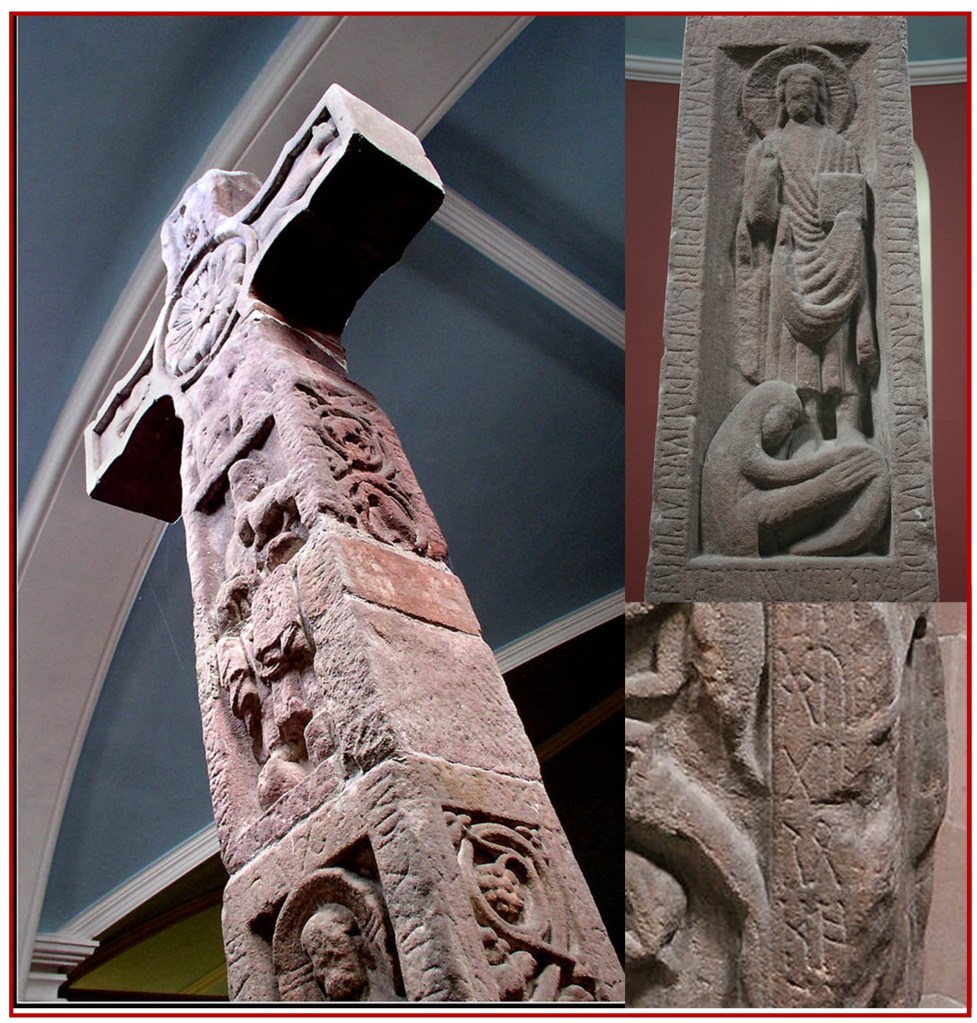
Near the shore of the Solway Firth, in Dumfriesshire lies the village of Ruthwell. It is famous for two things. The Trustees Savings Bank was first established here and there is a fascinating museum in the main village street.
If that serves mammon then God is also served in Ruthwell’s second and more important claim to fame.
On the edge of the village is the Parish Church with its neat and well-kept churchyard. Inside, it seems, at first, to be a simple and fairly ordinary Church of Scotland Church but it would not take you very long to notice that this is a church with a huge difference.
In an apsidal section there is a well (not a water one!) from which rises up an 18 foot Stone Cross, beautifully carved. It is breathtaking and it is also providential because it might never have been there at all.
The Ruthwell Cross, carved in the 8th century began life as a preaching cross – a common sight in Celtic and Anglo-Saxon times.
In the absence of Churches, missionary monks would build stone crosses on which were carved intricate scenes from the Bible as a kind of teaching aid – much as stained glass windows were to do in medieval churches. The monks would gather people around the cross and using the carved illustrations they would proclaim the Gospel. It was a kind of outdoor pulpit.
Many of these crosses survive – especially in Ireland, Wales, Scotland and Cornwall. These are hard evidence of the Celtic/Anglo Saxon Christian Mission in Northumbria, the Scottish Borders and elsewhere.
The Ruthwell Cross is Anglo-Saxon and was probably constructed as a preaching cross on the shore of the Solway Firth by Northumbrian monks from the double monastery of Jarrow and Monkwearmouth, who went to Dumfriesshire to assist King Necthan of the Picts in the re-Christianization of his territory.
The names associated with Ruthwell are the Venerable Bede himself (from whose Ecclesiastical History of the English Nation we learn so much about early Christianity in Britain ) and Ceolfrith, Abbot of Jarrow who is credited with Ruthwell’s construction.
Long after it was no longer needed as a Preaching Cross, it was removed to the local Church where it stood near the altar. In 1642, during the Scottish Reformation it was taken down, partially defaced and broken up. Part was used to repair the Church floor and the rest was buried in the churchyard.
In 1802 Henry Duncan, the then minister, dug up fragments of the Cross and then he set about finding as much of it as he could, carefully reconstructing it as a monument in the Churchyard.
In 1887 the Cross was moved back into the Church where it now stands, the damage having been repaired. It is now under the protection both of the Church of Scotland and the Historic Monuments Commission of Scotland.
Thus we have restored to us one of the finest examples of carved crosses there is to see anywhere in the world.
And it is truly magnificent. Many Visitors, myself included, are reduced to awe at its beauty.
It has much elaborate ornamentation and there are Gospel scenes and Old Testament scenes, common on many such crosses but it also has something else which makes this a very special cross indeed.
The Cross is also inscribed with Anglo-Saxon Runes – the Runic Alphabet of Germanic tribes which became the Anglo-Saxon tongue and which evolved into the English Language.
The Runes on the Ruthwell Cross are remarkable because, translated, they are part of a poem which is now known to be the earliest Christian poem in the English Language – and maybe the earliest Anglo-Saxon writing we possess.
The poem is known as the Dream of the Rood. (Rood is the Anglo-Saxon word for Cross and from it, of course, we get the Rood screen which in many churches is the chancel arch screen surmounted by a carved Crucifix.)
Michael Alexander *** in his work The Earliest English Poems says it was the most famous poem of its day and we know of it particularly because it is carved on the Ruthwell Cross.
A more complete version is a 10th century manuscript version in the style of early Gospel mss found in the Italian library of Vercelli which has therefore given it the name it is now known by.
It is an intriguing poem in which the main narrative is provided by the Cross itself, of the Crucifixion of Jesus from its own experience. The Cross speaks of the Young Warrior (Jesus)dying for his people and is a wonderful example of Anglo-Saxon dream vision poetry.
It’s presence, in runic form, on the Ruthwell Cross, is a testimony that the Northumbrian Mission, converted people by proclaiming the faith of Christ Crucified, using illustrations carved on the Ruthwell Cross. People discovered just how much the Love of God for them was demonstrated in the proclamation of the Victory of God’s love in Jesus from the Cross.
A good reminder on the weekend which includes the celebration of Holy Cross Day. (September 14th)
[Mr G]
Holy Cross Day 2024
*** Earliest English Poems, Professor Michael Alexander
There are many translations of the poem, Dream of the Rood.
A Choice of Anglo-Saxon verse, edited by Richard Hamer, contains a translation I enjoy.
A good introduction to the poem is : The Dream of the Rood, edited by Michael Swanton.
 Mr G's Ponderings