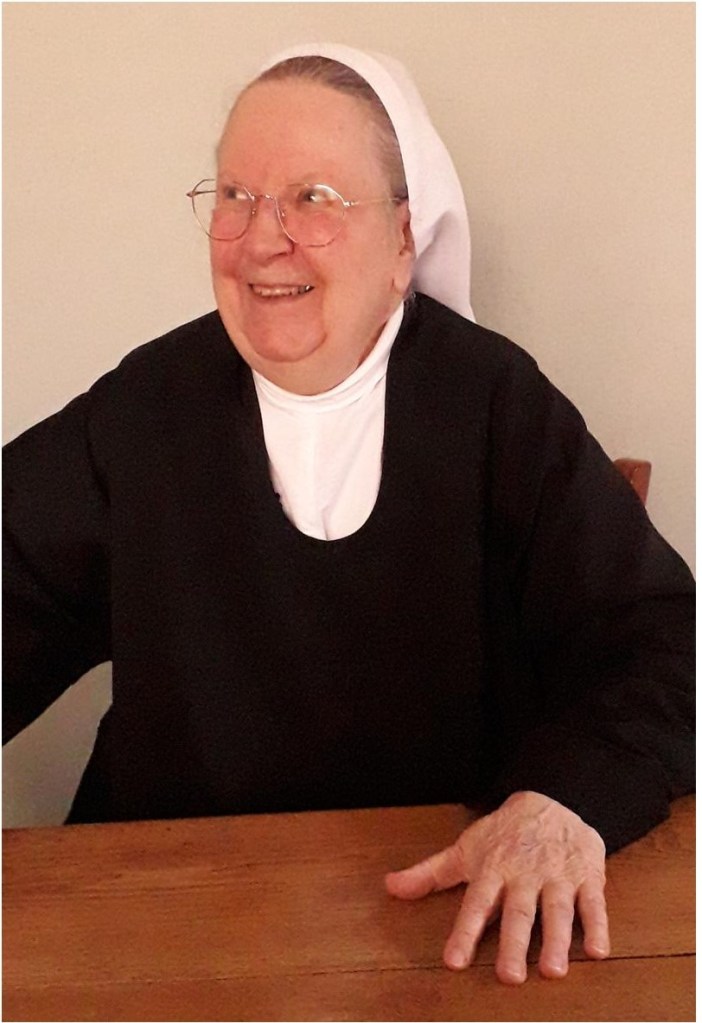
Photo from the Convent at Le Bec taken by the Sisters.
At the Weekend, I posted a blog item about Sister Irène-Marie, a beautiful nun and iconographer. She was a member of the community at the Monastère Sainte Françoise Romaine, Le Bec Hellouine, Normandy. You can read more about her if you scroll back two blog entries.
Her funeral is today, Thursday 9th, at the Convent and I just wanted to mark the entry into heaven of a dear friend. So I have written the following poem.
Dear Sister Irène-Marie, bearer of Peace, held in the love of Mary, you brought a singular joy into our lives. We met you and sensed your nearness to God. We were enraptured by your sacramental eyes which mirrored the Divine.
Extending monastic hospitium , you encircled us with welcome, embracing our need with thoughtfulness and gentle love, which was kept warm within the folds of your habit.
Your listening expressed concern for a broken world from which you could draw a reservoir of experience. No hidden cell housed you. The lives of others glazed your windows and held open the door from which rays of love shone.
Most of all, you ‘wrote’ visible signs of God’s Presence in Jesus and the Saints. You dipped your brush and pen in the palette and inkwell of God. From the depth of your prayerful iconography you led us into the heart of faith which has led you now into the bosom of your Saviour, for as you said, that is what you, (and we,) “are here for.”
Thank you for opening and sharing the images of your faith with us. By you we have been truly blessed.
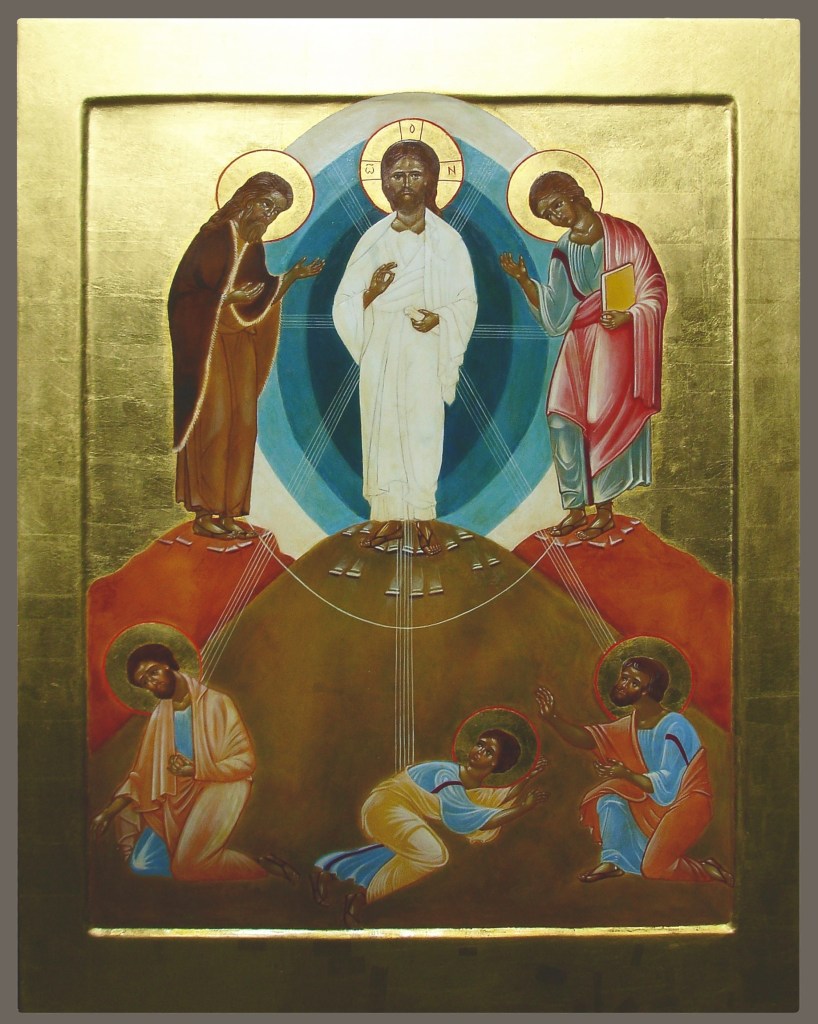
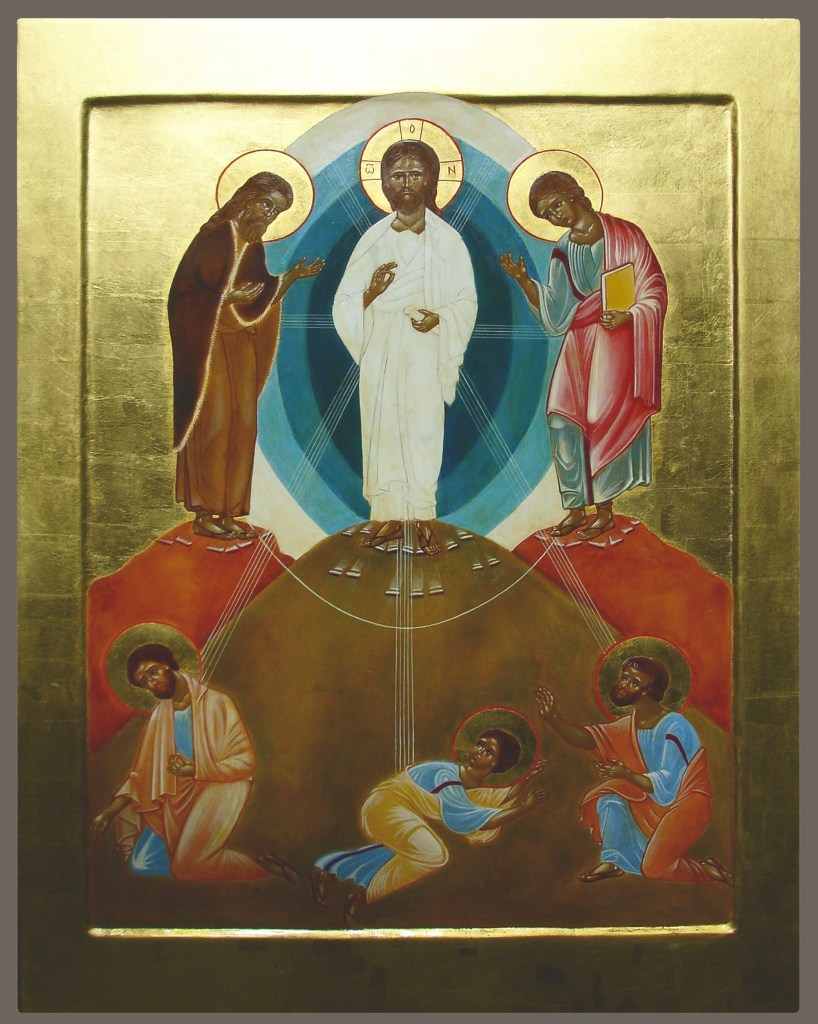
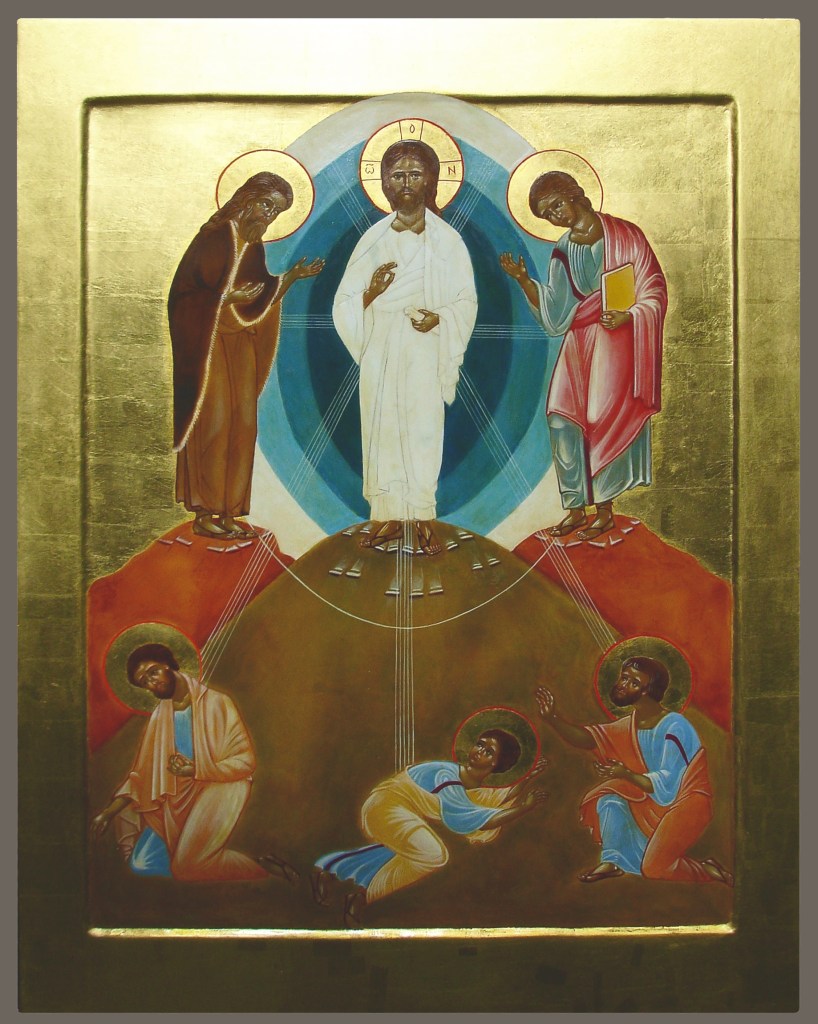
Icon of the Transfiguration. written by Sr. Irene of Le-Bec, in the Chapel of the Transfiguration, Parish Church of St John the Baptist, Epping, Essex.
Sr Irène
‘Pray to your Father who is in secret’. Matthew 6:6
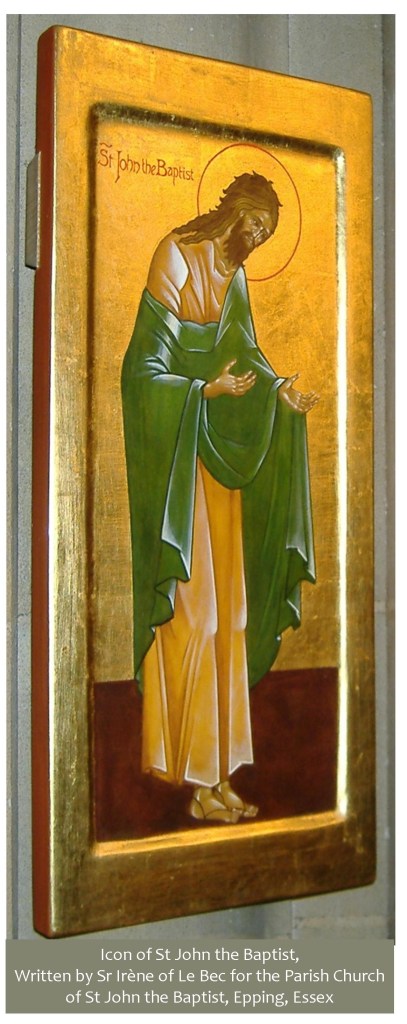
A number of years ago I was searching for an iconographer to write an icon of St. John the Baptist for a church dedicated to him in Epping, Essex.
On a visit to Bec-Hellouin in Normandy I arrived at a Convent which sold what appeared to be original icons. When I enquired about them, I was immediately introduced to Sr. Irène. By the end of our visit she was commissioned to write the icon for us. Not, however, without a small consultation! In the original icon, the figure of John was part of a triptych with our Lord and the Blessed Virgin Mary. He occupied the right hand panel. Because of where he would be positioned, with his hands facing the Blessed Sacrament, I needed him on the left! Sister Irène had to consult in prayer with St Tikhon, the original writer before it was agreed! She was to write three other icons for me. Two are of the Transfiguration and one of St. John.
Tonight we have just heard that Sister Irène died at Candlemass. I was so glad that I had been able to see her again last August.
These notes are from Sr Marie-Patrick of the Community at Bec.
Of Burgundian origin, and an elder sister to three boys, Chantal Boillot – Sister Irène Marie – entered the monastery at the age of 38, after caring for her elderly parents. She joined a novitiate which was then numerous (9!) and which shook her up a bit… She made profession as an Oblate nun on the feast of St. Benedict, July 11, 1979, and was soon sent to our little foundation at Mesnil saint Loup, near Troyes. As life in Troyes proved difficult, she was transferred to our other foundation in Abu Gosh in the Holy Land, on 1 February 1984. She stayed there for a good eight years but was called back to Le Bec at the end of 1992, a decision that was painful for her and that she never explained.
Back at Le Bec, she was able to deploy her talents as an iconographer, and even organised a few training sessions in this art. Very cultured and quite original, her interventions were sometimes unexpected, always enriching, but you didn’t want to be in a hurry!
In recent years, she bravely faced serious health difficulties, with cancer spreading despite numerous operations. Heavy treatment – which exhausted her – proved necessary. Recently, the nurse who came early to take a blood test found her struggling for breath and called the paramedics. Taken to Evreux, to the department that was treating her for her cancer, she was quickly transferred to cardiology: her heart problem – which had remained in the background until then – had worsened! Under oxygen and perfusion, she did not know when she would have a heart operation; and on her last visit, Mother Prioress admired her confident state of peaceful abandonment: “That’s what we’re here for, isn’t it? Sister Irene said to her with simplicity, leaving us with an exemplary testimony of a profound life of faith of which she spoke little. Her condition deteriorated rapidly despite the care of the clinic staff – whom we thank warmly – and she passed away at the age of the prophetess Anna, at the end of the first Vespers of February 2, (Candlemass), entering into that eternal Light to which she aspired with all her being.
If I were to try and sum her up, I would say that she was a person of deep holiness with a careful eye on the world. A writer of Icons which she infused with prayer and which she treated with utmost reverence. A woman of determination who served her Lord with dogged determination, not least through her long illness and sometimes in times of spiritual trial. All this and more framed in a gentle face with twinkly eyes and a genuine smile. We have a new and caring friend in heaven.
Icon of the Transfiguration, written by Sister Irène-Marie of the Bec Community. The original is in St John the Baptist Parish Church Epping and a second version is in the author’s home.
In 1984, the novelist J G Ballard published a book, ‘Empire of the Sun’, The title is a reference to Japan and though the book is a novel, it is based on Ballard’s own experience of life after the Japanese drove out the British from Shangai during the 2nd World war. The novel was turned into a film
The central character of the film was Jim, a spoiled young British boy – played expertly by Christian Bale. He lived with his wealthy family in pre-World War II Shangai. During the Japanese takeover, Jim was separated from his parents and taken prisoner. Much of the film is shot in a Japanese Concentration camp where Jim grows up from being a boy to becoming an adolescent who learns to survive without a retinue of servants at his beck and call. Thanks to a meeting with an American who was a bit like Fagin in Oliver Twist, Jim became much more the street-wise kid who knows just how to survive. For him, the Camp is one big adventure playground and he flits and darts between the various groups – American, British and even Japanese.
In 1945, when the Japanese know that the writing is on the wall, the Camp is ‘liberated’ and the inmates are force marched towards Nantow where they are told there will be food. All this is against a backdrop of American planes bombing the airfield near the camp
On the march he is befriended by Mrs Victor who, with her husband, had been kind to him. Now alone after the death of her husband, Jim stayed with her, suggesting that she acts ‘dead’ so that the Japanese won’t shoot her. Unfortunately for Jim, she died in the night and as morning breaks, Jim saw a bright white light in the eastern sky. He thinks it is Mrs Victor’s soul going to heaven. Later he was told that what he saw was the atom bomb exploding on Hiroshima. “I saw it” he said, “it was like a white light in the sky. Like God taking a photograph.”
The day it happened, of course, was August the 6th – the Christian Day of Transfiguration. There is a strange irony that the brilliant light made by that bomb should share its birth with the day when Jesus was surrounded by a brilliant light – transforming him until, as St. Luke tells us, his clothes became dazzling white.”
Since 1945, Transfiguration has been linked It is a day of remembering God’s act of glorifying his Son and also a day when humanity sank to its lowest ebb, using a nuclear force to destroy rather than create. Here is how one victim of that bomb described the experience:
On the 6th of August, 60 years ago, I was a college student, 20 years old. When the atomic bomb wasdropped, I was near the Hiroshima City Hall, about one kilometre away from the ground zero. I’ve seen so many Hibakusha wounded, injured and killed in blood and in burns. It was like hell on earth. I really believed Hiroshima was dead at that time. I was fortunate to survive the instant bombing, but one week later, I fell unconscious. For forty days, I was staying in unconscious so I didn’t know when the war ended. After so many years, I’ve survived, but I have many, many illnesses: A plastic anemia, angina, colon cancer, prostate cancer. Many Hibakusha who have survived the atomic bombings still suffer from many, many difficulties and illnesses, and they have been constantly under medical care. The most cruel damage on human beings by the atomic bomb is that even if you luckily survived you have to continue to suffer from psychological and physical disruption of human beings until your life ends. That’s why we call the atomic bombing the absolute evil.
He ended his speech with the words ‘No more Hiroshimas’ – a cry that has become a clarion call by many. A cry that has, of course been heeded so far because no nuclear or atomic bomb has been used in war since those two bombs dropped on Hiroshima and Nagasaki. We live however, in very uncertain times just now.
There is always something to be learned through quiet reflection and prayer. On the mountain, Jesus was transfigured – glorified, exalted. In the words that Jim might understand it is as though God was sending a photograph of what humanity could become. For it is within the destiny of humanity to become so filled with the image of God that we are bound for glory. Our world at present does not show this destiny very clearly so we need to be reminded of what the Transfiguration points to in our own lives.
The word Transfiguration means transformation or radical change. In the Transfiguration of Christ this change was to turn outside in and inside out. What I mean is that the inner glory of Jesus became totally visible – so visible in fact that it was dazzling. Not surprisingly Peter tried to capture the moment almost as if he had a camera to capture the scene.
For Jesus, this was not to become a memorial of an historic event. Through the Cross and Resurrection which followed and the descending of the Holy Spirit, the Transfiguration was to be the glimpse of God’s glory which was to lead to the total transformation of humanity in an even more dazzling display of God’s glory. This is real. This is the real moment of transfiguration for us all and it is God’s way of dealing with human frailty, sin and the temptation, ever present to a greater of lesser degree, to choose evil rather than good. Something which we are seeing a lot of us in the world today.
The Japanese survivor told his harrowing story and pleaded ‘No more Hiroshimas!’ In our dark world we cannot guarantee this but what transforms the demonic is Love. It is a powerful, sacrificial love. Only that kind of Godly love can save our world now.
Jesus absorbed all human pain, conflict and hurt and he became the instrument of our transfiguration. He absorbed human sin and nailed it to the Cross and he did so out of sheer love for humanity and the world. God is saying to us . “You can do this to me and yet I will go on loving and you cannot stop me for it is only love that transforms humanity and changes our destiny.” Today, God calls us to this witness where the pain that is in our world can be absorbed and by our love transformed by God. We are no longer standing with the disciples at the foot of the Mount of Transfiguration. The Glory of God shining in and through our lives is a kind of living Transfiguration today.
Here’s a prayer which I have found helpful. I cannot remember the source.
Ever loving God, Thank you for always being a light in the dark places of the world and the dark places of our lives. May we always place our hope in you, for you are the light of the world and you call us to be lights for others. You tell us your story in many ways, in people in Word, in art and music, In pain and struggle and in suffering, But you constantly surprise us with healing and joy, Compassion and in holding us. You enlighten our thoughts and nourish our hearts, But we thank you, most of all, that you lighten our way as we walk the pilgrimage of life, and love us until we are safely in heaven May we be, like icons of light and love reflecting and refracting that joyous vision to all we meet and so share with you in the transfiguration of the world, Through Jesus Christ our Lord
This Icon of the Transfiguration was ‘written’ by Sister Irène-Marie of the Community at the Monasterie of Sainte-Françoise Romaine, Le Bec-Hellouin, Normandy. Sister wrote two Icons. One is in the Transfiguration Chapel in the Parish Church of St. John the Baptist, Epping. The other is a personal Icon blessing the home of Mr. G. Sister Irène-Marie used traditional methods to write the Icon undergirded by prayer.
Transfiguring Love
Thoughts on the feast of the TRANSFIGURATION, August 6th
In the Transfiguration God gives us a snapshot of human glory – Christ transformed and it is as if God is telling us that this is what we can become if we follow his way of doing things.
What follows the Transfiguration is the journey to Jerusalem and to our Lord’s death on the Cross. There, Jesus absorbed all human pain, conflict and hurt and he became the instrument of our transfiguration. He absorbed human sin and nailed it to the Cross and he did so out of sheer love for humanity and for the world. What transforms the Cross is love because the Crucifixion is God’s ultimate statement of His love for us. “You can do this to me,” his actions say, “and yet I will go on loving and you cannot stop me for it is only love that transforms humanity.”
A young Russian priest was arrested when communism took over his country. For years he was held in a prison camp and there he was beaten and tortured. When he was eventually released his friends asked him what was left of him. ‘Nothing’ he said, “they have taken everything away. Only Love remains.”
That priest had discovered the one thing that changes every human situation and disarms every human conflict – sacrificial self-giving love. It is through The Cross which Jesus took upon himself on our behalf that we can all be changed– and when we are changed, the world is changed. Only Love remains – only love will conquer the human heart. Only love will Transfigure the world. Perhaps we are unable to see that as a possibility in conflicts throughout our world and amidst the effects of Covid but there is one area where we can see this possibility and that is in our own lives and in our own dealings with others. Wars do not begin on foreign battlefields far from home. They begin in our hearts – when we refuse to allow others dignity or understanding. When we refuse to accept and celebrate them for who they are. When we want what we want come what may and when we believe our own views to be the only right views – a sure way to begin oppression of others.
That is not God’s Way. As Mother Mary Clare of the Sisters of the Love of God put it so clearly, God’s way is to call us to stand at the place of the Cross – at that intersection where human pain, hurt and conflict meet and are held by the transforming love of God.
It is only when we stand in this place where God in Jesus Christ always stands – the place of transforming love – that we will begin to see the glory in each other. That is a lesson from the Transfiguration. If we do not grasp it then not only will we mistreat others, we will also diminish ourselves – and, more importantly, we will deny God and His saving love.
[Mr.G.]
Father in heaven, whose Son Jesus Christ was wonderfully transfigured before chosen witnesses upon the holy mountain, and spoke of the exodus he would accomplish at Jerusalem: give us strength so to hear his voice and bear our cross that in the world to come we may see him as he is; who is alive and reigns with you, in the unity of the Holy Spirit, one God, now and for ever.

 Mr G's Ponderings