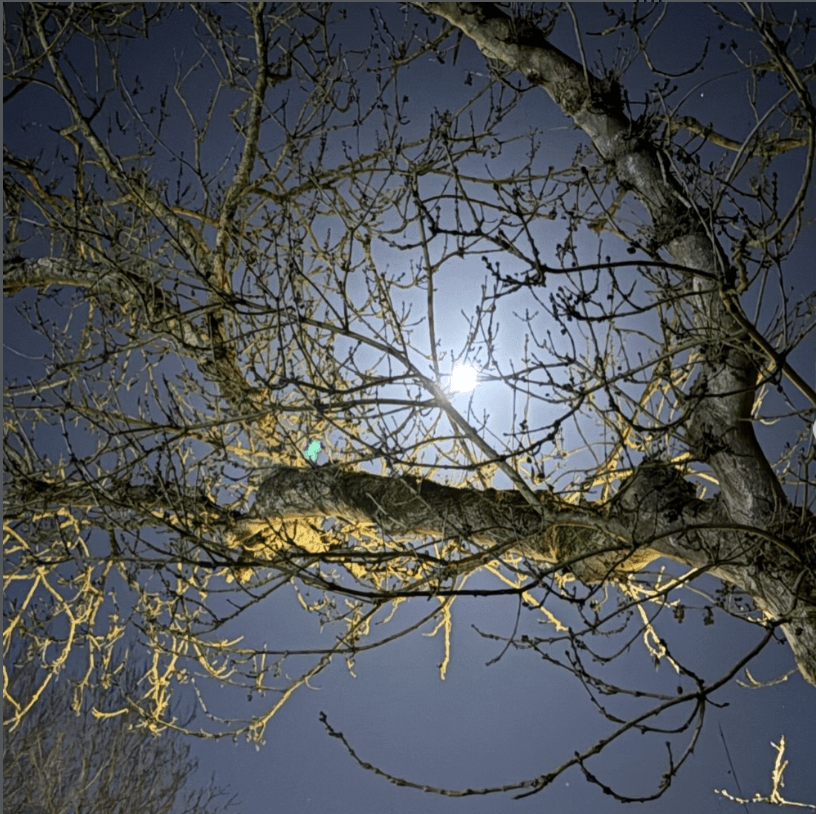
My artist friend, Kay Gibbons, caught up with the Super (Wolf **) Moon last evening.
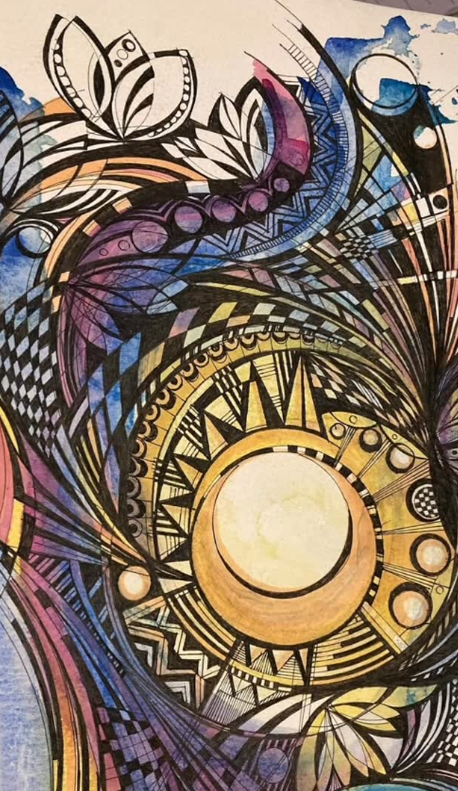
Driving home last night I watched the tree reaching up to catch the moon …. but the moon carried on her journey to return another night and I was the only one to catch the Moon -stopped suddenly in its tracks by the click of a button on a screen in the palm of my hand . I was reminded of an early painting which was inspired by the Wolf Moon in January 2022.
**The January Full Moon is often called the Wolf Moon from the howling of hungry wolves in the winter. This name is thought to have a Celtic and Old English origin. Other traditions may also know it as: Celtic: Quiet Moon North American: Old Moon Cherokee: Cold Moon In the S. Hemisphere it is known as the Hay Moon, Buck, Thunder or Mead Moon
A Prayer of the Moon
O Lord God, you called me to be a light to shine from the heavens, to lighten the earth. You fashioned me, as an instrument of creation, as your Sun became the great light to rule the day, so I became his refracted light. Reflecting the brightness of my brother, set in the canvas of night where you fixed the stars.
There will never be a time nor a place where your light won’t shine upon earth, a reminder that even when humanity is at its darkest point, Your light penetrates, is always present, a divine presence waiting for the clamour of human vice and voice to be stilled and emptied of meaning.
Your Sun, Stars and Moon, we are a trinity of light, reflecting your majesty. Part of your cosmic desire for your love to penetrate the density of human sin; sadness; selfishness and so bring hope, light and true life to a world you have created to be aglow with the joy of creation.
May your People be reminded of the Light of your dear Son, who converts all hearts, no matter how dark and dim, to sing your praises. May they be good and responsible stewards of your earth and allow your love to penetrate the whole of creation so that with us, Sun, Moon and Stars, they may glorify you!
Mr G. 3rd January 2026
[][][][] Photograph & painting by Kay Gibbons. If you would like to see more of Kay’s art, it’s on Instagram: kaygibbons_art.glass.sculpture
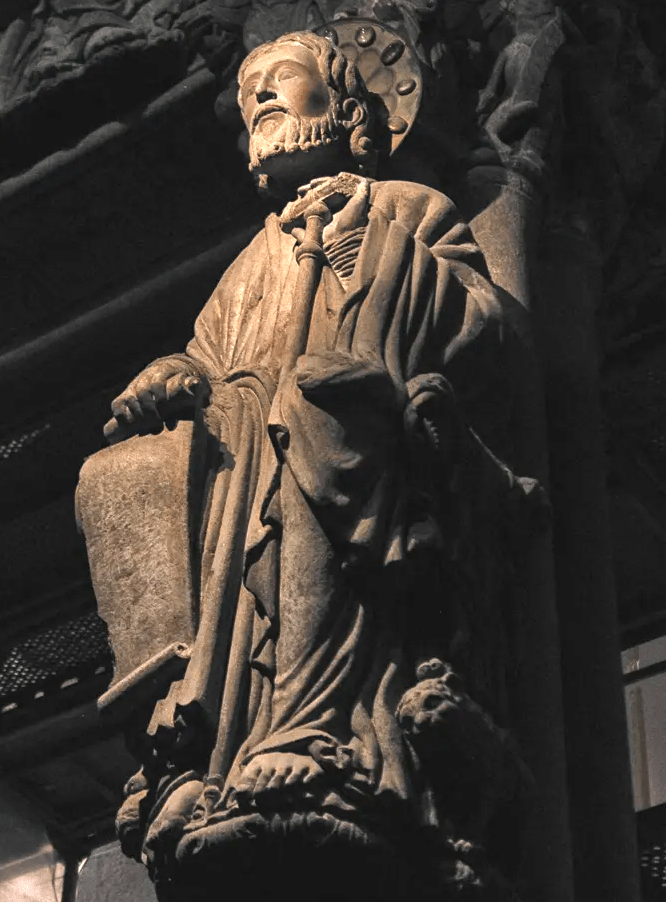
Statue of St James, Apostle & Martyr, Santiago de Compostela Cathedral.
Thoughts on the feast day of St. James, Apostle & Martyr, the first of the Apostles to give life for the Christian faith. f.d. 25th July.
I have a special love of St James whose feast day we keep today. The Church where I learned what the Christian faith was really about was dedicated to him. Another church where I worshipped with much joy for 10 years was also under the patronage of the great apostle. Perhaps I like him too, because he was something of a hot-head, always shooting his mouth off before he thought what he was saying! He also hoped for a special place in the kingdom of heaven but learned that worldly ambition has little to do with the Christianity. Humble, sacrificial service was the lesson he really had to learn and, as the first apostle to be martyred, (when he was beheaded for his belief in Jesus Christ) he learned that the Kingdom of God can never be had on the cheap.
I think I am attracted to him mostly because he is the Patron Saint of Pilgrims. This came about because legend has it that his body was brought to Spain and laid in a church built at Compostela in Northern Spain which has the added name of ’Santiago’ (Spanish for St James). When the Holy Land became cut off for Christians, it was Santiago de Compostela which became the European centre of Pilgrimages and Pilgrims flocked there (as they still do) to make a special journey which is both physical and spiritual.
As the Holiday season gets in full swing it is good to be reminded that ’Holiday’ is derived from ’Holy Day’ – a time of refreshment for body and soul. A pilgrimage is not just a holiday nor a journey to see the sights. It’s a holy journey which has a special purpose. Those who go away on holiday are looking to re-charge their batteries and that is true for those who go to centres of pilgrimage too. People who go on Retreat or who visit holy places are seeking rest for the soul as well as the body. Of course, there is lots of fun to be had too and for pilgrims the journey is part of that. Meeting up with fellow-travellers whose life experience is different and with whom one can share faith is as important as the destination—perhaps more so.
I felt something of this when I visited Assisi, the centre of pilgrimage connected with St. Francis and people who go to Taizé, Holy Island, Iona, Walsingham, Canterbury and other centres of Pilgrimage throughout the world, feel much the same. What is often felt is that God calls us apart to a place where, as the poet T S Eliot puts it, prayer has been valid. It’s a thin place, where God is more easily experienced. This is what I discovered when I took the Pilgrim way to Santiago a few years back. Of course, this should also be true of every church building but some places are special.
The word for this journey is ‘ Camino’ . That is a Spanish word meaning path, or way. It refers to a network of pilgrimage routes from all over Europe and beyond. These ways each lead to the Shrine of St James in the city of Santiago de Compostela in Spain.
But journeys are not just outward. The real journey is inward and from Baptism onward Christians are all called to make a pilgrimage of faith—the journey of life—which leads us more and more into that most holy of all places, the Kingdom of God. The description of the Church as the Pilgrim People stresses this journey. We are a people always on the move, always changing and being changed by grace as we try to make space for God in our lives. This is true for most who are members of the world religions. We are all called to travel in faith to God.
Of course, we don’t always have to leave our homes at all! I love the story of an old lady who was asked why she just sat in her room. “I’m not sitting’ she replied, ‘I’m on a journey!’ She didn’t need a special place to find God. He was in her heart. We find him best when we are still. Happy travelling!
[See my Blog entry for July 31st 2022 for a poetic reflection on Camino Communion by Piers Northam]
St Brigid and the Manger. Last Saturday, February 1st, we remembered St. Brigid (sometimes spelt, Brigit). Along with St. Patrick, she was Apostle to Ireland and is credited with him as one who proclaimed the Good News of Jesus Christ to the Irish people. At that time the links between Ireland and what is now the southern part of Scotland were very strong. So Brigid(t) enjoys a special place in the hearts of both nations. Her abbey was at Kildare in Ireland and, as in some parts of the Irish Christian tradition, it was a double monastery of both women and men. This practice was later transferred to Northumbria via the mission from Iona.
Many stories, traditions, myth and legends grew up around St Brigid, including one that suggests she was ordained Bishop to serve her Irish congregations. There is more evidence than not about this and if true, Brigid would have the honour of possibly being the first Woman Bishop in the Christian Church! That’s a thought for another time but one legend about her was brought to my attention by my dear friend, Heather Upfield, with whom I enjoyed a lovely friendship when we were both in Edinburgh. Her love of what we now call the Celtic spiritual tradition did much to feed and inspire my own love of it. Earlier this week I received this note from her:
“In the Scottish tradition, St Bride was carried by angels from Iona to Bethlehem on Christmas Eve to be midwife to Mary at the Nativity. She then remained with the Holy Family till Mary and Joseph took the baby Jesus to the Temple. In the Candlemass mythology, she walked ahead of them carrying lighted candles, with a crown of lit candles on her head.”
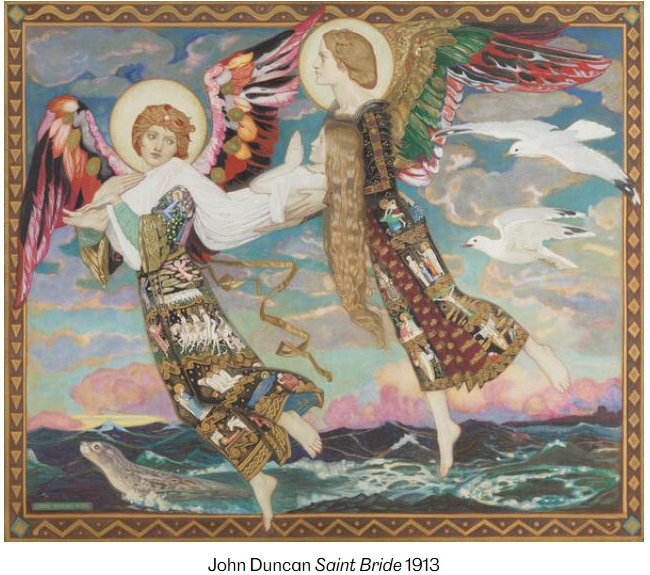
The painting above by John Duncan, painted in 1913, which is in the National Gallery of Scotland, is inspired by this story. The two angels are carrying the saint between them to Bethlehem.
Wanting to know more, who better to turn to than my friend, Heather? I happened to find an article, by her, on St Brigid which was published in 2017. Here is the part of that which refers to this story.
“In the mythology, St Bride is carried from the Isle of Iona, in the Inner Hebrides, to Bethlehem on Christmas Eve, to be mid-wife to Mary at the birth of Jesus. In the Ghaidlíg, she was known as‘Ban-Chuideachaidh Muire’ ‘knee woman of Mary’, as in the Hebrides, women gave birth on one knee. Not only is she present at the birth of Jesus, but she also takes on the role of the Foster mother of Jesus – ‘Muime Chroisd’. In the Hebridean tradition, a Foster mother was considered more important than a natural mother. They took the view that any woman could become a mother – and be good or indifferent or bad. But the Foster mother took on the rearing of a child who was not her own, and this gave her greater status. In the eyes of the Hebrideans, therefore, St Bride is more important than St Mary and it is she who is considered the true Mary of the Gaels. A Hebridean prayer during labour was ‘Bride, Bride, Come in. Thy welcome is truly made. Give thou relief to the woman and give thou the conception to the Trinity’. Following the Nativity, the Church celebrates Candlemas forty days after Christmas. St Bride is closely connected to this Festival. When Mary and Joseph carried the infant Jesus to the Temple, St Bride walked ahead of them. She wore a crown of candles and held a lighted candle in each hand. The flames stayed completely still and were not moved by the wind. In some traditions, Candlemas is known as Feast Day of St Bride of the Candles, and she herself is known as St Bride of Brightness. The legend of the flames also corresponds with what we know of Oimelc (or Imbolc) as a Fire Festival.”
A certain caution must be exercised and possibly a suspension of belief in this story. It is part of a folklore which belongs to a people who understand the importance of myth as containing a kernel of truth rather than made-up fiction. Chronologically, of course, it can’t be an historical truth but there is more than one sort of truth, especially where angels are involved! Sometimes we have to move from the human realm to the heavenly to discover a new way of discovering the heart of God. Poetry, art, storytelling and music belong to this realm. Often words fail us in their bareness and logic but spring to life in a new way if we use our communication skills differently.
So the myth of St Brigid’s visit to Bethlehem and the echo of a Candlemass ceremony which is ascribed to St. Lucy in Scandinavia , are wonderful stories about new birth, tenderness, care and light. Bride’s visit to Bethlehem is also a delightful and fun story. Anything that brings a smile to our lives right now can only be good!
Thank you, Heather, for bringing this source of joy to my heart.
[If you wish to know more about the painting by John Duncan, go to the website of the National Gallery of Scotland. Search for John Duncan and click on to the the very informative podcast]
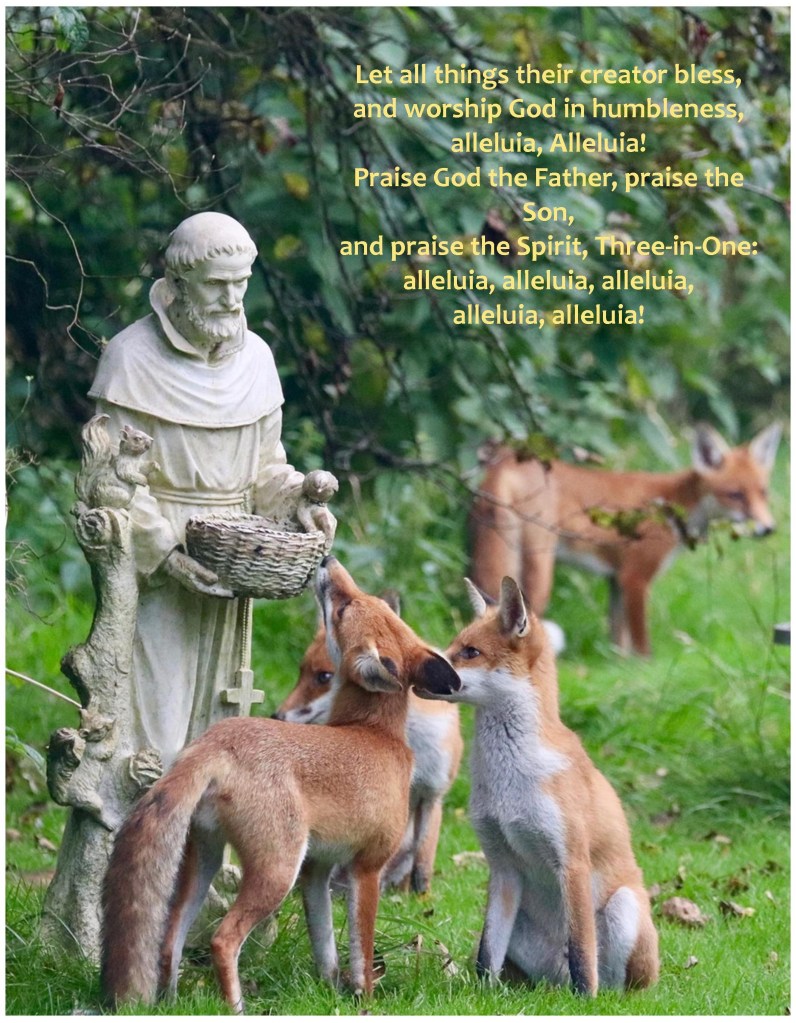
Latton foxes gather around St Francis. Photo by The Revd Lynn Hurry
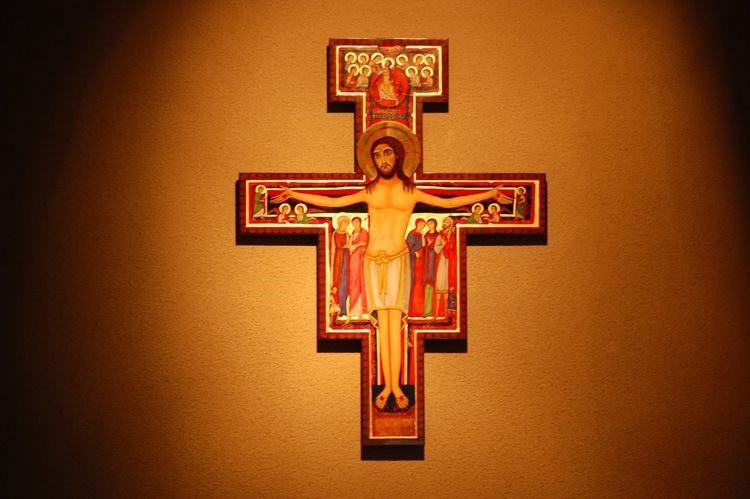
When St Francis gave up his life as a kind of lad-about in Assisi – when he turned away from drinking, fighting, leading a pack of rebels, it was because he had been brought up sharp by Jesus. Not for the first time or the last, God had visited the soul of one whose life was going in entirely the wrong direction. Francis’s soul was sick and needed healing. So God drew him away to a derelict church of St. Damiano on the edge of Assisi. There he knelt in prayer and looked at the faded crucifix still hanging over the altar. Francis insists that the voice of Christ came to him from that crucifix, at that moment. The words he heard were: Francis, rebuild my church, which you see is falling down. The derelict Church certainly needed repairing, just as Francis’s soul needed rebuilding. Francis was about to begin his ministry and service for God.
First, though, he had to get to know the One who called him to this service and to know the love of God flowing into him and through him to others. Francis opened his heart to God in Holy conversation. As he knelt in that place of meeting with Jesus, the first prayer he said was one that was to remain with him throughout the rest of his life.
The Prayer before the Crucifix
Most High, glorious God, enlighten the darkness of my heart and give me true faith, certain hope, and perfect charity, sense and knowledge, Lord, that I may carry out Your holy and true command
Another prayer is this which was to become food for his soul, in which he prays that the love of the Lord Jesus should enter his heart and absorb him with its fire and sweetness. It is known as the Absorbeat because God’s loving Spirit possesses him.
May the power of your love, Lord Christ, fiery and sweet as honey, so absorb our hearts as to withdraw them from all that is under heaven. Grant that we may be ready to die for love of your love, as you died for love of our love. Amen
Francis certainly used this prayer often , and it is characteristic of his spirituality.
A simple, yet deeply profound prayer was one that he is said to have dictated as he lay dying. It was a prayer which he had used often and wasn’t original, but it was so important to him that it was his deathbed prayer. Many will know it in some form.
We adore you, most holy Lord Jesus Christ, here, and in all your churches throughout all the world; and we bless you, because, by your holy cross, you have redeemed the world.
Francis grew quickly and deeply in love with God and this spurred on his eagerness and zeal to serve others in God’s Name.
Richard Rohr, a much loved Franciscan brother who lives in America and teaches Franciscan spirituality wrote this week that the only way we can truly know how to love God is to love what God loves. Only then do we love with divine love and allow it to flow through us.
It is not always easy to do that because such love has to be stripped of anything that makes demands or is tinged with our desire for them to be what we want. A Franciscan theologian, Duns Scotus, put it this way.
“we are to love things in and as themselves, to love things for what they are, not for what they do for us. That’s when we really begin to love our spouses, our children, our neighbours, and others. When we free them from our agendas, then we can truly love them without concern for what they do for us, or how they make us look, or what they can get us. We begin to love them in themselves and for themselves, as living images of God. Now that takes real work!”
Through Prayer and especially time alone with and for God, this spirituality of loving what God loves, simply because God does so, became central to St Francis’s own spirituality and way of life. It became the driving force for his work with the poor, the sick, the lepers, animals, birds and all of nature. It was how he came to love and honour God.
So he came to Praise God above all else. This he expressed in another Prayer poem
Praises of God.
You alone are holy, you who work wonders!. You are strong, you are great, you are the Most High, you are the almighty King, you, holy Father, King of heaven and earth.
Lord God: you are Three and you are One, you are goodness, all goodness, you are the highest Good, Lord God, living and true.
You are love and charity, you are wisdom, you are humility, you are patience, you are beauty, you are sweetness, you are safety, you are rest, you are joy, you are our hope and our delight, you are justice, you are moderation you are all our wealth and riches overflowing.
You are beauty, you are gentleness, you are our shelter, our guard and our defender, you are strength, you are refreshment, you are our hope. you are our faith. you are our love, you are our complete consolation, you are our life everlasting, great and wonderful Lord, all powerful God, merciful Saviour!
Amen.
Of course, we are probably all familiar with the poem/song Make me a channel of your peace. It is known as the Prayer of St. Francis but it was not written by him. Indeed in was probably written in the 1920’s but who could read, pray or sing it, without acknowledging that it is marinated in St. Francis’s own spirituality.
There is so much in his sayings, these prayers, and canticles I haven’t referred to, but if we are to understand the witness and service of St. Francis, these prayers above are a good place to start.
 Mr G's Ponderings