Tag: St Patrick

St Brigid, Mary of the Gaels

Many years ago now, I made a pilgrimage around some of the sacred sites of Ireland. I saw some amazing places and towards the end I visited Kildare which was the holy site associated with St. Brigid.
Together with St. Patrick she is regarded as the Patron Saint of Ireland and was, in fact, baptized by Patrick in about 525AD
Her feast day is February 1st so she is the Saint who brings to a close the Christmas season and points us towards Lent and Easter.
Her festival day coincides with an earlier pagan festival – IMBOLC, the season which marked the coming of light after the dark days of winter.

Once again, the Christian Church displayed ingenuity and common sense in replacing a pagan festival with a Christian one, because Imbolc became the feast of Candlemass, the day when we celebrate Christ as the light of the World – the light which overcomes darkness, or to put it into the words of Simeon’s song, the Nunc Dimittis – the light to lighten the Gentiles (the world).
Brigid was herself a showing forth of Christ’s light in the darkened world of her times.

She was a gentle, caring soul who had a special love of the poor.
Before she became a nun and founded a monastery at Kildare she would regularly give possessions to the poor – not all of them her own! Her father didn’t take kindly to losing some of his goods and he complained to the King when he discovered that his sword was passed on to a leper.
He dragged his daughter before the King who asked her if she intended also to give all his property to the poor as well.
She told the King that if the whole of his kingdom was at her disposal she’d give the lot away!
The King gave her father a new sword on her behalf!
She regularly gave food to people.
Whenever she made butter she divided it into twelve equal pieces in honour of the 12 apostles and a larger lump in honour of the Son of God.

Here also was a clue to why she cared for those in need for she said,

“It was Christ and his Twelve Apostles who proclaimed the Gospel to the peoples of the world and it is in their name that I look after the poor, for Christ is to be found in the person of every faithful poor person.”

She believed it was her duty as Christ’s servant to lead people over the dangerous bridge of this life to the gleaming country of heaven.

This was the heart of her faith.  Brigid was a bridge between this world and the world of heaven. As such it is fitting that she occupies that point in the Christian Calendar which turns our thoughts and prayers from Christmas to Easter – from the wonderful joy of God coming to be amongst us in the Incarnation, saving us and the world from within to the completion of that salvation in the Glory of the Cross and through the Crucifixion.

An illustration of this bridging of the world by Manger and Cross, is through the Cross that is called after her – St. Brigid’s Cross.
It is said that it saw the light of day because, when  a pagan chief from the neighbourhood of Kildare lay dying, he sent for Brigid to come and to talk to him about Jesus.
By the time she got there, he was delirious and raving with fever. It was impossible to talk to her nor could she instruct him about Christ. Instead, she sat by his bed and gave him comfort.
As was usual, the floor was strewn with rushes for warmth and cleanliness. Brigid picked some  up and began to weave them into a cross as she talked.
His delirium quietened and he was able to ask her what she was doing. As she talked, she gently explained about Jesus, his Cross and the salvation he brought.
In that quiet moment, handing him the little cross she moved him gently from earth to heaven as she baptized him at the point of his death.
And to help her do it, she had taken symbolically, some strands of the Manger and turned it into the sign of the Cross – the Saving Sign.
The straw of the Manger and the wood of the Cross.

God uses what he finds and through the simplicity of nature and the ordinariness of our lives, as with Brigid, He moulds consecrated vessels to contain His grace so that He can touch others.
So it was with Brigid and it can be so for us.
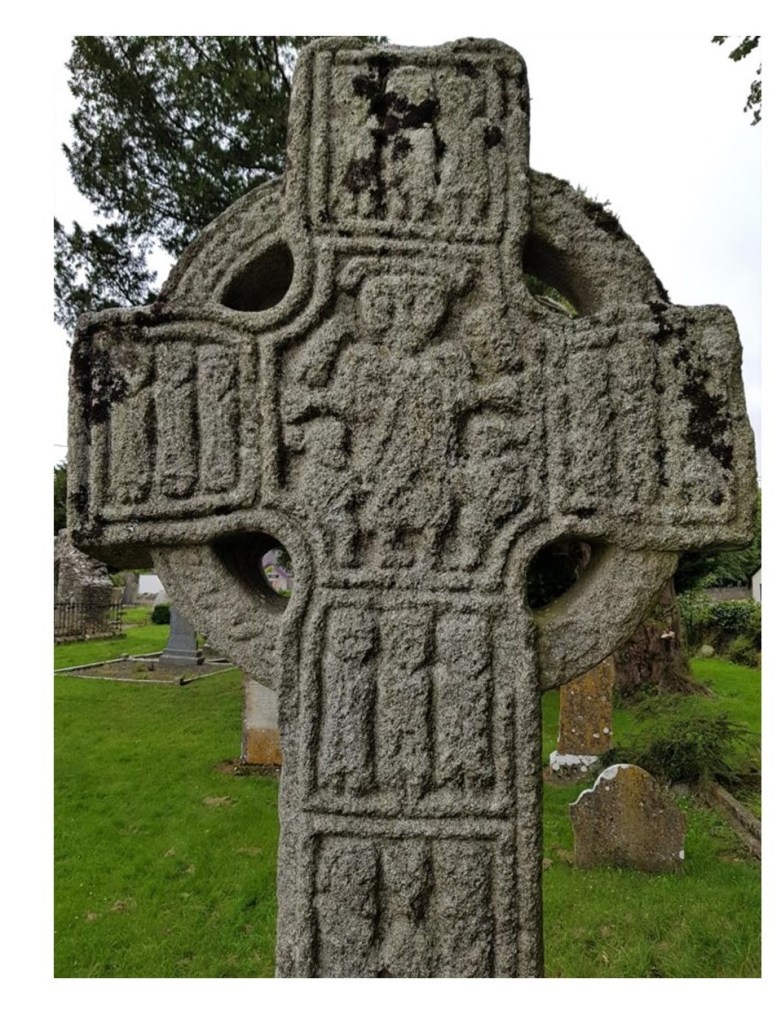
High Cross, detail. Kildare churchyard

Brigid

You were a woman of peace.
You brought harmony where there was conflict.
You brought light to the darkness. You brought hope to the downcast.
May the mantle of your peace cover those who are troubled and anxious,
and may peace be firmly rooted in our hearts and in our world.
Inspire us to act justly and to reverence all God has made.
Brigid you were a voice for the wounded and the weary.
Strengthen what is weak within us. Calm us into a quietness that heals and listens.
May we grow each day into greater wholeness in mind, body and spirit.

Amen.

a traditional Irish prayer about St Brigid.
I bind unto myself today…

Today, 17th March, is St. Patrick’s day, Patron Saint of Ireland.

Patrick’s first experience of Ireland didn’t begin very well. Raiders from Ireland kidnapped him from England and took him into slavery. We aren’t exactly sure from where.
We do know, because he told us himself, that his grandfather (Potitus) was a priest and his father (Calpornius) a deacon. As this was before the two Missions from Iona and Canterbury they must have belonged to the Romano-British Church which had links with the Roman occupation. The Church of Ninian and of Kentigern (St Mungo) where established in the Dumfries and Glasgow areas with developments in Cumbria
Ancient place names often leave clues and in Cumbria there is Mungrisedale (Mungo) and Patterdale (Patrick dale). There is a well at Glenridding (southern end of Ullswater) which, whilst Victorian, is called ‘St Patrick’s Well’ and is claimed to be on a site of an older well where Patrick was baptized. (along with a number of other sites stretching around the country!)

A true fact is one that Patrick supplied. When he was kidnapped he was 16. We know this from one of the two certain writings that he left us. In his Confession he says that he was about 16 years old.  This would date the event about 406.

In the edition of the Confession published in 2011, a translation by Pádraig Mc Carthy, Patrick left us an indication of his spiritual nature and the humility with which he was to follow Jesus Christ. He said:

My Name is Patrick. I am a sinner, a simple country person and the least of all believers.

He spent 6 years as a slave before he managed to escape. By that time, his faith had grown stronger. He confessed to having gone away from God and did not keep his commandments.  
The Lord, however, “opened my awareness of my lack of faith. Even though it came about late, I recognized my failings. So I turned with all my heart to the Lord my God and he looked down on my lowliness.” Patrick went on to say that even before he fully knew the Lord, Christ “guarded me.” Even before he came to wisdom and “could distinguish between good and evil,” he knew the protection and consolation of that of a father caring for a son. These were important insight of Christ watching over him because it was something that would shape his life, mission and ministry.

Alongside this growing faith in Christ, Patrick felt a yearning and desire to open the Irish people to faith in the Good News of the Gospel. He became attentive to the voice of God speaking to his heart and so his vocation became stronger and stronger.
When he escaped from Ireland he knew that one day he would be back.

He didn’t return home nor to England at all. He had a feeling that the British Church might not honour nor encourage his vocation.
So, he  spent many years in Europe and awaited God’s moment in preparing spiritually, theologically and personally. Some time in this period the Irish Church gained its independence from Britain and Patrick begged the Pope to send him as an Apostle to the Irish.  He arrived about 432. He set up his base in Armagh and from there, the Good News was preached. A record in one of the Papal annals recorded, briefly but with approval, ‘Patrick flourished.’

But it was a ‘flourishing’ which needed all of Patrick’s strength, faith and determination.
The pagan religion was not to be defeated easily and there are times when Patrick had confrontations, not least with the High King and his religious pagan leaders who saw the threat of Jesus Christ to their livelihood, power, influence and way of life.
In the end Patrick and Christ prevailed.

Patrick’s faith was deep and prayerful. It was centred on the Holy Trinity and his relationship with God as Father, Son and Holy Spirit. This faith compelled him eagerly to share the Gospel and Salvation of Jesus with the people of Ireland.
Everything was centred on God and He was certain of God’s protection and blessing.

Patrick expressed his Trust in God in what is known as a Lorica. A Lorica, or Breastplate prayer, is essentially a ‘protection prayer’ in which the petitioner invokes all the power of God as a safeguard against evil in its many forms.

As we have seen, Patrick knew his need of God and the prayer enshrines this and it therefore has an appeal for us today in our own particular need. We know it today as St. Patrick’s Breastplate often sung in churches on Trinity Sunday. Whilst there are many who say that it was written after Patrick’s time, there is little doubt that it enshrines Patrick’s theology and spiritually. It contains the essence of his belief and also his certainty of God’s love, protection and blessing of him and of his mission.

There are many versions of it but the one most used is that  composed by Mrs Alexander in 1889 for St Patrick’s Day.

The beginning of the Hymn anchors Patrick’s belief in God in a powerful way.

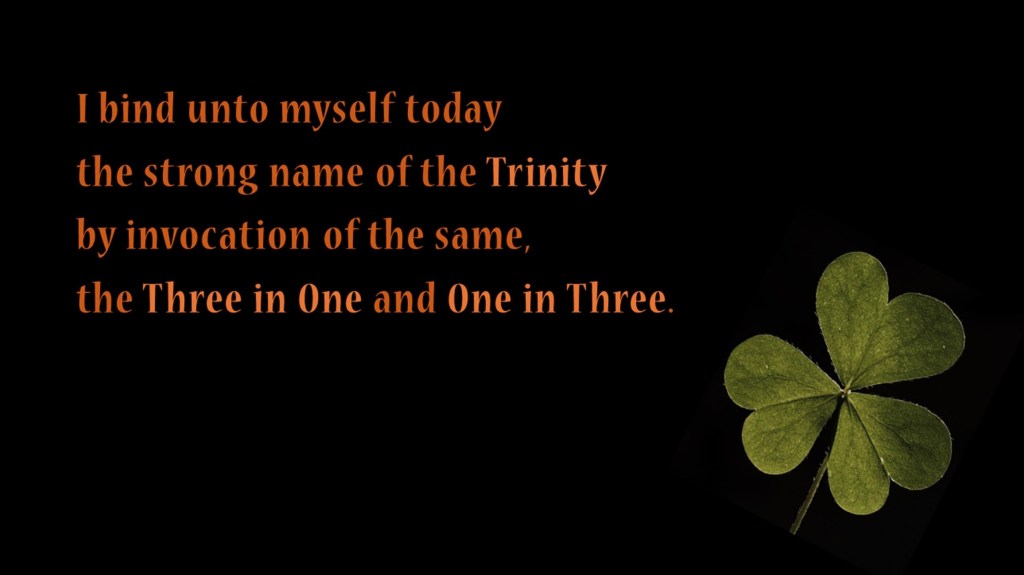
I bind unto myself today
the strong name of the Trinity
by invocation of the same,
the Three in One and One in Three.

Our life is bound up with the Holy Trinity. We are enfolded by the Father, Son and Holy Spirit who protects and flows into our lives. This is union with God who holds, cherishes and nourishes us. We belong to God and God pledges his total presence and eternal life to us. It deserves praying over
Part of the hymn becomes a Protection Prayer in its own right.

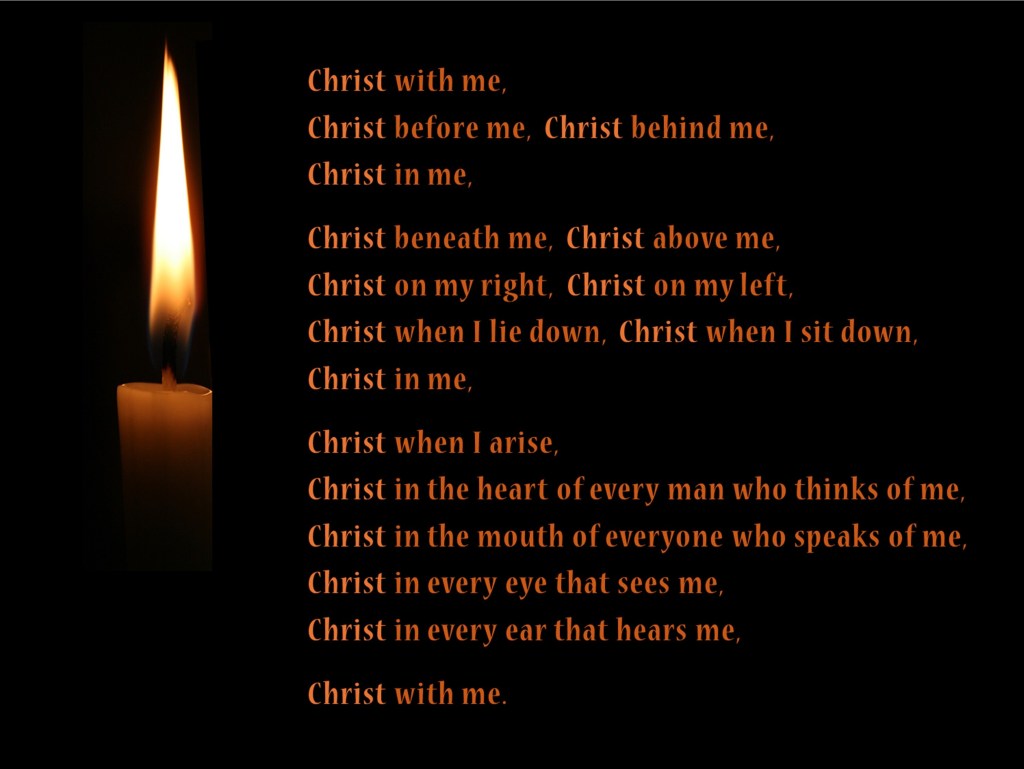
Christ be with me, Christ within me, 
Christ behind me, Christ before me,
Christ beside me, Christ to win me,
Christ to comfort and restore me.
Christ beneath me, Christ above me,
Christ in quiet, Christ in danger,
Christ in hearts of all that love me,
Christ in mouth of friend and stranger.

This is such an intimate and personal prayer.
In Jesus each of us is surrounded, circled by his presence. This is sometimes known as a Caim Prayer, a circling with God’s love and protection. This is a favourite theme of Irish and Celtic spirituality. We call upon God and He circles with His protective love. He is with us every day of our lives and is our joy and our comfort. So we can say that Our God is with us and we are with Him.

There is also a version which ends like this:
Christ in the heart of everyone who thinks of me,
Christ in the mouth of everyone who speaks to me,
Christ in every eye that sees me,
Christ in every ear that hears me

This reminds  us that when we are living close to Jesus Christ we live close to all others. Our being bound to Christ is inclusive and extensive. And if we live trustfully, faithfully, and open-heartedly then others will see us in Him and much more importantly see Him in us. That is what Christ achieved in Patrick’s life and ministry and mission.

ooooooooooooooooooooooooooooooooooo

The prayer, Christ with me (see above) has been set to music by Arvo Pärt. It is very beautiful and moving. The two versions I know are sung by Voces8  and The Sixteen.

The version of the Confessio, ‘My Name is Patrick’ translated from the Latin by Pádraig McCarthy is © 2008 The work itself was published by the Royal Irish Academy 2011 and is available from them price 5 euros.   It is also available on Amazon.

A note in the Confessio invites people to copy and distribute the text but also to remember that it is still subject to copyright law and should not therefore be distributed or copied for monetary gain.

The words of the Hymn by Mrs Alexander, Patrick’s Breastplate, “I bind unto myself today” is  in many regular hymnbooks or can be viewed on one of the hymnal sites on the web.