Tag: St Teresa of Avila

Nowt nor summat !

Casting Lots on St Matthias Day

nowt nor summat  

There is a saying in the North of England (some say it originates in Lancashire, others Yorkshire but I know where my money is!) – it’s neither nowt nor summat.
For the benefit of those not familiar with northern English dialect, it means that it is ‘neither one thing nor the other’.

It is very tempting to say this is what it feels like after Ascension which the Christian Church celebrated last Thursday.
At the feast of the Ascension We were led to the end of the Gospel of St Matthew when Jesus  gave his last instructions and final blessing to his followers. Then, before their very eyes, he disappeared into the heavens.
Jesus had told them that they were his witnesses and the task before them was to proclaim His Good News to all Nations. (Matthew 28: 16-end)
In the nowt nor summat time they were to wait until they have been clothed with power from on high (Luke 24: 49).  Jesus was, of course, referring to Pentecost when the power of God’s Spirit came upon them in the dramatic way Christians will remember next Sunday.

So we are between the Ascension and Pentecost. We are caught up in what I call a mathematical moment . From Easter Day to Ascension Day is 40 days. The same length as Lent. But Easter is the great Festival time of the Church so it must be the longest season, the ‘jubilee’ season of great rejoicing. So it has been given 50 days. The extra 10 days are those between last Thursday and next Sunday. So we are still in Eastertide!
So this is not quite the negative time I’m suggesting.

According to the New Testament the disciples, together with the women who were special to Jesus, returned from Mount Olivet to the upper room where they devoted themselves to prayer. They also attended to the matter of choosing a successor to Judas. Matthias (whose feast day is May 14th – today) was chosen by lot.
When I was younger I used to read in the Acts of the Apostles that the lot fell on Matthias! Not being familiar with this form of voting, I wondered, Did it hurt?

Through this sacred vote the disciples were thus ‘complete’ in the number of those who were destined to lead the infant Christian Church. (The sacred number 12 equating to the 12 tribes of Israel in the Old Testament.) The ‘ordination’ for this Leadership—their setting apart for the task, would come at Pentecost. For now they ‘waited’ and they prayed.
Those being ordained to the Church’s ministry today go into ‘retreat’ just before they are commissioned by the Holy Spirit.
The ‘nowt nor summat’  period is a time of getting oneself prepared. It is an inner activity in which God pours out his blessing. The importance of prayer as a time of being prepared by God for some work in His name cannot be over-emphasized. It is a time not of nowt nor summat but of expectant waiting. If God is to act through us, he needs us to be receptive to his Will, his plan. Which is why waiting in prayer is an important part of bringing a new and loving vision to a world (and a Church!) in great need.

I think in such moments of the lovely prayer of St. Teresa of Avila.

Christ has no body now on earth but yours;
no hands but yours; no feet but yours.
Yours are the eyes through which the compassion of Christ must look out on the world.
Yours are the feet with which He is to go about doing good.
Yours are the hands with which He is to bless His people.

Christ has no body now on earth but ours….

[Mr G]

PS>

A Lady full of Grace

Mary emerging, a work in progress, a sculpture by Kay Gibbons and photographed by her.
For reflection see the end of the piece below.

Today, August 15th, many Christians celebrate the Blessed Virgin Mary.

There are many interpretations of this festival and much that has been added to the simple picture given of her in the Bible. Theologically it can be argued that Mary is Primus Inter Pares – first among Equals  amongst Christians. She is, of course, also Theotokos – God-bearer. This is what makes her so special a human being.

English Christianity has always had a special relationship with Mary, partly because of the Glastonbury legend that she came to England after the Resurrection and partly because a biblically-based Christianity cannot ignore her. There are more English churches dedicated to St. Mary than any other saint and even those not dedicated to her usually have a ‘Lady Chapel’ which takes its name from her.

The Mary of the Gospel has much to teach Christians about what it actually means to be a Christian. Take the Annunciation for example (Luke 2:26-38).  We see her singled out by God for a very special purpose—the human instrument in God’s plan for the world’s salvation. A young maiden whose faith is deeply rooted in the Jewish tradition is confronted by an angel. His announcement didn’t initially thrill her and she tried to wriggle out of God’s plan with objections and a sense of being unworthy. However, God’s assurances were enough for her to accept her role with humility and obedience. Mary’s ‘Yes’ to God was hard won but total when it came. Her instinctive reaction was to turn things away from herself and when she visited her cousin Elizabeth she was greeted as a woman blessed among women. Mary immediately says the hymn of praise to God which we know as the Magnificat. All her thoughts are rooted in God and from the moment of the Incarnation through to the Crucifixion her concern is for the child she bore at God’s bidding. The best statues of her show her looking at the child in her arms pointing us to Jesus himself. This was her purpose.

Her humility, obedience, praise of God, love and dogged determination to see things through -The Crucifixion where she stood at the Cross when others fled- are all things that should mark out the Christian life. The Orthodox Church calls her ‘Theotokos’ – God-bearer. That is the role of every Christian—to bear Christ to the world. We can learn much from this gentle but at times fiesty, Lady who was truly ‘full of grace’ – praying that we might be too.

The art which heads this article is by my artist friend, Kay Gibbons. It is a work of stone. She was working the stone in garden but was making too much noise and dust. When she told me that she was covered in honey coloured stone dust  I suggested that she might stand nicely on the 4th Plinth in Trafalgar Square, London! Pocketing that irreverent thought, we talked of the effect of bringing the sculpture into the kitchen. It has changed the perception. As Kay said, our perceptions are constantly changing.  Here amongst the kitchen utensils this was true. Mary was, in effect, being rescued from being a figure out of reach (On a pedestal, as it were), into someone who was accessible. That accessibility brings us nearer to the heart of Jesus.  It was St Teresa of Avila who coined the phrase, “God walks among the Pots & Pans.” So Mary emerges in our picture from kitchen artefacts. The white and black lines are traced outlines of chopping and draining boards, pan stands; Kilner jar, even tea bags. Mary is placed among ordinary things. This is not to downgrade her but rather the opposite. She is consecrating with God’s grace the ordinary to make them extraordinary, just as the simple maiden in Nazareth became herself extraordinary  through God’s grace to make her mother of Jesus, Mother of God.

Kitchens are holy places where food is cooked and dishes are made clean. They are also often places where people gather at parties and converse. They have a community role. In Kay’s picture we see something of this and maybe your reflection will find much more.
There is never one way of regarding and contemplating God, Jesus, Mary or the Saints. Or, for that matter, the ordinary, extraordinary people we meet in prayer and in our lives.
In all, and in different ways, we experience the Grace of God at work

Hail Mary, Full of Grace,
Blessed are you among women,
Blessed are you among Christians,
Blessed is the fruit of your womb, Jesus
.

[Mr G]

Time for you, time for God

Beauty in creation. Artwork by Kay Gibbons.
Kay was a guest at my lunch party. You can find lots of her work on Instagram.

At a lunch party recently, five friends gathered to catch up, eat together, relax and take our ease. After a busy week for all of us, it was a time to re-charge our batteries. We are living through difficult times, both internationally and locally. So much is going wrong with our world and for many, life is a struggle. We are also caught up in so much busy-ness. There is often very little time to minister to ourselves. So it was good for us in our little group to try and redress the balance a bit. Being busy without having time for rest and re-creation can only lead to exhaustion, emptiness spiritual listlessness, and eventually ill health. We need to build into our lives a time of caring for each other and of just being rather than always doing.

There is a story, which illustrates this, about St. Antony of Egypt who was one of the pioneer founders of the monastic life.
One day he was resting with his disciples in the desert when a hunter came upon them. The hunter was a great activist and was quite shocked to see the holy man taking his ease. He complained and chastised the saint. Antony simply told him to draw his bow and shoot an arrow. The hunter, puzzled, did as he was bid.
“Now” said Antony, “do it again.”
The man shot a second arrow.   “And again” commanded Antony.
The hunter protested that if he continued to shoot arrows as Antony had asked, his bow-string would break.“ And so it is with men” Antony replied. “Without rest we too shall break.”

In our pressurised world we need to take time to relax and rest if we are not to break. For me, the lunch party  was one such time. Having time for friends, loved ones, and those who can share hobbies, interests and experiences is very important if we are to grow as people. If we are to feel and be cherished by others and equally, if we are to love and support others.

I recently shared time with a friend who is suffering bereavement. The death of her loved one came through an accident for which there could be no preparation. The nature of an accident, is that there is often  no way we can really influence its outcome. At one point, in our conversation, my friend said something both moving and important. She told me to never put off spending time with loved ones. Treat such relationships as precious because that is what they truly are.

So the lunch party was more than a time for re-charging our batteries. It was a time of sharing love and friendship. It was a joyful time of gladness which flowed between us. It is those such moments that tell each of us how we are important, cherished and healed by being with others who care about us and long to share in our lives. That is also true of our relationship with God.

At this time of year, one of the ways I try to develop this is by spending time with God in the Garden. It’s a wonderful time of growth and amazing display as creation bursts alive in colour and beauty. Of course, there is a certain amount of work to be done to get it that way but I regard it as a work of co-operation with God.

The friends I shared lunch with were all artistic in differing ways. I don’t regard myself as gifted in that sense but, as I looked around the garden, I recognized that what I was seeing was God’s palette. Here, God paints a picture which is an ever-changing kaleidoscope of creation, alive and buzzing. Yet it is also a still-life. The garden is a place of stillness, quietness, re-creation. A place for God to silently colour not only the flowers but also the soul. Whether it’s a garden, a secret place, a quiet walk or sitting in a still place, it’s the same. There are so many places were God can easily be found.
Not least, of course, inside each of us. We always have God with us, his palette of love carefully colouring our soul.

But, of course, we have to stop, spend time with Him, letting Him love and care about us. Far too often, for whatever reason, we don’t spend enough time with God. We don’t appreciate just how much he loves us and we don’t love Him as much as we should. That is not an admonition. It’s just something that sorts of happens. And that’s mostly because we succumb to other things along the way. It is very easy to fall into the trap of letting the outside world and its cares and worries take us over.

In Matthew Chapter 11, Jesus tells us something comforting and yet also very challenging: Come to me all you that are weary and carrying heavy burden, and I will give you rest. I will refresh you and hold you. Jesus continues:
Take my yoke upon you, and learn from me; for I am gentle and humble in heart and I will find rest for your souls.
No excuse then for being distracted or being buffeted by external things that try to claim our attention from God.
There is, Jesus tells us, a surer way of dealing with worry, anxiety and hopelessness: I will find rest for your souls.
Why would you not want that?

In my garden there is a carved stone. It was a gift and is the work of a stone sculptor, Paul Flack, who carved on it the words of a prayer by St Teresa of Avila. Her prayer reinforces what Jesus says:

Let nothing disturb you;
Let nothing frighten you.
All things are passing.
God never changes.
Patient endurance obtains to all things.
Whoever possesses God is wanting in nothing.
God alone suffices.

The prayer is known as St Teresa’s bookmark because it was found in her prayer book after her death. It had clearly been
her constant companion. St Teresa  was often so busy that she was known as God’s Gadabout. She was often struck by illness and, as she founded convents and disputed with bishops and even Popes, she coped with immense anxiety. This prayer carried her through it all and kept her rooted deeply in God.

Do not worry. God alone suffices.
May that be true for you.

[Mr G]

All is beauty

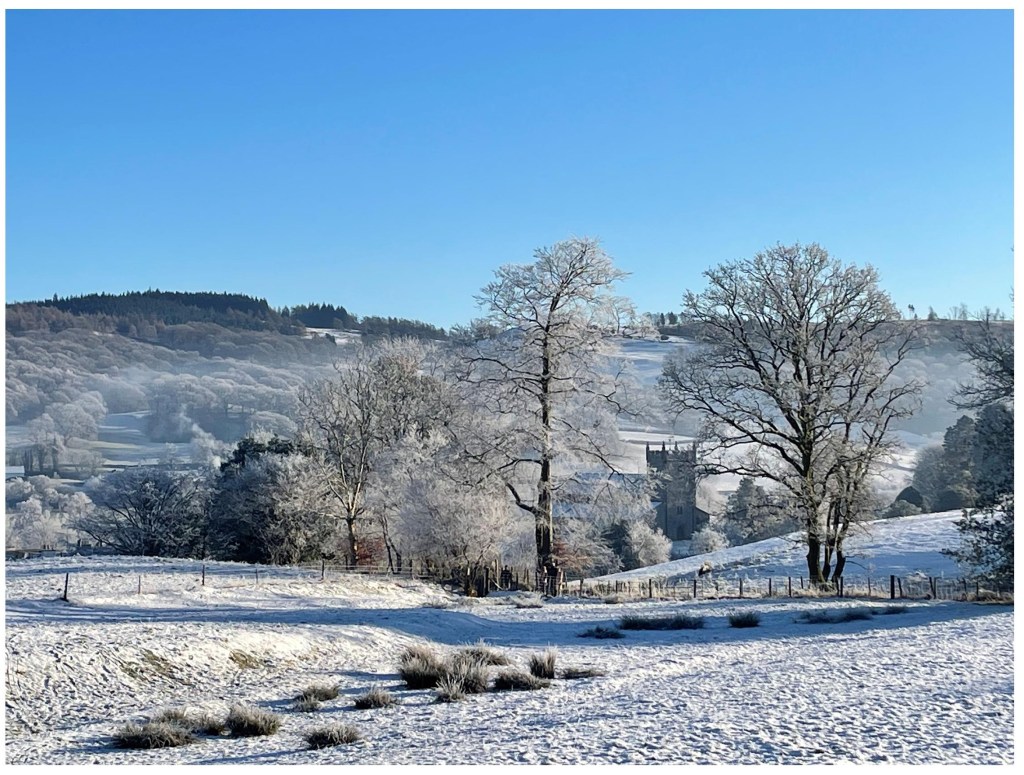
The photograph of Hawkshead is by my friend, Gill Henwood.
The quotation is by St John of the Cross whose feast day is December 14th.

John of the Cross was regarded as one of the greatest Spanish mystics of the sixteenth century.
His writings still nourish modern Christians in their hunger for a true experience in the spiritual life.
He was born in 1542 and became a Carmelite friar at the age of twenty-one. Four years later he met Teresa of Avila in one of those God-moment meetings were two souls are fused together by the love of God, for the greater good of Christianity.
Teresa was occupied in reforming the Carmelite Order, instilling renewed vision and discipline and founding many new Convents of Prayer throughout Spain. John of the Cross joined her in this work. He served as a spiritual guide to the nuns and to Teresa herself. He was one who encouraged her to write her teaching on Prayer. His prominence in the reform movement made him a target for those who preferred the more comfortable old ways and twice he was abducted and imprisoned. After Teresa died, he was again targeted, this time by his own superiors in the Reformed Carmelites. Their harshness contributed to his death in 1591.
Nothing, however, took him away from his love of God and he gladly accepted the hardships because he saw them as sharing in the sufferings of Jesus on the Cross. Hence his name.

Like Teresa, he experienced the presence of Christ in “intellectual visions.” His reflection upon these experiences issued, first of all, in poetry of extraordinary power and beauty. At the urging of his disciples, he selected a number of his poems and produced prose commentaries on them, which have become classics of mystical theology. This includes one of his most famous writings on The Dark Night of the Soul.

John united the vocation of a theologian with the experience of a mystic, and his writings are the good example of theology as the fruit of prayer.

The most lovely thing that was ever said about him was by St Teresa.  “I cannot be in the presence of John without being lifted up into the presence of God.”

John said, himself, about God:

How gently and lovingly
You wake in my heart,
where in secret You dwell alone;
and in your sweet breathing,
filled with good and glory
how tenderly You dwell in my heart
with love
.

from, The Living Flame of Love by St. John of the Cross

and here is something for us to ponder over and pray about, applying it to ourself.

God is more pleased by one work, however small, done secretly, without desire that it be known,
than a thousand done with the desire that people know of them.
Those who work for God with purest love not only care nothing about whether others see their works,
but do not even seek that God himself know of them.
Such persons would not cease to render God the same services, with the same joy and purity of love,
even if God were never to know of these.”

― John of the Cross, The Collected Works of Saint John of the Cross

[Mr G]