Tag: St Teresa of Avila

God walks among the pots and pans

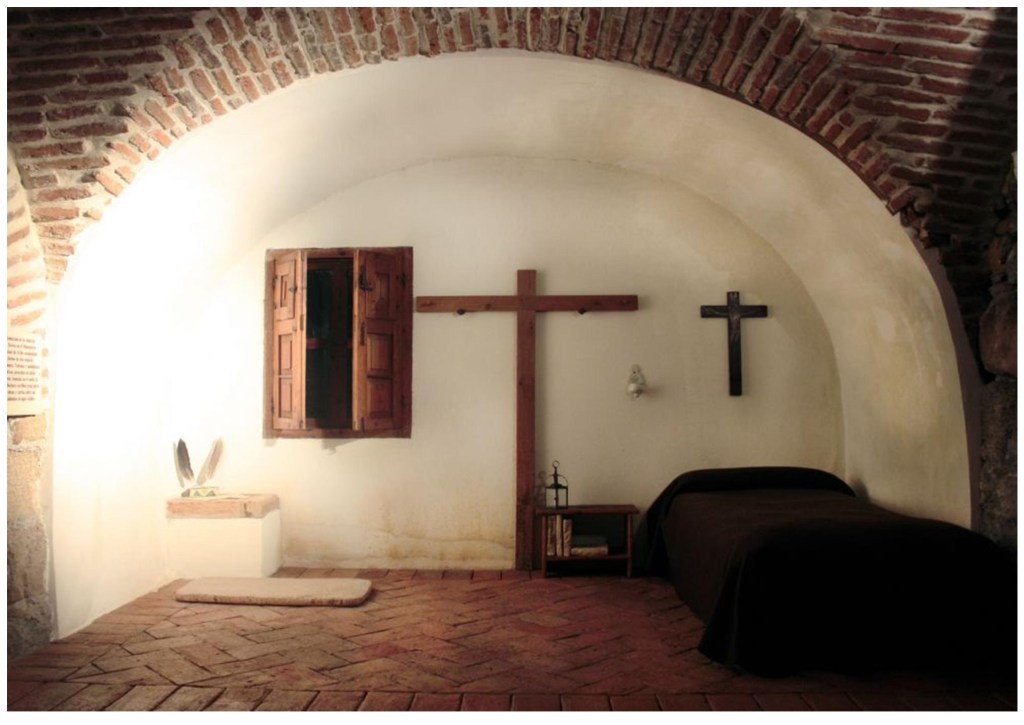
Cell of St Teresa, Avila

God walks among the Pots and Pans – a reflection on St Teresa’s day October 15th

Teresa of Avila believed that God could be found in everyday and rather ordinary activities as well as in the silence of prayer in church or some special place.
Though she herself had experienced deep mystical experiences she was down-to-earth and practical.
When it was reported to her that a sister was having an extreme religious experience which threatened to overwhelm her, Teresa advised that she should eat marmalade. (she knew the importance of sugar balance!) Another sister in a similar state was told, quite sharply, that she was there to do the dishes!
Though she was granted a particularly great spiritual experience of God, known as the Ecstasy of St. Teresa, which she described as a “complete transformation of the soul in God,” she firmly believed that God was to be found and experienced in everyday ways.

Most of the time, our journey of faith is really quite ordinary. Yet it is in the midst of ordinariness that God opens Himself to us and warms our hearts. I’ve always liked what St. Teresa of Avila said—God walks among the pots and pans.  He’s can be found in the ordinary things that we do and the tasks we perform, like cooking and cleaning the dishes. Whilst experiencing Jesus in church worship and in the sacramental life, God is always near us. If our hearts are tuned to him we shall recognize him in the mundane, the unexciting, the ordinariness where Jesus is constantly waiting to meet us.

Teresa was born in the 16th century and her feast day is on Tuesday. At an early age she was fired up by the lives of the saints and she was particularly taken by the martyrs and their complete self-offering to God.
When she was about 12 she decided that she would leave home and travel to where there were enemies of Christ who would, she confidently believed, behead her! Then she would immediately enter heaven. She took her younger brother Rodrigo with her but fortunately for them, they were apprehended by an uncle before they had reached the outskirts of the town. He noted that the ever-practical Teresa had remembered to pack sandwiches.

Though she failed to receive the martyrs crown she responded to the call from God which was to be total and life-long. Entering a Carmelite convent at the age of 21, she was to be dogged by ill health for many years, even to the point of death. It was when she experienced a mystical visitation from God which left her heart trembling that she was “left completely afire with a great love for God.” She knew then that her soul would “never be content with anything less than God.”

At this time in Spain, the convent life was one of luxury. Nuns even had their own personal maids! Teresa received a call from God to restore a sense of sacrifice and simplicity to the Carmelite order. With thirteen other nuns, she left the security of her convent and for the rest of her life she founded a different sort of convent. Throughout Spain she introduced reforms, some of which she had to argue for in front of prelates and even a Pope but she was not afraid of anything that she saw as standing in the way of God. Simple convents for a simple God-centered way of life. The nuns went barefoot as they trod gently but purposefully towards God and  His Kingdom.

 Teresa rushed all over Spain founding such convents, and earning the nickname as ‘God’s Gadabout’. But in the midst of all this activity was a soul stilled into prayer. She remained close to God in the silence of true prayer. She never ceased to find him in the ordinariness of her daily life.

Sometimes she met Jesus in ways she would have preferred not to! On a particularly rainy day, the ox-cart in which she was travelling got stuck in the mud. Seeking to help in some way, she jumped from the cart into mud almost up to her knees, whereupon she shook her fist towards heaven and is supposed to have said, It is no wonder that your Majesty has such few friends, the way you treat us!’
She was to write many fine words about prayer but surely none would come straight from her heart as that did! 

Her spiritual guides insisted that she wrote down her thoughts about prayer and they are, to this day, among the great spiritual classics. They reflect her holiness, wisdom and sense of humour. Through them she has become a favourite teacher of prayer to many, many people.
Her teaching was recognized by the Church, when shortly after her death she was made a saint who was truly a ‘teacher of the faith’

Her words, her teaching, her example, have given us a rich treasury from which to discover how to both accept and give the love of God; a love through which we grow faithfully and in the knowledge that God is always close to us. In everyday ways and everyday words Teresa helps us to open our hearts more fully in peace and trust to the one she always called Your Majesty, and lived close to in deep friendship and love. So might we.

[Mr G]

photo: Mr G.

Heaven in Ordinary

A new tweet from my friend Joyce Smith. She makes this important observation.

This little bird reminds me that in looking for the exotic and colourful, I often overlook the wonder in the ‘ordinary

God can be found in our ordinary lives.

TERESA of Avila  was sometimes referred to as ‘God’s Gadbout‘ because she spent a lot of her energy in founding convents of nuns throughout Spain in the 16th century.  She was forever on the move and yet she is remembered best for her teaching about Prayer and particularly about Contemplative prayer which requires stillness.  No matter how busy she was – and she was very busy – she made sure her heart was constantly fixed on God, whom she referred to as Your Majesty, though not always politely! God for her was very near.  Indeed she coined a famous phrase – ‘God walks among the pots and pans’. We find God in the ordinariness of life, and if we train ourselves to recognize that, we shall meet Him in the everyday events of our lives and in the people we meet.  This is about finding Heaven in Ordinary.

Teresa believed that God was within us as well as beside us, and here she took up our Lord’s own teaching that the Kingdom of God is within us.  We encounter Him in the silent depths of our hearts.

You know that God is everywhere, she says, which is a great truth; wherever God dwells there is heaven, and you may feel sure that all which is glorious is near His Majesty.

Then she refers to St Augustine who sought God in many places and at last found the Almighty within himself.  We don’t need to go to heaven to find God, she says, We are not forced to take wings to find Him, but have only to seek solitude and to look within ourselves.

She calls this seeking God in solitude within ourselves the prayer of Recollection – or Contemplation.  In her work Interior Castle she develops this using the imagery of a King in his Palace.

Let us realize that we have within us a most splendid palace built entirely of gold and precious stones – in short, one that is fit for such a Lord – and that we are partly responsible for the condition of this building, because there is no structure so beautiful as the soul full of pure virtues, and the more perfect these virtues are, the more brilliantly do the jewels shine

What we find in this Palace is the mighty King who, she says,  has deigned to become your Father and Who is seated on a throne of precious value, by which I mean your heart.
Realizing this took her quite a while.:

Had I understood always, as I do now, that so great a King resided in my soul I should not have left Him alone so often, but should have stayed with Him sometimes and not kept His dwelling place in such disorder.

For Teresa, then, it is when we enter into silence and spend a little time with God in our hearts that the soul makes progress in the prayer.  God becomes the centre of our being, always to be found when we still the voices of the world that claim so much of our attention.

Teresa says that it is only through silence that we can encounter the love of God and receive it into our hearts. 
God is very near.  We should seek him within. He is much closer to us than we might imagine.
We are not ordinary to Him who loves us to be near to His heart.
Of course, it is when we recognize this that we are actually quite extraordinary!

The Sparrow knows the answer!

Even if it fell to the ground our heavenly Father will notice! See Matthew 10:32. and Psalm 84:3 where the sparrow and her mate, the swallow, find a dwelling place in God’s house where they may quietly and safely lay their young.

That’s why the sparrow is a long way from ordinary. Just like us!

[Joyce & Mr G]

Big in the eyes of God

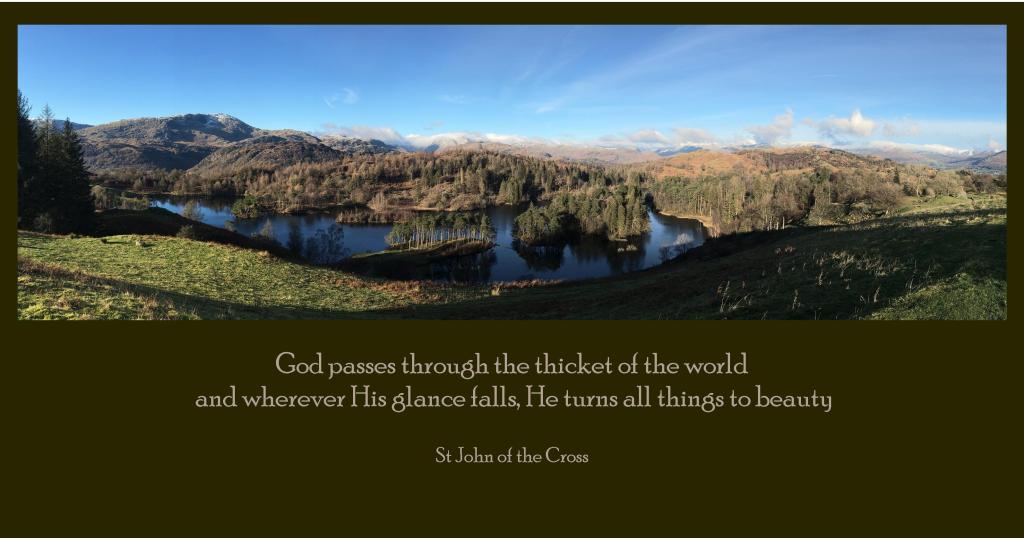
Photo of Tarn Hows and surrounding hills by Gill Henwood

Today, December 14th, is a special day. It’s the day the Church keeps the feast of St. John of the Cross.

Some years ago, towards the end of a visit to Spain, we arrived at Ubeda. It was a wet Sunday afternoon and the town was all but deserted. The one eating and drinking place was the only crowded place. I had gone there, however to see something very important.

We had started the Spanish journey by travelling from Madrid to Avila. There, my companion and I visited the shrine of St. Teresa of Avila. She has been a favourite saint of mine for a long time and I have tried to dig deep into her spirituality. There is something profoundly mystical about her and yet, also, an accessible ordinariness. Teresa tells it as it is! She also tells God what’s on her mind!

Her legacy, for which she was honoured as a Doctor (Teacher) of the Faith, is her teaching on prayer. Yet her writing, done usually on the hoof, had to be encouraged. She was busy at the time reforming the Carmelite order and founding new convents of what became known as the discalced (barefoot) order of the contemplative Carmelites. (when she wasn’t actually shouting at popes, nobles and, at times God!)

In all this activity she had a series of mentors, confessors and encouragers. The chief amonst these, and her very special friend was St John of the Cross. His friendship did so much to help her in guiding others and in leaving us the great spiritual treasure we still have today.

St. John of the Cross was, himself, a man of deep spirituality. His writings and, especially his spiritual poems, established him as a mystic who walked close to God and for whom God’s love was deeply personal. The power of God’s love to touch ALL hearts is expressed by John in something he truly believed. He said, Where there is no love put love in and you will find love. In people and in situations where love is lacking, put the love of God in and you will draw love out. John of the Cross saw this as one of the most important witnesses we can make for God.

Often misunderstood and persecuted, even imprisoned, he found strength from his deep relationship with God. He also found a spiritual home in Teresa’s discalced Carmelites which he joined.

Amongst his writings is ‘The Dark Night of the Soul’, ‘The Ascent of Mount Carmel’ and ‘Spiritual Canticle’. A good introduction to his life and spirituality is by E Allison Peers, available still from good bookshops.

Like Teresa he was made a Doctor of the Church.

That rainy afternoon in Ubeda, our knocking on the door of the museum/monastery was rewarded at precisely 4pm! (When siesta was over). We were led by a quiet but welcoming monk to the shrine of St. John of the Cross. A wonderfully profound moment at the end of our joureying in Spain. In my heart was the link between the beginning of that journey and its end, not least because these two saints, in so many ways, had hearts for God that beat as one. Teresa said of John: “I cannot be in the presence of John without being lifted up into the presence of God.” In each other, they found God’s friendship and company.

But let Teresa have the last word about him on this, his feast day. She said of him, ‘Though he is small in stature, he is Big in God’s eyes.’ What better thing could be said of anyone!

[Mr. G]

God is very near – Teresa of Avila

Today, October 15th, the Church keeps the feast-day of one of my favourite saints – Teresa of Avila.  She was often referred to as God’s Gadbout because she spent a lot of her energy in founding convents of nuns throughout Spain in the 16th century.  She was forever on the move and yet she is remembered best for her teaching about Prayer and particularly about Contemplative prayer which requires stillness.  No matter how busy she was – and she was very busy – she made sure her heart was constantly fixed on God, whom she referred to as Your Majesty.  God for her was very near.  Indeed she coined a famous phrase – ‘God walks among the pots and pans’  We find God in the ordinariness of life, and if we train ourselves to recognize that, we shall meet Him in the everyday events of our lives and in the people we meet.  This is about finding Heaven in Ordinary.

Teresa believed that God was within us as well as beside us, and here she took up our Lord’s own teaching that the Kingdom of God is within us.  We encounter Him in the silent depths of our hearts.

You know that God is everywhere, she says, which is a great truth; wherever God dwells there is heaven, and you may feel sure that all which is glorious is near His Majesty.

Then she refers to St Augustine who sought God in many places and at last found the Almighty within himself.  We don’t need to go to heaven to find God, she says, We are not forced to take wings to find Him, but have only to seek solitude and to look within ourselves.

She calls this seeking God in solitude within ourselves the prayer of Recollection – or Contemplation.  In her work, Interior Castle, she develops this using the imagery of a King in his Palace.

Let us realize that we have within us a most splendid palace built entirely of gold and precious stones – in short, one that is fit for such a Lord – and that we are partly responsible for the condition of this building, because there is no structure so beautiful as the soul full of pure virtues, and the more perfect these virtues are, the more brilliantly do the jewels shine

What we find in this Palace is the mighty King who, she says,  has deigned to become your Father and Who is seated on a throne of precious value, by which I mean your heart.

Realizing this took her quite a while.

Had I understood always, as I do now, that so great a King resided in my soul I should not have left Him alone so often, but should have stayed with Him sometimes and not kept His dwelling place in such disorder.

For Teresa, then, it is when we enter into silence and spend a little time with God in our hearts that the soul makes progress in the prayer.  God becomes the centre of our being, always to be found when we still the voices of the world that claim so much of our attention.

Teresa says that it is only through silence that we can encounter the love of God and receive it into our hearts.  God is very near.  We should seek him within.

A Prayer of St Teresa
(often known as Teresa’s bookmark.
It was found in her prayer book after her death)

Let nothing disturb you.
Let nothing frighten you.
All things are passing;
God only is changeless.
Patience gains all things.

Who has God wants nothing.
God alone suffices.