Tag: The heugh

Sit Awhile

Photo: Emmanuel Head. This striking structure, built between 1801 and 1810 by Trinity House, is one of the earliest daymarks built in Britain (possibly the earliest one). A daymark is a navigational aid for shipping, and this one stands 35 feet high. A good place to sit awhile. Photo taken by Gill Henwood.

My friend Gill Henwood recently stayed on Lindisfarne (Holy Island), Northumbria. Near the ruins of the Benedictine Monastery, is a cliff top walk along what is known as The Heugh (pronounced ‘Hee-uff’). It is believed that this rock was utilized by the Celtic/Anglo-Saxon monks, as part of the early monastery, built in 635AD when King Oswald, newly reclaiming his father’s kingdom, sent to Iona for a monk to begin the work of bringing the Northumbrian people to the Christian faith. St Aidan set up his monastery on Lindisfarne which becomes an island twice a day. It was near enough to Bamburgh, the King’s castle to allow Aidan free access to the King and yet quiet enough for the young Anglo-Saxon novices to learn the Gospel of Jesus, the prayers, the sacramental life and the lessons of mission.
Because Lindisfarne becomes an Island twice a day, it can welcome tourists and visitors but also it can flow into silence. Both purposes are valid but it is good that sometimes, being still allows the voice of God to enter our hearts, where we are converted by Love for a life of love.

We are invited to Sit Awhile and allow the multi-faceted island re-create us from within.
Gill’s poem below takes its inspiration from this.

Sit Awhile

A place to sit awhile
to listen…

sea splashing as the tide retreats
oystercatchers piping as they fly on the wind
swans overhead in their pair…

to see…
seal heads bob up in the surf
cormorant fishing in the seaweed
ships on the horizon far off
the low silhouette of the Farne Islands.

But nobody here
‘til the causeway opens
and the coaches arrive.

I feel…
wind ruffling my hair
the breeze brushing my cheek
a Presence balming my soul
the Spirit enlivening all.

Lastly …
the gannets skimming the waves.
Stunningly beautiful.

Holy Island,
indeed.

Gill Henwood
October 2023
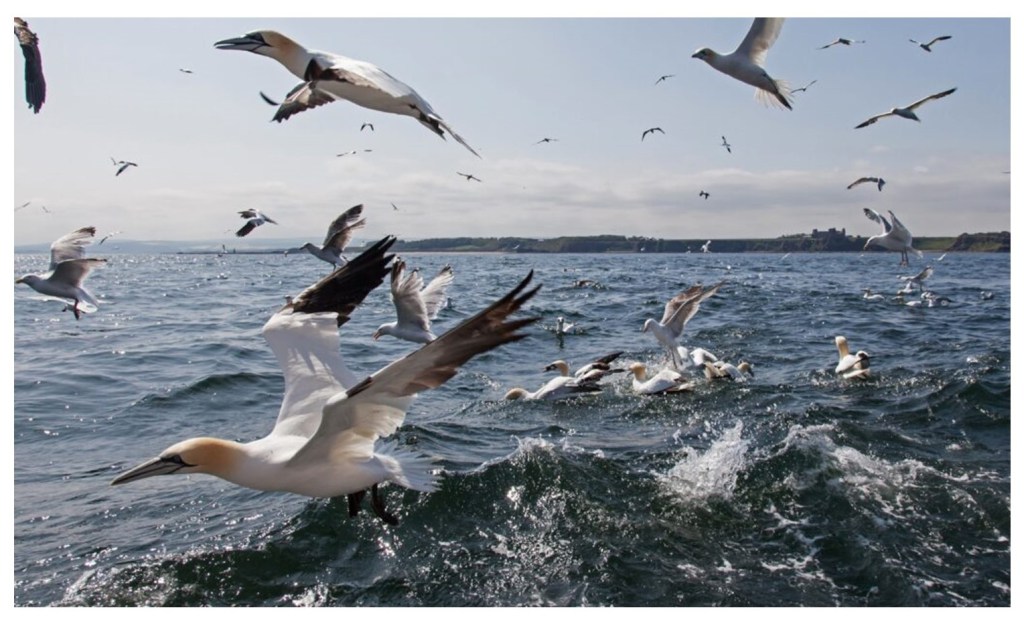
Northumbrian Gannets

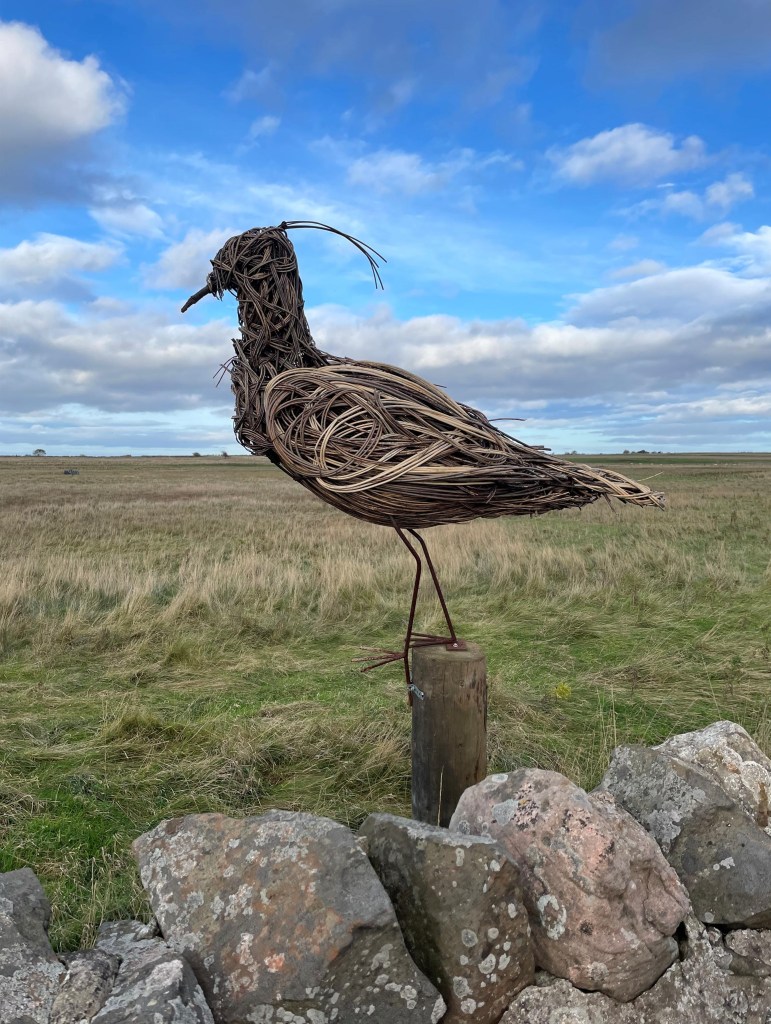
Lindisfarne Lapwing

Photo by Gill Henwood

My friend Gill has just sent me this photo of an amazing willow sculpture on the Holy Island of Lindisfarne. It’s too splendid not to share! Especially as Gill has sent an accompanying reflection:

Holy Island weather cleared by late morning to a beautiful autumn afternoon. From the Heugh and the castle, the lighthouses on the Farne Islands were clearly visible and Bamburgh Castle towered over the sea. 

The willow woven lapwing  surveys the wildlife lough near the viewing centre. Calling birds were all around: overhead hanging on the breeze, feeding in the soft ground and shores, flocking together by the trees.
Seals bobbed up in the channel below the Heugh as the tide swept in, marooning island dwellers and visitors for the day (unless they had a boat, or could fly!)
Bladder wrack floated as the sea lifted its prostrate carpet from the wave cut platforms of rock, the lush seaweed dancing in the swirling currents with airy buoyancy – alive with joy.

In the church, the (renovated) hewn monks still carry St Cuthbert in his coffin, seeking safety and sanctuary, journey’s hasty start fleeing Holy Island, wandering to his final resting place in lofty Durham.
“Who are they?’ My five year old grandson asked, astonished as he looked up by their life-sized embodied presence. Now at the back of the church, as if to process out of the south door. 

The story of Cuthbert lives on, of Aidan before him and Oswald too. Of the Lindisfarne Gospels written in the scriptorium somewhere here, back in the north this autumn to visit again.
It is also our story, as we too seek sanctuary from the dark troubles of our fragile world.

May the lapwing who migrated speak to us of the turning of times, tides and the seasons on Holy Island, a place of fragile peace and sanctuary. May s/he speak to us of the need to fly, to flee, when adversity comes. May s/he reassure us that, in God’s loving economy, there are places of safety when we seek together – even when that resting place is our ‘place of resurrection’, our own graves.

Gill Henwood

Note:

  • The Lapwing was part of a Nature Trail created by Anna and volunteers  under the guidance of Lindisfarne National Nature Reserve.
  • The Lapwing, also known as the peewit in imitation of its display calls, its proper name describes its wavering flight. Its black and white appearance and round-winged shape in flight make it distinctive, even without its splendid crest. This familiar farmland bird has suffered significant declines recently and is now a Red List species.
  • The Heugh (pronounced Hee-uff) is an elevated rocky ridgeoverlooking the village and providing some protection from the wild weather which assails the island village. It was here that St. Aidan set up his monastery in the 7th Century when Lindisfarne became the cradle of Christianity for a vast area of England and Southern Scotland.