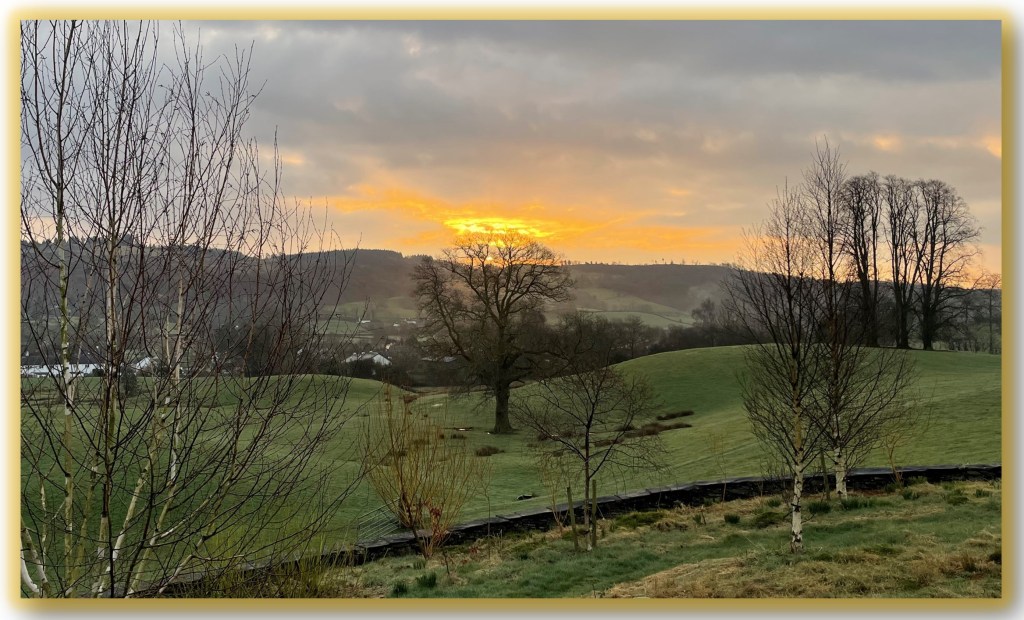
The dancing Sun on Easter Morn
Some while ago, I came across a film made by an English visual artist, Tacita Dean. It was of a sunset filmed off the coast of Madagascar. It’s purpose was to catch the final ray of the sun as it disappeared over the horizon. The final ray is not red or orange but green and it lasts for less than a second. It has been described as a green flash, which occurs more commonly at sunset is a phenomenon in which part of the sun can be observed suddenly and briefly changing colour. It usually lasts only a second or two — which is why it is referred a flash — as the sun changes from red or orange at sunset, for example. The green flash is viewable because refraction bends the light of the sun.
Tacita Dean managed to capture this moment and the flash is just visible. Mostly it has eluded her attempts to film it but then, just once, she was rewarded. She described the filming as an act of looking. It’s about faith and belief in what you see.
Remembering the film and what Tacita said, brought to mind the story of the sun’s action on another occasion at the other end of the day—the dawn on Easter morning.
There is an old Irish and Gaelic belief that when the Sun rises on Easter morning, it dances with joy that the Saviour has risen.
A version of this was recorded by Andrew Carmichael in his monumental work Carmina Gadelica. A woman, he met, in the Outer Hebrides, Barbara Macphie, describes her experience: She tells of climbing the highest hill on Easter morn and seeing the sun dancing in delight:
“The glorious gold-bright sun was rising on the crests of the great hills, and it was changing colour—green, purple, red, blood-red, intense white, and gold-white, like the glory of the God of the elements to the children of men. It was dancing up and down in exultation at the joyous resurrection of the beloved Saviour of victory. To be thus privileged, a person must ascend to the top of the highest hill before sunrise and believe that the God who makes the small blade of grass to grow is the same God who makes the large, massive sun to move.”
This belief is widely held in Ireland but it is a much wider custom than that.
In the Middle Ages it was held that at the hour of sunrise, this legend was fulfilled when the sun was said to make ‘Three cheerful jumps” as it rose from the sky. This was said to be in honour of Christ’s Resurrection. Some even suggested that the rays penetrating the clouds were the angels, dancing for joy.
I read somewhere that some people would put a pan of water in the east window and so watch the dancing sun mirrored in it.
Sir John Suckling. An English poet of the 17th century refers to this in his Ballad upon a Wedding.
In a very long poem, one stanza reads:
Her feet beneath her petticoat,
Like little mice, stole in and out,
As if they fear’d the light:
But oh! she dances such a way
No sun upon an Easter-day
Is half so fine a sight.
Resurrection morning customs are still common in parts of Europe, America and until this year, in Bethlehem.
No doubt some so-called rational thinking people may suggest that this is fanciful but we need to remember that God communicates Himself to us in many ways and through many mediums.
We just have to have faith and belief in what we see.
Closing our minds and our hearts to such religious insights and experiences might well result in our missing the many splendoured thing which God wants to show us if we but look with the eyes of faith.
As Frances Thompson puts it in a cautionary note in his poem, In no strange land;
The angels keep their ancient places;—
Turn but a stone and start a wing!
’Tis ye, ’tis your estrangèd faces,
That miss the many-splendoured thing.
[Mr G]
++ The versions of the two poems are those by the Poetry Society.
Barbara Macphies’ words are those recorded by Alexander Carmichael in his Carmina Gadelica
[I haven’t quite mastered receiving comments except from WordPress subscribers. I’ll get there eventually!
Meanwhile please feel free to use my email address: geoffrey_connor@priest.com.
 Mr G's Ponderings