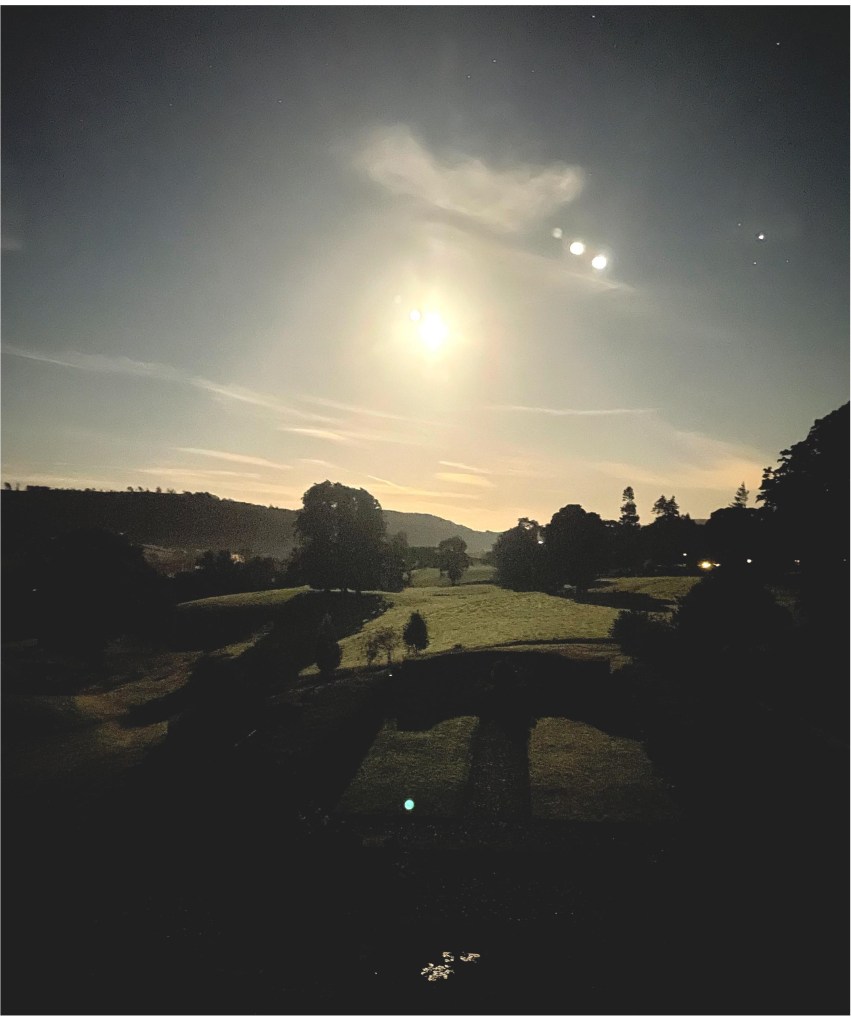
Equinox in Cumbria. This photo, sent to me by my friend Gill Henwood, celebrates the autumn equinox.
This is when the earth tilts on its axis by about 23.4 degrees. During the autumn equinox, the Southern and Northern Hemisphere trade places in receiving the amount of light and warmth from the Sun. This results in the change of the seasons. Hence we begin to celebrate Autumn
NIGHT
Shadow movements hug and cloak the earth with crepuscular furtiveness. Inky blackness shuts out Light.
There are those who draw breath, embracing stillness; though for others night is a time of phantoms, fears, emptiness. Not all welcome the changing hues.
But wait! for that tipping moment when pinprick stars merge with a sky-streaked dawn. Darkness always becomes Light, Shadows always turn the world. Light always needs darkness for it to dazzle anew with a radiance so bold, our spirits soar.
My friend Joyce Smith has sent me another picture tweet of a Gannet in flight. The caption is by Henry David Thoreau. Joyce writes: Dear Friends, This graceful gannet witnesses to beauty in our present lives as well as to our future hope. With my love and prayers, God bless, Joyce
I was inspired by the photo to try and capture my feelings in a poem.
All is Gift.
Gannet soars, taking a path between earth and heaven. Grace in flight buoyed up by the whisper of God’s breath A joyful beauty here.
She reminds us of God’s creative love fashioning the world spreading signs and reflections of His heaven – brooding under, over and within Creation. Entrusting this message not to us but to a creature of His artistry. The gentle flap of her wing carries her through clouds, across an ever-moving sky, from time to time she drops to kiss an azure sea, beak dipping foaming wave forming, where love breaks.
Gannet carries a gift from God, A message from His heart ; “Enjoy the freedom of grace-filled life. I glide around you revealing the beauty above, below and within you for I am always there.”
Look up and see, look down and feel. Look within and breathe. Live for a while in true harmony with all that I have made. But know, (and here Gannet flies away to spread her wings of beauty), that all is gift.
On November 14th, 1940, the Luftwaffe blitzed the City of Coventry with bombs. So fierce was the bombing that a new word was coined by the Nazi’s for wholesale destruction – to Coventrate.
A victim of the bombing was the medieval Cathedral. It also had a word : Forgive.
Today, if you visit Coventry, the new Cathedral, designed by Basil Spence and opened in 1962, hugs the old. A remarkable fusion of death and re-birth, though truthfully, the symbol for both is of reconciliation and Resurrection.
Another symbol is the Cross of Nails.
On the morning after the destruction, a local vicar, whose own church had suffered much damage, picked up from the Cathedral ruins three sharp nails, which had been part of the roof, and with a bit of wire, bound them into a cross. He was not to know then that his Cross would become the potent sign of what was to be a worldwide community of the Cross of Nails, dedicated to prayer and action, especially in dark and broken places.
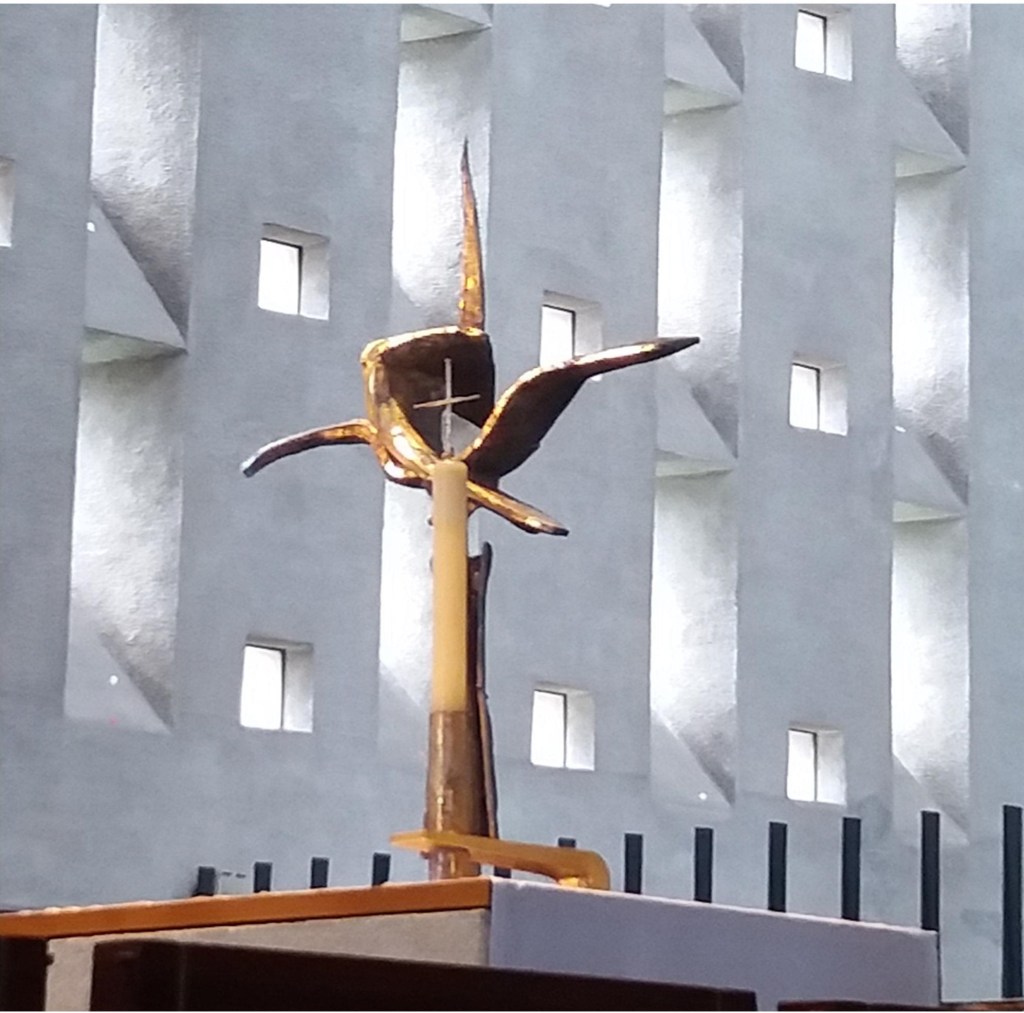
Those three nails, now gilded and placed in the Sanctuary of the new part of the Cathedral, (see photo above) were to inspire a remarkable ministry. It was, and is, a portent for good in a dark world so much in need of light and hope.
This ministry is summed up in the Coventry Litany of Reconciliation and in this weekend of special remembrance both of the atrocities of what happened 20 years ago, known forever as 9/11, and all that has transpired subsequently both bad and good, it is an appropriate Litany to pray, either alone or with others.
COVENTRY LITANY OF RECONCILIATION
All have sinned and fallen short of the glory of God. The hatred which divides nation from nation, race from race, class from class
FATHER, FORGIVE
The covetous desires of people and nations to possess what is not their own.
FATHER, FORGIVE
The greed which exploits the work of human hands and lays waste the earth.
FATHER, FORGIVE
Our envy of the welfare and happiness of others,
FATHER, FORGIVE
Our indifference to the plight of the imprisoned, the homeless, the refugee,
FATHER, FORGIVE
The lust which dishonours the bodies of men, women and children’
FATHER, FORGIVE
The pride which leads us to trust in ourselves and not in God,
FATHER, FORGIVE
Be kind to one another, tender-hearted, forgiving one another, as God in Christ has forgiven you
<><><><><><><><><><><><><><><><><><>
You may also like to ponder these prayers offered in remembrance of 9/11 and those whose lives were lost and the many whose lives were forever changed.
The prayers are from an array of faith leaders from many religious traditions. They were found in the internet from Huffington Post, Prayers for Peace & Healing on 9/11 Anniversary.
Jesuit Prayer:
In times of pain, give me comfort, in times of despair, give me hope. In times of hatred, give me love. In times of doubt, give me trust. And even when I feel far from you, be close to me, Loving God.
Fr. James Martin, S.J.
Jewish Prayer:
We pray to live with memory, with constant love, with the promise both to combat evil and to cherish goodness. Do not let our pain cloud our hopes or crush our hearts. Help us grow through this tragedy, keep faith with its victims, and sustain our trust in you.
Rabbi David Woipe
Hindu Prayer:
While our landmarks collapsed in a cloud of smoke and debris, beneath a surge of shock and rage, something awakened in our hearts: compassion.
Radhanoth Swami
Sikh Prayer:
Universal Creator, grant us resilience in the face of hate, and the courage to face it with dignity. May we all unite and share one another’s pain and tears. May the hatred in the world melt away in Your boundless and everlasting love. And living in Your Will, may all find peace, harmony and serenity.
Dr. Satpal Singh
Christian Prayer:
Dear God: We seek your grace to strengthen us as we commemorate the lives of loved ones who have been lost on this day of anguish for our country and our world. Lord, teach your children to love each other as much as they profess to love you.
Bishop T. D. Jakes
Muslim Prayer:
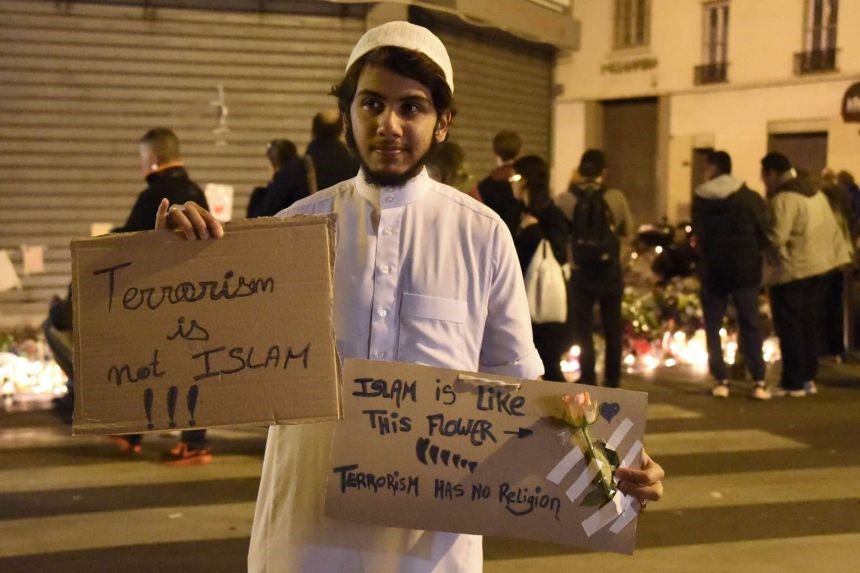
There was a prayer from an Imam but this picture, of a young Muslim holding up cardboard signs, is to my mind, one of the most powerful expressions of hopeful prayer.
A Meditation by Piers Northam on last Sunday’s readings: Isaiah 35:4-7a James 2: 1-10, 14-17 Mark 7: 24-37
Over the years in my design career I’ve worked on quite a few projects in Kuwait and, along the way, I picked up one or two Arabic phrases – mostly to do with food, numbers or building sites. One expression – and I can’t remember why I learnt it, though I think we might have been playing games with one of our clients’ children – was the Arabic for ‘Open sesame!’ which is ‘iftah ya simsim!’ [افتح يا سمسم ]
And of course that word iftah (open) comes from the same root as the word that we hear Jesus say this morning as he opens the ears and loosens the tongue of the man in our story.
Ephphathà! [’eφφαθά] – be opened!
I’m drawn to this word because it seems to me to be what God is all about: openness. Openness to us and to our concerns; arms stretched open on the cross in an embrace for the world and all humanity; a heart never shut to us – always open to welcome us when we turn to him; ready to come running down the road to meet us like the prodigal son’s father.
And it seems to me that it’s what God asks of us too: openness to him, but also openness to each other.
’eφφαθά – be open!
It’s why I pray the prayer I always pray before my sermons – that our eyes be opened to God’s presence, our ears to his voice and our hearts to his love – because it seems to me that that’s what God is asking of us. That we are aware of his presence in the world and in each other; that our hearts are open to others just as his is open to us.
’eφφαθά – open your hearts!
These last weeks the crisis in Afghanistan has once again highlighted the agony of those who are forced from their countries and livelihoods, their families and familiar surroundings to flee; to undertake dangerous journeys and to leave everything that they’ve ever known behind – to become refugees because the alternative is simply too dangerous or too awful to contemplate. As the world seems to become ever more troubled – through war, tyranny, oppression, economic collapse and natural disasters brought on by climate change – the numbers of refugees leaving their homes and seeking asylum and the chance of life elsewhere are on the rise – and this poses a real challenge. How do we deal with these people? Where do we put them? How might they impact on our own lives? Our instinct is to think of people of different nationalities as ‘other’.
And yet, as we read in James’s letter, we must beware showing partiality: treating people differently and favouring some whilst disadvantaging others.
We find it a lot easier to deal with people who are clean and fed than people who are grubby, hungry and needy. But God is shockingly blind to all of that. He doesn’t hear their accent or notice the colour of their skin. He simply sees a beloved child.
Our reading from James last week told us to ‘be doers of the Word, not merely hearers’. And here he is again, underlining the importance of actions alongside our faith.
Jane Williams sums it up rather well:
‘ “Faith changes the way you live”, James says, in that obnoxiously black and white way of his. You might feel tempted at this point to turn to that nice St Paul, who really understands the importance of faith, and doesn’t go droning on about having to do things as well. Dream on. Try reading Romans 6. There is no escaping the New Testament conviction that faith is a commitment to a changed way of life because it is a commitment to trying to see the world with the eyes of God.’
We have to open our eyes to the world – and to those refugees around us.
’eφφαθά – open your eyes!
The first half of our Gospel story is interesting though – Jesus is in the region of Tyre when the Syrophoenician woman asks for his help for her daughter. Remember, she’s a Gentile, not a Jew. Jesus’ words sound rather like some of the rhetoric that we hear at the moment much closer to home:
‘Let the children be fed first, for it is not fair to take the children’s food and throw it to the dogs.’
In other words, he’s suggesting that the Jews should come first and merit his attention and his help before anyone else. But the woman challenges this, certain that God’s provision is for everyone and that there’s enough to go round.
I can’t work out whether she really is opening Jesus’ eyes to the breadth of his Father’s love, or whether he draws her on to say this as a test of her faith and so that others might hear it. But whichever way, she’s unafraid to open her mouth and challenge the view that some are more important and deserving than others in God’s eyes.
And it seems to me that it’s incumbent on us too – that we open our mouths to challenge these attitudes.
’eφφαθά – open your mouths!
I’ve felt very disturbed by stories I have heard in the news recently – first about RNLI lifeboatmen being abused and criticised and possibly facing the threat of criminal proceedings because they continue to risk their own lives attempting to rescue illegal immigrants in trouble at sea. And then by the actions of the Government in the last couple of months as they have put the Nationality and Borders Bill through parliament criminalizing people who attempt to seek asylum here and those who help them. There are plans within the bill to imprison people for 4 years if they arrive illegally by sea in small boats for example – this despite the fact that the cost of housing a prisoner comes it at around £42,000 per year as against around £9,000 per year for putting someone through the asylum system. People do not get into those boats lightly: it’s a last and desperate resort and our country’s response to this seems heartless in the extreme. I say I’m disturbed. I’m not. I’m appalled and disgusted – and deeply, deeply ashamed that this sort of thing is going on in my name.
And as Christians we should all be opening our mouths to cry out loudly against this behaviour which speaks of shut minds, shut hearts and the very partiality that James warns against.
’eφφαθά – open your mouths and cry out!
There is no sense in the Government’s approach – it seems to me plain wicked if I’m honest – evidence shows that where we work to help people and do our best to integrate them into society, they fast begin to build new lives and to contribute to that society, socially, culturally and economically. But it requires some initial generosity on our part.
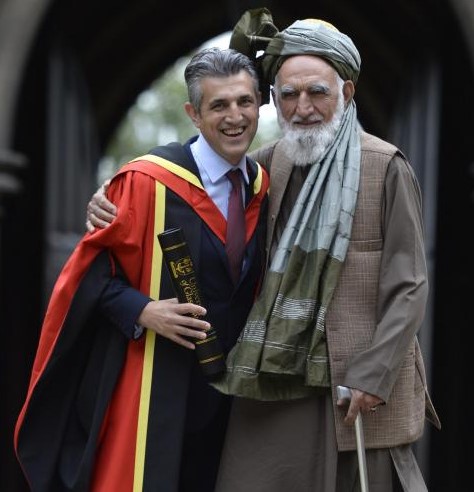
In thinking about all of this, I came across a story of another Afghan, Sabir Zazai, who arrived in this country seeking asylum in 1999 in the wake of the troubles in Afghanistan then. The joke was that he was ‘sent to Coventry’ but he speaks of the warm of welcome that he received there.
‘I left home in search of peace and reconciliation and I found myself in a city associated with peace and reconciliation. […] Coventry inspired me and especially its cathedral; both old and new buildings have been a real source of hope for me and many others seeking protection in the city.
One sunny day I sat in the cathedral ruins […] My eyes were caught by the word ‘Forgive’ engraved behind the cross that was burnt during the [World War II air-]raids. On reflection I thought forgiving is a gift from God, but only if we use it often to be more forgiving to one another and more welcoming and understanding of others’ needs. This way, we can build a more welcoming and hospitable society in which people fleeing persecution and human rights violations can rebuild their lives in safety and dignity.
Wise words. Sabir – the 23-year-old refugee who came to the UK over 20 years ago in the back of a lorry with not a word of English – is now based in Glasgow where he serves those seeking asylum and refuge as CEO of the Scottish Refugee Council, and as chair of the City of Sanctuary movement. In Coventry, a city rebuilt after the Second World War on peace, reconciliation and sanctuary, he worked tirelessly to make life better for all those in similar situations to himself and became CEO of the Coventry Refugee and Migrant Centre. His drive, energy, compassion and commitment have been extraordinary and were marked by his award of the Civic Prize for his efforts in bringing peace and reconciliation to the City of Coventry.
The refugee who brought peace and reconciliation…
What would happen to him today?
‘Then, looking up to heaven, Jesus sighed and said ’eφφαθά’ – open your eyes to what is happening… – open your hearts to the heart-wrenching stories – open your hands to do what you can – and open your mouths to speak words of welcome but to cry out against injustice!
’eφφαθά! – be opened!
Amen.
Piers Northam 5 September 2021
Sabir Zazai with his father, after receiving an Honorary Doctorate from the University of Glasgow.

 Mr G's Ponderings