Sometimes when things seem to overwhelm us, it’s good to think about nice things, or things that we don’t have to think too deeply about and maybe a bit nonsensical.
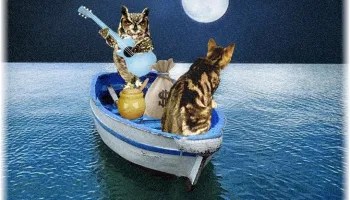
Today is the birthday of Edward Lear (born 12 May 1812) He was an English artist, illustrator, musician, author and poet, now known mostly for his poems and limericks and most especially for the Owl and the Pussy-Cat. Lear wrote it for Janet, the three year old daughter of a friend of his. It was first published in 1871.
The Owl and the Pussy-cat went to sea In a beautiful pea-green boat, They took some honey, and plenty of money, Wrapped up in a five-pound note.
The Owl looked up to the stars above, And sang to a small guitar, “O lovely Pussy! O Pussy, my love, What a beautiful Pussy you are, You are, You are! What a beautiful Pussy you are!”
II Pussy said to the Owl, “You elegant fowl! How charmingly sweet you sing! O let us be married! too long we have tarried: But what shall we do for a ring?”
They sailed away, for a year and a day, To the land where the Bong-Tree grows And there in a wood a Piggy-wig stood With a ring at the end of his nose, His nose, His nose, With a ring at the end of his nose.
III
“Dear Pig, are you willing to sell for one shilling Your ring?” Said the Piggy, “I will.” So they took it away, and were married next day By the Turkey who lives on the hill. They dined on mince, and slices of quince, Which they ate with a runcible* spoon; And hand in hand, on the edge of the sand, They danced by the light of the moon, The moon, The moon, They danced by the light of the moon.
Edward Lear.
Try not to worry about the meaning of ‘runcible’ It was a word invented by Lear and has no obvious meaning.
With thanks to Edward Lear for entertaining us with much-needed nonsense which is very different from the nonsense being played out on the world’s stage just now.
This posting has received full approval from the sponsor of this Blog, Pagli.
Heavenly Father, at this time we feel so helpless over the situation in Ukraine. When we hear of the terrible atrocities that are being pounded upon this Sovereign State we can hardly believe our ears or believe our eyes. When we hear about the attitude of Mr Putin, we find it incredulous that in this day and age, such evil can be found in one man.
We can only put our trust in you, we can only pray to you and we can only hope that this situation will soon be over through your intervention. We pray for the many, many civilians who have been affected by this invasion. We also pray for those who have lost their lives and have been thrown into mass graves. May their souls all now be with you in your kingdom.
Rainbow over the Lake District, photo by Gill Henwood
Waiting on God, is a reflection shared by my friend, Ruth Howes, last week to a Zoom group at St Mary-at- Latton. It draws its inspiraration from Genesis 12: 10-20 and 16
We read in Genesis 12 from verse 10 that because there was a famine in the land of Canaan, God told Abraham to go to Egypt. Abraham was concerned because, we are told, that Sarah was a very beautiful woman, and he was worried that the Egyptians would kill him and take Sarah for themselves. So, Abraham said to Sarah, please tell them you are my sister. Then they will spare my life and treat me well because of their interest in you.
Pharoah did find Sarah attractive, and because he thought that Sarah was Abraham’s sister took her into his palace and didn’t kill Abraham so he could have Sarah. God sent a plague upon Pharaoh, who in fact accused Abraham of it being his fault but Sarah and Abraham were spared from any ill-fate. Pharaoh said to Abraham, ‘Why didn’t you tell me she was your wife? Why did you say, ‘She is my sister,’ and allow me to take her as my wife? Take her and get out of here’.
I have only skimmed the surface, but it is an intriguing story!!
And it goes on!! In Ch.15, we read that God promised Abraham many things, especially that he would have a son, but Abraham knew that Sarah was barren and that they were getting old, so questioned how this could be? But God assured him it would happen.
I have often thought that surrogacy was something recently used for women who couldn’t have children maybe in the 20th or 21st Century. But obviously, this is not so. We are told about it in our reading in Genesis Ch.16, for Sarah, Abraham’s wife. God promised Sarah that she would have a son. But there was a problem … Sarah couldn’t have children. And even if she hadn’t been barren, she was 90 years old!! As far as Sarah was concerned, there was simply no way God could do it. So, she decided to help Him out!!!! In those days it was quite normal for women who were barren to be able to use her servant as a surrogate to have a baby for her. So, Sarah decided that this is what she should do. She got Abraham to agree to go with her servant Hagar in the hopes of having a baby through her. And it worked … sort of. Hagar did have a son, but the situation caused nothing but trouble and ruined their relationship.
God didn’t need or want help. He promised that Sarah herself would have a son. And that’s exactly what happened – 10 years later against all the odds as far as both their ages were concerned.
Waiting on God is hard. When we face impossible situations, do we trust God, and do we try and fix things ourselves? So often during our prayer time we pray for people we know who are going through a hard time or are poorly and we want nothing more than to see them get better. Sometimes our prayers are for ourselves but the answers we receive are not necessarily the ones we hope and wish for. God will answer in His own way and in His own time, very often testing our patience and not what we were asking for, because sometimes the answer to our prayers is ‘No’.
If Sarah’s story teaches us anything, it is that God doesn’t need us to help Him do the impossible. He just wants us to trust and wait.
This is a difficult thing to do – to wait!!
Remember, when you were a child, Christmas and Birthdays seem to take an age to come round. Not so now!!! The years go by too quickly!! Those of us who were fortunate to have children, towards the end of the pregnancy must have felt, as I did, that the baby was never going to arrive. It seemed to go on for ever!! God had his hand securely on the situation regarding Abraham and Sarah.
So, you see, they didn’t appear in this instance to trust in God which must have caused God to be disappointed in them, and yet despite all of this, God kept His promise that she would have a Son. What is interesting is that God did not forsake Hagar either and if you have time, it makes good reading.in Genesis 21.
Sarah is known as ‘The mother of the nation of Israel who thought God needed a hand’. Well, he does need us and needs our talents to do His will, but when it comes down to it, it will be His will, not ours. Our commitment to Him is to wait and see what He calls us to do and respond as best we can. He has promised that he will not give us anything to do that is beyond our capabilities. Yes, sometimes we are tested to the limit, but we can still call on Him to meet the resources we need.
Red Fox in Latton Garden photographede by Revd. Lynn Hurry. Red is the hue of ardour and the sun’s blazing radiance. To put it another way, witnessing a red fox is an indication of someone who is full of life and enthusiasm. How true that is!
Readers of this blog last summer may recall that the Foxes which make their home in the garden of the Vicarage at St Mary-at-Latton, Harlow, featured in some of the postings. Mama Fox has now returned with a new partner and very shortly we expect to see the little ones cavorting in their summer playground. No doubt we shall include photos on the blog. Meanwhile, anticipation got me thinking about Foxes.
A little bit about the Fox.
It must be said that the Fox doesn’t get a good press in The Bible. References are mainly derogatory. Of the two references made by Jesus, one compares the puppet King Herod to a fox – Luke 13:32 – “Go tell that Fox…”. The other reference, of course, in Luke 9:58 when Jesus spoke of the fox having a hole in the ground, whereas he nowhere to lay his head. In Matthew 8, where Jesus used the same words, it was part of a response to a Scribe who wanted to follow Jesus wherever he would go. Jesus warned him that following as a disciple would mean giving up all the comforts and security of his life. Here the fox is used as an illustration rather than a negative comment.
Later views of the Fox varied. In much of Europe the fox was thought to be a sly, cunning, crafty and generally up to no good. In the Far East, the fox was regarded as tricky and deceitful. St. Francis, with his deep love of the animal world, was interested in the welfare and safety of all creatures and wasn’t specifically concerned for the fox.
It was the Irish Christian church, which we now refer to as Celtic, who had favourable stories about foxes. They referred to the fox as being sometimes naughty but on the whole capable of reform.
St. Cieran, for example, founded a monastery where all the brothers were animals – so legend has it. He believed that all could be reformed, ever Brother Fox and Brother Badger! Some might return to their old ways but could be brought back to the straight and narrow path.
This view is echoed in a conversation between the little Prince and the fox in Antoine de Saint-Exupéry’s tale, ‘The Little Prince’*
“To me, you are still nothing more than a little boy who is just like a hundred thousand other little boys. And I have no need of you. And you, on your part, have no need of me. To you, I am nothing more than a fox like a hundred thousand other foxes. But if you tame me, then we shall need each other. To me, you will be unique in all the world. To you, I shall be unique in all the world…”
But if you tame me, it will be as if the sun came to shine on my life . I shall know the sound of a step that will be different from all the others. Other steps send me hurrying back underneath the ground. Yours will call me, like music, out of my burrow. And then look: you see the grain-fields down yonder? I do not eat bread. Wheat is of no use to me. The wheat fields have nothing to say to me. And that is sad. But you have hair that is the colour of gold. Think how wonderful that will be when you have tamed me! The grain, which is also golden, will bring me back the thought of you. And I shall love to listen to the wind in the wheat…” The fox gazed at the little prince, for a long time. “Please, tame me!” he said.”
Whether the foxes-at-Latton can be ‘tamed’ remains to be seen, but certainly, Vicar Lynn will care for them.
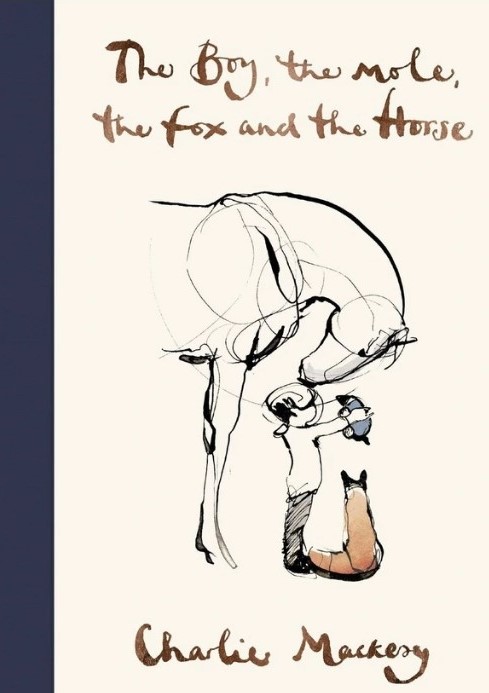
Finally, many of you will know the book by Charlie MackesyThe Boy, The Mole, The Fox and The Horse. * It’s another way of meeting the Fox in a new and special way.
[MrG]
** The Little Prince by Antoine de Saint-Exupéry’ is available in a number of editions ** The Boy, The Mole, the Fox and the Horseby Charlie Mackesy published by Ebury Press RRP. £16.99






 Mr G's Ponderings