One of the joys of having friends in the Lake District is that I am sent wonderful, scenic photographs from time to time.
Over many years I have visited, camped, trecked over hills and down a few ‘mountains, visited bookshops in Ambleside and Grasmere, where I have also partaken of the famous and delicious ginger bread. I could go on and on. More recently I have come to know something of Josephina de Vasconcellos, an amazing sculptor and her husband, the watercolourist Delmar Banner. They lived near Hill Top. Through them I have found a connection with Beatrix Potter.
But my ‘living’ connection is with my friend, Gill and Stephen and, further North, Lesley and John, and in Carlisle, my friend Michael who ministers at the Cathedral. It is through Gill’s camera eye that I am able to share the photos with you. The recent mixture of wild, snowy, frost dressed weather has provided contrasts. We are now in the thick of winter and just over halfway through January. Yet there are signs leading to expectation of new growth and new life.
Gill supplies me with reflections, notes and thoughts.
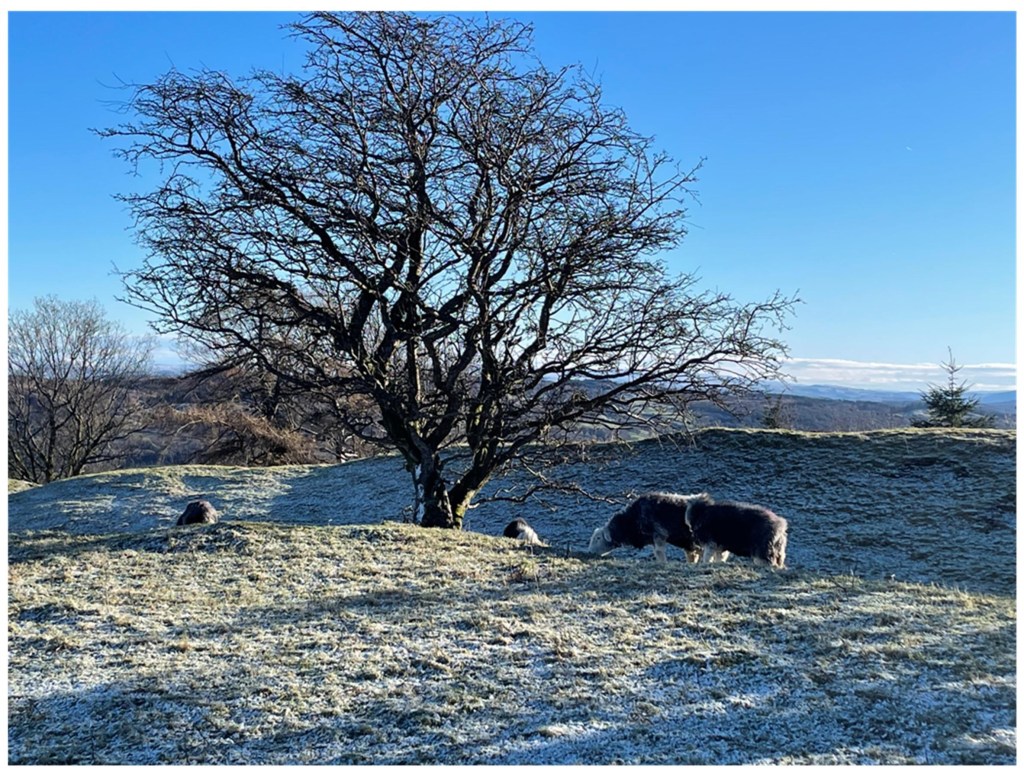
The photo above looks towards Fairfield Horseshoe on the Helvellyn range, over mist rising from Windermere and the River Rothay. In the foreground, the frosted roof of the sheep shed shelters 250 expectant ewes. Another 95 are due to join them as they prepare for lambing from 12th March. The local fell breed ewes beloved of Beatrix Potter, Herdwicks, are up on the thin grazing sheltering at night by dry stone walls, foraging in the sunlit uplands by day. Here she suggests, sheep may safely graze, the ‘Herdies’ are sheltering and nibbling their way down the slope.
There has been a recent storm. So much of nature around Tarn Hows has been battered but there is also resilience. We dare to be confident whilst woefully aware that the real damage to Nature is being done by human beings. Up in the Lakeland Hills it is easier, perhaps, to see that beauty and sustainability come at a cost, not so much to us but the struggling animal kingdom. I often hear it referred to as the ‘natural world’ (of Nature), which ironically suggests that we are the ‘unnatural’ world. I think that the way our humanity is behaving right now, that could be very true!
Storms in Nature are often followed by silence; a time of re-collection and respite. Gill talks of a ‘still small voice’, as that which surrounded Elijah on the mountain. (1 Kings 11;9-13) She calls it The Shekinah – the Glory – of the Lord – as cloud over Hellvellyn ridge.
Frost and snow, wind and cloud, rain and sunshine, air and life. New growth bringing new hope. Gratitude, Thankfulness . Dependence on God. Love assured. Kindness lived out in hearts warmed by grace.
Allowing God to See Us A thought on St Antony’s Day. (January 17th)
I was having a conversation with somebody recently and we got onto relationships and, in particular, our relationship with God. This led us to thinking about what form our prayer with God takes and how, so often, it’s about just talking and asking, interceding for others and generally verbal. Many of us aren’t all that good about silent praying which takes the form of meditation or contemplation. In our conversation, we thought that part of the reason why we might shy away from non-verbal prayer is because it involves us in listening rather than talking and we don’t always want to hear what God is saying to us.
In what is known as the Desert Tradition of Prayer there is a lot of wisdom about how we should approach God and about how we develop our relationship with Him. This wisdom comes to us through stories about the holy men and women who, when Christianity began to be ‘respectable’, took themselves off into the desert to be alone with God. This ‘aloneness wasn’t easy – they weren’t, as it were, getting away from it all for a nice rest or quiet time! Prayer for them involved struggle – first with self and then with what they knew to be demons or the mischief of the devil. Only through this struggle did they come to recognize the pureness of God’s voice, or presence.
It’s rather like the struggle Elijah had on the mountain after he fled away from King Ahab after his wife Jezebel stirred up trouble for him – (see1 Kings 19). Elijah went into the wilderness, felt sorry for himself, was touched by an angel and then went off to hide in the mountains. Here God looked for him but there was a cacophony of noise – whirlwind, earthquake fire after which the stillness, the silence through which Elijah heard the voice of God speaking to him. This was, in a similar way, the experience of the Desert Fathers and Mothers and it is their teaching that can help us to go beyond words in our praying.
An experience I had during a stay at a convent in Oxford is a kind of illustration of this. I was in my room reading some of the sayings of the Desert Fathers and I read of three men who used to visit St. Antony of Egypt. They came every year, and two of them used to bombard Antony with spiritual questions. The other, younger man, simply sat in silence. This went on for a number of years until, eventually, Antony said to the younger man, “How is it that you come with these two every year and they ask me lots of questions but you never ask anything?” The young man replied, simply, “It is enough for me to see you Father.”
Soon after reading this, I went to the chapel to join the nuns for Compline, the Night prayer of the Church. I was a little early and the place was in complete darkness – I could just make out the dark shape of several nuns kneeling in prayer. There was just one light – almost a pinprick – the lamp burning in front of the Blessed Sacrament. And as I sat looking at the light the thought kept recurring: “It is enough for me to see you, Father.”
I would like this to be my focus for the year ahead, and maybe yours too – that we must grow in the kind of prayer which is about looking at God and being still, just letting his gaze of love fall on us. There are too many strident and demonic voices at looses in our world today. Too much talking and acting as if people not God, nor the rest of His beautiful creation matter.
If we listen to God and to each other with generosity and kindness we will slowly change our world and each other. We should place ourselves often in God’s presence so that he can really see us and we Him. .He has things to show us and, as the young man who visited St Antony recognized, ‘it is enough’. .
[Mr G]
Let us enter into the cell which is our hearts, where God dwells within. Be still and know that He is God Enter into the chamber of your heart. There is the kingdom of God, in the utter stillness within. From that depth comes human joy; human love; human activity. Relax into the assurance of His love, His care; He has provided for every moment. Be still and know that He is God.
January 12th was the feast day of Saint Aelred who was especially known for being one of the most holy abbots of the abbey of one of England’s greatest monasteries, that of Rievaulx in North Yorkshire.
Aelred was born in Hexham in 1110. His family was well connected with the Scottish Royal Family. Aelred was taken into the Court of King David I were he became the Royal Steward. He also wrote the biography of King David. His future in the service of the State was assured. However, God had other plans. About 1134 he responded to a ‘call’ he discerned to be from God and he entered the Abbey at Rievaux as a Cistercian monk. The Abbey itself was about 2 years old at the time, so with the early monks he grew into its spirituality as a house of prayer. He was eventually to become its Abbot.
He had been brought up to love learning and he put this to good use. He was a noted preacher and many of his sermons are still in print today. He also wrote some important books, including a work about living the monastic life, The Mirror of Charity; a book of Pastoral Prayers and, the book which is really his legacy, Spiritual Friendship. In the writing of this, Aelred was much influenced by a classical thinker of pre-Christian times, Cicero. His greatest influence was Jesus himself who, as he prepared for his death by crucifixion, spoke intimately to his disciples and claiming them to be his friends.
Aelred saw that friendship with God was essential for our relationship with Him but it also had important lessons for us to learn in how we deal with and related to each other.
A Dominican Friar, Robert Gay, OP comments on this: “True friends treat each other with a Christ-like gentleness and sympathy. They are constant in their love, frank, and congenial. When the friendship has these characteristics, it can be said to be a true friendship, a ‘spiritual friendship’, one which builds up both parties and helps them journey towards God.” (RG)
There are many kinds of friendship but working towards spiritual friendship involves us in a progress towards God which is two-fold. It is about our personal walk with God and it is about our walk together as a Christian community. We learn God’s friendship within our heart/soul and with our sharing the common life of Christ as worked out by and with others.
This brings me to something which has always intrigued me and on which Aelred has an opinion. He was a great preacher and one of the sermons, which survives, is based on the Gospel about Jesus visiting Mary and Martha. (Luke 10:38-42) Many see this as a story of the Contemplative (Mary) and the Activist (Martha). We sense this by Jesus’ reaction when Martha complained about her sister, that he holds up Mary as the truly spiritual sister. Many commentators on this passage point out the contrast between Martha’s distraction with many things and Mary’s single-minded devotion to God. They have drawn out from this passage the importance of keeping a spiritual dimension in our lives. There is a clear implication that distractions prevent us from the true purpose of loving God and of listening attentively to his Word as it is communicated to us in and through Jesus. Aelred, in his sermon, seems, initially, to be taking up that view:
“Recognize the state of these two sisters, Martha and Mary. The one was busy, the other was at leisure. The one gave, the other asked. The one was anxious to serve, the other nourished her affections. She did not walk about or run hither and thither, was not concerned with the reception of guests, nor distracted by household worries, nor busy with answering cries of the poor. She just sat at Jesus’s feet and listened to what he had to say.”
Aelred then said something different.
Both these women live in the house of your soul.
What I think he is saying here is that both Mary and Martha are needed. They represent two aspects of what Jesus needs from us. On the one hand He needs us to sit and listen to his words and be still. On the other hand He needs us to serve him through practical deeds. Aelred spells this out:
If Mary alone is in that house there would be no-one to feed the Lord. Therefore, Martha signifies that action by which we labour for Christ which is a call to ministry. On the other hand, says Aelred, Mary signifies that rest by which we are freed from activity in order to delight in the sweetness of God through reading, prayer and contemplation. We need both because, he says, if you neglect Martha, who will feed Jesus? If you neglect Mary, what does it matter that Jesus entered your house, when you taste nothing of his sweetness? These sisters are not enemies. They complement each other and Jesus needed them both. Just as he needs them both at work in us .
Jesus needs us to be active in our service to others which is part of our mission to bring God’s love to those parts of his world where we have some influence. But he also needs us to be still so that he can whisper his gospel into our hearts and remind us why we are serving – but also, because he needs to tell us how much he loves and cares for us. This activity and stillness before God is done in friendship. Jesus loved Mary because she was such a genuine contemplative but he also loved Martha because she found God among the pots and pans, as St Teresa of Avila would put it. When their brother Lazarus died and Jesus was taking a while coming, it was Martha who had a deeply theological conversation with him about the Resurrection. She found her religious insights in the ordinariness of her work. Both of them are deep, loving friends of Jesus. As are we, individually and together.
Christians are often called disciples, followers, even apostles, but the title that is, to my mind, the best is ‘friends’ of Jesus. Jesus gave us this title in his final teaching to the chosen 12 after the Last Supper and which takes up Chapters 13 to 16 in St John’s Gospel and culminates in the great prayer of Christ which is chapter 17. In his farewell talk to his disciples he called them ‘friends’.
St Aelred of Rievaulx says that “Friendship is like a step to raise us to the love and knowledge of God. Friendship lies close to perfection”.
When Jesus told his disciples (and by extension, tells us) that he regarded them as his friends, he was opening up a new way of relating to God. That we can be friends with the Almighty, Immortal and Awesome God is saying something vitally important about how we should live our life as Christians. To see Jesus as our friend makes a big difference to how and why we do things to proclaim the Gospel to others. It changes our relationship with God in worship; it opens up more honest and real praying; it reveals the scriptures not simply as a story of how God deals with his people but how, from the beginning he has been conducting a love-affair with us.
As he did with Martha and Mary, and Aelred.
Almighty God, who endowed Aelred the abbot with the gift of Christian friendship and the wisdom to lead others in the way of holiness: grant to your people that same spirit of mutual affection, so that, in loving one another, we may know the love of Christ and rejoice in the eternal possession of your supreme goodness; through Jesus Christ your Son our Lord, who is alive and reigns with you, in the unity of the Holy Spirit, one God, now and for ever.
My friend Jonathan sent me a present of a poem as an Epiphany gift. It is named The Ballad of the Cross and is by Theodosia Garrison.
Though she wrote quite a number of poems and a few sacred songs, not a great deal is known about her. She was born in Newark, New Jersey in 1874 and she married Frederic Faulks but continued to write under her maiden name. She was on the staff of Life Magazine, resided in New Jersey and was a friend of the American poet, Ella Wheeler Wilcox. She died in 1944. There are hints about her in a number of places but, apart from her published poetry being still in print, not a great deal more.
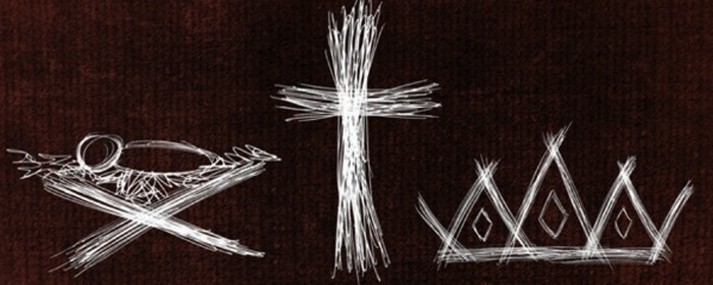
The poem Jonathan sent me is connected with today’s feast of Epiphany though it is called the Ballad of the Cross. The reason for this becomes evident at the end but, as a spoiler, it makes the connection between with the Crib/Manger of Christ and the Cross of Christ (hence the title). It reminds us that God’s work of Incarnation reaches its fulfilment in the Easter of Christ – his death and resurrection.
Here’s the poem.
Melchior, Gaspar, Balthazar, Great gifts they bore and meet; White linen for His body fair And purple for His feet; And golden things—the joy of kings— And myrrh to breathe Him sweet.
It was the shepherd Terish spake, Oh, poor the gift I bring— A little cross of broken twigs, A hind’s gift to a king— Yet, haply, He may smile to see And know my offering.
And it was Mary held her Son Full softly to her breast, Great gifts and sweet are at Thy feet And wonders king-possessed; O little Son, take Thou the one That pleasures Thee the best.
It was the Christ-Child in her arms Who turned from gaud and gold, Who turned from wondrous gifts and great, From purple woof and fold, And to His breast the cross He pressed That scarce His hands could hold.
’Twas king and shepherd went their way— Great wonder tore their bliss; ’Twas Mary clasped her little Son Close, close to feel her kiss, And in His hold the cross lay cold ~Between her heart and His!
Comment on the text
The reference at the beginning of verse 2 to the Shepherd Terish, may be simply a reference to the earlier visit of the Shepherds to the manger The origin of the name may be Persian, which could link it with the Magi who are believed to have come from the East – as in the carol, Three Kings from Persian lands afar. This is my conjecture. There are no notes from Theodosia to help.
The second is about the word ‘gaud’ (gaudy) in verse 4. It means something like a ‘trinket’ or ornament. Maybe jewels which would link into the ‘wondrous’ gifts of the Magi. This is followed by an obscure reference to ‘‘Purple Woof and fold‘. This is her second reference to the colour ‘purple’. (see verse one,line four) Purple in biblical times and also in the days of the Roman and Byzantine Empires is the colour of Kingship, and Royalty. As a mixture of red and blue, it is an expensive dye and therefore rare. In the beginning of the poem it is one of the ‘great gifts’ from the Magi,‘and purple at his feet’. This is the garment signifying both king and God. It is also linked with the theme of the poem because after his trial, Jesus was mocked by being dressed in a purple (kingly) robe. It is translated ‘scarlet’ in many Bibles but in the Greek it could be translated ‘purple.’ The important thing here is about the Kingly association between the babe of Bethlehem and his subsequent Crucifixion.
The word ‘woof’ and its link with ‘fold’ are connected with cloth. Woof here is the same as ‘weft’ – threads in a garment running crosswise as the warp runs lengthwise. What Theodosia is saying is that though these costly gifts and fine garments are for a King and a God, the baby Jesus, turning away from them, indicates a very different destiny and throne. The gift of twigs given by the Shepherd, became the Cross Jesus held in his tiny hand and pressed to him. This simple, inexpensive gift reminds of the carol,In the bleak Midwinter; ‘What can I give him, poor as I am’. The Shepherd’s gift is returned to us by Jesus as the true gift God gives to us. For now, as the Magi and the shepherd leave, the cross ‘lay cold’ until its time.
The Wood of the Manger and of the Cross are brought together as instruments of our salvation.







 Mr G's Ponderings