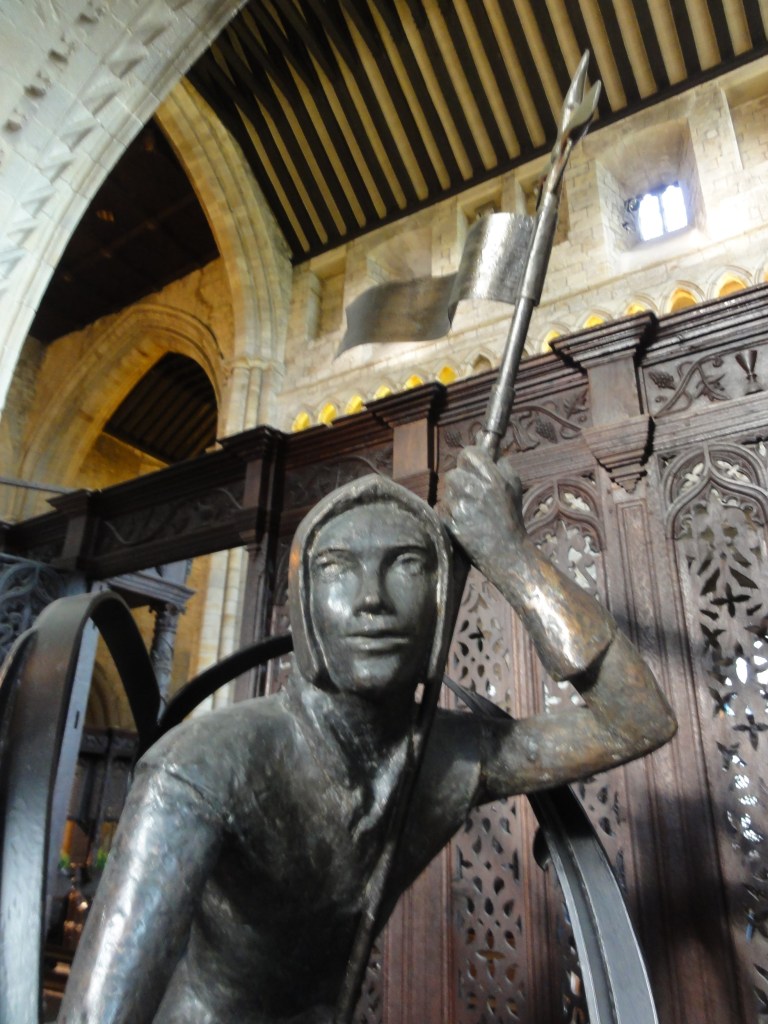
~ first exhibited in Manchester Cathedral in the winter of 1991
~ now it is on permanent display in Cartmel Priory, in the Lake District.
photo by Mr. G.
| Therefore with Angels and Archangels … At almost every Eucharist Christians pray: “Therefore with angels and archangels and with all the company of heaven, we proclaim your great and glorious name.” The picture is of our being part of a great company, invisible but near, who worship Almighty God without ceasing. At this point in the Eucharist we are at what the Celts call a ‘thin place’ when the barrier between earth and heaven is opened to those who have faith to see it. That can be very helpful when we are missing departed loved ones but we are also reminded that our worship is caught up in a greater praise. We, as it were, plug in to a current of worship which is forever flowing and for ever being proclaimed. But for many, angels belong to myth and one wonders what is going through many Christian minds when they reach that point in the Eucharist. Despite the fact that Holy Scripture is crammed with references to angels and they play a significant part in the Christmas and Easter stories, it is easy to dismiss them. It is also rather arrogant because it assumes that God who is the great creator of everything on earth, is incapable of creating any other order of being than we can actually see. Yet we continue to explore space for other forms of life—assuming, naturally, that what we will find will be ‘human’ life! As we seem to be making quite a mess of our own planet it might be better if we hoped any life form found might not be human! The writer of Psalm 8 praises creation and puts humanity in its place: “When I consider your heavens, the work of your fingers, the moon and the stars that you have ordained, What are mortals that you should be mindful of them; mere human beings, that you should seek them out? You have made them little lower than the angels and crown them with glory and honour. Though human beings have dominion (or stewardship) of creation on earth we are ‘lower than’ angels. They have a special place in God’s scheme of things—as Defenders in the cosmic battle between good and evil; as messengers of God’s word to humanity as in the Annunciation; as healers and as guardians. Jesus himself spoke of angels in this way saying that God’s little ones have their Guardian angels and he, himself, knew of their ministrations at the end of his wilderness experience. If Jesus believes in angels, who are we to dispute their existence and their part in God’s plan? [St Michael’s Day is September 29th] |
[Mr G]


 Mr G's Ponderings