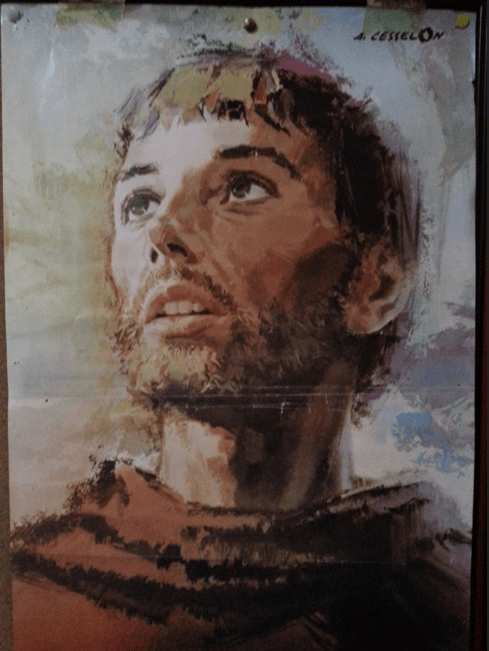
(Saint Francis – from a poster in Santiago de Compostello)
God rebuilds the spiritual heart of St Francis. The start of a Saints journey to the Kingdom of heaven, as we commorate the 800th anniversary of his pilgrimage this weekend.
When Francis gave up his life as a kind of lad about – when he turned away from drinking, fighting, leading a pack of rebels, it was because he had been brought up sharp by Jesus. Not for the first time or the last, God had visited the soul of one whose life was going in entirely the wrong direction. Francis’s soul was sick and needed healing. So God drew him away to a derelict church of San. Damiano on the edge of Assisi. There he knelt in prayer and looked at the faded crucifix still hanging over the altar. Francis insists that the voice of Christ came to him at that moment. The words he heard were: Francis,rebuild my church, which you see is falling down. The derelict Church certainly needed repairing, just as Francis’s soul needed rebuilding. Francis was about to begin his ministry and service for God. The words of Jesus to him from the cross where his ‘call’ ~ his response was to be his vocation, not just to physically rebuild the Church of San Damiano, but much more, a renewal of the Church in need of a deeper vision of God.
First, though, he had to get to know the One who called him to this service and to know the love of God flowing into him and through him to others. As he knelt in that place of meeting with Jesus, he formed this prayer which was to remain with him throughout the rest of his life.
The Prayer before the Crucifix
Most High, glorious God, enlighten the darkness of my heart and give me true faith, certain hope, and perfect charity, sense and knowledge, Lord, that I may carry out Your holy and true command
Another prayer which was to become food for his soul is one in which he prays that the love of the Lord Jesus should enter his heart and absorb him with its fire and sweetness. It is known as the Absorbeat because God’s loving Spirit possesses him.
May the power of your love, Lord Christ, fiery and sweet as honey, so absorb our hearts as to withdraw them from all that is under heaven. Grant that we may be ready to die for love of your love, as you died for love of our love. Amen
A simple, yet deeply profound prayer was one that he is said to have dictated as he lay dying. It was a prayer which he had used often and wasn’t original but it was so important to him that it was his deathbed prayer. Many will know it in some form.
We adore you, most holy Lord Jesus Christ, here, and in all your churches throughout all the world; and we bless you, because, by your holy cross, you have redeemed the world.
For Francis his spirituality was totally bound up with the Crucifixion. He is said to be responsible for encouraging the devotion known as The Stations of the Cross, the 14 meditations on our Lord’s journey to His Crucifixion. He himself was to be granted the gift of thestigmata when, after a vision of Christ crucified, the wounds of Jesus, in the form, of scars like nail wounds on his hands, feet and right side appeared on his body and remained with him until his death 2 years later.
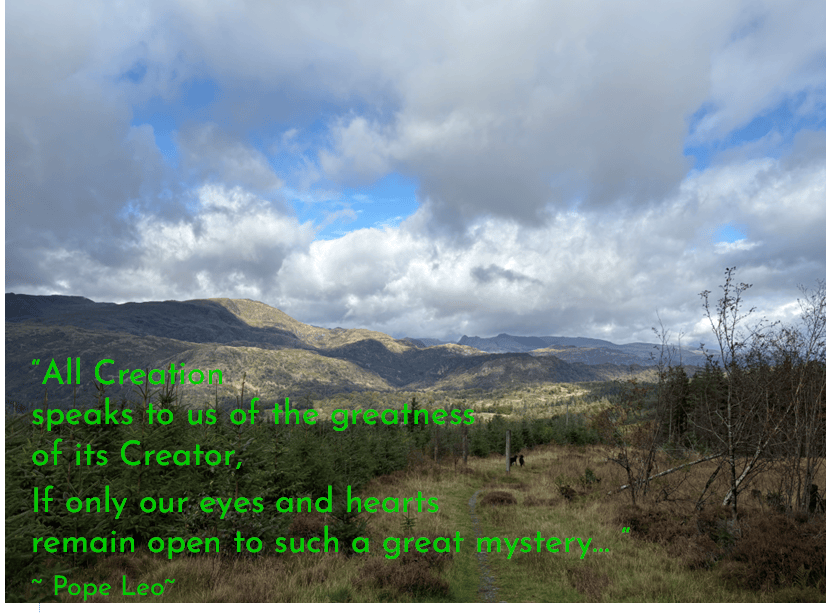
Photo of The Ridge, Lake District, by my friend, Gill Henwood.
The future of humanity depends on each person’s commitment to collaborate with God and with their brothers and sisters, in building up a more humane world (Pope Leo, September 2026)
POPE LEO’S Prayer of Creation.
Let us pray, that inspired by St Francis, we might experience our interdependence with all creatures who are loved by God and worthy of love and respect.
Lord, you love everything you have created and nothing exists outside the mystery of your tenderness; every creature, no matter how small, is the fruit of your love and has a place in this world. Even the simplest life is surrounded by your care.
Like St Francis of Assisi, today we want to say “Praise be to you My Lord!” Through the beauty you reveal yourself as the source of goodness.
We ask you to open our eyes to recognize You, learning from the mystery of Your closeness to all Creation, that the world is infinitely more than a problem to solve. It is a mystery to be contemplated with gratitude and hope. Help us to discover Your presence in all creation, so that, in fully recognizing it, we may feel and know ourselves to be responsible for this common home where You invite us to care for, respect, and protect life in all its forms and possibilities.
Praised be You, Lord! Amen.
~Pope Leo~
(On October 4th the Christian Church celebrates the 800th anniversary of the death of St. Francis. The Roman Catholic Church is celebrating a special Jubilee Year until January 10th 2027)
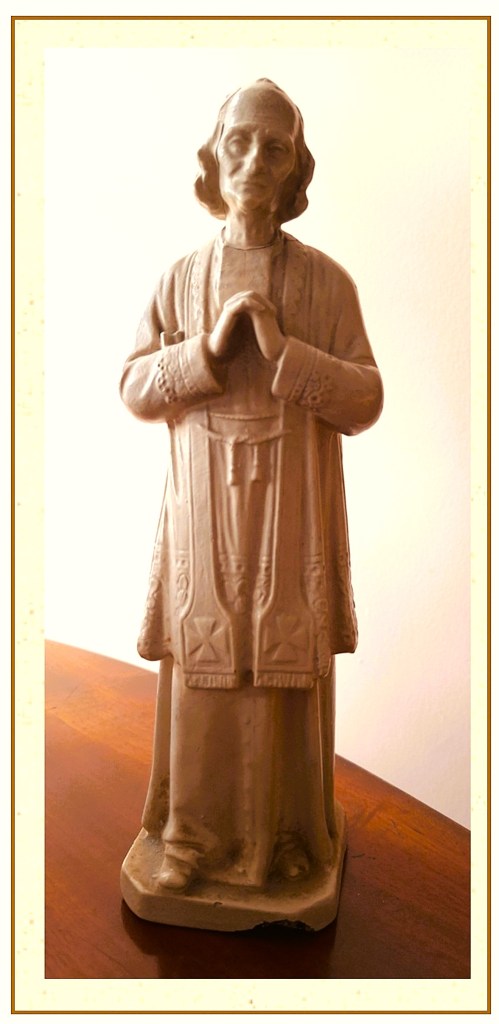
One of my most treasured possessions is a plain plaster statue of a French parish priest known universally as the Curé d’Ars—so named because for over 40 years he served the parish of Ars-en-Dombes.
John-Marie Baptiste Vianney (whose feast day we keep on August 4th) was brought up in a peasant farming family near Lyons. He was born in 1786 and as a child of farmers he was given very little formal education. Yet, by the time he was 20 he had heard God’s call to ordination and had begun to study for the priesthood. He found study very hard and on more than one occasion his superiors thought to end his time in the seminary. However, they noted his devotion to God and a quality of holiness which far outweighed academic ability. They saw a young man whose heart God had touched.
He was ordained and after a curacy he was appointed the Parish Priest of a backwater village—Ars. He went there in 1818 and remained until his death in 1859 on August 4th. Very quickly he gained a reputation for being a preacher and people began to flock to hear him. At the same time he became known as a priest who could give wise and gentle counsel to souls in distress. Very soon people began to consult him and to bare their souls to him.
The trickle of people became a stream and then a torrent. Many came to him to receive both God’s forgiveness and wise counsel. All was rooted in personal prayer and devotion. He would preach a sermon daily at 11am and then spend many hours in hearing confessions and giving spiritual direction. He was often moved to tears by the things people told him and he brought to them the comfort born out of someone who understood human weakness and the power of God’s love.
He was offered more important jobs in the Church and he also struggled with a call to the monastic life but he stayed where God had put him and in so doing put the little village of Ars on the map—not only in his own day but for all time.
Not surprisingly, after his death, he was declared a Saint and he became known as the Patron Saint of Parish Priests. As an example of the devotion and service priests are called to emulate, this is hardly surprising. The simple statue I have, unadorned by paint, is a reminder of what priesthood means. Here’s one of my favourite sayings of his:
Speaking of the difference between private and public prayer, he said:
“Private prayer is like straw scattered here and there : if you set it on fire it makes a lot of little flames. But gather these straws into a bundle and light them and you get a mighty fire, rising like a column into the sky. Public prayer is like that.”
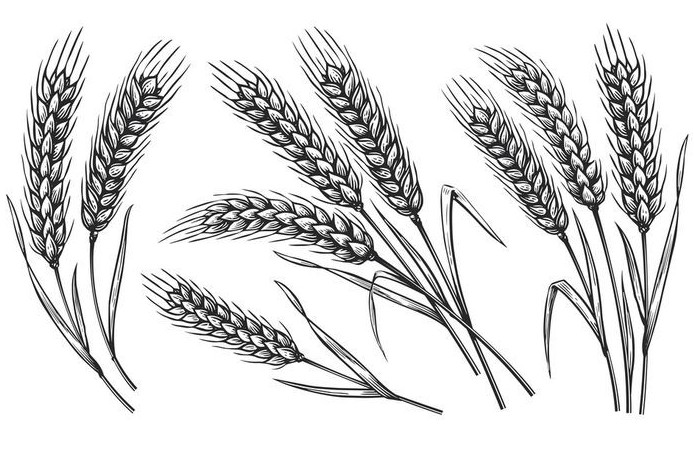
As the Lectionary takes us through Matthew’s Gospel, we come to the Parable of the Good and Bad Seed – or the Wheat and the Tares. The gardening or farming theme continues – I suspect Jesus could well be a fan of Gardener’s World or Farming Today – so last week we had the Parable of the Sower where the Sower sowed seed extravagantly, broadcasting widely, so that it fell on a variety of different types of ground. In today’s story however, Jesus focuses on the contrast between the good and bad seed; or between the wheat and the tares as some translations have it.
Historically and in biblical texts, a tare is a plant called Poison Darnel (or Lolium temulentum if you’re BBC TV Gardener, Monty Don). The thing about this particular plant is that it grows to look exactly like wheat in its early stages – it’s pretty much indistinguishable – and of course that’s why the Master doesn’t want his servants to pull up the weeds, for in doing so they might pull up the wheat too. And every grain, every seedling is precious to him.
Of course when the disciples later ask for the parable to be unpacked, Jesus explains that the field is the world, the sower is the Son of Man and he refers to the wheat as the children of the kingdom and the tares as the children of the evil one. I have to admit, there’s a part of me that struggles with this, for I think there’s a temptation from this to assume that the world is simply divided into good people and wicked people, with the good ones destined for heaven and the baddies destined for hell. Almost as if there’s no choice or agency in the matter.
But I think it’s a wee bit more complicated than that… For a start the good and the bad are indistinguishable – the tares look just like the wheat: so much so that the workmen in the field would have a hard time telling them apart and might finish by uprooting the wrong ones. What Jesus says is that the moment of sorting and judgement will come later. And anyway, it’s not for us to judge, for there is only One who can judge and who can truly discern what lies in people’s hearts. There’s a warning here – not to think that we can take a glance at someone and simply write them off as being what we might consider to be a bad seed. I think anyone who’s experienced being marginalised at some point in their lives will have a sense of what it’s like to be on the receiving end of that. Yet of course, in these polarised times, that’s what we’re constantly being encouraged to do, isn’t it? To make judgements about others; to decide whether they’re in or out. And if we don’t like the cut of their jib or the way they think or live their lives, then we’re encouraged to consign them to the fire, pronto. But that’s not what the Lord of the Harvest would have us do. No, he says, let them grow together…
And by the same token, it can be all too seductive to simply assume that we’re the good seed – that somehow, we’ve got it right and that we’re just fine and dandy as we are. But again, I think we’re being invited to look deeper than that.
Because as I pondered further on this story, it seemed to me that both the good and the bad seed can sit within each of us. There are times when the fields of our hearts are full of ripening corn; when they are yielding good fruit for the kingdom. But there are other times when the tares grow up and diminish the potential harvest. When the Evil One gets to us and sullies the crop. When we get seduced or distracted, or pulled away from God.
St Augustine, in a sermon on this parable, puts it rather beautifully:
“Listen, dearest grains of Christ; listen, Christ’s precious ears of wheat; listen, Christ’s dearest corn. Take a look at yourselves, go back to your consciences, interrogate your faith, interrogate your love, stir up your consciences. And if you discover that you are good grain, let the thought occur to you, ‘Whoever perseveres to the end will be saved.’
Any of you who, on shaking up their consciences, finds themselves among the weeds must not be afraid to change. The command hasn’t yet been given to cut, it isn’t the harvest yet; don’t be today what you were yesterday, or at least don’t be tomorrow what you are today.” [1]
‘You must not be afraid to change.’ Augustine is encouraging us to take a good look at ourselves and our motivations; to see where our hearts lie, But he also sees in each of us the possibility to change. For tomorrow comes with a new dawn.
There may be times when we realise that the tares are taking over, but the Good News is that nothing is irredeemable with and through Jesus, for our God is the God of new beginnings and new life; of forgiveness and fresh starts; always ready to plant seed afresh in the fields of our hearts. Perhaps that’s also why letting the two grow together is important – because in God’s economy, tares – through the power of Jesus – can become wheat. There is the potential in all of us; none of us is a lost cause to our Father in heaven.
And finally, (because the more you ponder one of Jesus’ stories, the more viewpoints you discover…) we’ve thought about being the seed, but it’s also worth thinking about what sort of sowing we are doing. How – and what – are we planting into other people’s lives? Are we working for the Son of Man and planting seed that will yield a harvest; wheat with the potential to become the bread of life? Or are we coming by night and sowing bitter tares in others’ fields? When we pass judgement about people and spread negativity we’re sowing those tares; when we close our hearts and our minds to people, we’re sowing those tares. We have to be vigilant to ensure that we’re always planting the good seed.
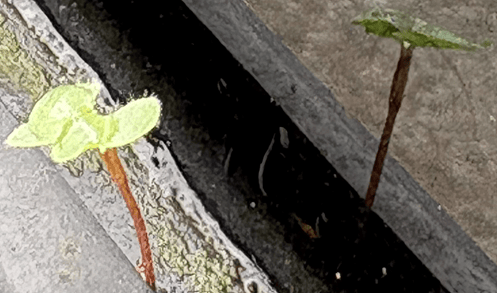
The raising and nurturing of plants is a long game. Last week our preacher talked about how ‘much of God’s work happens beneath the surface. Seeds spend a long time underground before anyone sees signs of life.’ And she went on to say that
‘God is often working beneath the surface long before we can see the results. […] Our role is to cooperate. […] Every act of kindness is tending the seed. Every prayer is watering the seed. Every act of hospitality is nourishing the seed. […] we are cultivating the ground where God is already at work.’ [2]
Jesus calls us to sow good seed in our own lives and the lives of those around us; to beware being seduced by the Evil One into planting bitter tares; and to leave the final judgement to Him.
Amen.
[1] St Augustine – Sermon 73A on the Parable of the Wheat and the Tares
[2] Rachel Griffiths – sermon preached on the Parable of the Sower – St Mary-at-Latton 12 July 2026
Piers Northam teaches Interior Design at the Inchbald School of Design, London. He is priest in The Church Of England and particularly serves at St Mary-at Latton- Harlow.