The Path / softly. a photo by Gill Henwood taken near her home in the Lake District.
I have walked the ancient highways, Pilgrimaged Caminos, along tracks through forests to Santiago de Compostella where the Gospel bell rings and envelops us with the scent of heaven.
Stone age tracks and rumoured Roman roads carrying ancients across Lakeland ridges above Ullswater , Pooley Bridge to Howtown, touching Martin’s dale and High Street where the holy feet of Kentigern trod carrying the Gospel words on both his sole and soul.
I have waited on the shore as Northumbrian seas flow and ebb revealing the track over water leading to the haven of Aidan’s gathered boys, long ago to pray and hear the word of the Lord, going out eagerly to imprint God’s love to a thirsty, hungry people.
I have travelled up Welsh valleys and heard the whispered stories of holy men and women consecrating the soil with joyful presence and with pain; meeting St. Melangell, hiding trembling nature, a hare protected against royal need to kill.
I have shuffled up worn steps, prayer walking to kneel with the common people at Canterbury’s shrine. ( left hand only please! Make way for the richer folk who hope to anticipate the right hand side of heaven with their purses of gold!).
I have trodden along disused railway line In the valley of Bec were monks and nuns travelled between monastery and convent, and more than once Archbishops and Bishops left their homeland for Canterbury and beyond.
These ancient tracks, once deeply trodden remain, echoes of journeys taken into a past world, presently, and leading to a future steeped with hope, to the end of all our walking, the cell at the heart of God.
I post this on St Cecilia’s Day, November 22nd. Since the 15th century she has been known as the Patron Saint of Music. A document known as the Golden Legend’ described her as a “bride of Christ whose love of music elevated her soul to God. This document also encouraged us to consider the link between earth and heaven. It is a link between the song of heaven, led by the angels and the echo of that song on earth, particularly in religion, poetry and music.
The poet, John Dryden, wrote a Song for St Cecilia’s Day which strengthened that link and serenaded the power of music with the line:
“What Passion cannot music raise and quell?”
For many of us, this is expressed in song and hymns and psalms whilst others use the gifts they have to make music in other ways. (Not a mutually exclusive experience!) Song and music as an expression of faith has been the subject of a short piece of writing by the Taizé Community which is worth pondering over:
Singing is one of the most essential elements of worship. Short songs, repeated again and again, give it a meditative character. Using just a few words they express a basic reality of faith, quickly grasped by the mind. As the words are sung over many times, this reality gradually penetrates the whole being. Meditative singing thus becomes a way of listening to God. It allows everyone to take part in a time of prayer together and to remain together in attentive waiting on God, without having to fix the length of time too exactly. To open the gates of trust in God, nothing can replace the beauty of human voices united in song. This beauty can give us a glimpse of “heaven’s joy on earth,” as Eastern Christians put it. And an inner life begins to blossom within us. These songs also sustain personal prayer. Through them, little by little, our being finds an inner unity in God. They can continue in the silence of our hearts when we are at work, speaking with others or resting. In this way prayer and daily life are united. They allow us to keep on praying even when we are unaware of it, in the silence of our hearts. (Taizé Community)
I love the quotation from Maya Angelou which accompanies the photo above. In the interplay of the Godly song of heaven and our earthly melody of the heart it is good for Maya to remind us that the main reason we can sing and make music is because there is a song in our heart to be sung. A Song put there by God. It raises spirits and lifts our lives beyond ourselves to God. That’s a good enough reason for me to sing.
Last weekend we kept the annual Remembrance for those who died/gave their lives for their country in both the First and Second World Wars. Increasingly, and sadly, we have added further conflicts for our remembrance, since 1945. From Aden to Afghanistan (and now in Europe and the Middle East) the battle for peace and justice continues to need both our prayers and our participation.
Last weekend, at the UK Festival of Remembrance in the Albert Hall, London, there were deeply moving moments as, through the medium of television, we joined in thanksgiving for all who in the armed forces, the support groups who worked with them, and the Merchant Navy contended against evil. In different ways, all of us were involved. This included those who worked in the munitions industry and in farming, as well as others in reserved occupations in civilian life. One group, however, has rarely got a mention beyond being classed with the ‘civilian services’.
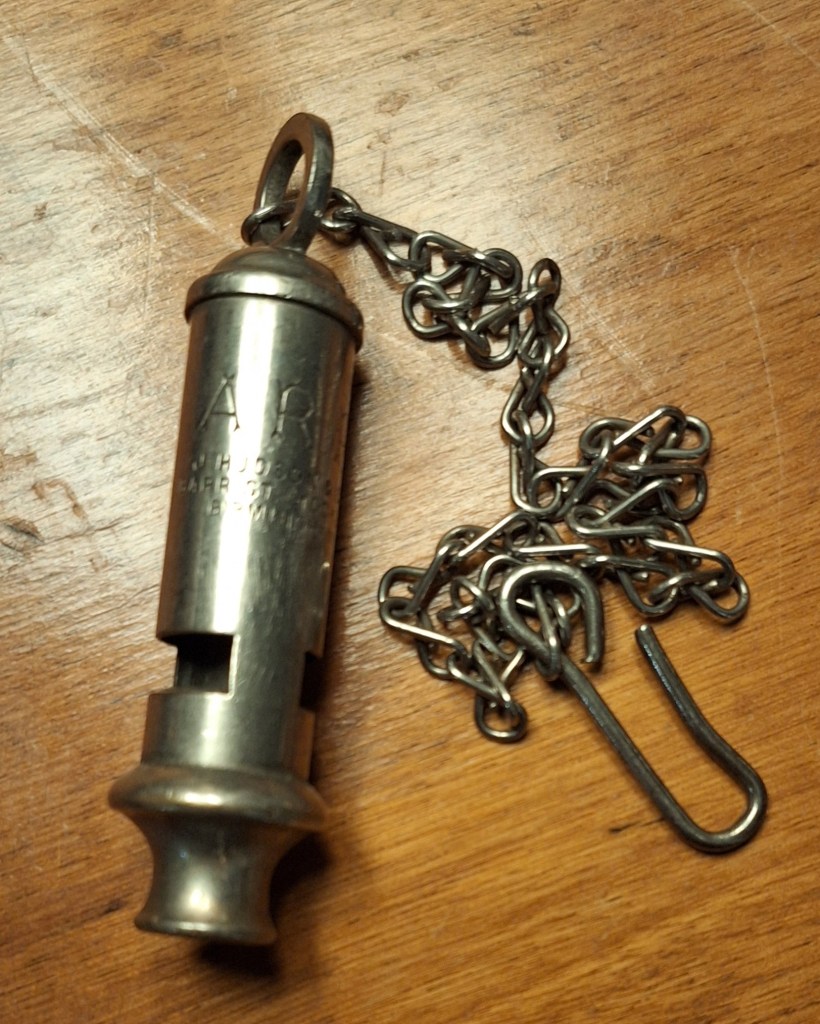
As I looked for the family medals, I came across a ‘whistle’ with the inscription ‘A R P’. I was immediately reminded of ‘Auntie’ Annie, who, though unable to join the Army, could at least do her bit. The letters ARP stood for Air Raid Precaution and the whistle was a vital part of the equipment given to those who ‘volunteered’ as Wardens.
The main role of an ARP Warden was to protect people during air-raids when enemy attacked by dropping bombs, especially on our cities. After the bombings began in 1940, in what is known as the ‘blitz’, ARP wardens became important and necessary members of our communities, especially in highly populated areas.
They received prior warning of the raids and shepherded the population into shelters, either purpose built or designated such as the London Underground. They were also in charge of making sure that the ‘black out’ was observed, checking that every light was switched off or blocked with heavy curtain. This was to ensure no naked lights could be seen by the enemy. After the bombing, wardens led the rescue of any caught in the rubble, trying to reunite families and seeking those who were on their own. The wardens would also try to find temporary shelter for those made homeless. All this, as well as tending the injured with First Aid and even helping to put out any fires alongside fire-fighters.
The Whistle was provided to alert people of an incoming raid. Most were made in Birmingham by J. Hudson & Co, in brass and then chrome-plated. The company also made police whistles and in order to distinguish them, the ARP whistle was given a less sharp and shrill sound. An ‘Air Raid Warning’ pamphlet produced by the government in 1939, explains:
‘When air raids are threatened, warning will be given in towns by sirens, or hooters which will be sounded in some places by short blasts and in others by a warbling note, changing every few seconds. The warnings may be given by the police or air-raid wardens blowing short blasts on whistles.‘
As in the photo above, the letters ARP were engraved on the body.
All in all, in some areas particularly, being an Air Raid Warden was a very demanding and dangerous job and many communities relied on their service. Most of those who became Wardens were part-time and voluntary and over 7,000 were killed during raids in the 2nd World War. It has been estimated that over a million Wardens served over the whole period of the war. One of them was Annie Chiverall whose ARP whistle is in my possession.
Winston Churchill said, in 1940, that “it was not only soldiers who were engaged in battle but the entire population, men, women and children”. Those who served in as ARP Wardens responded to that call to serve alongside so many in the Civilian Services. They deserve a recognition for what they did and why they did it. It is often said that wars begin and prosper where, in the face of tyranny, good people do nothing. Dear ‘Aunty’ Annie was a good person who did her bit and more.
I hold them in loving remembrance and share in a peace and a justice that they worked for and know that this isn’t something confined to times of war. It is now and it is always.
A Reflection from Piers Northamon Remembrance Sunday
The beginning of St Mark’s Gospel tells of Jesus walking along the beach at the Sea of Galilee, calling his disciples, the fishermen Peter and Andrew, James and John. Calling them to follow him and calling them to a life of service. Ultimately, for many of his disciples, it would turn out to be service that would cost them their lives.
And on this Remembrance Sunday morning we remember those who have answered another call to service – in this case the service of their country – and who have given their lives in that service.
As I’ve reflected, this week, on what I might say on this Remembrance Sunday morning, I’ve been pondering on the difference between ‘memory’ and ‘remembrance’, and I wonder if we might take ‘remembrance’ to be the shared calling to mind and recounting of events or people that we don’t necessarily directly remember ourselves? Certainly, if we take the Second World War, there is a sense that it is receding into history and that fewer and fewer people remember it first-hand and with that comes the danger that it will seem less and less ‘real’, less and less affecting. And, of course, there have been many other conflicts since, that British forces have been involved in – Aden, Korea, the Falklands, Kosovo, Iraq, Afghanistan – all of which will be remembered by those who served and were involved, but which otherwise can also seem increasingly distant and less relevant.
Yet on Remembrance Sunday each year we gather as a nation to remember; to recount the stories of war and the cost of war; to remember and give thanks for the sacrifice of those who gave their lives – or who had their lives irrevocably altered – hopefully, in the pursuit of peace and stability. Remembrance and the wearing of poppies is also bound up in our sense of identity – one of the rare times in the year when so many of us, from all walks of life, are drawn together collectively to reflect and to remind ourselves of the horrors of war; of the ways that we can, as humans, descend so quickly into conflict and of the urgent and constant need to work for peace and never to be complacent.
Currently, as we look around the world, it seems as though the vital lessons of war and conflict have been entirely forgotten in some places. Mr Putin blithely sends thousands of men to their deaths in an attempt to grab land and territory from the Ukrainian people; Mr Netanyahu – despite the historic imperative for remembrance of the horrors of the Jewish experience in the Second World War – rains bombs and missiles on thousands of defenceless civilians in Gaza and now in Lebanon. It seems that, all too easily, we forget the human cost of war – or we forget what it was like to be on the receiving end of such aggression and begin to entertain the notion of meting it out on others.
All of which underlines the importance of gathering together to remember. Of looking the cost of war in the eye and striving all the more conscientiously and urgently for peace.
Remembrance is important.
In our Tuesday housegroup, we’re currently doing a series of sessions where we’ve begun looking at and comparing readings from the Old and New Testament to see what they help us to understand about Jesus. This last week we looked at the first Passover in Egypt when the Israelites, who had been living in slavery under the Egyptians, were given specific instructions about killing and eating an unblemished, year-old lamb and using its blood to mark the doorposts and lintels of their dwellings so that, when the Angel of Death came over the land in the final plague on Pharaoh and the Egyptian people, it would pass over their houses and the Israelites would be spared death – and subsequently would be able to flee the country and the years of slavery they had endured and so set out on their very long journey to the Promised Land.
The book of Exodus sets out the very particular instructions that the Lord gives to Moses and Aaron for the people and the Lord also says:
‘This day shall be a day of remembrance for you. You shall celebrate it as a festival to the Lord; throughout your generations you shall observe it as a perpetual ordinance.’
And, of course, that is what the Jewish people have done ever since – they have gathered around the family table each year to keep the Passover and to tell the story: to recount how, through the goodness and faithfulness of God, they were spared death and set free from their years of bondage and slavery. The Passover story is a huge part of Jewish identity – a story that all Jews brought up in the faith will know. A story that teaches them about the nature and the goodness of God.
And on Tuesday night we discovered some of the strong parallels between what happened at the Passover in Egypt and the story of Jesus’ Passion in Jerusalem. Because of course, at the Last Supper, Jesus and his disciples were keeping Passover – they had gathered around the table in the upper room to remember; to recount their story and to share food for the journey and, in a new twist, Jesus gave them just that. Not the traditional food of the Passover meal, but bread and wine: the body and blood of Jesus, the Lamb of God. And what does Jesus say as he gives them the broken bread and the cup of wine?
The details of the ancient Passover were fulfilled in Jesus – he was the perfect, unblemished Lamb. And the next day, as he was crucified, his blood was shed for us, marking not the posts and lintels of the Israelites’ doors but the wooden upright and crossbeam of the cross. It was his blood that set us free from the slavery of sin and opened us up to everlasting life. And so, we became a pilgrim people: the people of the Way – Christians from all over the world and down the ages, travelling towards God’s Kingdom.
So, in a sense, for us as Christians, every Sunday is Remembrance Sunday; every Sunday is a family Passover where we gather to remember what Jesus did for us on the cross. In the eucharistic prayer that we will hear in a moment and in the creed that we say collectively, we recount the story of God’s saving and redeeming love for us in Jesus – of how he set us free from the limitation and slavery of sin and how he spared us from death and opened the gate of glory – the way to everlasting life. And every Sunday we share the family meal – the food for the journey – the bread and the wine that we take in remembrance of Jesus, to nourish and sustain us. And then we are sent out into the world – ‘to love and serve the Lord’ and to help the world to make its way into God’s Kingdom; to bring His Kingdom in…




 Mr G's Ponderings