Tag: Faith

From Bloodline to Loveline

Lessons from Queen Elizabeth

[Based on a sermon by Piers Northam and adapted and added to by Mr G.]

This week we, in the United Kingdom and the British Commonwealth, have commemorated the Anniversary of the Birth of Queen Elizabeth II (our longest reigning Monarch) who would have celebrated her Centenary on April 21st.
She died in 2022.

At the time of her death, our present King – Charles III – wrote:

‘The death of my beloved Mother, Her Majesty The Queen, is a moment of the greatest sadness for me and all members of my family.  We mourn profoundly the passing of a cherished Sovereign and a much-loved Mother.  I know her loss will be deeply felt throughout the country, the Realms and the Commonwealth, and by countless people around the world.’

In his message we can note a  holding together of the two things: the personal and the shared.  The Royal Family were mourning  a mother, grandmother, great-grandmother; and we as a Nation were mourning the death of our Sovereign – who for many of us at the time  was the only one we’ve ever known – but one with whom so many of us feel a strong, personal connection. 

At the Platinum Jubilee, just before her death, the then Prince Charles began his speech ‘Your Majesty… Mummy…’ to huge applause.   For Queen Elizabeth inhabited both those roles and in so doing, she became the person who drew us together as a worldwide family – through national ties, but also through ties across the Commonwealth and beyond.  She inspired love and that drew people of all races, colours, creeds and classes together.  This was her gift and, in her way, she made possible a drawing together of people.

She not only brought people together but also, through her historic ancestry was a link with many previous generations. She had clearly defined links to Queen Victoria and further back to Margaret of Scotland – the sister of Henry VIII.  Her bloodline was well established. 
It brought with it a right to rule but this right was tied with both responsibility and accountability.
No one, with power to govern, either elected or inherited, can avoid accountability which defines how they act and how that action is carried out in service for others.
This is very important in our present day when some world leaders are wielding power for their own ends and with no real sense of care for others.
Queen Elizabeth did not rely on right or might. What defined her was not bloodline, but rather, loveline.

For Queen Elizabeth the Loveline had its roots in God and in an Almighty Love which has a global outreach – and one that extends beyond humanity to all of Creation.

Queen Elizabeth gladly accepted that God’s love is for each and every one of us, his beloved children who, through Jesus are drawn into a global and eternal family of love.
She expressed this in terms of a belonging together as a community under God, remembering that community is about holding our world in a common unity. Her Majesty, in her Christmas broadcasts, clearly proclaimed her belief in the importance of community:  In 2001 she said this:

‘I believe that strong and open communities matter both in good times as well as in bad.  Certainly they provide a way of helping one another.  Communities also give us an important sense of belonging which is a compelling need in all of us.  We all enjoy moments of great happiness and suffer times of profound sadness; the happiness is heightened, the sadness softened when it is shared.  But there is more than that.  A sense of belonging to a group, which has in common the same desire for a fair and ordered society, helps to overcome differences and misunderstanding by reducing prejudice, ignorance and fear.  We all have something to learn from one another, whatever our faith… whatever our background, whether we be young or old.’

But her understanding went further than that, as she said in 2007:

Jesus of Nazareth reached out and made friends with people whom others ignored or despised.  It was in this way that he proclaimed his belief that, in the end, we are all brothers and sisters in one human family.

Our humanity alongside our responsibility for the Care of all Creation is rooted and grounded in Love which flows from the Love of God.

For Queen Elizabeth this became an essential part of her loveline which she expressed in two ways.  
One is that she had a deep interest and love for people.  At an individual level, so many have talked of how when they met her, she paid them her full attention; really listening to them; entirely focused on them during their exchange.  There is that sense that in so doing, she honoured their identity, openly and without judgement.

The other theme is the way that at a national and international level, she was able to draw us together; to point to something bigger than our own private concerns.  Her ability to forge a connection with us; to show her love and care and concern for us in that  long life of service – service to the Nation, the Commonwealth and the wider global community;– helped us to feel that vital sense of connection to each other; helped us to see beyond ourselves and give us a sense of belonging.
In our deeply fragmented world both internationally and locally, we need to take those words, which are the essence of who Elizabeth was, and cherish them deeply in our own hearts.

All this sprang from her profound faith and trust in God.

This must be something we seek for our own lives and what we should expect and demand from others. Not least from those in leadership who act in ungodly ways whilst pretending to believe they have some kind of Divine right to behave as they do! Not least those who have the temerity to believe they might have some claim to a Godliness which couldn’t be further from the truth.

Reflection on the Saints, their actions, prayers and faith has always been an helpful way of shaping our own lives and souls. Queen Elizabeth lived a saintly life (indeed, for me she is a worthy candidate for for Canonization!) and as we seek a way out of the present morass of our world, we would do well to ponder on her example, values and faith.

Here’s how we may set about doing it:

  • by following her example;
  • by trusting in the goodness of God
    and his ability to do great things;
  • by looking beyond ourselves to others;
  • by seeking to draw all people into family;
  • by honouring each of God’s beloved children
    who are our brothers and sisters;

So, here’s a blessing prayer which was a favourite one of  Queen Elizabeth’s.

{Piers Northam &Mr G 22nd April 2026}

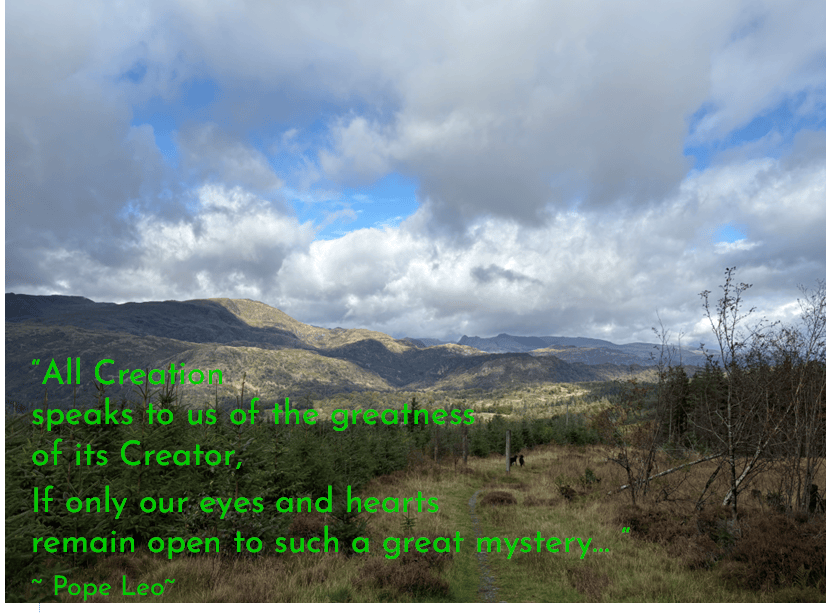
Pope Leo reflects on Peace

Peace Vigil Reflection
Part of the text of Pope Leo’s reflection at the Prayer Vigil for Peace in St Peter’s Basilica at the Vatican on April 11th

“Your prayer is an expression of that faith which, according to the words of Jesus, moves the world to pray for peace.
War divides; hope unites. Arrogance tramples upon others; love lifts up. Idolatry blinds us;
the living God enlightens. My dearest friends, all it takes is a little faith, a mere “crumb” of faith, in order to face this dramatic hour in history together — as humanity and alongside humanity.
Prayer is not a refuge in which to hide from our responsibilities, nor an anaesthetic to numb the pain provoked by so much injustice.
Rather, it is the most selfless, universal and transformative response to death: we are a people who are already risen! Within each of us, within every human being, the interior Teacher teaches peace, urges us toward encounter and inspires us to make supplication.
Let us rise from the rubble! Nothing can confine us to a predetermined fate, not even in this world where there never seem to be enough graves, for people continue to crucify one another and eliminate life, with no regard to justice and mercy.

Prayer teaches us how to act.
In prayer, our limited human possibilities are joined to the infinite possibilities of God.
Thoughts, words and deeds then break the demonic cycle of evil and are placed at the service of the Kingdom of God. A Kingdom in which there is no sword, no drone, no vengeance, no trivialization of evil, no unjust profit, but only dignity, understanding and forgiveness.
It is here that we find a bulwark against that delusion of omnipotence that surrounds us and is becoming increasingly unpredictable and aggressive.
The balance within the human family has been severely destabilized. Even the holy Name of God, the God of life,
is being dragged into discourses of death. A world of brothers and sisters with one heavenly Father vanishes, as in a nightmare, giving way to a reality populated by enemies.
We are met by threats, rather than the invitation to listen and to come together.
Brothers and sisters, those who pray are aware of their own limitations; they do not kill or threaten with death.
Instead, death enslaves those who have turned their backs on the living God, turning themselves and their own power into a mute, blind and deaf idol (cf. Ps 115:4–8), to which they sacrifice every value, demanding that the whole world bend its knee.
Enough of the idolatry of self and money! Enough of the display of power! Enough of war!
True strength is shown in serving life. With evangelical simplicity, Saint John XXIII once wrote: “The benefits of peace will be felt everywhere, by individuals, by families, by nations, by the whole human race.” And echoing the incisive words of Pius XII, he added: “Nothing is lost by peace; everything may be lost by war” (Encyclical Letter Pacem in Terris, 116).

Let us, therefore, unite the moral and spiritual strength of the millions and billions of men and women, young and old, who today choose to believe in peace, caring for the wounds and repairing the damage left behind by the madness of war.
I receive countless letters from children in areas of conflict. In reading them, one perceives, through the lens of innocence, all the horror and inhumanity of actions that some adults boast of with pride.
Let us listen to the voices of children!

Dear brothers and sisters, there are certainly binding responsibilities that fall to the leaders of nations. To them we cry out: Stop! It is time for peace!
Sit at the table of dialogue and mediation, not at the table where rearmament is planned and deadly actions are decided!
Yet there is a no less significant responsibility that falls to all of us — men and women from all over the world. We are an immense multitude that rejects war not only in word, but also in deed. Prayer calls us to leave behind whatever violence remains in our hearts and minds. Let us turn to a Kingdom of peace that is built up day by day — in our homes, schools, neighbourhoods, and civil and religious communities. A Kingdom that counters polemics and resignation through friendship and a culture of encounter. Let us believe once again in love, moderation and good politics. We must form ourselves and get personally involved, each following our own calling. Everyone has a place in the mosaic of peace!
As Pope Francis taught us, “There is also a need for peacemakers, men and women prepared to work boldly and creatively to initiate processes of healing and renewed encounter”

Dear brothers and sisters, let us make a commitment to pray without ceasing and without growing weary, a commitment to a profound conversion of heart. Throughout the world, it is to be hoped that every community become a ‘house of peace,’ where one learns how to defuse hostility through dialogue, where justice is practiced and forgiveness is cherished

Brothers and Sisters of every language, people and nation: we are one family that weeps, hopes and rises again.
“No more war, a journey with no return; no more war, a vicious cycle of grief and violence;” (Saint John Paul II,)

Dear friends, peace be with you all!
It is the peace of the Risen Christ, the fruit of his sacrifice of love on the cross.
For this reason, we raise our prayer to him:

Mr G’s Ponderings 13th April 2026

We are Paper Cranes

Paper Cranes at the Hiroshima Childrens’ memorial, Japan
Photo by Gill Henwood

My friend, Gill, is touring Japan at present and has sent me photos of a visit to the Hiroshima Peace Memorial.

Whilst there she was able to share in the practice of making Origami Cranes (Orizuru). This is a traditional Japanese craft of paper-folding symbolizing hope, peace and healing.

It became linked with the Childrens’ Memorial at Hiroshima through the inspiration of Sadako Sasaki, a 12 year old girl who survived the 1945 atomic bombing of Japan by the USA, but who later died from leukemia. She was encouraged by a Japanese legend that folding 1,000 cranes grants a wish. When she was suffering and facing death she folded the paper cranes and this became a global icon for peace and the inspiration for the Children’s Peace Monument.

A Monument in the Peace Park is entitled ‘Atomic Bomb Children’. It was designed by Kazuo Kikuchi and Kiyoshi Ikebe, using money raised by Japanese school children. The figure of Sadako Sasaki is on the top and a boy and girl at the sides. Sadako holds a wire crane above her head. Behind the Statue are glass cases containing paper cranes.

Sadako’s wish, when making the paper cranes, was doubtless of personal healing, but her greater wish was to have a world without nuclear weapons.

When Gill and friends made their paper cranes they left behind a statement common to thousands of visitors of a desire for a world without nuclear war.

This desire is in forefront in many minds just now as we try to live with Global upheaval threatening the whole human race. Ukraine, Gaza, Sudan are names that easily trip off the tongue but are easily forgotten when other struggles take up the media’s attention. Even the struggle between Israel, the USA and Iran have become linked with whether the cost of petrol might spoil our Easter holiday! Humanity is sadly fickle and can be self seeking. Yesterday Holy Week began with the ‘Hosannas’ of Palm Sunday but how quickly that moved to ‘Crucify Him!’ by Good  Friday.

It is often hard to fathom human motives.

We know that the regime in power in Iran is a danger and threat to the world (not least to its own oppressed people!) It might therefore be a justification by Mr Trump and his ally in Israel for the action they are undertaking.  Yet there appear to be other motives which are drawing humanity to the kind of brink we saw in mid-1930’s Germany.

Perhaps the difficulty in trying to see similarities between the Nazi era and now is that it is far more complex. Too many vested interests are swirling around a vortex of demonic activity. To me, this feels like Satan’s time and it isn’t clear who are his agents. It would be wise, I feel, to remind ourselves of the events of August 6th 1945 and take heed.

It is always much easier to make war than it is peace and easier still to use God and religion to justify it but there are consequences leading from this which are not always taken into account. For example, the World Economy and resultant poverty and anxiety.

So, yesterday’s warning by Pope Leo is pertinent. Speaking during the Palm Sunday Mass, he said:

“Jesus is the King of Peace, who rejects war, whom no one can use to justify war. He does not listen to the prayers of those who wage war but rejects them.”
He lamented the many wounds of the human family in our world today, as people cry out to God with the “painful groans of all those who are oppressed by violence and are victims of war.”
“Christ, King of Peace, cries out again from His cross: God is love! Have mercy! Lay down your weapons!  Remember that you are brothers and sisters!” said the Pope.     [source:Vatican News]

In this Holy Week of the Christian Church we are therefore reminded how Jesus confronted the evil, which so easily grips humanity, with the power of God’s Love.  John’s Gospel makes it very clear that the Crucifixion of Jesus Christ is a Victory. It is a Victory of Love over all that is unlove (sin) in the world. It is also a victory in which God’s plan for all of Creation is renewed by a deep outpouring of total freely given Love. That seems to run counter to the way human beings seem to be behaving. However, the paper cranes have a message too. They only happen when they are fashioned and made in that chosen image of peace. So, a renewed humanity only happens when we are fashioned and remade not with paper but with the love of God. 

As Professor John Barton, in his book, Love Unknown, says, Christians share Christ’s victory through sharing his … vocation to be the love of God for a fallen world, and like him going out to embody God whatever the cost.

In her own way that is what Sadako Sasaki achieved, So may we.

[Mr G and Gill Henwood]
30th March 2026

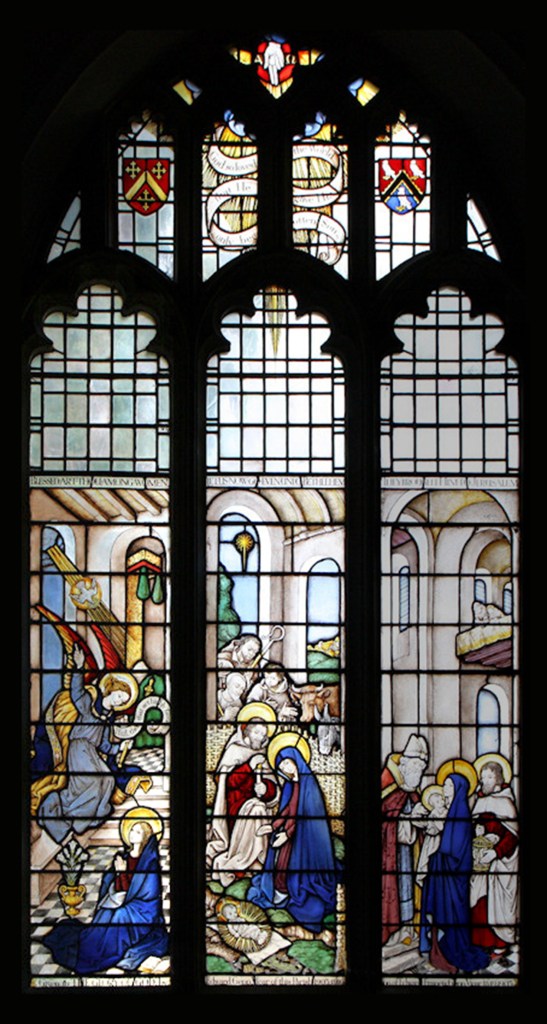
Joseph, man in background.

St Joseph, detail from Crib @
St John’s Epping.

St Joseph could be called the man in the background. His importance at one level is that he provides a link with his ancestor David, thus giving Jesus the lineage back to the establishment of the Royal Kingdom of which Jesus is the heir.
In the story of Jesus’s birth, we have to go to St. Matthew for the story of Joseph’s own Annunciation. (Matthew 1: verses 18 to 25)
Having learned of Mary’s pregnancy, Joseph’s life was in a turmoil.  The law was quite clear that Mary should be punished but Joseph was a compassionate man and he wanted to spare her and her family disgrace.  It was then that an angel visited him in a dream and explained about the work of the Holy Spirit in Mary and about both their parts in the Incarnation. Joseph is central to the Christmas story and it is because of him that they must go the Bethlehem for a census.  There he provides shelter for Mary to give birth to the Saviour of the World.  We next hear about him when Herod seeks to kill Jesus and they take the long journey to Egypt.  Later he is told by an angel to return home and the family settle in Nazareth. After this, the only reference to Joseph is in the incident where the boy Jesus remains in the Temple and his parents have to rush back to search for him. We are told that after this Jesus went back home with his parents to Nazareth where he was obedient to his parents.  Then, Joseph fades completely from the story though there are references to him when the crowd say of Jesus, Isn’t this the Carpenter’s Son?

Reading the Bible there are many people who appear for some particular reason and then disappear from its pages. 
Joseph, however, stands not only as one who completes the picture of the Holy Family but who is also a reminder to all of us that God does not always need us to shine on the centre stage.  God needs people who are faithfully living out a life of prayer and support with compassion, kindness and loving obedience. People who, like Joseph are attentive to God’s will.  He needs people who are content to be in the background and who, by a life of quiet service, allow Jesus to take centre stage in all our lives. 
Too often the Church is preoccupied with itself and can get so bogged down in its own affairs that it fails to proclaim the Lord we are there to serve. Joseph never does that. He always points away from himself and shows us a vision of God in Christ Jesus. That is God’s call to Christians ~ to us.

[Mr G. St Joseph’s Day, 19th March 2026]