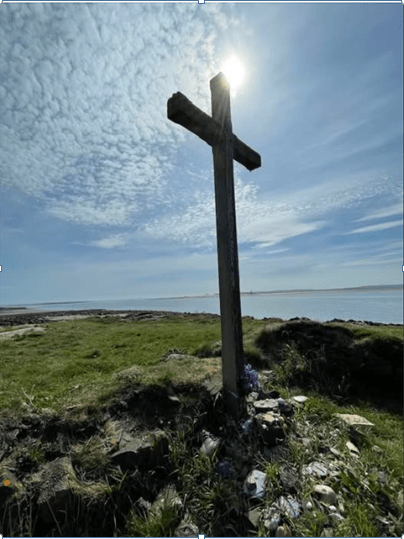
Piers Northam ponders on the mission of St. Aidan
St Aidan of Lindisfarne, whom the church remembers today, modelled humility. He was active in Northumbria in the 7th Century. Aidan was of Irish descent and was a monk at the monastery on Iona. Oswald, who became king of Northumbria in 634, wanted to bring Christianity to his people and the Venerable Bede tells us that he contacted the monastic community on Iona and they sent a bishop called Corman to bring the good news to Oswald’s people. But Corman didn’t go down well – he was haughty and harsh, and thought the Northumbrians were too stubborn and stupid to be converted. On his return to Iona, Aidan criticized the way that he had gone about things: “Shouldn’t you have been a little gentler and more patient brother?” Aidan is reported to have asked and, before he knew it, he was being sent off to have a go himself.
So what was it that differed in Aidan’s approach? Well, first, he was aware that if he was going to bring a lasting Christian faith to this part of the country he was going to have to have a long-term strategy. So his first move was to set up his little monastery on the island of Lindisfarne and in it a school that took in local Northumbrian boys. In doing so, he was valuing the people of Northumbria rather than assuming that they were stupid and stubborn. He was noticing, valuing and nurturing their potential, because they were to be the very foundation of this local church.
His next move was to begin to learn the language of the local people so that he could go out into the lanes and farms talking to people and telling them the Gospel stories in a language they could understand. You have to remember that Aidan would have spoken Old Irish and the Northumbrians Old English – two languages that had no linguistic ties – so this was no mean feat. Thankfully, King Oswald came to his rescue being bilingual. If you think about it, that’s the exact opposite of a colonial approach, where you take your own culture and impose it on another society and culture – again, Aidan saw the value in what was there and approached the task with humility.
In those times, people were in the habit of carrying knives – and not just to cut their meat up – allegiances were fiercely local; foreigners and outsiders generally mistrusted and Aidan, of course, was one such outsider. Yet Aidan and his followers refused to tuck a knife in their belt – a risky strategy, but a courageous one, for it showed that they were essentially defenceless and meant that they were reliant on people to help them – trusting them to do so. And, of course, we see the parallels between that and the gospel account of Jesus sending the disciples out in pairs. Whereas Corman, Aidan’s predecessor had ridden around the farms and villages of the area on horseback, gathering people together, preaching to them and then aiming at mass conversions, Aidan’s methods were far more humble: he literally walked thousands of miles, tramping the lanes and pathways, and getting into conversation with those he met. His was a patient approach: aiming to kindle a curiosity in his listeners so that in time they were drawn into the way of Christ and would ask to be baptised. His methods did not hinge on mass conversions which had little to back them up, but rather on personal, long-lasting relationships that led to a real desire to learn more about Christ. He was not talking down to people from the back of a horse, rather, he was encountering them face-to-face – eye-to-eye – on a level: treating them as equals – all valued, beloved and precious to God.
Needless to say, Aidan’s approach found far greater success than Corman’s and Christianity took hold and became deeply rooted in the North East of England. His humility and the way that he approached and valued people was effective in spreading the Good News of Jesus Christ.
[Extract from a sermon by Piers Northam, preached on St. Aidan’s Day, Sunday 31st August 2025]




 Mr G's Ponderings