Month: September 2025

Festival of Creation

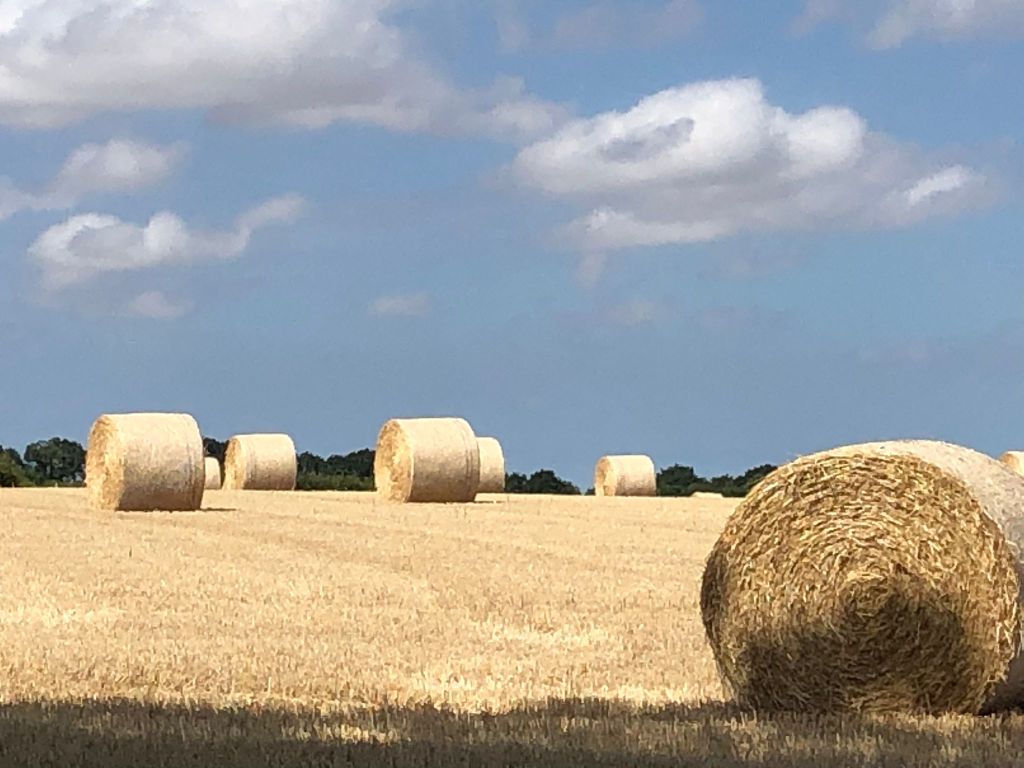
Haybales in Norfolk. Photo by Julia Sheffield

EQUINOX, AUTUMN & HARVEST
a Festival of Creation

Today, September 22nd, the Earth’s axis and its orbit line up so that both halves of the planet get an equal amount of sunshine. From today, in the Northern Hemisphere, the nights will be longer than the days. This is the opposite case in the Southern Hemisphere
The seasons change. We in the Northern Hemisphere enter officially into the season of Autumn whilst in the South, Spring begins. Both seasons are festivals of Creation.God paints his Earth with colour and beauty ~ Gold and Red in the North and Radiant Green in the South.

The season of Autumn is often associated with the gathering in of the Harvest, when the fruits of the earth are garnished and the fields are mown. The poet Keats called this the season of mellow fruitfulness. He was writing at a different time when the festivals of the Countryside marked the stages of the year, each with its own characteristics of Nature. Today, it is less marked and food production is taken for granted. It  is less about the movement of Creation and more about the packing of supermarket shelves! Quite often, in these days of globalization it is hard to take on board the seasons. Blueberries look about the same and are available for much of the year but their point of origin can be from almost anywhere in the world ~ well. Maybe not the Arctic or its southern equivalent!

Equinox, Autumn, Harvest are ‘Earth Festivals’ through which we can be led to celebrate the gift of Creation and the bountiful goodness of God. At a time when all across the globe humanity is hell-bent on self-destruction and with it ,the destruction of the earth, it is good to remind ourselves that God’s provision for our life on earth is all Gift.

Maybe that’s why I like the poem by John Keble, from his anthology of payer poems, The Christian Year, now sung as a hymn, which centres our praying on God, His Creation, His gifts of nature, and His year-long provision for our needs.
Lord, in Thy Name Thy servants plead, is not sung very often these days but it remains my absolutely favourite hymn for this season.

Lord, in Thy Name Thy servants plead,
 And Thou hast sworn to hear;
 Thine is the harvest, Thine the seed,
 The fresh and fading year.

Our hope, when autumn winds blew wild,
We trusted, Lord, with Thee:
 And still, now spring has on us smiled
 We wait on Thy decree.

The former and the latter rain,
The summer sun and air,
The green ear and the golden grain,
All Thine, are ours by prayer.

Thine too by right and ours by grace,
The wondrous growth unseen,
The hopes that soothe, the fears that brace,
The love that shines serene.

So grant the precious things brought forth
By sun and moon below,
That Thee in Thy new heav’n and earth
We never may forgo.

John Keble 1792-1866

[Mr G. 22nd September 2025]
Saving Sign

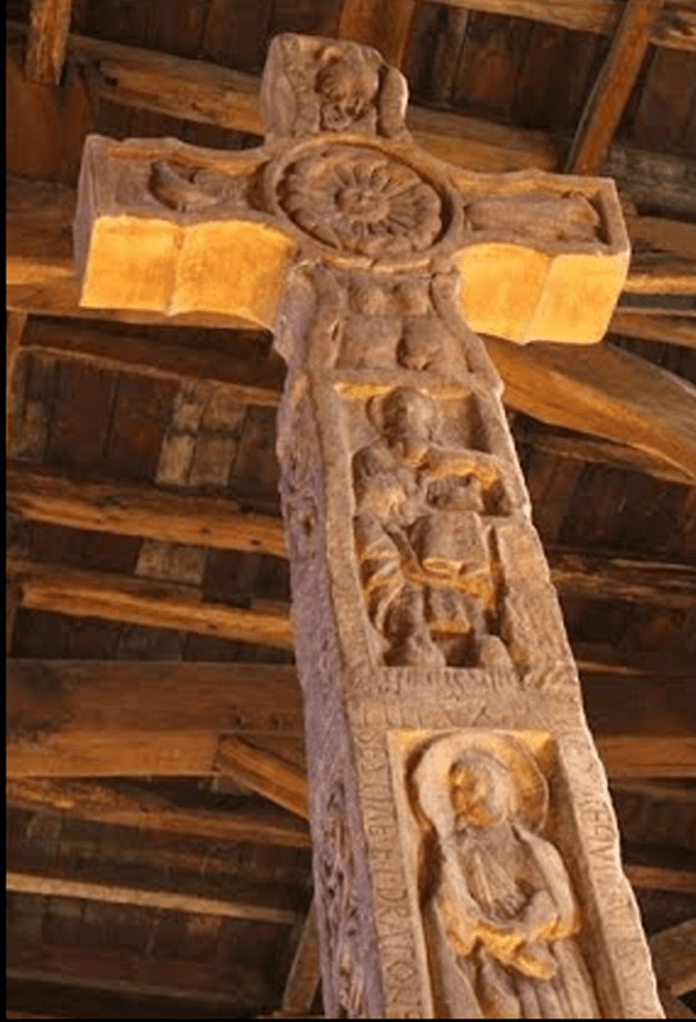
Bradwell Chapel Cross from a church near you site

THE SAVING SIGN.  Thoughts on Holy Cross Day September 14th 2025

One of the most sacred sites in Essex is the simple Chapel of St. Peter on the North Sea shore at Bradwell. It is all that remains of a more extensive monastery which was originally built there by St. Cedd. He was one of twelve Anglo-Saxon boys who had entered the monastery at Lindisfarne, founded by St. Aidan. It was the Irish custom to build monasteries in remote places and there to train up young  people to be apostles for Christ. St Aidan, trained on Iona adopted this practice with the Anglo-Saxons of Northumbria
Once trained, they were sent out to proclaim the Good News of Jesus Christ. So, St Cedd left Lindisfarne and sailed down the North Sea coast before landing, in 654 AD, at Bradwell. Here he founded a monastery and from where the Gospel was proclaimed to much of Essex.

The Chapel of St. Peter at Bradwell has enjoyed mixed fortunes, even for a time being used as a barn but today it is a simple reminder of the Gospel coming to Essex.
Its interior is of breathtaking simplicity, the only adornment being a beautiful Cross, designed by the Church artist, Francis William Stephens.
On it are painted figures of The Blessed Virgin Mary and St. John and above the figure of Christ is a depiction of the Hand of God in an act of blessing. St. Cedd kneels at the foot of the Saviour. On either side of Christ are the faces of St Peter and St. Paul. Christ is shown with a halo marked by the cross and his arms are outstretched in blessing. This is a figure not of grotesque suffering but of triumphant victory.

It is an artistic representation of the Crucified as shown to us by St. John for whom the Cross is a sign of Triumph – of a completion of the saving work of Father and Son. Michael Ramsey, former Archbishop of Canterbury, commenting on St. John’s portrayal of the Passion of Christ says that on Calvary Christ ‘Reigns’ as he accomplishes his Father’s will and fulfils the Scriptures. This was his moment of supreme glory.’
Michael Ramsey makes the comment:
“Calvary is no disaster which needs the Resurrection to reverse it, but a victory so signal that the Resurrection follows quickly to seal it.”
Celtic/ Anglo-Saxon  Christianity which fed the soul of St. Cedd  was inspired by  St. John’s understanding of the Cross.  The Cross was seen as the ‘Saving Sign’ and its victory dominated spirituality and mission. They had a firm belief in the power of the Cross to transform hearts and lives.

Visitors to ‘Celtic’ countries like Ireland, Scotland and Wales will be familiar with the High Crosses, elaborately carved with biblical scenes from both Old and New Testaments all contained within the form of the Cross. These were (and still are) sermons in stone offering the onlooker a way into Scriptural truths of Salvation brought to our world by Christ. They are the Waymarks for the soul’s spiritual journey marking out the earth for God and leading the people towards eternal life.
They were often preaching posts – wayside pulpits at which the missionaries stood and proclaimed the Gospel and claimed souls for Christ.
I think of the magnificent Ruthwell Cross in Dumfrieshire which is carved with Old & New Testament scenes. It stands today in a small church, rescued from oblivion by a Church of Scotland minister at the end of the 19th century, but it once stood on the shoreline, a gathering point for those who would hear of Christ’s triumph and Victory of the Cross preached to them by monks from as far away as Lindisfarne and Durham.
It is unique also because carved around the edges are Anglo-Saxon Runes which depict part of the oldest English poem, The Dream of the Rood.

When Cedd came to Essex, he came in the power of the triumph of the Cross. He sailed from Lindisfarne and by tradition he would adopt the Irish custom of placing the Cross of Christ in the prow of his boat so that he was constantly reminded in whose name and service he sailed.
No doubt, like so many Celtic and Anglo-Saxon Christians he practiced the Cross prayer – which involved hours of standing with arms outstretched in the Cross position.
Celtic praying included a gathering at the Cross for daily prayer. An eighth century monastic rule says:
“The monks should follow the head monk (abbot) to the cross with melodious chants, and with abundance of tears flowing from emaciated cheeks”, in imitation of a daily prayer office sung in Jerusalem at the Church of the Resurrection – the church built by the Emperor Constantine which gave rise to today’s special observance of the Holy Cross.
Hymns would be sung and the people would move slowly around the Cross – not unlike what happens today in modern Taizé which has done much to restore the Cross to the heart of Christian devotion.

Hardly surprising that the Cross has such a central place in the worship at Taizé which was born out of the ravages and destruction of a war- destroyed Europe and which preached Reconciliation as its central message.
As the stone crosses reclaimed Celtic and Anglo-Saxon Britain, so Europe was reclaimed for God and the hearts of the people led back to Christ.  As the problems in the Ukraine, Gaza and other troubled areas of the world are showing us that reclaiming for God is on-going and always vital. We must go on proclaiming that the Victory of the Cross overcomes all evil. It is this Victory which is the about love transforming a disfigured and at times enslaved humanity.
As a prayer from Taize puts it:

Through the repentance of our hearts,
And the spirit of simplicity of the beatitudes,
You clothe us with forgiveness, as with a garment.
Enable us to welcome the realities of the Gospel
With a childlike heart,
And to discover your will,
Which is love and nothing else.

Here we are brought to the heart of the Cross’s message – the Victory of love. Not only sin and death are defeated by love but also those other things which afflict our lives and drag us down. In the face of evil, pain, hurt and uncertainty, the Cross becomes a protection – the Saving Sign.

There is a Passiontide Prayer which includes the lines:
Yea, by this Sweet and Saving Sign,
Lord, draw us to our peace and thine.

[Mr G]

Ruthwell Cross
Photo: Mr G

Doing what you didn’t think you could…

When I studied Art at Grammar School there was a general agreement amongst my teachers that I lacked the talent to become even a modest artist. There was much evidence to substantiate this view. With disappointment I accepted this judgement on my ability, or rather lack of it!  It has kept me away from paint brush, water colours, oil, canvas etc ever since.  Thankfully I did discover that I had a deep appreciation of art thanks to one of my teachers. He opened up within me the enjoyment of art in its many forms.  However, I have never felt confident in my practical skills in this area.

That changed slightly last Saturday.

I was encouraged to join a Craft morning at my church. It was advertised as a fun morning where creative juices flowed and we needed no previous experience. There was also a variety of things we could try. My Vicar was leading a group who, under her tutoring made felt animals, mainly sheep! Another table was devoted to what is called Creative Doodling, which is described as the act of drawing simple or complex designs, patterns, or scribbles without a specific goal in mind, often for relaxation, focus, or creative expression, rather than as a planned artwork. That sounded attractive.
Other possibilities were craft work making place mats and other objects; making striking animals such a cat with it’s tail held high and a very convincing Giraffe; and also a table where, using oil, acrylic or water-colour paints, it was possible to create a painting.
This was clearly my nemesis to be avoided.
Perversely,  I joined this table, led by my friend Paul who is an accomplished artist. He encouraged me to have a little dabble. So I did, using the medium of water-colour!

On a blank sheet of art paper, I attempted a group of trees which were not very like real trees. Then inspiration came to me. I took up a pencil and drew what I hoped was some resemblance of Tarn Hows in the Lake District. It’s a beautiful spot and I was probably inspired by photos sent to me by my friend Gill who lives near the Tarn. (Many of her photographs and reflections appear on this blog).

Very soon, hills looking rather like pyramids and water and more trees appeared. I accidentally dipped my brush in a cup of coffee and discovered it was a perfect medium to absorb paint and also brought its own texture to bear. I Found a stick of charcoal and managed to dot a kind of shoreline. The result can be seen in the photograph above.

But that was not the real result.

I arrived at the Craft morning in a poor emotional state. I had been to my dearest friend Anne’s funeral in the North East and spent time with her family who are very dear to me. I was full of memories and they mixed together in sadness, joy, tears and loss but also wrapped in the solace of faith.
Spending a morning reflecting and painting was just what I needed.
Without intention on my part, I found a quietness to my inner turmoil and a kind of healing.  Becoming absorbed in something different can bring a new perspective for our lives and a new value. We often get embroiled in the sheer slog of daily living in a world which increasingly devalues the beauty and the joy of our humanity. So much is about pressure, getting through the day, dealing with the demands of others and generally a loss of discovering who we truly are inside. Our souls get submerged in the sheer effort of a kind of living which actually can be self-destructive.

When I picked up the paintbrush on Saturday I wasn’t sure why but two things emerged.
One was that I was doing something that I didn’t think I could and that I had been told I couldn’t. I certainly didn’t produce a great piece of art but it was my first ever watercolour.
There was a lady there who had been an art teacher and she came up to me at the end and said, ‘I give you an ‘A’ for that’. She had no idea just how much that meant to me and how many ghosts of the past she put to rest!

The other thing which emerged is that for various reasons some of us put low limitations on what we can do and on who we are. Discovering that we can do something new can raise us up. After all, we were created by God to become the best person we can be and when we accept that God never limits our development as a human being made in His likeness, we can soar!
Other people may try to limit us but God lifts us up and awakens his Creative spirit within us. When we accept that, nothing can stop us!

The day after the craft morning we sang John Bell’s hymn about the Holy Spirit. All 4 verses celebrate the Spirit of creativity, full of movement, joy, action. The third verse particularly moved me because it seems to describe what I experienced the day before.

She dances in fire, startling her spectators,
waking tongues of ecstasy where dumbness reigned;
she weans and inspires all those whose hearts are open,
nor can she be captured, silenced or restrained.

[Mr G. 8th September 2025]