Author: mrgsponderings

A Symbol made of Straw

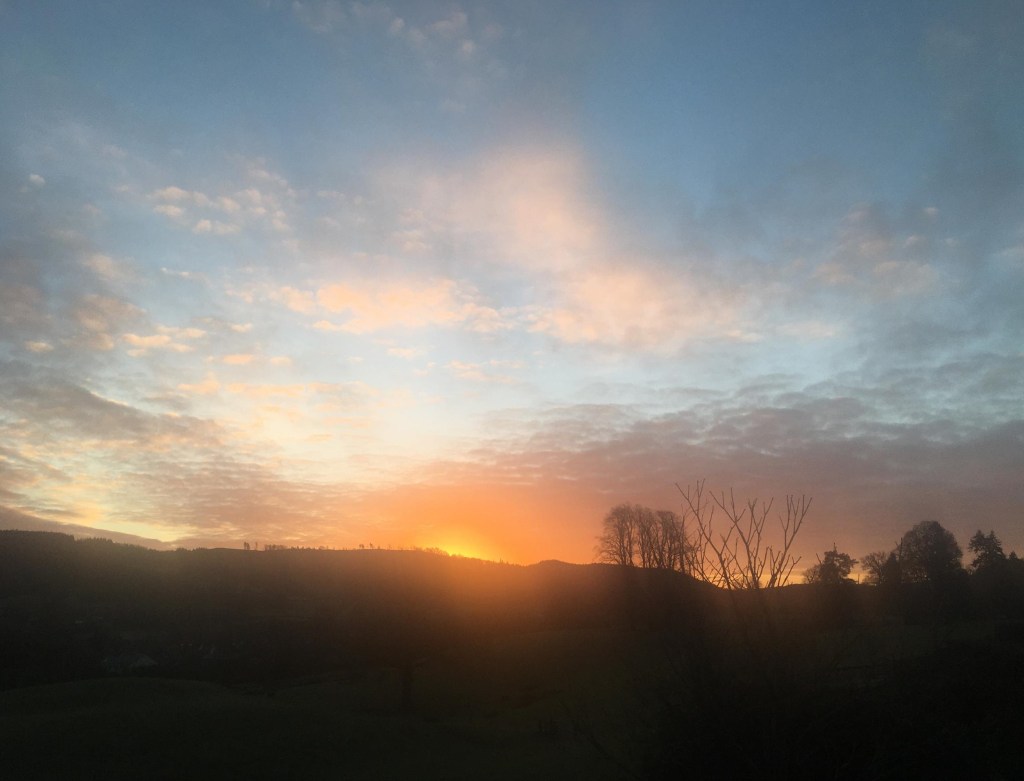
Sunrise on St Brigid’s Day, February 1st 2021. Photo taken in the Lake District by my friend Gill Henwood

One of the highlights of a visit I once made to Ireland was to arrive at Kildare which was made famous by St. Brigid (sometimes known as Brigit, or Bride). She is said to have been baptized by Patrick and with him is known as Patron Saint of Ireland.  She founded a monastery there just after Patrick began to convert the Irish. Brigid’s monastery was a mixed house of women and men—something that was unknown outside Celtic lands. (They were more enlightened than most!)

Her feast day kept today, on February 1st, coincided with the pagan festival of Imbolc, the Celtic season that marked the coming of light after the dark days of winter. Once again, the Christian Church displayed ingenuity and common sense in replacing a pagan feast with a Christian one because Brigid’s day is quickly followed by Candlemass, the day when we celebrate Christ as the Light of the World—the light which overcomes darkness or to put it in the words of Simeon’s song the Nunc Dimittis: a light to lighten the Gentiles (non Jews).

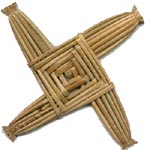
There is a further connection between Brigid and the feast of Candlemass. Just as we are pointed, by Simeon’s prophecy, towards the Cross of Christ, so too is the story of Brigid connected to a Cross. The story goes that on a visit to a sick friend who was close to death, Brigid reached down and picked up pieces of straw from the floor of the cottage. As she prayed for healing she wove the straw into a simple square-braided cross and hung it in the rafters over the bed. The friend began to get better and the Cross became a symbol of this healing. Today, it is known as St Brigid’s Cross.
Christianity is often a faith of paradoxes and none more so than the connection of birth with death. At Candlemass we complete our Christmas celebration of Christ the Light and then begin our journey towards Holy Week and Our Lord’s death on the Cross. Yet there is nothing strange in this. Christ’s victory over the human heart, and the darkness which so often besets our lives, begins in the Christmas event but needs Calvary to complete it. There Christ’s love shine from the Cross and in the light of that love we can claim our place in God’s heart.

Brigid’s cross, woven from simple straw became a sign of healing and of life.  The straw of the Manger and the wood of the Cross, woven together, are symbols of our healing and salvation.  A salvation that  we Christians believe only Jesus Christ can offer.

[Mr G]

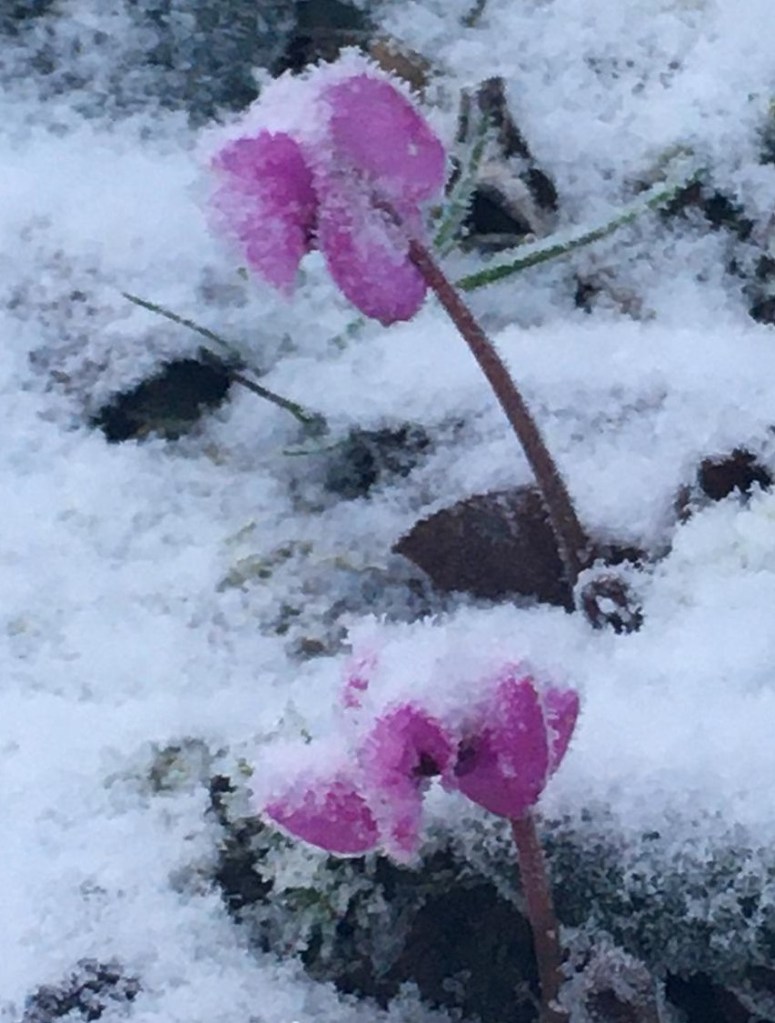
Cyclamen in the Snow

Cyclamen in fresh Snow photographed by my friend Gill Henwood in the Lake District.

Gill sent me this photograph a little while ago. It moved me very much at the darkest time of the year just as we were entering the 3rd Lockdown. At the time I couldn’t decide how to respond to it. There were allusions to lockdown, hope, struggle at a very difficult time for us. Gill used the word endurance.

As I continued to mull over it, I discussed it with my friend Piers and he came up with this reflection:

Initially I looked at this image and thought of the ice and snow as something that was holding the flowers back; through which they had to struggle – and this made me think of feelings thrown up by this current lockdown. But actually, as I thought more and read Geoffrey’s poem, it dawned on me that the ice and snow protect and insulate the seed as it germinates and emerges to flower. The struggle is filled with new hope and possibilities.
We tend to see being in lockdown as a negative, threatening thing but of course it’s a collective act in which we’re protecting each other and ourselves – and looked at that way it feels far more positive. And just as the dormant plant flowers to new life, we can also use it as a time to discover what is truly important: what values and priorities will help to sustain our lives, our society and our planet.
What if the snow and ice of lockdown are allowing us to emerge into really new life?

PN

Here’s a poem I have written on this photograph.

Lockdown wake-up

Earth’s untidy clutter
of hurried hibernation
covered over with scattered flakes
of heaven’s protection.
Opaque cloak of winter
wraps warmly around dormant seed.

Early buds break open crusty ground
scattering melted crystal.
Coloured life announces
Nature’s lockdown ended,
beckoning us to New Beginnings
at last!

Alleluia!

[Mr G]
Photo | Gill Henwood.
Reflection| Piers Northam

Little Bird

This photo of one of Britain’s smallest birds, The Wren inspired me to share the Prayer of the Little Bird.

This weekend January 29th -31st is the annual ‘Big Garden Birdwatch.
The RSPB (The Royal Society for the Protection of Birds), our leading conservation charity, across the UK says that nearly 9 million hours have been spent watching garden birds since the Birdwatch began in 1979 with more than 137 million birds counted. This has helped to provide the charity with valuable insight for its work.

What is the Big Garden Birdwatch?

2021 marks the 42nd RSPB Big Garden Birdwatch, which sees keen birdwatchers across the UK join the largest garden wildlife citizen science project by spending one hour tracking the birds they see in their gardens, record them and then inform the RSPB. In the past 42 years, across the UK, hundreds of thousands of people have volunteered their time to count and log birds landing in their gardens, local country areas, ponds and wild-life areas. Unlike humans birds are not keeping lock-down and reminds us that not everything is restricted in movement. This year Big Garden Watch seems even more popular. For details and further information, log on to the RSPB and BBC Countryfile websites.

Meanwhile, I share the delightful prayer by Carmen Bernos De Gasztold translated by Rumer Godden – The Prayer of the Little Bird. It is from the collection Prayers from the Ark. This book is still available, mostly as a second hand copy.

The little Wren is singing its prayers of praise joyfully and will do so as the world enters Spring. We need to hear the birds as they help us to look in praise to God and lighten our hearts, our lives and our journey forward.

Fear and Belief

My friend Diana sent me this quotation from Barbara Brown Taylor’s book, The Preaching Life.
Barbara is an American Episcopalian priest and one of today’s most outstanding preachers.
Her latest book is Always a Guest published in 2020. It is a collection of stories and sermons of faith, grace, humour and hope.

In this short extract she speaks to the human condition of our times and contrasts fear with belief and points us to Jesus to encourage us to let go of fear and embrace life, learning to love it, whatever difficulties we face, because He is with us.


Fear is a small cell with no air in it and no light. It is suffocating inside and dark. Belief is something else altogether. It is like a rope bridge over a scenic gorge, sturdy but swinging back and forth, with plenty of light and plenty of air but precious little to hang onto except the stories you have heard: that it is the best and only way across, that it is possible, that it will bear your weight. All you have to do is believe in the bridge more than you believe in the gorge, but fortunately you do not need to believe in it all by yourself. There are others who believe it with you. They have crossed the bridge in front of you and are waiting on the other side.

It takes a lot of courage to be a human being, but if Jesus was who he said he was, the bridge will hold. Believing in him will not put us in charge or get us what we want or even save us from all harm, but believing in him, we may gradually lose our fear of our lives. Whatever the human condition we find ourselves in, we may finally learn to live it, maybe even to love it, if only because we believe he lives and loves it too.