Author: mrgsponderings

St Nicholas, Giver of kindness and love

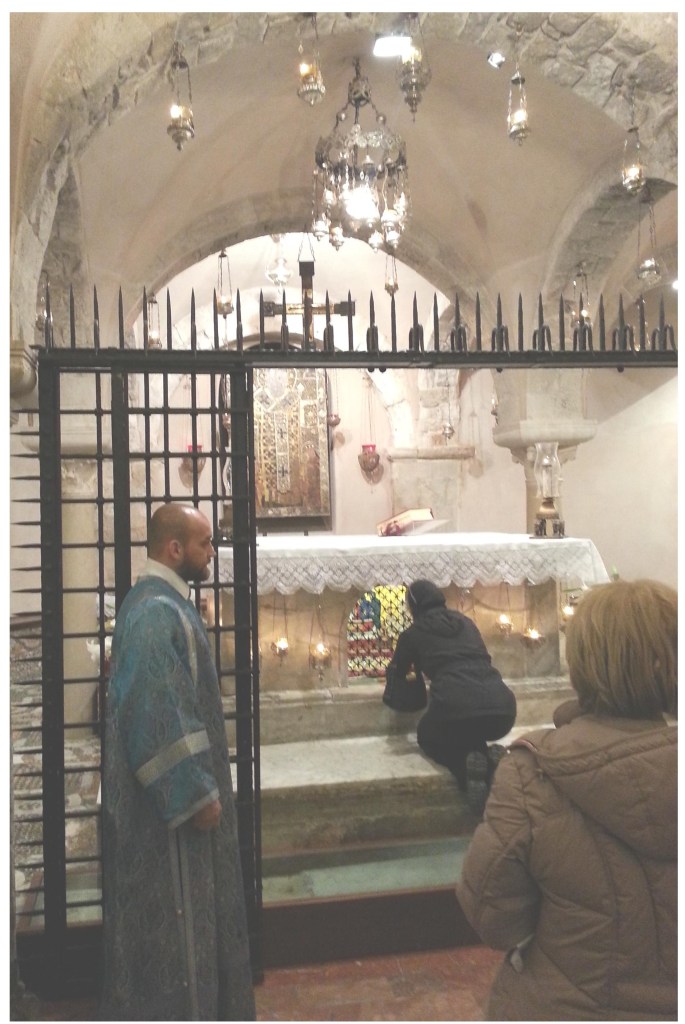
Shrine of St Nicholas, Bari. Photo by Mr G

SAINT NICHOLAS. Feast day 6th December

A story told by Victor Hoagland, C.P.

Saint Nicholas, the 4th century saint who inspired our modern figure of Santa Claus, was born near Myra, a port on the Mediterranean Sea serving the busy sea lanes that linked the seaports of Egypt, Greece, and Rome. Ships sailing these waters, laden with grain and all kinds of goods, found safety in the port from raging storms and menacing pirates.

Nicholas came from one of the city’s wealthy merchant families, but he was not spoiled by his family’s wealth. His mother and father taught him to be generous to others, especially those in need. So Nicholas came to see that helping others makes one richer in life than anything else.

One day, by chance, Nicholas heard about a rich man in Myra who lost all his money when his business failed. The man had three lovely daughters, all wishing to get married, but he had no money for their marriage. Besides, who would marry them, he thought, since their father is such a failure? With nothing to eat, the man in desperation decided to sell one of his daughters into slavery. At least then the rest of them might survive.

That night before the first daughter was to be sold, Nicholas, with a small bag of gold in his hand, softly approached their house, and, tossing the gold through an open window, quickly vanished into the darkness.

The next morning, the father found a bag of gold lying on the floor next to his bed. He had no idea where it came from. “Maybe it’s counterfeit,” he thought. But as he tested it, he knew it was real. He went over the list of his friends and business associates. None of them could possibly have given him this.

The poor man fell to his knees and great tears came to his eyes. He thanked God for this beautiful gift. His spirits rose higher than they had been for a long time because someone had been so unexpectedly good to him. He arranged for his first daughter’s wedding and there was enough money left for the rest of them to live for almost a year. Often he wondered: who gave them the gold?

But by the end of the year, the family again had nothing, and the father, again desperate and seeing no other way open, decided his second daughter must be sold. But Nicholas, hearing about it, came by night to their window and tossed in another bag of gold as before. The next morning the father rejoiced, and, thanking God, begged His pardon for losing hope. Who, though, was the mysterious stranger giving them such a gift?

Each night afterwards the father watched by the window. As the year passed their money ran out. In the dead of one night he heard quiet steps approaching his house and suddenly a bag of gold fell onto the floor. The father quickly ran out to catch the one who threw it there. He caught up with Nicholas some distance away and recognized him, for the young man came from a well-known family in the city.

“Why did you give us the gold?” the father asked.

“Because you needed it,” Nicholas answered.

“But why didn’t you let us know who you were?” the man asked again.

“Because it’s good to give and have only God know about it.”

Because of his kind , generous and loving nature,  he was later elected as Bishop of Myra. His shrine is in the Church at Bari, in Puglia, Italy, cared for by members of the Orthodox Church.
Today he is known to children as Santa Claus (derived from Saint Nicholas)
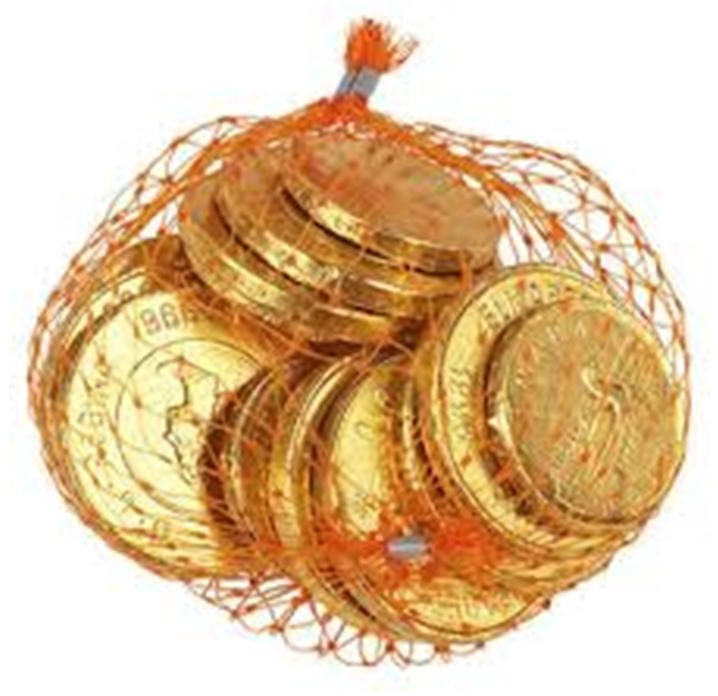
Chocolate Gold coins are popular at Christmas. It has been suggested that these are symbols of St. Nicholas’s gift

Father Victor Hoagland, C.P.

Father Victor Hoagland, C.P. is a Catholic priest and a member of the Passionist community. He resides at the Immaculate Conception Monastery, Jamaica, New York. He’s the author of numerous spiritual books and videos, among them: The Book of SaintsFollowing Jesus ChristMary the Mother of God,  Daily PrayersThe Way of the Cross and Pilgrim Churches of Rome.

BLOG

Father Victor is a blogger and writes online at The Victor’s Place. You can hear him read this story, with illustrations, on YouTube.
Click on this link : https://www.youtube.com/watch?v=ADevygB9jNs

“God is our life,
God is our fulfillment,
in Christ God comes to give us life
and life to the full.”
~ Father Victor Hoagland, CP

Buds and Dewdrops

One of the joys of the Lake District is the spectacular landscape and, of course, the changing reflections of the seasons.
My friend Gill lives in the heart of it all which is a privilege she recognises.
Her photography provides me with a lot of inspiration for Blog items.
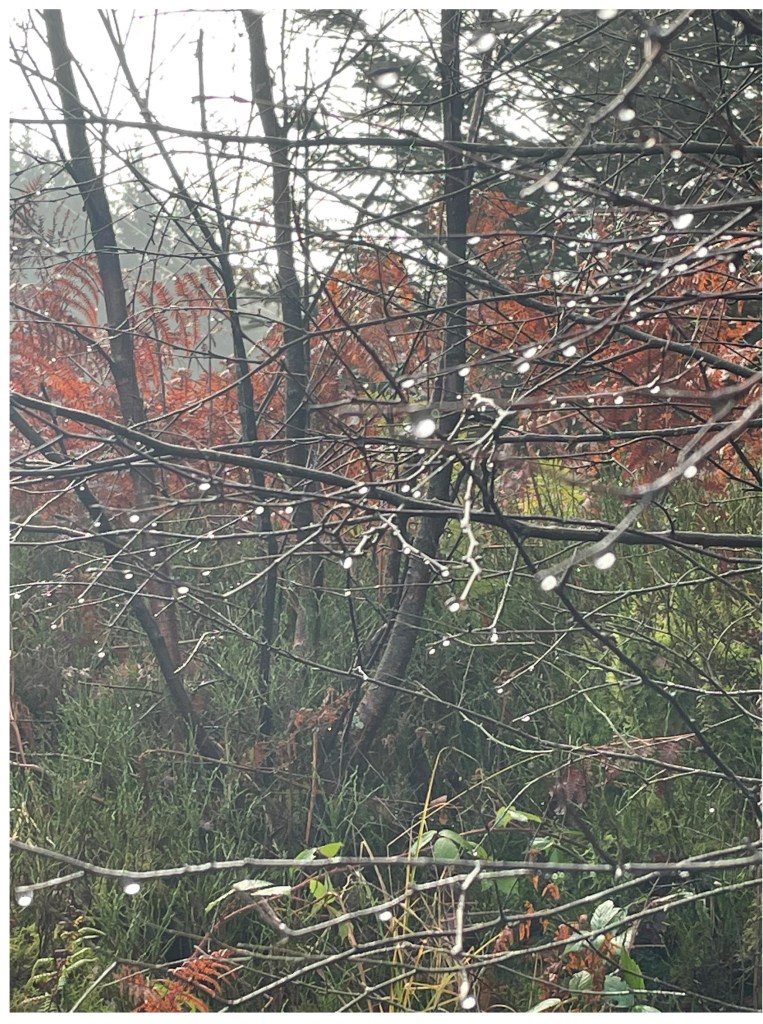
The theme of these two photographs is dewdrops and buds
They also capture something of the change from Autumn to Winter.
There is also a hint of the Advent theme of Light.

Here’s what Gill has to say:

On birch in Grizedale Forest, misty sunlight shines through the dew.
Nature’s Advent with sparkling jewels.
Light dazzling on bare branches above the russet bracken.
Looking closely, each dewdrop hangs from a bud …
There is more…
There is hope, promise, presence, glory – Advent longing ..
The trees and shiny dewdrops call to mind Christmas tree candles, St Lucy’s crown lights and Advent Carol tea lights,
The Advent ring.

The darkness is pinpricked with moments of light as we move through this season towards the glorious light of the Incarnation – the birth of the Christ-child.
The birth which comes with the renewal of our lives through  new hope, joy and expectancy….
In the gloom of our present world we long for the bright presence of God to spring us into a deeper meaning of our humanity.
A meaning  of which Nature shows us signs of being almost here in bud and dewdrop and in Advent waiting.

Photographs by Gill Henwood – Autumn in the Lake District

[Mr G and Gill Henwood]

Understand – Refuse – Resist

Carrière des Fusillés Intro to poem
 
In the summer, I visited friends in Brittany. Amongst the places they took me to was near the town of Châteaubriant.
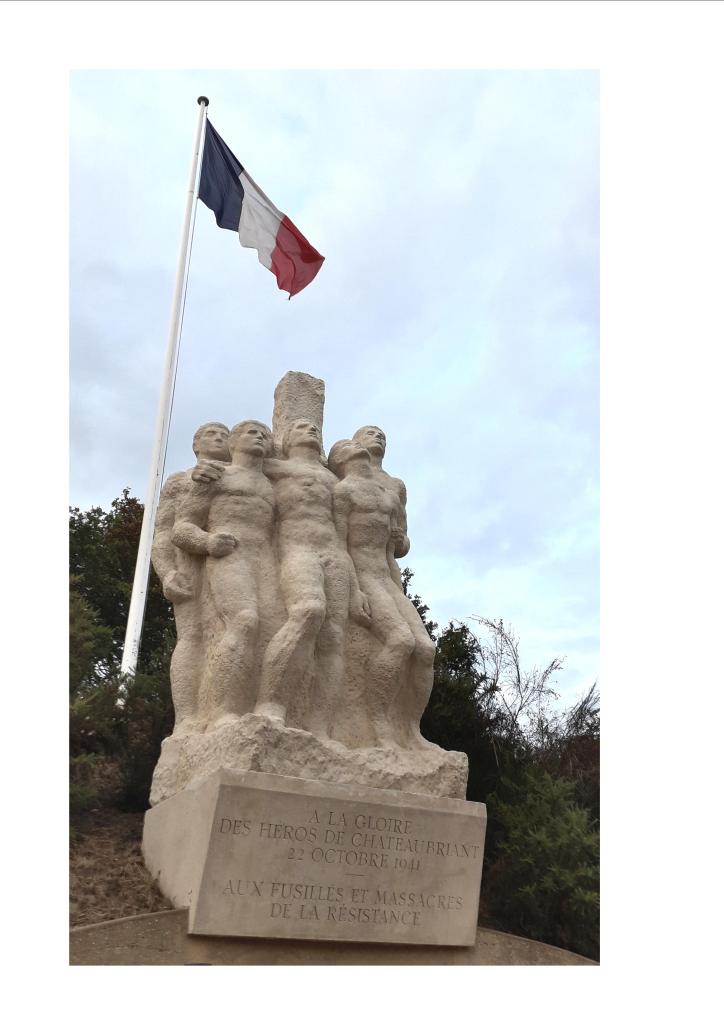
Just outside the town is a war memorial at the Carrière des Fusillés.
It is a Memorial with quite a story to tell.

In 1941, the Nazis occupied this part of France when a member of the French Resistance assassinated Feldkommandant Hotz,
the Commandant of the German Forces, in Nantes. As a reprisal, the occupiers arrested 27 hostages and took them to a nearby quarry where they were shot. All were members of the French Resistance but none were involved with the death of the German officer. A further 23 hostages were shot elsewhere.
On the morning of 22nd October, the hostages were driven from Choisel Internment camp to the quarry.
All refused to be blindfolded and as they travelled to their death, they sang La Marseillaise, the French National Anthem. The youngest were 17, 19 and 21 and the two eldest were 58.
After the war the Quarry became a place of memorial and today, there is a sense of quiet brooding there. All of the 27 men are commemorated in a moving display around the quarry, telling their story. Each display board commemorates three of the hostages – they were shot in threes and are remembered in that way. The path then leads to an amazing sculpture by the artist Antoine Rohal, completed in 1950. (See above; photo by Mr G)
For me, visiting the quarry was a profound experience and in the quietness at the end of the day it was possible to reflect on the human cost of war. The price so many paid in so many ways. Individuals, communities, countries and our world.
Every act of violence, every war, every hurt inflicted diminishes our humanity but also has immense consequences for all who share our planet with us.  As we are beginning to realize, there is a cost. There is also a debt. Those like the men who died in that quarry in 1941 have a message for us. I’ve tried to express this in the following poem I wrote the other day.

Understand – refuse – resist

Our voices cry out from the ground where we fell,
Comprendre – Refuser – Résister !
The principles of our stand,
written in the blood of our sacrifice.
The message from our yesterday to your today:
Understand – Refuse – Resist!

Your world accepts too much;
making compromises,
and so collaborating –
without heed to the consequences –
for you have forgotten to remember…

Listen!
Our footsteps tread the ground behind you.
as you hurriedly try to flee your realities.

But we are your reality!
Do not try to escape the past
but in the stillness of our final resting place,
hear our urgent whisper –
for it is about your future and that of
your broken, fractious and fumbling world.

Let our message speak to your acceptance.
Remember and repent – turn away from
your hate-encrusted world and back to God.
Work together and take up our cry:

Comprendre – Refuser – Résister !
Understand – Refuse – Resist !

[Mr G]

Lunar Incantations

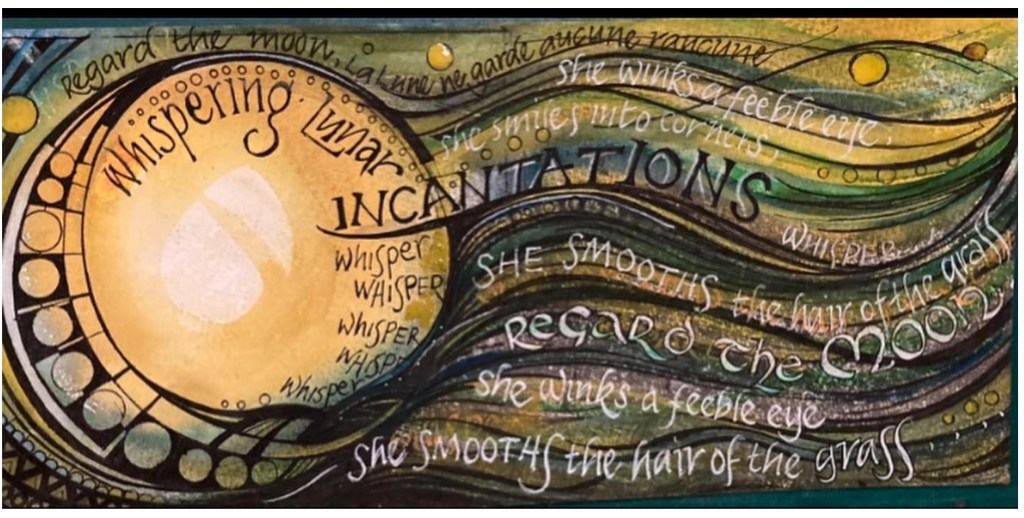
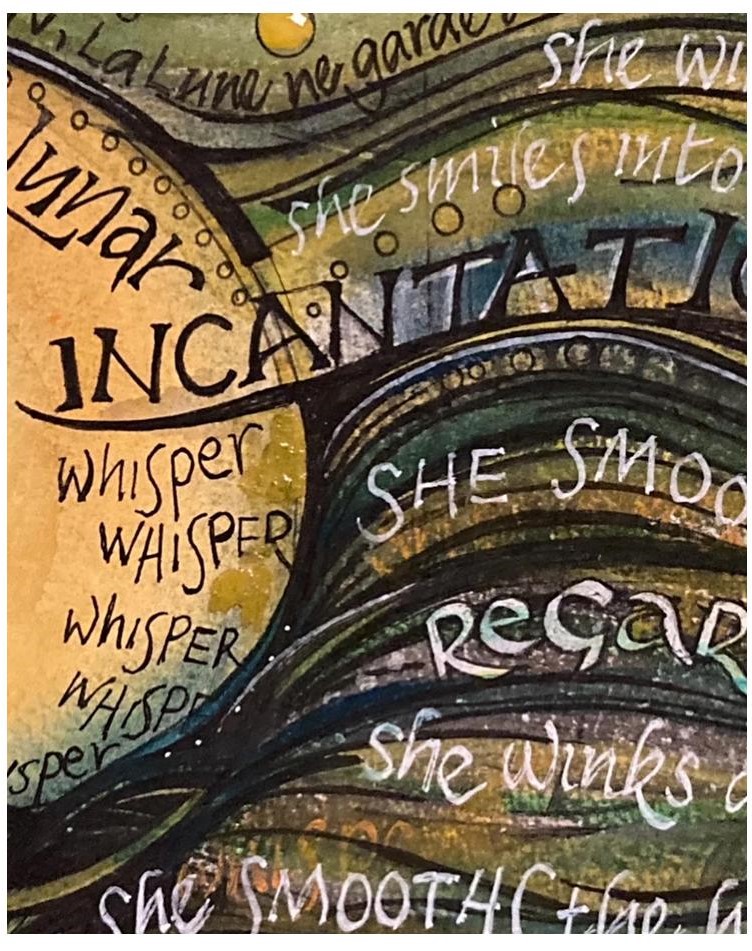
I have been a friend of Kay Gibbons for quite some time but recently I have also got to know her art as well. She recently produced the Calligraphy art above. I asked her if she would write something about the personal and artistic process involved

Lunar Incantations by Kay Gibbons

…..’half past three,
The lamp sputtered,
the lamp muttered in the dark,
the lamp hummed ;
‘Regard the moon,
La lune ne garde aucune rancune,
She winks a feeble eye,
She smiles into corners,
She smooths the hair of the grass….
The moon has lost her memory ..
A washed out smallpox cracks her face ….

                                                                            T. S. Eliot, Rhapsody on a windy night.       

These descriptive words about the moon inspired me to explore lunar imagery in Eliot’s poetry , especially in this poem, Rhapsody on a Windy Night.

I attempted to paint an image but was dissatisfied with the outcome and left it for a couple of days . When I returned I could see within the image ‘the moon smoothing the hair of the grass,’as in the lines of the poetry  and I played along with the drawn lines and emerging image before me.

I added the words and their imprecise lines seemed symbolic of being lost in the dark of the night, partially visible by the light of the moon across the landscape. A happy accident for the Calligrapher within,  to be able to add a sense of meaning to something which jarred against my need for the perfect line.

My process is one of thought and quiet meditation lifted with the joy of a babbling brook when it all falls into place and my understanding of Eliot’s words is satisfied by the art before me … tinged with a niggling desire to tweek a bit here and there as Eliot would have done too ..

T S Eliot inspires within me a creative welling response to a dialogue between word and image; between poet and artist.
I am delighted to encounter and explore Eliot’s poetry with its imagery and translate it into my own visual interpretation born out of a lively response to his own expression of feeling and emotion.

My work is a personal visual translation of Eliot’s  words and intonations, the incongruities, the dichotomies, the discordant resonance inspiring a intriguing , meditative yet playful reflection on his words . Poet , Artist . Artist , Poet .

The arid dry texts of the ‘A’  level set texts transitioned during lockdown into a passion to interpret visually. Eliot’s words with my own subjective interpretation onto the artists paper .
A dialogue between words and pictures .the pouring out of creative energy in response to an emotional , intellectual stimulus.

An interplay between two destinies ..
Poet and Artist

And so in the dialogue between
La lune and Earth .

Kay Gibbons.

[] Kay is an artist who lives in Oxfordshire. She will be exhibiting there next year.
You can find lots more of her art on Instatgram – kaygibbons_art.glass.sculpture.