My friend, Joyce Smith, has sent a Tweet about Nature’s heralding of Spring. Last Sunday was International Dawn Chorus Day (there’s always something for everyone!) and this Robin obliged by turning up in Joyce’s garden and giving a deeply spirited performance.
It got me thinking and so here’s a poem –
At the Break of Day
The Orchestra of Light tunes up; Trying out riffs and practising scales Cock clears his throat, ‘Ahem … a-doodle-doo!’ Songthrush bustles importantly into the auditorium –‘They rely on me to begin, you know.’ ‘Not so’, cuts in Robin, with Blackbird on the wing, ‘We are well-known early risers our song is eagerly awaited!’ Little Wren, never one to push, slips onto the stage, apologizing profusely for her small stature. ‘Small, but beautifully formed’ says Mr Owl on his way to bed, ‘sing me to sleep little one.’ The chiffchaff flies into the melée of slowly gathering sound as Chaffinch and Sparrow take a bow. Mr Cock raises his beak, ‘Ladies and gentlemen, shall we begin? Please open your music at the ‘Dawn Chorus’, written, I believe, by God.’
Rogation (meaning ’to ask’) has traditionally been a time when we ask for God’s blessing on the land and the crops growing in the fields. This was combined with a tradition known as ‘beating the bounds’. A Church procession would walk the boundary of the parish, pausing to pray for God’s bountiful goodness for the farming community as well as ensuring the parish boundary was observed and marked. I know of an ancient custom in the Northern town of Oldham of erecting seven crosses around the boundary of the parish thus claiming – or re-claiming – the land for God (and, less spiritually, ensuring that tithes were paid to the Church!)
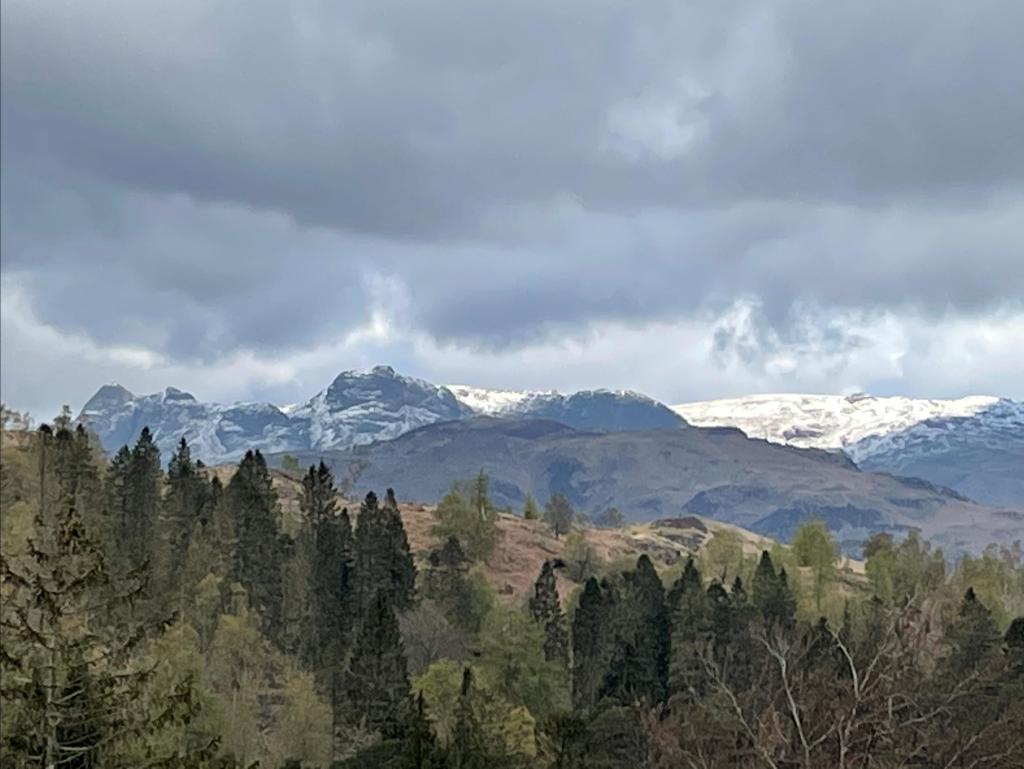
When I lived deep in the countryside, we fought shy of actually beating the bounds because a part of the boundary was up a fell which peaked at 1059 ft. Whilst it would have been easy for a fit person like myself, (I may be telling an untruth here) we had to consider more delicate flowers in the congregation. So we contented ourselves with a gentle ramble through bluebell woods and an open air service at the local Scout camp. I think Gill Henwood, who took this photo of Langdale Pikes draped with snow last week, may well remember the bluebell wood walk.
The priest/poet George Herbert, writing in 1630 commended the custom for 4 reasons:
As a blessing of God on the fruits of the field.
As justice in the preservation of the boundaries.
As an act of charity in loving, walking and neighbourly accompanying one another, reconciling differences and forgiving wrongs.
As an act of mercy: as the blessing of God was invoked, the people were to be mindful of the needs of the poor and give them what was needed for their well-being.
This blessing of God’s earth was sometimes given a wide interpretation! Once, when I told a clergy friend about our bluebell walk, he responded rather sniffily that he had done something much more spectacular – he had blessed the Atlantic Ocean. So there!
As he was Vicar of a landlocked parish up on the North Lancashire moors I expressed my disbelief. So he told me:
“We had a service at one of our local farms and running through it was a little stream. I blessed that. The stream flows into a local river which then joins the River Ribble. The Ribble flows into Morecambe Bay and from there to the Irish Sea which eventually becomes the Atlantic Ocean.So I blessed the Atlantic Ocean.“
I had to give it to him – he either had a fanciful imagination or a big, big vision!
God has a big vision for his world and for all he has created. We tarnish that vision with our selfishness and our failure to bless, care for and feed a world in great need. Our desire for the well-being of others and a healing for our earth are needs that we have to respond to as well. It is no accident that Christian Aid Week, when money is raised to help countries and peoples less fortunate than ourselves, is linked to Rogationtide. At a time of blessing, we should become people of blessing to others. I write this just days after we have been told that Her Majesty’s Government has considerably reduced aid given to developing countries. This is, in my view, a lack of vision and also a failure to see that Global means Global (to recoin a phrase!). As the Psalmist reminds us:
The earth is the Lord’s and all that is in it, the world, and those who live in it. (Psalm 24. 1)
Never more than today is that vision needed for India, Brazil and so many other places on our planet. It isn’t enough to look after ourselves – the vaccines God has given us the knowledge to find are not our property but for sharing.
As St. Ambrose says:
“It is not from your own possessions that you are bestowing alms on the poor, you are but restoring to them what is theirs by right. For what was given to everyone for the use of all, you have taken for your exclusive use. The earth belongs not to the rich, but to everyone. Thus, far from giving lavishly, you are but paying part of your debt.”
It is hard to argue with St Ambrose, but why should you want to?
In Britain, Christian Aid Weekthis year is 10th—16th May.Because of Covid, door to door collections are risky for collectors.
If you wish to help the poor, the hungry, the sick and needy, please visit Christian Aid’s Website or support through the Roman Catholic CAFOD website.
A new tweet from my friend Joyce Smith. She makes this important observation.
This little bird reminds me that in looking for the exotic and colourful, I often overlook the wonder in the ‘ordinary
God can be found in our ordinary lives.
TERESA of Avila was sometimes referred to as ‘God’s Gadbout‘ because she spent a lot of her energy in founding convents of nuns throughout Spain in the 16th century. She was forever on the move and yet she is remembered best for her teaching about Prayer and particularly about Contemplative prayer which requires stillness. No matter how busy she was – and she was very busy – she made sure her heart was constantly fixed on God, whom she referred to as Your Majesty, though not always politely! God for her was very near. Indeed she coined a famous phrase – ‘God walks among the pots and pans’. We find God in the ordinariness of life, and if we train ourselves to recognize that, we shall meet Him in the everyday events of our lives and in the people we meet. This is about finding Heaven in Ordinary.
Teresa believed that God was within us as well as beside us, and here she took up our Lord’s own teaching that the Kingdom of God is within us. We encounter Him in the silent depths of our hearts.
You know that God is everywhere, she says, which is a great truth; wherever God dwells there is heaven, and you may feel sure that all which is glorious is near His Majesty.
Then she refers to St Augustine who sought God in many places and at last found the Almighty within himself. We don’t need to go to heaven to find God, she says, We are not forced to take wings to find Him, but have only to seek solitude and to look within ourselves.
She calls this seeking God in solitude within ourselves the prayer of Recollection – or Contemplation. In her work Interior Castle she develops this using the imagery of a King in his Palace.
Let us realize that we have within us a most splendid palace built entirely of gold and precious stones – in short, one that is fit for such a Lord – and that we are partly responsible for the condition of this building, because there is no structure so beautiful as the soul full of pure virtues, and the more perfect these virtues are, the more brilliantly do the jewels shine
What we find in this Palace is the mighty King who, she says, has deigned to become your Father and Who is seated on a throne of precious value, by which I mean your heart. Realizing this took her quite a while.:
Had I understood always, as I do now, that so great a King resided in my soul I should not have left Him alone so often, but should have stayed with Him sometimes and not kept His dwelling place in such disorder.
For Teresa, then, it is when we enter into silence and spend a little time with God in our hearts that the soul makes progress in the prayer. God becomes the centre of our being, always to be found when we still the voices of the world that claim so much of our attention.
Teresa says that it is only through silence that we can encounter the love of God and receive it into our hearts. God is very near. We should seek him within. He is much closer to us than we might imagine. We are not ordinary to Him who loves us to be near to His heart. Of course, it is when we recognize this that we are actually quite extraordinary!
The Sparrow knows the answer!
Even if it fell to the ground our heavenly Father will notice! See Matthew 10:32. and Psalm 84:3 where the sparrow and her mate, the swallow, find a dwelling place in God’s house where they may quietly and safely lay their young.
That’s why the sparrow is a long way from ordinary. Just like us!
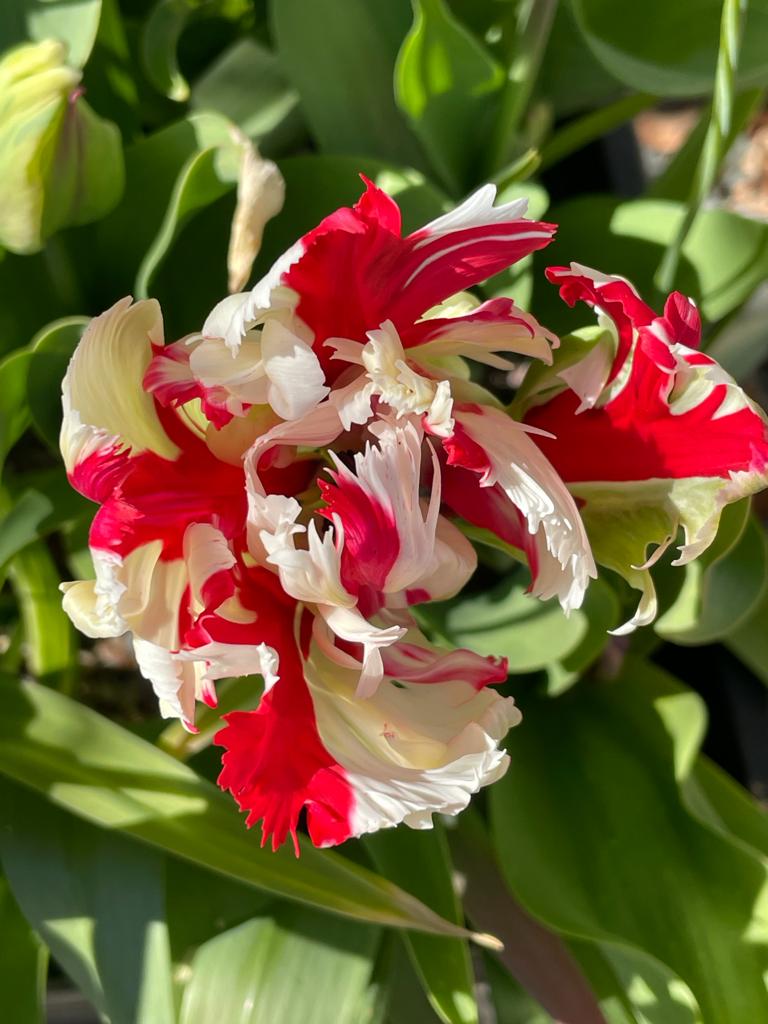
My friend, Gill Henwood, sent me this photograph of what I think is called a parrot Tulip, which is certainly very beautiful and unusual. It encouraged me to write this poem.
Tulip
I bear witness to beauty, joy and loveliness in a world besmirched by ugliness, anger and hatred; a world where words snarl, tear and destroy, blackening the tongue and emptying the heart of light.
I shine with colour, dazzling to overshadow dullness; lives tarnished by pain, emptiness, harshness of spirit. I am painted with the palette of joy: dazzling hues of bright reds, pure white, swirling greens.
Care and fear are marked out in drab grey, muddied rust, blackened dust – shades of brokenness, distress, disease.
Crying out for attention, the uncared for, unloved and unserved lose hope, vainly seeking a vision which eludes them.
But there is still life, still hope, still signs of better ways.
My petals dance and swirl in a gentle breeze, blown from the God who painted me, filled me with capricious creativity and pure, pure love.
Open then souls meant for singing, dancing, loving, serving, sacrificing for others, as air rushes in, filled with renewed light.
Breathe.
Be filled with amazement, purpose, wonder, awesomeness, love. With… ah! God.



 Mr G's Ponderings