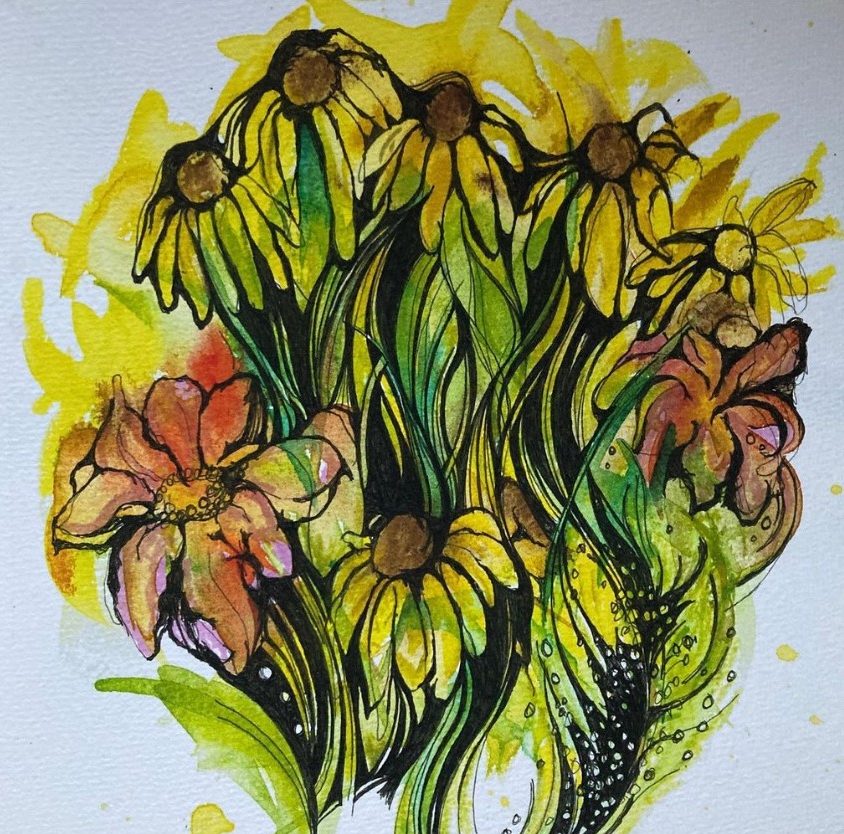
Kay was a guest at my lunch party. You can find lots of her work on Instagram.
At a lunch party recently, five friends gathered to catch up, eat together, relax and take our ease. After a busy week for all of us, it was a time to re-charge our batteries. We are living through difficult times, both internationally and locally. So much is going wrong with our world and for many, life is a struggle. We are also caught up in so much busy-ness. There is often very little time to minister to ourselves. So it was good for us in our little group to try and redress the balance a bit. Being busy without having time for rest and re-creation can only lead to exhaustion, emptiness spiritual listlessness, and eventually ill health. We need to build into our lives a time of caring for each other and of just being rather than always doing.
There is a story, which illustrates this, about St. Antony of Egypt who was one of the pioneer founders of the monastic life.
One day he was resting with his disciples in the desert when a hunter came upon them. The hunter was a great activist and was quite shocked to see the holy man taking his ease. He complained and chastised the saint. Antony simply told him to draw his bow and shoot an arrow. The hunter, puzzled, did as he was bid.
“Now” said Antony, “do it again.”
The man shot a second arrow. “And again” commanded Antony.
The hunter protested that if he continued to shoot arrows as Antony had asked, his bow-string would break.“ And so it is with men” Antony replied. “Without rest we too shall break.”
In our pressurised world we need to take time to relax and rest if we are not to break. For me, the lunch party was one such time. Having time for friends, loved ones, and those who can share hobbies, interests and experiences is very important if we are to grow as people. If we are to feel and be cherished by others and equally, if we are to love and support others.
I recently shared time with a friend who is suffering bereavement. The death of her loved one came through an accident for which there could be no preparation. The nature of an accident, is that there is often no way we can really influence its outcome. At one point, in our conversation, my friend said something both moving and important. She told me to never put off spending time with loved ones. Treat such relationships as precious because that is what they truly are.
So the lunch party was more than a time for re-charging our batteries. It was a time of sharing love and friendship. It was a joyful time of gladness which flowed between us. It is those such moments that tell each of us how we are important, cherished and healed by being with others who care about us and long to share in our lives. That is also true of our relationship with God.
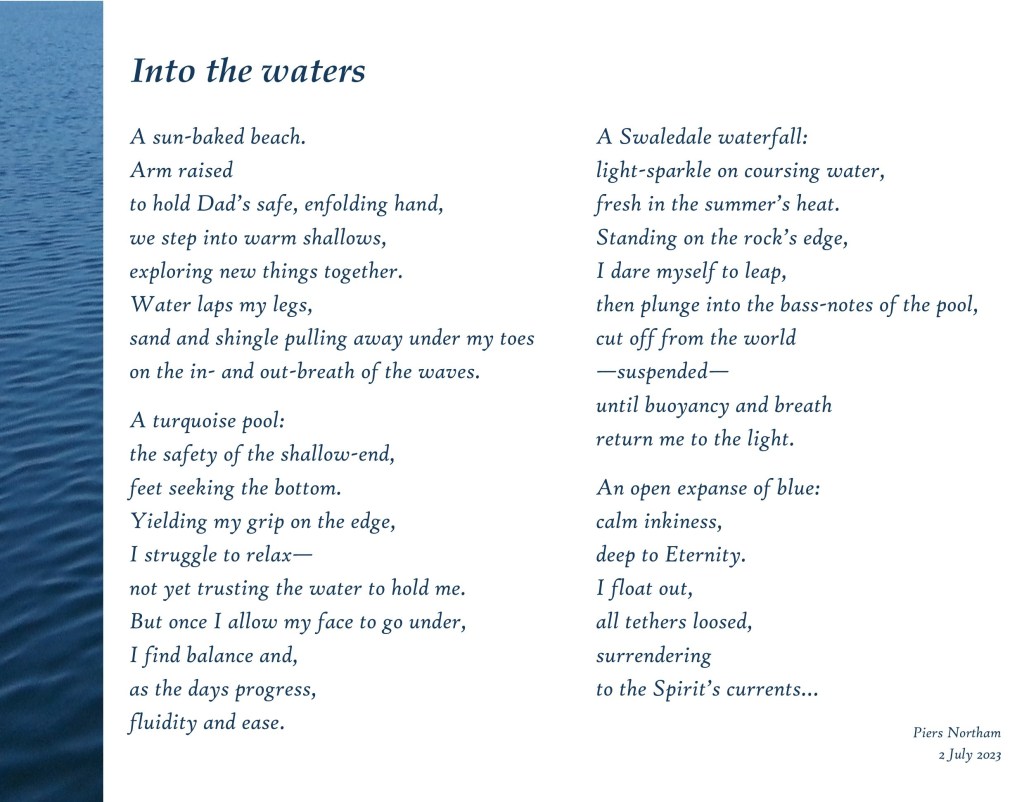
At this time of year, one of the ways I try to develop this is by spending time with God in the Garden. It’s a wonderful time of growth and amazing display as creation bursts alive in colour and beauty. Of course, there is a certain amount of work to be done to get it that way but I regard it as a work of co-operation with God.
The friends I shared lunch with were all artistic in differing ways. I don’t regard myself as gifted in that sense but, as I looked around the garden, I recognized that what I was seeing was God’s palette. Here, God paints a picture which is an ever-changing kaleidoscope of creation, alive and buzzing. Yet it is also a still-life. The garden is a place of stillness, quietness, re-creation. A place for God to silently colour not only the flowers but also the soul. Whether it’s a garden, a secret place, a quiet walk or sitting in a still place, it’s the same. There are so many places were God can easily be found.
Not least, of course, inside each of us. We always have God with us, his palette of love carefully colouring our soul.
But, of course, we have to stop, spend time with Him, letting Him love and care about us. Far too often, for whatever reason, we don’t spend enough time with God. We don’t appreciate just how much he loves us and we don’t love Him as much as we should. That is not an admonition. It’s just something that sorts of happens. And that’s mostly because we succumb to other things along the way. It is very easy to fall into the trap of letting the outside world and its cares and worries take us over.
In Matthew Chapter 11, Jesus tells us something comforting and yet also very challenging: Come to me all you that are weary and carrying heavy burden, and I will give you rest. I will refresh you and hold you. Jesus continues:
Take my yoke upon you, and learn from me; for I am gentle and humble in heart and I will find rest for your souls.
No excuse then for being distracted or being buffeted by external things that try to claim our attention from God.
There is, Jesus tells us, a surer way of dealing with worry, anxiety and hopelessness: I will find rest for your souls.
Why would you not want that?
In my garden there is a carved stone. It was a gift and is the work of a stone sculptor, Paul Flack, who carved on it the words of a prayer by St Teresa of Avila. Her prayer reinforces what Jesus says:
Let nothing disturb you;
Let nothing frighten you.
All things are passing.
God never changes.
Patient endurance obtains to all things.
Whoever possesses God is wanting in nothing.
God alone suffices.
The prayer is known as St Teresa’s bookmark because it was found in her prayer book after her death. It had clearly been
her constant companion. St Teresa was often so busy that she was known as God’s Gadabout. She was often struck by illness and, as she founded convents and disputed with bishops and even Popes, she coped with immense anxiety. This prayer carried her through it all and kept her rooted deeply in God.
Do not worry. God alone suffices.
May that be true for you.
[Mr G]



 Mr G's Ponderings