Tag: Latton Vicarage Garden

Mr Brock introduces himself

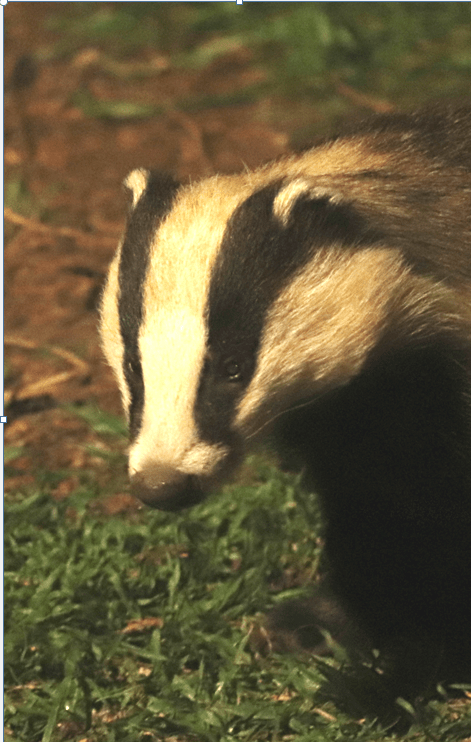
Badger in Latton Garden. Photograph by Revd. Lynn Hurry

The badger was a night time visitor in her garden and Introduces herself.

“ I try not to show my face too often. It isn’t always wise or safe.
As you see I have a rather distinctive face. It’s the broad white stripe that gives it away!
I am told that it serves a purpose. It’s a sign of my knowledge and insight into matters not easily accessible to other animals on earth.

One of my special attributes is my strong jaws. This is very useful because it makes it easier to chew and also, when required, to snap and bite at those other animals who like to throw their weight around.
A much more useful thing is that my jaws help me to habit the mysteries of the Word’, which is a pretentious way of saying how I reveal the ‘magic of storytelling.’

When needed, I give away generously to people, a magical word which is the way I guide people who are looking for beauty, encouragement and a more open mind especially when they seek a differing direction and purpose in life which otherwise deludes them.
I use the word, story’ in a sense of helping others to listen to that inner voice whereby God speaks. I am part of that spirit-filled creation which leads people to embrace courage and independence and so cultivate a tenacity which shows the importance of holding on when running away and hiding would feel much safer.

Drawing from my own characteristics and a tendency to dig deeper into the soil of the earth, I am able to show other members of God’s creation how to embrace untapped potential and take that journey all of us must take if we are to become our true selves under God.

I have this story to tell from the heart of my being and it has inspired a number of important people to use me as a character in their writings.
The late eighteenth century  poet, John Clare,  wrote of me in a poem  entitled Badger. At a time when many humans were cruel to animals, he took my tenacious character and wove it into a poem which emphasizes endurance and resistance rather than then being a victim.
Beatrix Potter, in her Tale of Mr Tod, was less kind of me, speaking of my curiously, earthy voice in a dismissive way. She called me Tommy Brock
By then, I was being referred to as Broc which actually was my Celtic Name and really only meant ‘grey.’.
That nice Mr Graham, who wrote the delightful book, Wind in the Willows, called me a “wise and kind badger” though he did say that I could be bossy at times, by which he meant that I was forthright!

Things are not always what they seem and humans are not the be all and end all of creation. Each of us animals have insights, hopes and loves to offer as we share in shaping Creation. Each of us is made by God and we are Icons of His presence in the world. We are all filled with God’s Spirit and signs of the totality of His loving being. Increasingly we need to see that truth and treat Creation and the Created order in a new and more grateful way, all of us as part of God’s story of pure love.

Many the gifts, many the people,
many the hearts that yearn to belong.
Let us be servants to one another,
making your kingdom come.
(Bernadette O’Farrell)

[Mr G, a visiting Badger and The Revd.Lynn Hurry]
30th April 2026

Comma

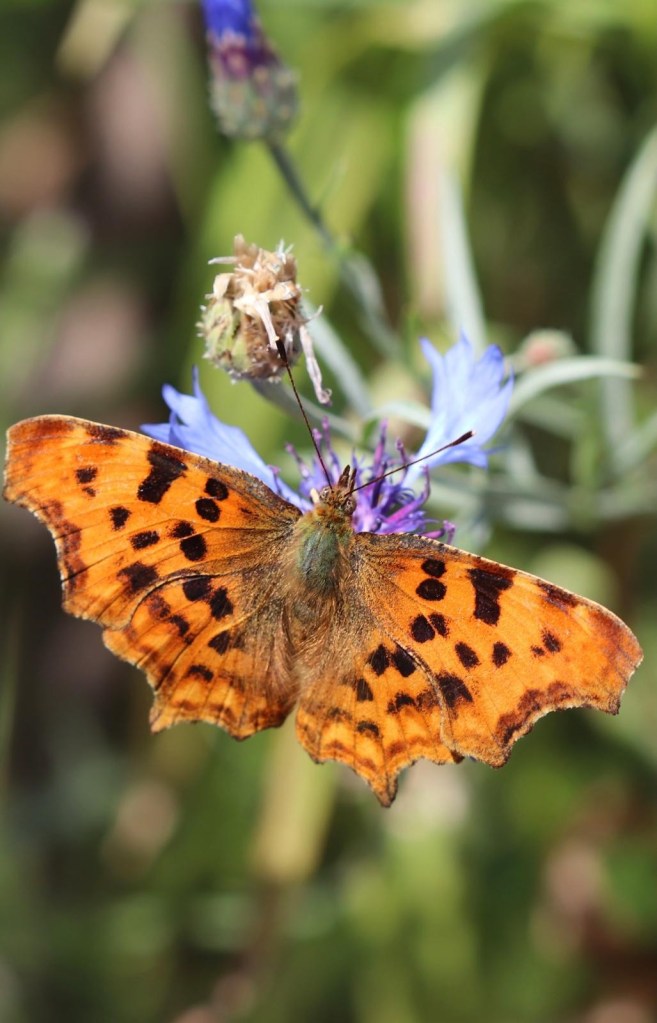
Photos of the Comma Butterfly in Latton Vicarage Garden, by Canon Lynn Hurry.

These photos by my friend Lynn Hurry are of the Comma Butterfly. 
It is so called because its orange-brown colouring is punctuated on the underwing with a distinctive white comma shape. It has ragged wing edges which, when it is at rest, resembles a dead leaf.

Unlike many butterfly species, which are becoming rarer, it is a success story of Nature, being more prolific and widespread. Some attribute this to global warming. It is commonly found in Britain, Europe, North Africa and Asia.

Spiritually, this butterfly has several meanings including renewal; rebirth; unconditional love; transformation and hope.

Personally, I see in its name ~ comma~ an invitation to pause briefly and for a moment enter into stillness.
A comma links two parts of a sentence and so we can allow a pause to be a link between one kind of activity and another.
The purpose of this brief moment can be to renew our connection with God and with Nature.
The Psalmist of Psalm 46 gives us a picture of a world in turmoil, whether it be of nations; planet earth, or more personal. Throughout this upheaval, God is our refuge and our strength. His voice melts the angry clamour of human voices; of our human spirit. God makes wars to cease, within our hearts leading hopefully to a renewed understanding of God’s presence in our hearts.
So, the Psalmist encourages to Be still and know that I am God.

We can see, therefore, that the grammatical pause in this butterfly’s very being has a purpose and a meaning which calls us to reflection, renewal and transformation. This comes if we pause with God.

Too often, in our daily life we are on the go in frenetic activity. So is the world. It is vitally important then to be still and to form a new connection with the World of Nature, represented by the Comma Butterfly, and appreciate the beauty of God’s world. Only then might we cherish all that God has made and find a new hope and a new beginning. Only so might we become deeper instruments of God’s healing love.
The Comma Butterfly is known as a pollinator, bringing the means of new life to the Natural World. That is a role we can learn from this butterfly in all our dealings with each other.

[Mr G. 9th July 2025]

The Jays come to call

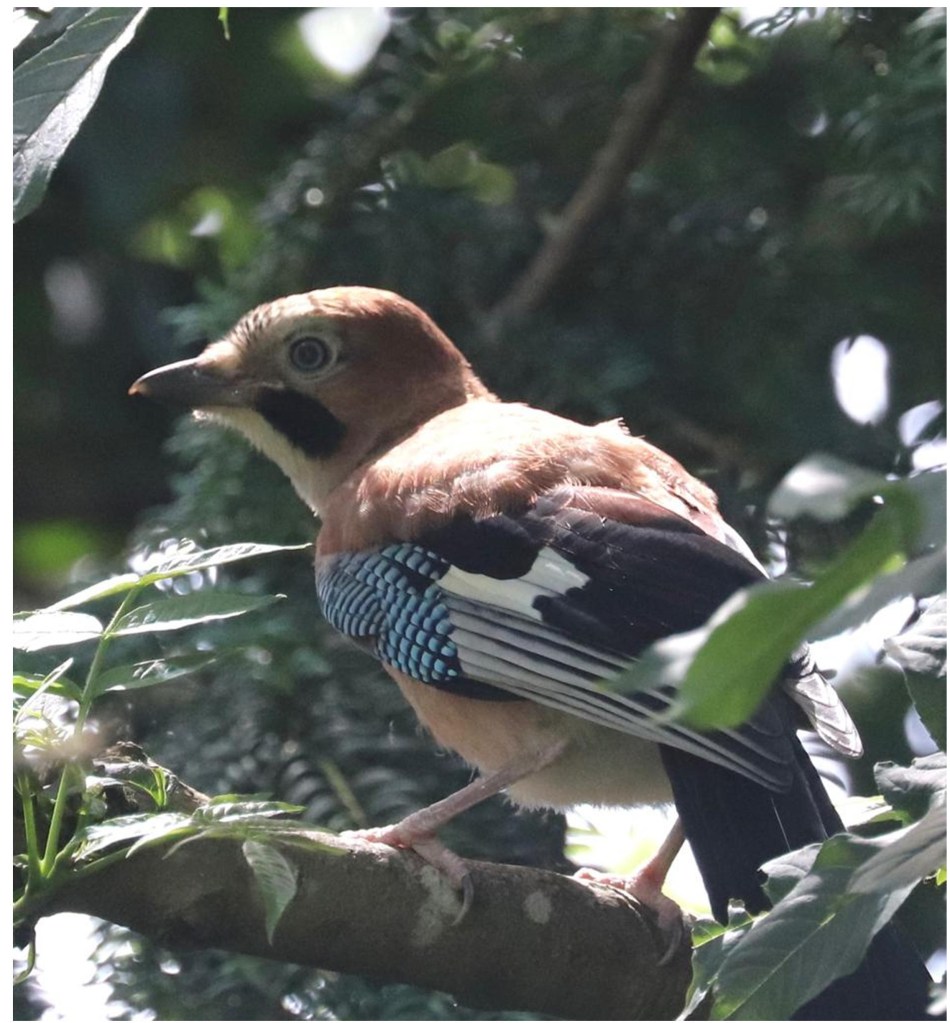
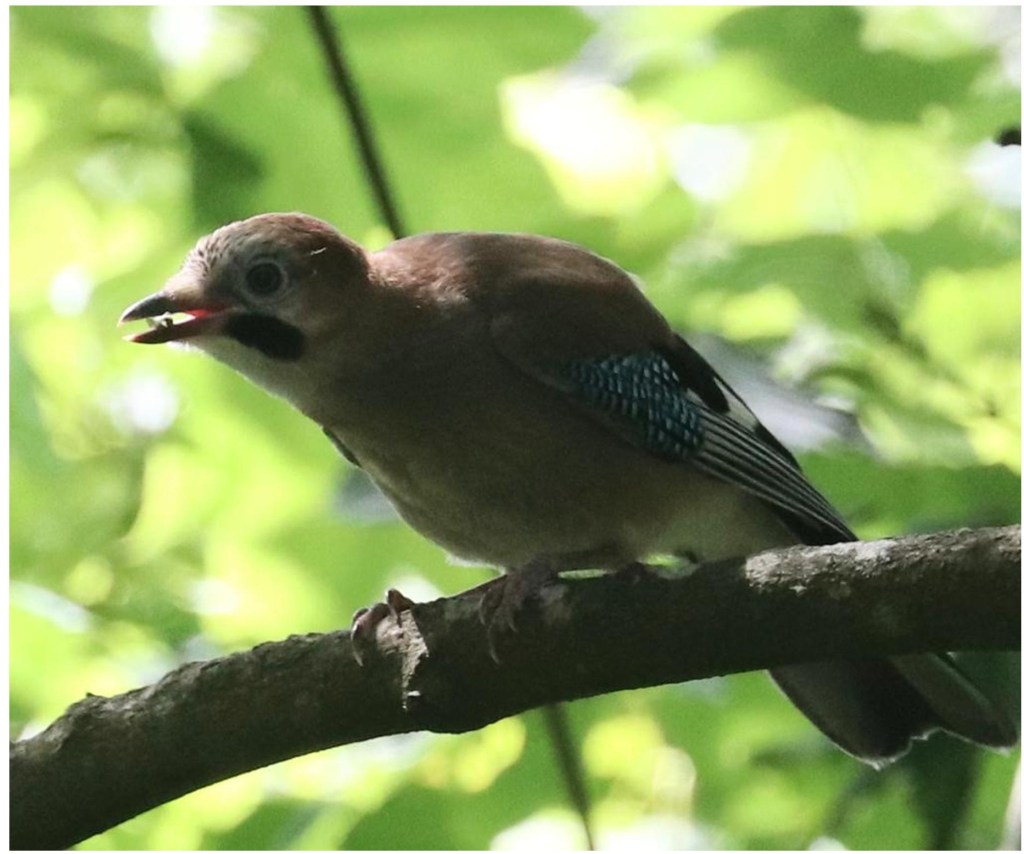
The Jay (a.k.a. Garrulus glandarius : chattering, noisy ; of acorns)

These photos of two baby Jays were taken in Latton Vicarage Garden by my friend, Lynn Hurry. Our intrepid photographer had to hide in the lower branches of a pear tree to get them and emerged covered in bugs, leaves, bits of wood and blossom. Sadly, there was no one on hand to take a photo of her!

A JAY WRITES A LETTER

I decorate your garden with my finery
but you do not trust me.
Some say that I am always up to no good.
A reputation for being shifty, flighty, mischievous,
precedes me;
more kindly I am a scallywag.
But do you notice how shy I am?
Perhaps you are distracted by my piercing ‘call’.
Dismissed as a chatterbox, incessant talker,
your proper name for me is ‘garrulous.’
Hardly, ‘reserved’!
Maybe those who are more suited to quietness
speak the loudest to hide our true nature.
How better to disguise myself as I search for acorns,
my Winter food.
I have a knack for foresight and planning.
I do not fear discovery from my well disguised hiding.
So be nice to me.
I bring colour and joy to your lives,
if you but look.

[Mr G]

A Tale

The crow and the pitcher

The Intelligence of the Corvidae family was observed 2,500 years ago by the famous Greek fabulist, Aesop. Here’s the tale, taken from the BBC website, about the crow and the pitcher:

One day, after a spell of hot weather which has dried up all the streams and ponds, the crow fears it will die of thirst. Coming upon a pitcher of water left in a garden, the crow tries to drink from it, but there is only a little water left in the bottom, and his beak can’t reach it. Having thought for a while, the crow hits upon the solution of dropping in pebbles until the water level rises sufficiently for him to drink.

The moral is: little by little does the trick

All photos by The Revd Lynn Hurrry