The Manger and the Cross

St Brigit’s cross

I post this on February 1st, the day the Church celebrates
St Brigit of Kildare (or Brigid or as she is also known Mary of the Gaels).

She is regarded as one of the patron saints of Ireland (with St. Patrick). She was founder and Abbess of a double monastery (for men and women) at Cill Dare (Church of the Oak).

Central to Brigit’s prayer and ministry was her belief that:
It was Christ and his Twelve Apostles who proclaimed the Gospel to the peoples of the world and it is in their name that I look after the poor, for Christ is to be found in the person of every faithful poor person.

She believed it was her duty as Christ’s servant to lead people over the dangerous bridge of this life to the gleaming country of heaven.
This was at the heart of her mission and of who she was.

She was a bridge between this world and the Kingdom of Heaven. As such it is fitting that she occupies that point in the Christian Calendar which turns our thoughts and prayers from Christmas to Easter – from the wonderful joy of God coming to be amongst us in the Incarnation, saving us and the world from within to the completion of that salvation in the Glory of the Cross and through the Crucifixion. Those two events form a bridge taking us from birth to resurrection.

An illustration of this bridging of the world by Manger and Cross, is through the Cross that is called after her – St. Brigit’s Cross.

It is said that it first came about because a pagan chief from the neighbourhood of Kildare lay dying.
He sent for Brigit come and to talk to him about Jesus.
By the time she got there, he was delirious and raving with fever. It was impossible to talk to him nor
could she instruct him about Christ.
Instead, she sat by his bed and began consoling him.
As was usual, the floor was strewn with rushes for warmth and cleanliness.
Brigit picked some of the rushes up and began to weave them into a cross as she talked.
His delirium quietened and he was able to ask her what she was doing. As she talked, she gently explained about Jesus, his Cross and the salvation he brought.
In that quiet moment, handing him the little cross she moved him gently from earth to heaven as she baptized him at the point of his death.

She had taken symbolically, some strands of the Manger and turned it into the sign of the Cross – the Saving Sign.
In this way God used the devoted and faithful Brigit to help him claim another soul for heaven.

She gave us an important sign too. In her woven cross she combined the straw of the Manger and the wood of the Cross and it takes us to the heart of Brigit’s understanding about God. Her spirituality is woven into the simplicity of the link between these two waymarks of our pilgrimage of faith.

[Mr G]
Little Things

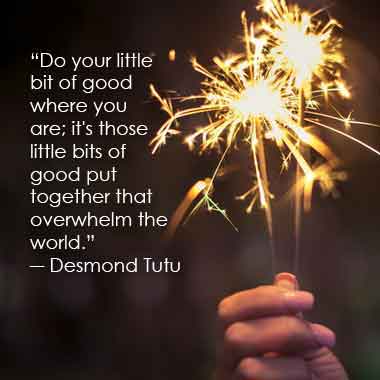
This quotation by Desmond Tutu put me in mind of similar sayings especially Mother Teresa of Calcutta. She used to insist that she and her sisters didn’t do great things but little things with a great love.

St David on his death bed drew his monks around him and his final words were:

“Brothers and sisters, be joyful Keep the faith and do the little things that you saw and heard from me.” The little things which David taught included prayer, being present for the breaking of bread at the Eucharist; reading scripture; speaking only when necessary and helping the poor. He believed also that we should have a deep respect for others; that we should always be lowly, possessing a humility which never expresses itself arrogantly and which steers us away from pride. He also set great store on hospitality – always being ‘at home’ for others and for God – having time for both.

Probably, though, my favourite story about doing the little things we can is about a little sparrow.

A little sparrow laid on his back with his legs in the air. Another sparrow came past and asked the sparrow in his back what he was doing. He replied that he had heard that the sky was going to fall in and thought that he should try and help hold it up.

The other sparrow laughed and said, “You’re only a little sparrow with little legs. How can you hold up the whole sky?

The sparrow laid on the floor with his legs in the air, turned his head and said:

“I know, but one does what one can.”

My friend and fellow blogger Daryl Madden whose bloggings I follow, wrote a poem a couple of weeks ago which he has given me permission to re-blog here. Daryl is a follower of Jesus and a lover of God. He lives in America and his daily poems often give me inspiration.

Here’s his poem, Little Things –

Little Things

Little gifts of kindness
Of generosity
Bring light to this world
Through humility

Little acts of love
Through the trinity
Draw the world as One
Bound Spiritually

Little prayers of faith
Through divinity
Turns the worlds direction
Oh, so gradually

All these little moments
One day we will see
In another world
Flow to eternity

The little things in life
The world sees as small
Turns out in the end
Are the greatest, of all

Daryl Madden

Sea Change: As Sea Levels Rise, Can Saltmarshes Be Saved? | All About Birds  All About Birds

Forgiveness out of suffering

Holocaust Memorial

As I lit a candle at 8pm tonight, in a window of my home I thought about the many millions of people who have suffered and died at the whim of tyrannical regimes who pursued warped and insane ideologies. People who cared only about themselves and their self centred beliefs. Germany, under the power of Adolf Hitler and his Nazi’s has come to symbolize this evil which destroys others in demonic acts of unadulterated hatred. This included not only Jews but gay people, gypsies, those challenged with physical and mental illness and black people who suffered in their millions. The Germany of today is very different but these demonic inhuman acts go on still in our world today.

The taste of death; the scars of life; broken memories; shattered families; history of peoples trod upon. No words can describe what it was like or what it would come to mean. Only those who were there in the camps could even begin to tell us, just as today only those who suffer through immense acts of inhumanity can really understand what it’s like.

Yet just as at every Remembrance Sunday, the moving Khoima Epitaph is spoken with its words, for your tomorrow, we gave our today, so the candle and the prayers and the remembrance of those whose lives were destroyed in the camps has a similar message. No more evil and destruction of people in an outpouring of the demonic on that or any scale. We too gave our lives for your freedom – do not squander our sacrifice. Work for the good, the peace, the harmony of all.

We are all human and equal in God’s sight, in God’s care.

So we are to be Watchful,  having concern for and holding fast to what it means to be truly human and in love with what that involves. We are to be generous, kind, compassionate, merciful and just .

Whilst it is all too easy to be angry, hurt and resentful, about the holocaust and those who suffered so deeply, it is easy too to be angry about the treatment of refugees and displaced people of today and those living in poverty and need of all kinds. Also, those who are different in race,colour,sexuality,gender and creed. To overcome those negative feelings there must be room for ‘Forgiveness’, born out of love.

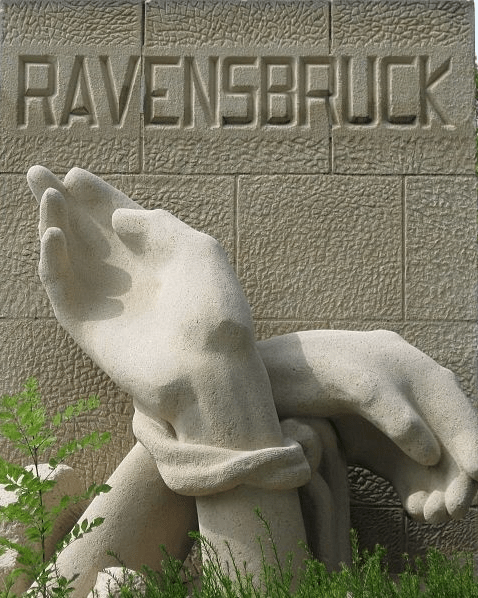
When the Ravensbruck Concentration Camp in Germany was liberated at the end of the Second World War, a prayer was found on a scrap of paper in the camp, and it is often used today in acts of remembrance for the Holocaust victims. Both the Jewish, Christian and other faiths teach followers not to seek revenge, but to pray for their ‘enemies’, for those who hurt them, or who make them suffer in some way. Although many Jews, Christians,  and those who follow other faiths  find this extremely hard, there are always some who astound us by their love and generosity.

In the Bible, God’s judgment is seen as something positive, something to look forward to.

Psalm 96 talks of the earth rejoicing and trees singing for joy when God comes to judge the earth. God’s judgment is seen as the time when wrongs will be put right, when those who suffer injustice or oppression will be rescued. But God’s judgment is also seen as merciful. Christians believe God’s judgment will rescue the perpetrators from their wrongdoing, as well as their victims.

Here is the Prayer. It is moving, amazing and deeply generous. It is born out of compassion and mercy.

Lord, remember not only the men of good will, but also those of ill will.
But do not remember all the suffering they have inflicted upon us.
Remember rather the fruits we have brought, thanks to this suffering:
our comradeship, our loyalty, our humility, the courage,
the generosity, the greatness of heart that has grown out of this.
And when they come to judgment,
let all the fruits we have borne be their forgiveness.

Then said Jesus a fellow Jew, Father, forgive them; for they know not what they do. (Luke 23:34)

[Mr. G]

Holocaust Memorial Day

The 27th of January is the day for everyone to remember the six million Jews’, Romanies, Homosexuals, Handicapped, Jehovahs Winesses , Christian ministers,  murdered in the Holocaust, the millions of people killed under Nazi persecution, and in the genocides which followed in Cambodia, Rwanda, Bosnia, and Darfur.
The 27th of January marks the liberation of Auschwitz-Birkenau, the largest Nazi death camp.

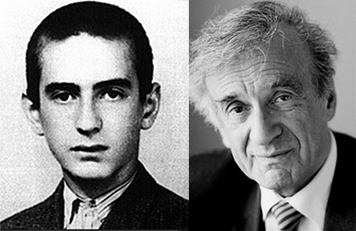
Elie Wiesel was both a survivor of the Holocaust and yet its victim too because everything changed for him. He became one of the most well known people to bear witness to what happened in the evil camps and his biography of his time in Buchenwald was also a kind of biography of the Nazi ‘final solution.’ He was born on the 30th of September 1928, and passed away on the 2nd of July 2016 at the age of 87.He was a noble peace prize winner and his biography during the holocaust called ‘Night’ is available still along with other writings.

Below is something about the struggle he was having after his ‘liberation’, which he tried to come to terms with in ‘Night’. I wrote about a meeting he had with the French novelist Francois Mauriac, who had agreed to write a preface. Much of what follows is based on what Mauriac said.

Elie Wiesel was a young Jew who was thrown into a concentration camp by the Nazi’s when he was just 15. He witnessed many horrors and he experienced the dereliction of feeling abandoned by God.
By some miracle he survived and he went on to write his experiences in a powerful book which he entitled Night.
It is not a long book but to read it is extremely moving and left this reader with a profound sadness.
Elie Wiesel’s faith was deeply shaken and after the war he was sent to interview a Roman Catholic novelist, Francoise Mauriac.

Mauriac wrote a foreword to ‘Night’.
There he tells of Wiesel’s bitterness at God.

“I no longer pleaded for anything. I was no longer able to lament”, said Wiesel to him, On the contrary, “I felt very strong. I was the accuser, God the accused. My eyes had opened and I was alone, terribly alone in a world without God..”

Mauriac, spoke of his reaction to this.
From the depth of his own faith he wanted to speak to Wiesel of “that other Jew, this crucified brother who perhaps resembled him and whose cross conquered the world.

Mauriac wanted to say that the connection between the cross and human suffering “remains the key to the unfathomable mystery in which the faith of his childhood was lost.”
He wanted to say: “We do not know the worth of one single drop of blood, one single tear. All is grace. If the Almighty is the Almighty, the last word for each of us belongs to Him.”

But as Mauriac thought this, he sensed that his words would have appeared empty to this young Jew, who in his own way was carrying a Cross on a journey that was uncharted and which defied explanation.
So Mauriac said nothing but what he did would speak volumes.
“All I could do,” he said,” was embrace him and weep.”

Elie Wiesel at 15 and later in life.

‘Never Shall I Forget’ by Elie Wiesel is a harrowing passage recounting the first night he spent at Birkenau, from Wiesel’s famous memoir Night

Never shall I forget that night, the first night in camp,
that turned my life into one
long night seven times sealed.
Never shall I forget that smoke.
Never shall I forget the small faces of the children
whose bodies I saw transformed
into smoke under a silent sky.
Never shall I forget those flames
that consumed my faith for ever.
Never shall I forget the nocturnal silence
that deprived me for all eternity
of the desire to live.
Never shall I forget those moments
that murdered my God and my soul
and turned my dreams to ashes.
Never shall I forget those things,
even were I condemned to live
as long as God Himself.

Never.

Elie Wiesel