Peace Vigil Reflection
Part of the text of Pope Leo’s reflection at the Prayer Vigil for Peace in St Peter’s Basilica at the Vatican on April 11th
“Your prayer is an expression of that faith which, according to the words of Jesus, moves the world to pray for peace.
War divides; hope unites. Arrogance tramples upon others; love lifts up. Idolatry blinds us;
the living God enlightens. My dearest friends, all it takes is a little faith, a mere “crumb” of faith, in order to face this dramatic hour in history together — as humanity and alongside humanity.
Prayer is not a refuge in which to hide from our responsibilities, nor an anaesthetic to numb the pain provoked by so much injustice.
Rather, it is the most selfless, universal and transformative response to death: we are a people who are already risen! Within each of us, within every human being, the interior Teacher teaches peace, urges us toward encounter and inspires us to make supplication.
Let us rise from the rubble! Nothing can confine us to a predetermined fate, not even in this world where there never seem to be enough graves, for people continue to crucify one another and eliminate life, with no regard to justice and mercy.
Prayer teaches us how to act.
In prayer, our limited human possibilities are joined to the infinite possibilities of God.
Thoughts, words and deeds then break the demonic cycle of evil and are placed at the service of the Kingdom of God. A Kingdom in which there is no sword, no drone, no vengeance, no trivialization of evil, no unjust profit, but only dignity, understanding and forgiveness.
It is here that we find a bulwark against that delusion of omnipotence that surrounds us and is becoming increasingly unpredictable and aggressive.
The balance within the human family has been severely destabilized. Even the holy Name of God, the God of life,
is being dragged into discourses of death. A world of brothers and sisters with one heavenly Father vanishes, as in a nightmare, giving way to a reality populated by enemies.
We are met by threats, rather than the invitation to listen and to come together.
Brothers and sisters, those who pray are aware of their own limitations; they do not kill or threaten with death.
Instead, death enslaves those who have turned their backs on the living God, turning themselves and their own power into a mute, blind and deaf idol (cf. Ps 115:4–8), to which they sacrifice every value, demanding that the whole world bend its knee.
Enough of the idolatry of self and money! Enough of the display of power! Enough of war!
True strength is shown in serving life. With evangelical simplicity, Saint John XXIII once wrote: “The benefits of peace will be felt everywhere, by individuals, by families, by nations, by the whole human race.” And echoing the incisive words of Pius XII, he added: “Nothing is lost by peace; everything may be lost by war” (Encyclical Letter Pacem in Terris, 116).
Let us, therefore, unite the moral and spiritual strength of the millions and billions of men and women, young and old, who today choose to believe in peace, caring for the wounds and repairing the damage left behind by the madness of war.
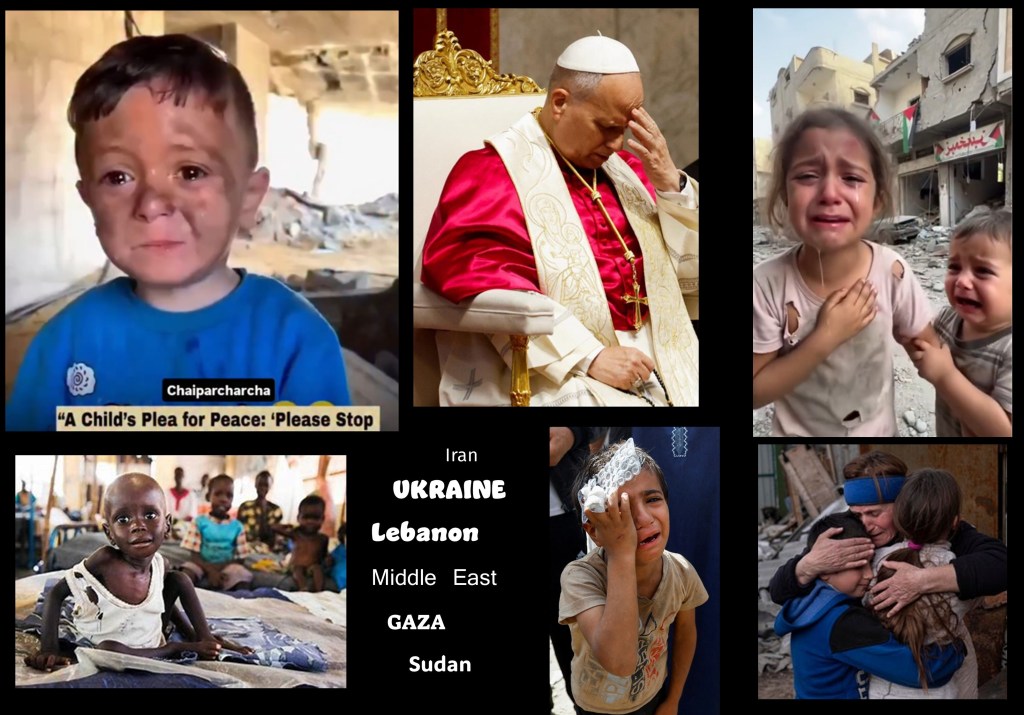
I receive countless letters from children in areas of conflict. In reading them, one perceives, through the lens of innocence, all the horror and inhumanity of actions that some adults boast of with pride.
Let us listen to the voices of children!
Dear brothers and sisters, there are certainly binding responsibilities that fall to the leaders of nations. To them we cry out: Stop! It is time for peace!
Sit at the table of dialogue and mediation, not at the table where rearmament is planned and deadly actions are decided!
Yet there is a no less significant responsibility that falls to all of us — men and women from all over the world. We are an immense multitude that rejects war not only in word, but also in deed. Prayer calls us to leave behind whatever violence remains in our hearts and minds. Let us turn to a Kingdom of peace that is built up day by day — in our homes, schools, neighbourhoods, and civil and religious communities. A Kingdom that counters polemics and resignation through friendship and a culture of encounter. Let us believe once again in love, moderation and good politics. We must form ourselves and get personally involved, each following our own calling. Everyone has a place in the mosaic of peace!
As Pope Francis taught us, “There is also a need for peacemakers, men and women prepared to work boldly and creatively to initiate processes of healing and renewed encounter”
Dear brothers and sisters, let us make a commitment to pray without ceasing and without growing weary, a commitment to a profound conversion of heart. Throughout the world, it is to be hoped that every community become a ‘house of peace,’ where one learns how to defuse hostility through dialogue, where justice is practiced and forgiveness is cherished
Brothers and Sisters of every language, people and nation: we are one family that weeps, hopes and rises again.
“No more war, a journey with no return; no more war, a vicious cycle of grief and violence;” (Saint John Paul II,)
Dear friends, peace be with you all!
It is the peace of the Risen Christ, the fruit of his sacrifice of love on the cross.
For this reason, we raise our prayer to him:
Lord Jesus,
you conquered death without weapons or violence:
you shattered its power with the strength of peace.
Grant us your peace,
as you did to the women filled with doubt on Easter morning,
as you did to the disciples who were hiding in fear.
Send forth your Spirit,
the breath that gives life and reconciles,
that turns adversaries and enemies into brothers and sisters.
Inspire in us to trust in Mary, your mother,
who stood at the foot of your cross with a broken heart,
firm in the faith that you would rise again.
May the madness of war cease
and the Earth be cared for and cultivated by those who still
know how to bring forth, protect and love life.
Hear us, Lord of life!
Mr G’s Ponderings 13th April 2026