St.Thomas shares his thoughts on the eve of his feast day. (July 3rd) See: John’s Gospel Ch20. v. 24-29
I was not there when the Lord in Risen Glory broke the locked door of the upper Room. Brilliantly alive and carrying joy. Resurrection Joy!
Full of a renewed sense of their call by God my friends loved telling me what I had missed. Had they made it up as a way of dealing with their grief? Mourning takes interesting forms sometimes. They were quite smug though so was it a but of one-upmanship?
Yet I wanted to believe them! It was too good to be true, so I was filled with uncertainty. That is when I doubted what they told me and that moment was to define me not just then but for all time. I gave my name to all doubters. Even those who did not share faith.
I don’t know what made me do it. I really wanted to believe what my friends told me. “Unless I see the marks of the nails in his hands… I will not believe!” My longing was so deep. But with those words, I had missed the chance. My heart was heavy, my soul seemingly cast adrift.
Eight days later we gathered again, to pray; to break bread; to find in each other’s company, a kind of solace.
Then, like a whirlwind of sheer light, HE came again. He looked at me, not with sadness, or anger or in a dismissive way. “Thomas”, he said, “my dear delightful Thomas. Always loyal, always a bit too eager, always sure. Come here.” He beckoned me to his side.
Gently, lovingly, he invited me to inspect his wounds. “Don’t doubt Thomas. Believe!”
My inner spirit burst with joy, my soul reached out to heaven. From the seed-bed of my praying I placed words around a thought I had long been praying silently in my heart. A praying which became so strong because I had wrestled with doubt.
It was a prayer that flowed from the deepest faith possible. “MY LORD AND MY GOD!”
There! I had prayed it! Aloud!
People may still use my doubting to justify their unbelief but I had reached beyond that into the very depth of my soul and I said that word which is all Jesus needs to lift us up into the beauteous light of eternal life. Here, Now and Always! Yes, Lord!
Jesus, our Risen Master, our Lord, Our God held me in his radiant smile and looked around at all of us gathered there. “I am indeed your Lord. I am indeed your God, but never forget to tell people what I tell you now, I love you. I am your most loving friend!
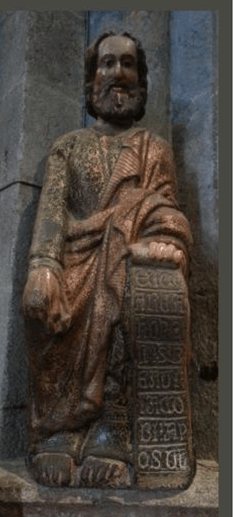
Statue of St James, A’Coruna, Northern Spain. The start of the ‘English Way’ to Compostella. photo. Mr G.
Reflection for St James’ Day. 2Do you seek great things for yourself”
July 25th is the day the Church celebrates the Apostle who gave up his life for his Lord – in an act of what we call Martyrdom- and as the first Apostle to do this. I speak of St. James, the brother of John, son of Zebedee.
I have a soft spot for Saint James for very personal reasons. The Church were my Christian faith was nurtured was dedicated to him, as was the country Church in Lancashire where I served for 10 years. In 2015 I was able to achieve a life-long desire which was to walk the special pilgrim way leading to the Shrine of St. James at Compostella in North West Spain. It’s called walking the Camino and there are various routes starting in many centres in Europe and beyond. Our Group walked the English Way, starting at A’Coruna. It is a very special Pilgrimage.
As with all Pilgrimages, it is a journey with a Holy purpose. We go on Pilgrimage to Holy Places and they become a focus for our journey, but the real focus and the real journey is not outwards but inwards. It is a journey to the centre of our being where we are told by we find the Kingdom of God within. It is a journey which enlightens and, hopefully, enlivens the soul.
It was a wonderful experience which included the building up of a special fellowship with those with whom I walked. I also took with me in my heart all the significant people who had made possible another journey in my life. This journey was both of faith and of devotion.
When I turned the corner of a hill at the entrance of the town of Santiago de Compostella (St James of Compostella) I was overwhelmed by the knowledge of all those who, in varied ways, had watched over me, encouraged and prayed for me. Entering the vast Cathedral I gave thanks. I also felt a sense of debt to the Saint who had also watched over my journey and to whom the Cathedral was dedicated.
Of course, he never visited Compostella physically but, in the hearts of all involved in the great Pilgrimage throughout the ages, he certainly visits it spiritually. As a result of the devotion and piety, the love and the tears and the joy and the prayers, of the pilgrims, and the knowledge of the presence of God there, it is truly an amazingly spiritual place.
Also, oddly, it provides something for which St. James, together with his brother John and his mother desired and asked Jesus for – greatness! Had St James been given the opportunity to follow his brother John into exile on the island of Patmos, he might have been invited to be a guest of Desert Island Discs. He would have been given a copy of the Bible and the collected works of Shakespeare. One would expect he knew something about the Sacred Scriptures but Shakespeare would be unknown. If, in a casual browse, he reached the play, Twelfth Night, he might have read: “But be not afraid of greatness: some men are born great, some achieve greatness, and some have greatness thrust upon them.”
As a humble fisherman plying his trade in a secluded sea he could not have claimed a birthright that was remotely great. To achieve greatness he would have needed more time than was allowed him for his life. His Apostleship was foreshortened by Herod’s sword. Any lasting impact he might have had on shaping the infant Church was therefore denied him. Yet, as the first apostle to be martyred it could be said of him that greatness was thrust upon him. It was the greatness which comes through the ultimate act of self-giving – of giving one’s life for Christ. And alongside that he has received the greatness of being the patron of a major centre of Christian Pilgrimage.
The request for greatness was an audacious request , yet Jesus treated it seriously and even gently. His reply is partly a response to them and partly a prophecy about his own suffering. Asked if they can drink the cup he must drink – that of suffering and death – they readily answer ‘We can’. And indeed they did. James was killed by the sword and John was sent into exile on the island of Patmos – without the collected works of Mr Shakespeare!
The feast of St. James therefore gives us an opportunity for reflection. What does it mean to be great?
In Chapter 45 of Jeremiah are the words: “Do you seek great things for yourself? Do not seek them”
In their original context, the words were spoken by Jeremiah to Baruch, his Scribe and trusted companion. They were spoken at a time when both of them were up against it because Jeremiah’s prophesies were not finding favour with a rather brutal King of Israel – Jehoakim. In fact, they were both on the run and had to go into hiding. Baruch was rather concerned for his own safety and Jeremiah more or less told him to stop being so pre-occupied. (I imagine Jeremiah saying, ‘stop being a wimp!’) Prophets can usually see more about a situation than meets the eye and Jeremiah also saw into Baruch’s heart. He wasn’t just concerned about his own safety. Baruch was also a bit ambitious and one of the reasons he was frightened of falling foul of the king was that it might spoil his chances for greatness. So Jeremiah told him to stop seeking great things for himself. After all King Jehoiakim’s days were numbered. No good looking for preferment there. Only service to and love of God would do.
At this point, of course, we must turn the spotlight away from James and onto ourselves for the lesson about seeking greatness in service applies to us all. Like James and Baruch, we may be far too pre-occupied with ourselves. Maybe ambition, status, wanting our own way, self-centredness get in the way, but there is a way forward We should constantly be seeking a different kind of greatness and it must be one that we paint with the brush of humility.
It is through our humble care, concern, and love for others, expressed through service to them (which, of course, is also service to God) which will move us all in the right direction – and in a partnership of service which has only the status of following a Lord who had no interest in the structures of religion but only in the condition of the human heart and through loving service to us all draws us into His Father’s Kingdom. Icome among you, said Jesus as one who serves. I came not to be served but to serveand to give up my life as a ransom for many. Let’s not forget precisely who said that.
This was the voice of God!
And it’s a pretty stupendous thing when you think about it. God Almighty, Glorious, Omnipotent, Majestic and every superlative you can think of – made Himself our servant. So,Jesus turned the wish for greatness by St James on its head and showed him that only humble service will do. It is a lesson that all of us needs reminding of. I know of someone who might help us here.
Archbishop Michael Ramsey cared nothing for status nor for greatness. In his role as, first, Bishop of Durham and then Archbishop of York and then Canterbury, he held three senior posts in the Church of England. He was a ‘dignitary’ – indeed, he was a ‘Prince of the Church’. He was a man who could be called ‘great’. But it wasn’t his status in the Church that made him great. He was flawed and he made mistakes. But he was great because he was humble. He thought of others before himself. In his dealings with people he had a deep love and concern for their well-being and in his daily praying he held them up in his heart to God.
It was his deep love of God that made him a very special person. He had greatness thrust upon him in one sense but in his heart he was already great because from the very centre of his being he had a love of God – and he showed it.
On the threshold of the feast of St. James I offer him as an example of what it means to be truly Great – that in a spiritual martyrdom where we are called to die to self we are being called to live humbly for God and in His service.
That is what Michael Ramsey did. That is ultimately what St. James did. May we do the same.
[Mr G]
God of our pilgrimage, you have led us to the living water: refresh and sustain us as we go forward on our journey, in the name of Jesus Christ our Lord.
You came on the flow tide blown in, full of hope and zeal. You carried the milk of the Gospel but in your satchel, the firm, solid Good News waited to be heard.
The waves revealed the pilgrim way to Lindisfarne, for its first journeying companion of Christ. Those waves, a sign of what your Lord achieved through you: first, lapping the hearts of those aspiring to know God, then rushing in, hurrying to swamp the land with love: a sea boiling with joy and hope and message.
Milk, then meat. Quiet ripples, then mighty waters of God’s love and grace.
You were sent, Apostle to the North. You came: a gentle breeze inspiring others, awakening in them the wind of the Spirit. Because of you, they stormed the Gospel message, opening others to grace and truth, to joy and love.
St Aidan window | Leonard Evetts Holy Island Church
In 635AD a monk from Iona arrived at the court of King Oswald at Bamburgh in Northumberland. The King had recently won back his kingdom from the pagan Penda and he vowed that his people should become, as he was, Christian. When his father was defeated by Penda, Oswald with his brother and sister were sent, for safety, to live with the monks on Iona – the island consecrated by the prayer of St Columba. There Oswald learned Christianity and it was to Iona that the newly crowned king sent for a missioner to begin the work of proclaiming the Gospel. The first monk to arrive failed to make any headway with the people and it is thought he was too harsh on them. It probably didn’t help his case when he called them ignorant, unteachable and barbaric!
The saintly monk Aidan gently told him that he had tried to feed the people with ‘meat’ when first they needed the ‘milk’ of the Gospel. Not surprisingly, the Abbot told Aidan if he could do any better, he should go to Lindisfarne and see what he could do. Thus he was sent to re-start the mission and his gentle approach to evangelism soon paid off.
As a Celtic monk, he preferred the isolation of an island – although one which was accessible to the mainland for his missionary work and also near the King with whom he intended to work in partnership. Ideally suited (and you can so easily detect the hand of God in this) was the island known as Lindisfarne or today, because of Aidan, Holy island.
Aidan’s approach to mission and evangelism was neither hard-line nor hard-sell. He was a Celt and the Celtic approach was to quietly but certainly overlay pagan beliefs with Christian ones but not by denouncing the pagan. To pagan belief, the Celts introduced a richer interpretation. For example, the pagan worship of the Sun was easily transferrable to worship of the SON, Jesus Christ. Without threatening but through gentle loving, the seed of Christianity was carefully and firmly sown and it paid off.
Aidan also went ‘local’. He set up a monastic school which trained youths for mission, having first steeped them in prayer and Bible study. Twelve boys (like 12 disciples) were the first to arrive and they laid the foundation for a monastic school which was to gain huge renown. The boys, when trained, were sent out as ‘Apostles’ to England. Cedd, for example, took the Gospel to Essex (having first proclaimed Jesus Christ in North Yorkshire). Chad, his brother, proclaimed the Gospel in the Midlands. Aidan himself was tireless in his Missionary journeys. The mission succeeded and was blessed by God, because it combined the deep zeal of Celtic spirituality to travel to foreign parts for the sake of the Gospel with a deep understanding of what the Gospel is. It used local people to spread the Word. Though Lindisfarne began as a Celtic foundation (and was staffed in part from Iona and Ireland) it was also an Anglo-Saxon (native) mission. That’s why it took root. It may sometimes be true that a prophet isn’t often heard in his or her own country but there is another truth which is that if you are convinced by Jesus Christ and build up your relationship with Him, then you will witness to people in your own locality.
Aidan was a clever, wise and astute purveyor of the Gospel and he made it his business to get to know the people he preached to. At first he even took King Oswald along to interpret what he said until he learned the native tongue. And he was gentle and loving. In all this he has much to teach Christians about mission today. He is the Apostle from the North but he became the Apostle of England. Ripples of Gospel love started from Lindisfarne and quickly spread by God’s grace.


 Mr G's Ponderings