Tag: Bethlehem

The King’s Cake

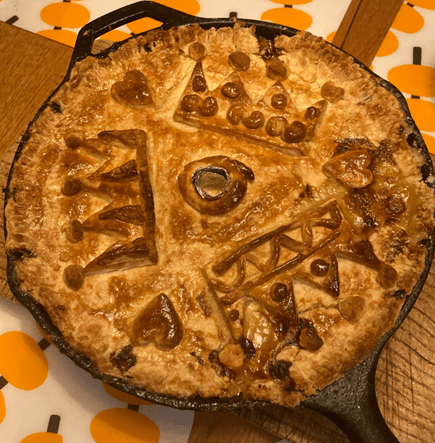
Galette des Rois photographed by Gill Henwood, cooked by her daughter, Kathleen.

This photo of an amazing and mouth-watering cake was sent to me by my friend Gill Henwood. It was made by her daughter Kathleen for the delectation of her two sons.

The cake is known as Galette des Rois, literally the Kings’ Cake. The name derives from the Kings or Wise Men who visited the infant Jesus in Bethlehem, having seen a bright star in the East. These Magi (Wise Men) travelled taking their bearings from the Star. The Gospel account recorded by Matthew in Chapter 2, verses 2 to 12, tells us of their journey, their visit to King Herod and then the arrival at the home of Jesus. Here, they knelt to pay Jesus homage and presented Him with three gifts ~ Gold, Frankincense and Myrrh.
Each of the gifts had a significance. Gold was given because Jesus is worshipped as a King; Incense to celebrate His Divinity (God) and Myrrh which is used to embalm the dead. It was a foretelling of the Crucifixion when the Son of God died for the well-being of humanity and opened the way for us to turn aside from sin and so live for God and in the depth of God’s love for us.

The feast of the visit of the Wise Men is known as the Epiphany – the showing forth of God’s Glory. There are other Epiphanies during this extended Christmas season to Candlemass (February 2nd). The Epiphany to the Magi is kept on January 6th, which coincides with Christmas Day in the Eastern Orthodox Churches.

Because the Wise Men brought three gifts it is commonly held that there were 3 of them and because they travelled from the East over desert lands, it is believed that they rode on three camels.
Later documents increased the number of kings – St John Chrysostom even suggested that there were 12 of them!
The Venerable Bede, writing in the 7th Century named them and that has become fairly definitive – Balthazar, Gaspar (Caspar) and Melchior.
Many other legends and customs grew up around them.
The Galette des Rois is one of them.

In many places on the night before the feast of Epiphany, a special cake would be served with three beans hidden inside, two white beans and one black one. Whoever found the beans would be the King at the Epiphany feast. Dressed in fine robes, they would preside over the feast and before leaving would hand out small gifts, equivalents of gold, frankincense and myrrh. In the royal courts of the Middle Ages, Epiphany Cakes would contain a bean for the king and a pea for the Queen. Whoever found the bean and the pea would be the King and Queen of the feast. A more recent variation is that the figure baked into the cake (especially in France) is a tiny plastic or ceramic statue of Christ. An alternative name for the Cake is therefore Christ cake. Whoever found the statue would be especially blessed throughout the coming year.

There are many recipes available for making the cake, especially in France, from where it takes its name. It is as popular in France as the Christmas Cake or Pudding are in Great Britain. The cake itself can be made with puff pastry, though often it is brioche. It is often filled with frangipane, an almond paste. As you will see on Kathleen’s cake, it is decorated with crowns and small figures of the kings. There are hearts representing God’s love and in the centre, a circle of pastry which tells me about this love of God which is eternal.

Though we are beyond January 6th it is not too late to bake a Galette des Rois. In France it is quite common to eat this cake throughout January.

[Mr G. 9th January 2026]

The Love of God for us

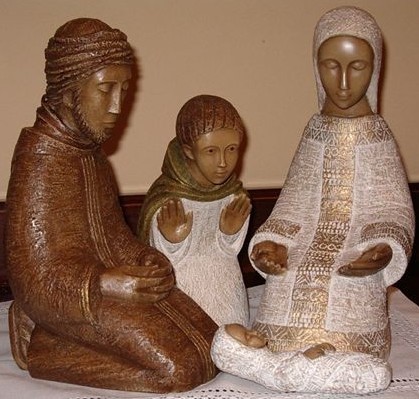
Crib figures photographed by Mr G

There is a story about a Vicar who was baptising a baby in a very large font. The baby slipped from his grasp and disappeared under the water. With presence of mind,he thrust his hand into the font and fished around, saying as he did so, “I know he’s in here, somewhere!”

That’s how I sometimes feel about Jesus and the Christmas hype. In the days and weeks before Christmas we get a bit manic and caught up in frantic activity which has very little to do with the real Christmas. Yet, amidst all the trappings of Christmas and all the false trails we are led along by commercialism or fantasy, there is a real message to be discovered. For Christians there is a real Jesus to be found; an Incarnation to celebrate; and a true God to thank for his greatest gift to the human race – the gift of Jesus as a supreme statement of His love for us all. It’s a truth – Jesus is in there, somewhere. We simply have to pause and be still to discover him.

One of the places I discovered him  is a little mountain village in  Italy called Greccio. Above the village there is a church, built on the site of a very special event which was to have a profound influence on the way we celebrate Christmas and understand its real message.

At Greccio in 1223, St. Francis of Assisi decided that he wanted to celebrate Christmas in a rather special way.
Christmas Day was always a day of special joy to him and in his mind and heart he would relive in spirit the Bethlehem event. It was always a great source of wonder to him that God had taken our likeness and become one of us in Jesus.

At that special Christmas in 1223 Francis spoke to one of the gentleman knights of Greccio and said: “I would like to celebrate the next feast of the Redeemer with you. I would like to recall his birth in Bethlehem in order to see all the poverty he endured from his birth to save us sinners.”
The knight wondered how he would be able to help St Francis to do this and Francis explained: “I want you to put a manger filled with hay in the cave you own on the mountain and I would like you to bring an ox and an ass exactly as at Bethlehem. On Christmas night, I will come up there and, together, we will pray in the cave.”

The knight did as Francis asked and as Christmas Day approached, a great procession made its way up the mountain track. The Franciscan friars were joined by the villagers, shepherds from the surrounding hills and local farmers. Their torches punctuated the darkness with light and the air was filled with song as the friars sang a special hymn which Francis had composed:
“God is our strength. The great and holy Lord sent from the heavens above, his Son born of the Virgin Mary. A chosen Child has been given us and placed in a manger.”

Reaching the cave they were greeted by a crib scene – no longer a distant scene in historic Bethlehem brought to their lives by a biblical text. It was there before them. It was as if, that year, Bethlehem was brought to the top of the mountain of Greccio and they were as much a part of it as those Shepherds long ago. The Eucharist was celebrated on a small altar and Francis explained the Christmas  Gospel – and then, he took a small child from amongst those gathered and laid him gently in the hay. There before them a defenceless child symbolized a vulnerable God who chose to become involved in our lives as one of us in order to bring to birth his love in our hearts.
As the Eucharist was celebrated so they each came forward to receive the sacrament of Holy Communion and their involvement was complete.
Jesus who had come to the world at Bethlehem came into their lives under the form of a piece of bread – vulnerably he placed himself into their hands, as defenceless as he had been in the manger – and it was their hands cupped to receive him which became the crib. Behind all this they discovered the profound truth of Christmas – that love had come to them; they were deeply loved.

The farmers and shepherds and villagers returned home full of joy. It is said that the night was glittering so bright that there was no longer need for their torches to light the way. Each of them was aglow with Christmas light and hope.
They had all been touched by God and had been caught up into heaven as they discovered in the simplest yet most profound  way possible the truth that in the birth of the Christ-child they had been drawn into the life of the :
Great little one whose all-embracing birth
Brings earth to heaven, stoops heaven to earth.

Of course, what happened in 1223 in Greccio was just a beginning. As a result of what Francis did cribs are to be found in almost every Christian church, many city, town and village centres and all places where Christ’s birth is celebrated.
Children gaze in wonder; adults are reduced to awe; prayers are said and hopes and longings find a focus; sadnesses are poured out and joys are celebrated. The image of the Christ child in swaddling clothes and lying in a manger draws people to contemplate the mystery of God born in our midst in so fragile an environment, so vulnerable a birth. And each one of us who celebrate Christmas is drawn into an involvement with the real Christmas.
Like the villagers, farmers and shepherds in central Italy long ago, we have been invited to discover that God really does love us. In our dark and vulnerable world of today we do need to hear and believe that!

This has not been the easiest year for the human race and so many are left feeling unprotected and fragile. We are less secure and less certain; Ours is a much darker world than it was last Christmas.
In Bethlehem today, as in many places of the world, there is not the stillness of that much loved Carol, Silent Night.
The Archbishop of York, Stephen Cottrell, in his Christmas message from Bethlehem, spoke of a silence of those feeling abandoned,living in tension, fear, turmoil. He spoke, too, of the people in Gaza and the West Bank and the pain and difficulties of their lives. Archbishop Stephen urged us all to pray, “as never before for peace in the Holy Land.” 

A meaningful peace is formed in hearts of love. It’s needed also in the Ukraine, the Sudan, Syria and so many areas of global conflict where there is struggle between human beings fighting each other in the name of ideologies which bring conflict. Bethlehem has become synonymous of all that is not pure and lovely in humanity and all that is wrong in the human heart. For many, the answer has been to live for themselves but we are all involved with each other.
We need to hear that we are loved and valued and of infinite worth. We need to feel secure enough to reach out in love to others.
The crib of Christ offers us that security, albeit from the most vulnerable place imaginable – the innocent heart of a babe born in the very margins of society and in the most inauspicious of circumstances.
Yet from the crib, Godly love pours out to us drawing from us awe and wonder of a God who is prepared to risk everything and who is prepared to love us despite what we do to him and to each other. In our own need and vulnerability, we should rediscover this.

Here are words of  the late Mother Jane SLG, a nun whom I had the privilege of knowing personally and whose wisdom lives on for us.
“If we have the courage to admit the reality of our situation, that we can rely only on God, we are open to receive the glory which will shine in every corner of our lives and ourselves, showing up the shadows more starkly, but inflaming us with a delight in God that keeps our perspective right and helps us to accept and transcend our own and other peoples’ shortcomings because the love of God is so much more important.”

The Love of God is so much more important – because of Christmas he is in our lives somewhere. May we discover that He is in our hearts. It will make all the difference.

[Mr G. Christmas Eve 2025]

St. Brigid and the manger of Bethlehem

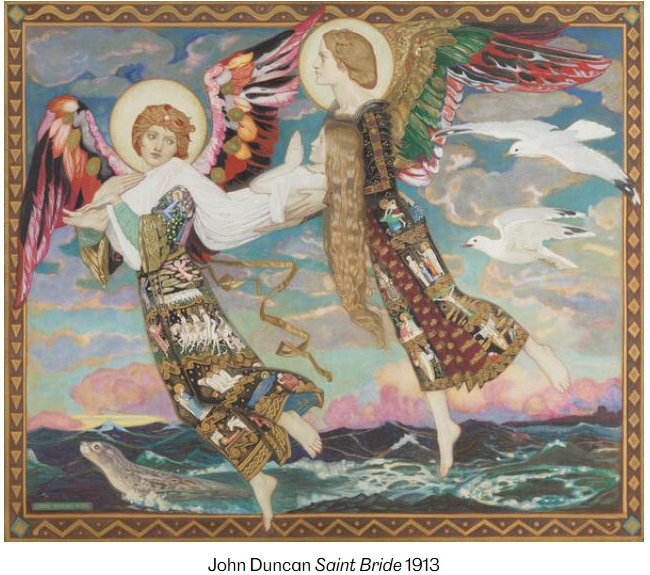
St Brigid and the Manger.
Last Saturday, February 1st, we remembered St. Brigid (sometimes spelt, Brigit).
Along with St. Patrick, she was Apostle to Ireland and is credited with him as one who proclaimed the Good News of Jesus Christ to the Irish people.
At that time the links between Ireland and what is now the southern part of Scotland were very strong. So Brigid(t) enjoys a special place in the hearts of both nations.
Her abbey was at Kildare in Ireland and, as in some parts of the Irish Christian tradition, it was a double monastery of both women and men. This practice was  later transferred to Northumbria via  the mission from Iona.

Many stories, traditions, myth and legends grew up around St Brigid, including one that suggests she was ordained Bishop to serve her Irish congregations. There is more evidence than not about this and if true, Brigid would have the honour of possibly being the first Woman Bishop in the Christian Church! That’s a thought for another time but one legend about her was brought to my attention by my dear friend, Heather Upfield, with whom I enjoyed a lovely friendship when we were both in Edinburgh. Her love of what we now call the Celtic spiritual tradition did much to feed and inspire my own love of it.
Earlier this week I received this note from her:

In the Scottish tradition, St Bride was carried by angels from Iona to Bethlehem on Christmas Eve to be midwife to Mary at the Nativity. She then remained with the Holy Family till Mary and Joseph took the baby Jesus to the Temple. In the Candlemass mythology, she walked ahead of them carrying lighted candles, with a crown of lit candles on her head.” 

The painting above by John Duncan, painted in 1913, which is in the National Gallery of Scotland, is inspired by this story. The two angels are carrying the saint between them to Bethlehem.

Wanting to know more, who better to turn to than my friend, Heather? I happened to find an article, by her, on St Brigid which was published in 2017. Here is the part of that which refers to this story.

[Brighid, St Brigid, St Bride, St Bride of the Isles and Scotland’ 
©Heather Upfield, www.brighid.org.uk/scotland_footprints.html, 16 April 2017.
]

A certain caution must be exercised and possibly a suspension of belief in this story. It is part of a folklore which belongs to a people who understand the importance of myth as containing a kernel of truth rather than made-up fiction. Chronologically, of course, it can’t be an historical truth but there is more than one sort of truth, especially where angels are involved! Sometimes we have to move from the human realm to the heavenly to discover a new way of discovering the heart of God. Poetry, art, storytelling and music belong to this realm. Often words fail us in their bareness and logic but spring to life in a new way if we use our communication skills differently.

So the myth of St Brigid’s visit to Bethlehem and the echo of a Candlemass ceremony which is ascribed to St. Lucy in Scandinavia , are wonderful stories about new birth, tenderness, care and light. Bride’s visit to Bethlehem is also a delightful and fun story. Anything that brings a smile to our lives right now can only be good!

Thank you, Heather, for bringing this source of joy to my heart.

[If you wish to know more about the painting by John Duncan, go to the website of the National Gallery of Scotland.
Search for John Duncan and click on to the the very informative podcast]

The Difficult Journey

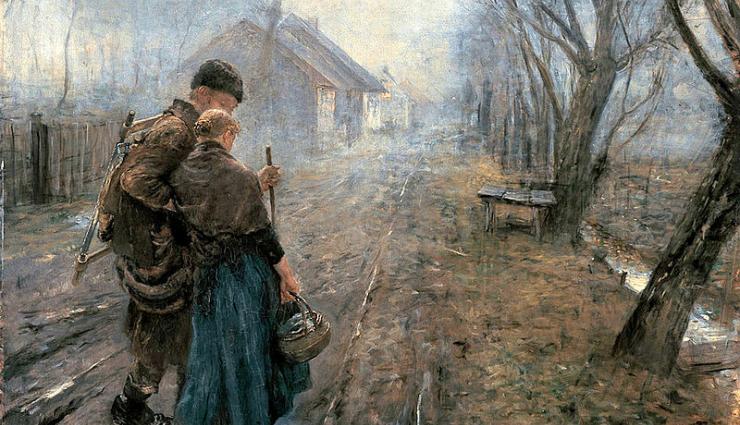
Difficult Journey is a painting by the German artist, Fritz von UHDE. Its original title was Transition to Bethlehem which locates the scene and therefore the subject. It is the journey of Joseph and Mary to Bethlehem for the Census. It depicts something of the difficulties they had in bringing Jesus into the world.

Many paintings of this journey and arrival are much more sentimental but this has a realism which roots it into a more contemporary interpretation. It isn’t located in the desert or the climate of the Middle East. This is Northern Europe. The road is muddy and uneven. There are no other people around and there is none of the bustle and crowded feel of a city where there is no room at an inn. There is, however, a sense of isolation and desolation. There are no people and no sense that the couple are welcome. They are dressed as outcasts, he carries the sign of his trade, a saw over his shoulder and she, a cooking pot. They could be refugees today, unwanted and uncared about.

There is  a sign that  Mary and Joseph are exhausted. No donkey carries them as in some accounts, though not in St. Luke’s Gospel. What is strongly portrayed is Joseph’s role as protector of Mary and therefore of Jesus. She leans into him and he holds her. He is concerned and caring. His love is obvious.

It is this which set me thinking again about Joseph’s role in the Nativity and a partial possible answer is in the poem below which I have written about this.

Difficult Journey

Against all judgement,
honourable, obedient Joseph
took Mary to be his wife.

It would be difficult
stepping into God’s shoes.
Overshadowed by an angel,
Joseph was appointed
to watch over the God-bearer;
the gentle, honest, open, faithful maid
who had conquered his heart.

It would be hard to fulfil God’s hopes,
God’s plan, worked out with angels
who were centre-stage of a sacred drama
played out on earth.
Joseph could see where Mary fitted in,  
but what of himself?

Legitimate descendant of David,
the sling-thrower warrior,
Joseph threw only wood on a lathe –
turning, shaping, forming,
revealing what was there;
allowing the inner core of wood
to show itself – its soul.

Joseph, gentle, watchful carpenter,
who strokes the grain,
and feels the beauty within,
holds Mary and the babe in her womb,
on the difficult road to Bethlehem
with its uncertain future.

He draws her carefully into the folds of his caress,
exhausted woman, with kicking  inner child,
who needs him.

The dawning realization:
he knew why God had called –
and that He held him too.

[Mr G. Christmas Eve 2022]