Tag: BLM

Pioneers of Black Rights

BLACK LIVES MATTER

Lewis Hamilton continues to draw attention to injustices towards Black people (and others) through his high profile anti-racism demonstrations at Formula 1 meets.

It is obviously something he feels deeply involved in and because of his celebrity status, the T shirts he wears and the actions he takes are powerful statements which remind us that, as far as human rights towards black and other ethnic groups, we have a long way to go.

However, whilst that is true, we have also come a long way and in the midst of much negativity about the way White people, especially those with power, have failed to work for change – not least a change of heart – there are those whose actions have made a difference.

There are many who, over the years have been working quietly and not so quietly to celebrate and promote the dignity, equality, integrity and joy of being a motley collection of people who populate this planet Earth – a planet which we share both with each other and with the Creation of which we are supposed to be ‘stewards’ not ‘lords’. Being stewards means we take responsibility for caring for, developing and enriching the Earth. This includes all peoples who share the gift of our beautiful world. Currently we are thinking particularly of displaced people who have been made refugees through no fault of their own. Many are suffering after being made homeless on the island of Lesbos when their camp was destroyed by fire.  Other refugees drown in the Channel.   All of them as much part of the human race as we are.

Yet, whilst we all have much to repent of in our failures in stewardship, care, and the fight for justice, we also have things to celebrate.  We can all think of the likes of Mother (now St) Teresa of Calcutta, Desmond Tutu, or Oscar Romero in his battle for the rights of people in El Salvador.

I want to mention, however, two particular men for whom Black Lives Mattered so much that they were prepared to lay their lives on the line in different ways but for the same purpose. They wanted those who suffer injustice, indignity, oppression and a lack of kindness to know that there are people who value and care for them.

They refused to accept the lot of those whom many would cast to the outer edges of society. Both are or were members of the Anglican Church and, as someone put it,

It is probably a truth that the Church makes her most powerful statements of faith from the margins of society rather from the centre of it.

My thoughts about these things are encouraged by my friendship with Patrice and her son, Ty. Patrice is from Jamaica but her heart was made in heaven.  However, it was in a book compiled by The Rt. Revd. Alan Smith, bishop of St. Albans to honour the holy people who have associations with that Diocese, that, on Holy Cross Day (14th) I was reminded about, Trevor Huddleston.  
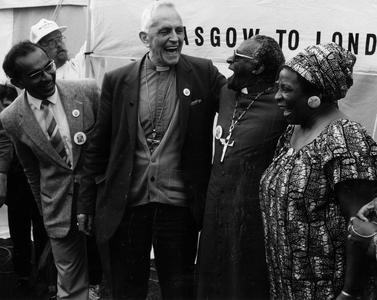
Bishop Trevor Huddleston sharing a joke with Archbishop Desmond Tutu

Long ago he played a significant part in my own faith journey but that is for another time. His entry in ‘Saints and Pilgrims’ gives us the reason why he is so important for the Black Lives Matter movement and for all who seek not only to right wrongs towards Black people and other ethnic groups, but actually to celebrate with them our common humanity.

Trevor Huddleston is ‘remembered for his tireless campaign against Apartheid.’ Many, like me, grew up with a knowledge of Apartheid—the insidious doctrine of separation which not only kept the races apart in South Africa but also ensured that most black and ‘coloured’ people lived in abject poverty.

The entry goes on to say that his costly prophetic ministry in South Africa, was a long way from his Bedford roots, and his education at Lancing College and Christ Church, Oxford. After that, he trained for ordination at Wells Theological College and then, perhaps as a surprise to many, he joined the Community of the Resurrection, an Anglican religious community based, as it still is, in Mirfield, West Yorkshire. The Community eventually sent him to a mission station at in Rosettenville in Johannesburg, South Africa. As the Priest-in-Charge of the CR’s Anglican Mission in Sophiatown and Orlando, Huddleston ministered in the townships between 1943 and 1956.

Amongst the people he had dealings with was Nelson Mandela with whom, together with another Anti-Apartheid leader, Oliver Tambo, he developed a great friendship. His ministry there has been described as a courageous witness against the evils of Apartheid but, on the positive side, his was a witness to a common heritage that makes us equal and mutually dependent on each other. His fight for Black people often took the form of protest and dispute but deep in his heart was a love of people that simply wanted to make them feel important, cared for and helped. The people responded to his deep kindness and battling on their behalf by nicknaming him, Makhalipile,  which means ‘the one who is fearless.’

Nelson Mandela said of him: ‘Father Huddleston walked alone at all hours of the night where few of us were prepared to go.  His fearlessness won him the support of everyone. No-one, not the gangster, tsotsi, or pick pocket would touch him.’

Of course, he made enemies – some powerful proponents of the Apartheid philosophy. There was a growing concern for his safety and the Community of the Resurrection recalled him back to Mirfield.  His heart was made heavy by the decision but as a monk he had taken a vow of obedience.
His struggle for justice continued, however, not least through lobbying powerful politicians but also through the writing of a book, ‘Naught for your Comfort.’ Published in 1956, it almost didn’t see the light of day. He managed to get the manuscript out of the country just 24 hours before all his papers were seized by the authorities for whom he had become a massive thorn in the flesh.

In the book he tells of his ministry to thousands and he gives a moving account of their struggles to make good and his determination to help them do so. At the time, Apartheid was little understood in Britain. This book was therefore explosive, all the more so because it was not so much about the theory of Apartheid as about what it was doing to human beings who just happened not to be White.

Trevor Huddleston returned to Africa twice more, first as Bishop of Masasi in Tanzania and, after a spell as Bishop of Stepney, later as Bishop of Mauritius and Archbishop of the Indian Ocean – a role that was less about preaching to the waves and more about loving the communities nearby!

When he retired he returned to Mirfield but he was to make one further journey to Africa: Father Huddleston died on 20 April 1998 at his home in Mirfield but his ashes were interred next to the Church of Christ the King in Sophiatown. As he lived, so in death he remained a ‘Citizen of Africa’ – something he was proud of.

He was given many honours but I suspect the greatest was to be known as one who, in a destructive society filled with hate for Black people who were the true natives there, brought love and kindness, two simple but powerful qualities which change the world. For Trevor Huddleston both stem from his own experience of being held in the love and care of God whom he simply served. It was a love and a care which flow through the suffering of Jesus on the Cross through to the glory of the Resurrection. It was no accident that God had called him to become a ‘Mirfield Father’ of a community that has, as its symbol, the Resurrection Lamb.

Alongside Trevor Huddleston, in a different way is the witness of another remarkable priest, Gonville ffrench-Beytagh.  I was privileged to meet him when I was a theological student. I have never forgotten him, nor his witness to the Gospel.
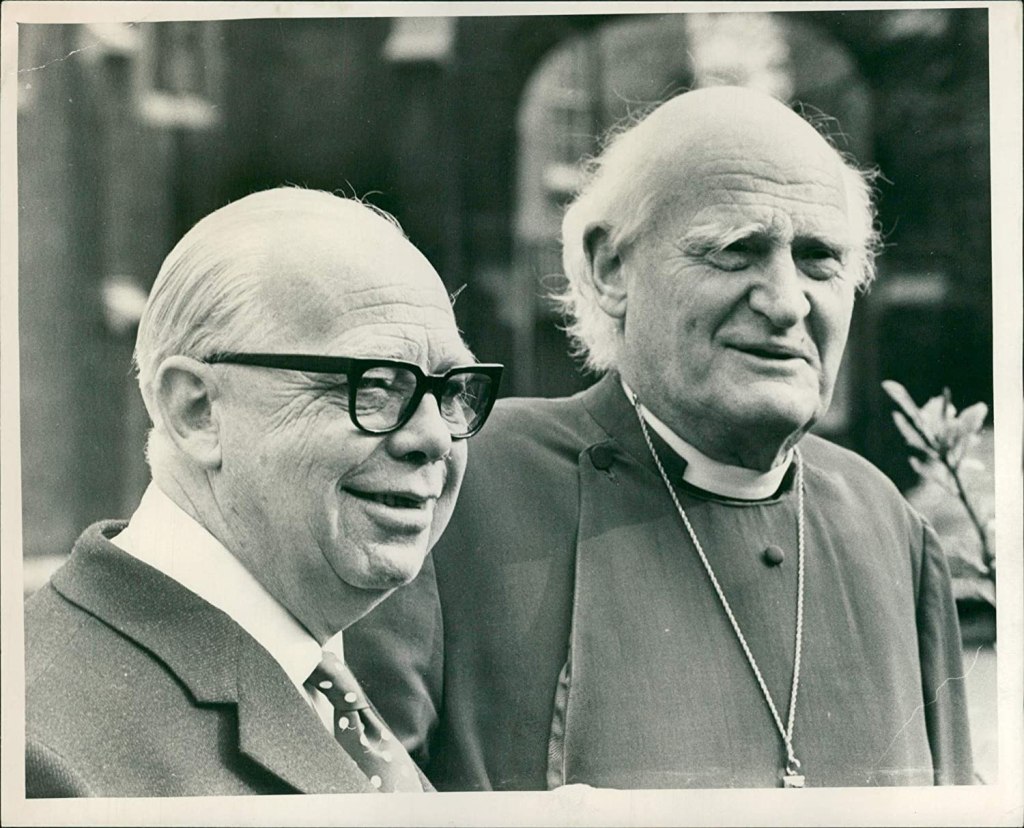
Gonville ffrench-Beytagh with Archibishop Michael Ramsey

He isn’t heard of these days but he was the Anglican Dean of Johannesburg. Apartheid was then at its height in South Africa. Gonville ffrench-Beytagh commited a terrible crime: he dared to give Communion to whites and blacks kneeling together at the same altar rail.  He was arrested and sent into solitary confinement.  He was fed on salted beef, given little water and every minute the light in his cell flicked on and off.  He was isolated and the aim was to break him as a human being. 

He almost went mad but he said that his faith had saved him. In a cell where he had nothing, he regularly celebrated the Eucharist. He had no bread or wine and no prayer book but he recited the service from memory and meditated on Scripture which had, over long years of study, impregnated his soul. He spoke of the moment of Communion, when he took nothing into his hands and received no sacrament, as one of the most spiritual experiences of his life. It was then that he felt the power of prayers being said for him throughout the Christian world.

In this he has been an encouragement during the time of lockdown when Christians also haven’t been able to meet together. There has been for many a discovery of ‘spiritual communion’ rather as Gonville ffrench-Beytagh experienced it. Through God’s grace it was deeply valid for him as it has been for us for at its heart is Jesus’ presence.

In giving Holy Communion to Black and White people kneeling together, he was making a statement of how God views his children on earth.  All are welcome, loved and accepted as equals. Gonville ffrench-Beytagh’s action might have challenged the authorities, leading them to act. (There is a precedent for this in the Gospel of course.) I think, however, that he was simply saying ‘God loves all of you. I love all of you. Jesus died for you and rose again. This Eucharist is the place where you all meet to celebrate that. That is quite a powerful witness!

Both Trevor Huddleston and Gonville ffrench-Beytagh are people who stood up for the truth that Black Lives Matter and whilst there is an inevitable sense of protest about that, what really matters is less about demonstration and more about loving action. When Black and White and Brown and Pink and every rainbow hue meet together and recognise each other’s worth and the need we have for each other, then maybe we will learn the importance of being kind to each other, cherishing and treasuring what is special in our mutual, common and eternally-bound lives.

I think that would gladden the hearts of Trevor and Gonville very much indeed.

[GC]

Mary Seacole – one who showed that both Black and White lives need each other.

Mary Seacole | Martin Jennings
photo | Piers Northam

In recent months, I have been having treatment at St. Thomas’s Hospital at the southern end of Westminster Bridge. In the garden there is a remarkable statue depicting Mary Seacole . It was unveiled in 2016 and it is claimed to be the first statue of a named black woman in the United Kingdom. I have sat at her feet on a number of occasions and wondered about her story.

The Plaque in the floor in front of her statue gives a little information:

MARY SEACOLE
Nurse of the Crimean War
1805 – 1881
“Wherever the need arises
on whatever distant shore
I ask no higher or greater privilege
than to minister to it.”

To find out more, I discovered that there was The Mary Seacole Trust which was set up to promote the values for which she stood. This article owes its inspiration from material by the Trust.

I discovered that Mary was born in Jamaica more than 200 years ago. This was the heyday of the slave trade when many Black people in the Caribbean were forced into slavery. However, though Mary’s mother was black, her father was a white Scottish army officer so Mary was born a ‘free’ person.

Her mother had skills in healing and she passed on her skills to her daughter. Mary was eager to learn and as a child she practiced her ‘skills’ on her doll, her dog and cat and even on herself. She spoke of having a yearning for medical knowledge and practice. Her doll supplied a ready patient and, in her autobiography, Mary wrote: “Whatever disease was most prevalent in Kingston, be sure my poor doll soon contracted it.”

By the age of 12  she was helping her mother to run a ‘boarding house’ where many of the guests were sick or injured soldiers. At the age of 15 Mary travelled to England to stay with relatives for a year. This provided her with an opportunity to learn about Modern European medicine. Later, in 1823, she was to return for 2 years. I was during this time that she first encountered racist comments made against her. After further travels she returned to Jamaica where she nursed her patroness through a long illness.

In 1836 she married Horatio Hamilton Seacole but sadly, they had been married but a short time when he fell ill. Mary nursed him until he died in 1844. Her mother died soon after and Mary was plunged into a double grief. A Cholera epidemic followed by an epidemic of Yellow Fever kept her busy and she was invited to supervise the nursing service at Up-Park in Kingston, the Headquarters of the British Army.

The compassion she felt for injured soldiers awakened a strong maternal instinct in her and it led her to the War in Crimea – part of what is now the Ukraine. The conflict was between Britain and her allies against the Russian Empire. It lasted from October 1853 until February 1856.

Mary heard that medical facilities were poor so she approached the British War Office to volunteer her nursing services. She was refused and later she thought this might have been because she was black and a result of racism. She was not deterred! She funded her own trip to the Crimea. There she established the ‘British Hotel’ with a relative of her husband, Thomas Day, to provide a place of respite for sick and recovering soldiers. It was near to Balaclava, close to the fighting.

Regardless of personal danger she visited the battlefield to nurse the wounded. Such was her deep care and kindness that the soldiers began to call her ‘Mother Seacole’. After the war soldiers wrote letters to the newspapers praising what she had done. Sir William H Russell, war correspondent for ‘The Times’ wrote about her:

“I trust that England will not forget one who nursed her sick, who sought out her wounded to aid and succour them and who performed the last offices for some of her illustrious dead.

These words are carved near her memorial at St. Thomas’s

Mary came back to England with very little money but those who admired her came to her aid. Soldiers, Generals and the Royal Family all contributed. A fund-raising event lasting 4 days attracted 80,000 people.

She also wrote her autobiography. Its rather dull title – The Wonderful Adventures of Mrs Seacole in many lands – did nothing to stop sales and it became an instant best seller.

She died in London in 1881. For a while – almost one hundred years – she was all but forgotten. Then some nurses from the Caribbean visited her grave. The local MP, who had became Lord Clive Scoley, set up fundraising for a statue. In 2004, Mary was voted the Greatest Black Briton and in 2016 her statue, by Martin Jennings was unveiled in the garden at St. Thomas’s Hospital.

She is remembered for her empathy, compassion and kindness. She needs to be remembered for much more. She is an icon for the Black Lives Matter movement but in a very special way. Her life, her self-giving, her tending of the sick, her desire and longing to heal others are important qualities which should inspire all of us.

She was also a bridge-builder. Her life, lived for others was mainly helping white people. For her, White Lives Mattered. So she reminds us that integrity, respect and love grow when we all recognize our mutual dependence on each other. All who needed her were met with acceptance, not judged, not treated as sub-human but with friendship and deep care. Many who were ministered to by her came to  see her not for the colour of her skin but rather for the depth of her heart.

That’s why she matters today.

Seeing with fresh eyes

Black Lives Matter
– a prayer installation at St Albans Cathedral that makes us think again...

A Last Supper | Lorna May Wadsworth

Quotation from the Cathedral website:

We are deeply grateful to the artist Lorna May Wadsworth who has given permission for us to use her striking painting of A Last Supper as part of a prayer installation in the North Transept. In the painting Jesus is a black man, and so calls us to ‘look with fresh eyes at something you think you know’.

At St Albans Cathedral we stand with the Black Lives Matter movement to be allies for change – building a strong, just and fair community where the dignity of every human being is honoured and celebrated; where black voices are heard, and where black lives matter.

Lorna May Wadsworth explained: 

“Painting the Last Supper altarpiece made me really think about how we are accustomed to seeing Jesus portrayed. Experts agree he would most likely have had Middle Eastern features, yet for centuries European artists have traditionally painted Christ in their own image. I cast Jamaican-born model, Tafari Hinds, as my Jesus to make people question the Western myth that he had fair hair and blue eyes. My portrayal of him is just as ‘accurate’ as the received idea that he looked like a Florentine. I also knew that, from a previous portrait of Tafari, there is something in his countenance that people find deeply empathetic and moving, which is the overriding quality I wanted my Christ to embody.” 

The installation can be seen at the Altar of the Persecuted in the North Transept until 31st October 2020

SAMBO – the tale of a young slave boy

BLACK LIVES MATTER

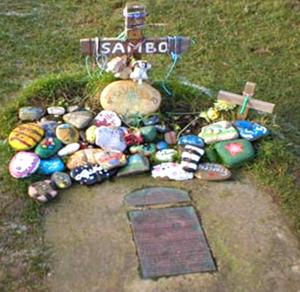
On the edge of Sunderland Point about a mile from the village of Overton, near Lancaster, there is a very special grave.  It is the last earthly resting place of a slave boy known only as Sambo (originally Samboo).

He was a cabin boy to his master who captained a vessel involved in trade between Lancaster and probably Angola.  From there, the ship was used for the slave trade, transporting men, women and children, to work in the plantations in the West Indies.

We know a little more about this because of the resurgence of a fight for justice by the Black Lives Matter movement.  Many in England were involved, some quite local Essex people, but we can assume that Sambo’s Master was a Lancastrian from the Lancaster area.  After a voyage to the West Indies, via Angola, the ship sailed back to Sunderland Point, then the port for Lancaster on Morecambe Bay.  (It was later superseded by Glasson Dock which eventually was itself usurped by the great port of Liverpool.)

Morecambe Bay is notorious for its fast-flowing tides which turn Sunderland Point into a tidal island.  This itself was why a group of 21 illegal Chinese immigrants caught up in the modern day slave trade , died: picking cockles from the Bay in 2004,they were caught by an incoming tide and drowned.

When the ship carrying Sambo arrived back in Morecambe Bay in about 1736, the Captain had business in Lancaster itself so Sambo was placed in a local inn until the ship was to sail away again.  Not being able to speak the language and in a foreign place he felt abandoned. Some records say that he also fell sick of a disease his body could not fight.  In his anguish he refused food and, before his Master returned, he died.

Sambo's GraveThe local worthies of Sunderland Point and Overton could not agree that he should be buried in the churchyard because he was a heathen and unbaptized.  The sailors took his body, therefore, and dug a simple grave about a few yards beyond the village.

In refusing to bury him in the churchyard the inhabitants of the area ensured that he would remain more renowned than any of them!  60 years later, James Watson, a retired Headmaster from Lancaster, raised money from donations by holidaymakers and erected a memorial to Sambo which reads:

Here lies Poor Sambo, A Faithful  Negro who
(attending his master from the West Indies),
Died on his arrival
 at Sunderland.

He also wrote a short poem, Sambo’s epitaph.

Full sixty years the angry winter’s wave,
Has thundering dashed this bleak and barren shore,
Since Sambo’s head laid in this lonely grave,
Lies still and ne’er will hear their turmoil more.

Full many a sandbird chirps upon the sod,
And many a moonlight elfin round him trips
Full many a summer’s sunbeam warms the clod
And many a teeming cloud upon him drips.

But still he sleeps – till the awakening sounds,
Of the Archangel’s trump new life impart,
Then the Great Judge his approbation founds,
Not on man’s colour but his worth of heart.

On my first visit there over 25 years ago, I noticed the grave was festooned with wild flowers, in simple jars and crude but lovely wooden crosses.  I was told that the local children tried to make sure that the grave was decorated. It was their way of taking care of one of their own.  Today, a wall is being built around the grave.

In our time, when the death of George Floyd has sparked a renewal of the spirit which drove William Wilberforce to champion the movement to both abolish slavery and to bring equality and justice for Black People, Sambo’s story is an important contribution to that movement.

Ironically, as statues of slave traders have been torn down or moved, Sambo’s memorial remains as a beacon for those who in different ways have suffered because of the inhumanity of others.  In death and since, Sambo has been treated with reverence, kindness and hopefully, humility.

It is clear that his Master, though of an age where the Slave Trade flourished, of which he was certainly part, was also a kind man.  He ‘bought’ Sambo and treated him as his cabin boy for whom he cared. Back in Lancaster he took him to an inn thinking he would be safe there.  Sambo’s well being mattered to him and his sailors had a similar compassion.  They made sure that the boy was decently buried, something that was almost denied him by local Christians at the time!

Out of evil comes good and out of darkness, light. The subsequent story of Sambo is being told by all those children and visitors who go to Sunderland Point to pay their respects and to adorn his grave with simple tokens.  They are showing an act of kindness and they are re-membering the memory of Sambo, bringing into the light of the present, the importance of treating people equally, with kindness and with love.

The statement being made by those who are Sambo’s grave-keepers is that: Black Lives Matter and also that all lives matter, whatever colour, creed, gender, sexuality, or personal circumstance.  We should all matter to each other and human dignity is an important thing we should cherish.  To share in this work is to share in our Lord’s work of Loving us because we all matter to God who judges us on the worth of our hearts.