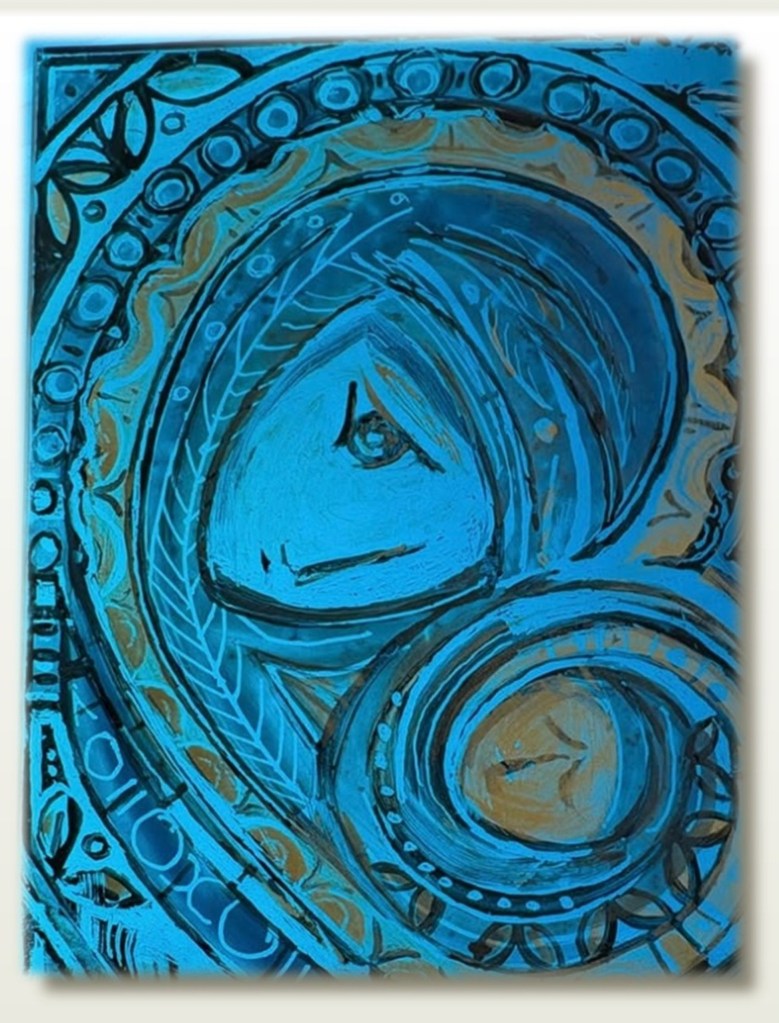
Mary & Christ Child, painting on glass, Kay Gibbons.
Nothing is impossible for God,a Poetic Reflection on Christmas by Jenny Dawkins
Heaven springs a leak over ordinary earth.
It starts over Nazareth a droplet of light holds its breath and falls into an ordinary home. At a young woman’s Yes, a secret starburst.
Shadows, shaken, take one step back.
Passers-by miss the glow But in her belly the promise has taken hold.
She grows luminous in this pregnancy Though some days she wishes otherwise the iridescence in her is irrepressible. When she sings the town hears sunrise.
Nine months later, Another angel drops liquidly onto a hillside.
The very grass becomes golden. Shepherds cheeks redden in the face of this midnight dawn.
An announcement defies the dark: Come and meet Light. Come and see Hope. Come and know Love. You need not be afraid.
And suddenly, heaven gushes light and song and joy over this ordinary earth.
It is unstoppable.
Shepherds run and splash through puddles shouting, “Come and See!”
Though the world is dark a new day has been born, and what was once, will become forever. and what was glimpsed will one day be seen in full.
Every ordinary place alive with this bright reality. every hillside drenched in glory.
For with God, nothing will be impossible.
~~~~~~~~~~~~~~~~~~~~
Jenny Dawkins (Revd). Vicar of Christ Church, Gipsy Hill, London. Poem reproduced by permission. for more from Jenny see her Instagram page ~ gipsyhilljen.
There is a story about a Vicar who was baptising a baby in a very large font. The baby slipped from his grasp and disappeared under the water. With presence of mind,he thrust his hand into the font and fished around, saying as he did so, “I know he’s in here, somewhere!”
That’s how I sometimes feel about Jesus and the Christmas hype. In the days and weeks before Christmas we get a bit manic and caught up in frantic activity which has very little to do with the real Christmas. Yet, amidst all the trappings of Christmas and all the false trails we are led along by commercialism or fantasy, there is a real message to be discovered. For Christians there is a real Jesus to be found; an Incarnation to celebrate; and a true God to thank for his greatest gift to the human race – the gift of Jesus as a supreme statement of His love for us all. It’s a truth – Jesus is in there, somewhere. We simply have to pause and be still to discover him.
One of the places I discovered him is a little mountain village in Italy called Greccio. Above the village there is a church, built on the site of a very special event which was to have a profound influence on the way we celebrate Christmas and understand its real message.
At Greccio in 1223, St. Francis of Assisi decided that he wanted to celebrate Christmas in a rather special way. Christmas Day was always a day of special joy to him and in his mind and heart he would relive in spirit the Bethlehem event. It was always a great source of wonder to him that God had taken our likeness and become one of us in Jesus.
At that special Christmas in 1223 Francis spoke to one of the gentleman knights of Greccio and said: “I would like to celebrate the next feast of the Redeemer with you. I would like to recall his birth in Bethlehem in order to see all the poverty he endured from his birth to save us sinners.” The knight wondered how he would be able to help St Francis to do this and Francis explained: “I want you to put a manger filled with hay in the cave you own on the mountain and I would like you to bring an ox and an ass exactly as at Bethlehem. On Christmas night, I will come up there and, together, we will pray in the cave.”
The knight did as Francis asked and as Christmas Day approached, a great procession made its way up the mountain track. The Franciscan friars were joined by the villagers, shepherds from the surrounding hills and local farmers. Their torches punctuated the darkness with light and the air was filled with song as the friars sang a special hymn which Francis had composed: “God is our strength. The great and holy Lord sent from the heavens above, his Son born of the Virgin Mary. A chosen Child has been given us and placed in a manger.”
Reaching the cave they were greeted by a crib scene – no longer a distant scene in historic Bethlehem brought to their lives by a biblical text. It was there before them. It was as if, that year, Bethlehem was brought to the top of the mountain of Greccio and they were as much a part of it as those Shepherds long ago. The Eucharist was celebrated on a small altar and Francis explained the Christmas Gospel – and then, he took a small child from amongst those gathered and laid him gently in the hay. There before them a defenceless child symbolized a vulnerable God who chose to become involved in our lives as one of us in order to bring to birth his love in our hearts. As the Eucharist was celebrated so they each came forward to receive the sacrament of Holy Communion and their involvement was complete. Jesus who had come to the world at Bethlehem came into their lives under the form of a piece of bread – vulnerably he placed himself into their hands, as defenceless as he had been in the manger – and it was their hands cupped to receive him which became the crib. Behind all this they discovered the profound truth of Christmas – that love had come to them; they were deeply loved.
The farmers and shepherds and villagers returned home full of joy. It is said that the night was glittering so bright that there was no longer need for their torches to light the way. Each of them was aglow with Christmas light and hope. They had all been touched by God and had been caught up into heaven as they discovered in the simplest yet most profound way possible the truth that in the birth of the Christ-child they had been drawn into the life of the : Great little one whose all-embracing birth Brings earth to heaven, stoops heaven to earth.
Of course, what happened in 1223 in Greccio was just a beginning. As a result of what Francis did cribs are to be found in almost every Christian church, many city, town and village centres and all places where Christ’s birth is celebrated. Children gaze in wonder; adults are reduced to awe; prayers are said and hopes and longings find a focus; sadnesses are poured out and joys are celebrated. The image of the Christ child in swaddling clothes and lying in a manger draws people to contemplate the mystery of God born in our midst in so fragile an environment, so vulnerable a birth. And each one of us who celebrate Christmas is drawn into an involvement with the real Christmas. Like the villagers, farmers and shepherds in central Italy long ago, we have been invited to discover that God really does love us. In our dark and vulnerable world of today we do need to hear and believe that!
This has not been the easiest year for the human race and so many are left feeling unprotected and fragile. We are less secure and less certain; Ours is a much darker world than it was last Christmas. In Bethlehem today, as in many places of the world, there is not the stillness of that much loved Carol, Silent Night. The Archbishop of York, Stephen Cottrell, in his Christmas message from Bethlehem, spoke of a silence of those feeling abandoned,living in tension, fear, turmoil. He spoke, too, of the people in Gaza and the West Bank and the pain and difficulties of their lives. Archbishop Stephen urged us all to pray, “as never before for peace in the Holy Land.”
A meaningful peace is formed in hearts of love. It’s needed also in the Ukraine, the Sudan, Syria and so many areas of global conflict where there is struggle between human beings fighting each other in the name of ideologies which bring conflict. Bethlehem has become synonymous of all that is not pure and lovely in humanity and all that is wrong in the human heart. For many, the answer has been to live for themselves but we are all involved with each other. We need to hear that we are loved and valued and of infinite worth. We need to feel secure enough to reach out in love to others. The crib of Christ offers us that security, albeit from the most vulnerable place imaginable – the innocent heart of a babe born in the very margins of society and in the most inauspicious of circumstances. Yet from the crib, Godly love pours out to us drawing from us awe and wonder of a God who is prepared to risk everything and who is prepared to love us despite what we do to him and to each other. In our own need and vulnerability, we should rediscover this.
Here are words of the late Mother Jane SLG, a nun whom I had the privilege of knowing personally and whose wisdom lives on for us. “If we have the courage to admit the reality of our situation, that we can rely only on God, we are open to receive the glory which will shine in every corner of our lives and ourselves, showing up the shadows more starkly, but inflaming us with a delight in God that keeps our perspective right and helps us to accept and transcend our own and other peoples’ shortcomings because the love of God is so much more important.”
The Love of God is so much more important – because of Christmas he is in our lives somewhere. May we discover that He is in our hearts. It will make all the difference.
My friend Pete Hellard-Malt, who shares worship with me at Church, has recently begun to write a Blog of Christian musings under the title godblog.org.blog Some thought-provoking and helpful spiritual gleanings are the result. He has kindly allowed me to include some of these in Mr G’s Ponderings and what better to begin with finding Jesus at Christmas. [Mr.G.]
Not Another Christian looking for Christ at Christmas
Recently, I went Christmas shopping and came home with a feeling I did not expect. Not panic over presents. Not sore feet. Not even shock at the price of wrapping paper. It was sadness. A quiet sort of sadness, like when you realise something precious has slipped out of sight without anyone noticing.
We were in The Range (a local shop), where Christmas has clearly gone to the gym and bulked up. Six foot lamp-posts with swirling snow inside. Lights that can change colour more often than a toddler changes their mind. Tiny ballerinas spinning in little glass worlds. Foxes dressed as Santa for reasons no theology textbook can explain. Carousels and wheels all moving in perfect mechanical cheer. My daughter stared in amazement!
And yet in the middle of all that spectacle, the one thing missing was… Christmas. Not a manger. Not a star. Not a shepherd. Not a single baby in a crib. Even the word itself had gone. It was “Xmas”, “Season”, “Festive Event”. A party without the birthday child. A story stripped of its opening line. It reminded me of that scene in Friday Night Dinner where the son says, “Isn’t it a bit odd, us being Jewish and celebrating Christmas?” Mum replies, “Why?” He says, “Because it is a Christian holiday.” She pauses and says, “It is not.” It used to be a joke. Now it feels like a shop policy.
For a moment, I felt like Christians had been politely uninvited. As if the world had taken the feast, kept the lights, the food, the music, the glitter, and gently pushed away the Christ it was all built around. It is a strange thing, to feel like a guest in your own holy day.
But then something shifted in me. A warmer thought began to grow. The very first Christmas looked a lot like this.
Nobody noticed. Nobody was waiting. There were no fireworks, no shop displays, no banners saying “Welcome Saviour”. Just a tired couple in a borrowed stable. Just a baby born where animals sleep. Just a single star and some shepherds who were working the night shift. God arrived so quietly that only the ones who were listening in the dark heard the news. And yet that quiet birth split history in half. Which made me realise: maybe Christ has always been most himself at the edges. Not in the grand displays. Not in the spotlight. But in the humble, the hidden, the overlooked places.
Maybe the absence of Christ in the shops is not the end of Christmas, but the beginning of something truer. Maybe when the high street forgets Him, the home remembers Him more deeply. Maybe when “Xmas” replaces “Christ” outside, His name becomes sweeter when spoken around the dinner table. Maybe the less the shops say about Jesus, the more meaningful it becomes when a parent tells the story to a child at bedtime.
And there is joy in that. Because the world, even when it does not use His name, is still hungry for everything He brings. People still long for light in the darkness. They still want peace on earth, even if they cannot explain it. They still reach for love that does not run out. They still gather round a table because something in us knows we are made for community.
Even the inflatable penguin wearing a Santa hat is trying, in its own confused way, to point towards joy!
The lights are still searching for the Light of the World. The gifts are still longing for the Gift beyond all price. The songs are still echoes of the angels’ first words: “Do not be afraid. I bring you good news of great joy for all people.” (Luke 2:10) And that is where the hope lives.
Not in complaining that the shops have lost the plot, but in quietly living the plot ourselves. Not by fighting the culture, but by filling the spaces we do have with wonder, prayer, story, and love. We can put a nativity in the window and know it shines brighter now than it did 30 years ago. We can sing a carol and trust it still touches something ancient in the soul. We can teach a child that Emmanuel means God with us, and watch their eyes widen as if they had heard it for the first time. We can light one candle and let it speak louder than a thousand LEDs. In a world that has forgotten the centre of Christmas, even the smallest act of Christlike love becomes radiant. And maybe that is the gift God is giving back to us: not a loud Christmas, but a meaningful one. Not a cultural tradition, but a living story. Not a holiday we share with the world, but a hope we gently carry into it.
So yes, I walked out of the shop a little sad. But also more hopeful than before. Because maybe Christ is not missing after all. Maybe He is still exactly where He has always chosen to be: not in the flashy places, but in the quiet ones. Waiting to be noticed. Ready to be welcomed. Alive in every loving heart that whispers, “This is why we celebrate.”
A school teacher once asked her class what was special about Christmas and a little child shot up a hand. “Jesus has the birthday and we get the presents”. Very perceptive – or was it simply hopeful! It is also a profound truth because that is what happens.
At the heart of Christmas is a Gift and the present above all other presents that we receive is Love. The whole meaning of Christmas is summed up in that one gift. In the birth of Jesus right through to his glorious Ascension, God is giving us a living testimony of how much He loves is.
The 14th century English mystic, Julian of Norwich was given a number of visions of the love of God. She meditated on these in the quietness of her cell and she left the world the fruit of these meditations in her book Revelations of Divine Love. At the very end of the book she deals with the questions of what our Lord’s meaning is – what his purpose is towards us – and she comes up with the answer; “Love is His meaning”. It is worth quoting her in full:
I had often wanted to know what was our Lord’s meaning. It was more than fifteen years after that I was answered in my spirit’s understanding. ‘You would know our Lord’s meaning in this thing? Know it well. Love is His meaning. Who showed it you? Love. What did he show you? Love. Why did He show it? For Love. Hold on to this and you will know and understand love more and more. But you will not know or learn anything else – ever!’ So it was that I learned that love was our Lord’s meaning. And I saw for certain, both here and elsewhere, that before ever He made us, God loved us; and that His love has never slackened, nor ever shall. In this love all His works have been done, and in this love He has made everything serve us; and in this love our life is everlasting. Our beginning was when we were made, but the love in which He made us never had a beginning. In it we have our beginning. All this we shall see in God for ever. May Jesus grant us this. Amen.
Love was His meaning. That message shines out from the crib as much as it was later to shine out from the cross. It gives us the meaning and the purpose of God for us but it also shapes the purpose of our own lives.
Christmas can be a time for sentimentality; for momentary truces in the battles we wage against each other for dominance, power or control. This is true between Nations but it can also be true in families. We can be filled with goodwill towards people for a time but it is often fragile. Real love, however, takes the hard road from Bethlehem to Calvary and never deviates. Real love demands costly forgiveness, repentance, understanding, compassion and a bearing towards one another that imitates the love of Christ. Too often, as now, our world fails to show that love; too often, sadly, so do we. Yet if we are to look towards the Bethlehem crib and understand its power and meaning, then only genuine Love will give it to us. As Christians we believe and experience God’s Love for us in Jesus Christ which awakens our love for Him and a sharing of that love with each other. If that is lacking, the meaning of Christmas is lost and so are we.
[Mr G]
Your Love
Bless us with Love, O Merciful God; That we may Love as you Love! That we may show patience, tolerance, Kindness, caring and love to all! Give us knowledge; O giver of Knowledge, That we may be one with our Universe and Mother Earth! O Compassionate One, grant compassion unto us; That we may help all fellow souls in need! Bless us with your Love O God. Bless us with your Love.


 Mr G's Ponderings