Our weekly study group has been looking at the meaning of the Eucharist, in particular at the Last Supper, its spiritual and biblical roots in the Jewish Passover in the Book of Genesis.
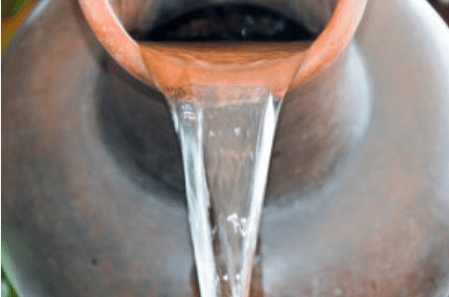
As we delved into these links, we read the details in St. Luke’s Gospel, Chapter 22 and about the preparations Jesus had made for the Passover meal. We are told that Jesus sent Peter and John to get the meal ready. In answer to their question as to where they might eat it, Jesus told them : When you have entered the city, a man carrying a jar of water will meet you’ follow him into the house he enters” and there they were to meet the master of the house who would show them where the meal was to happen. In our discussion we needed the signal Jesus had given them ~ a man with a water jar. We never hear of him again but as he was at the right place at the right time we can assume that he was known to Jesus and an arrangement had been made both with him and with the master of the house. Without giving much thought to it we have been in the company of two others with a role in the Gospel story and clearly, friends of Jesus. We thought of how often this happens in the New Testament; people are encountered who simply appear and disappear, given but a sentence or two, yet were signs of a Gospel friendship that was extended to so many. As we discussed; Pete, one of our group took the moment further and later he sent me the following poem.
Did you know?
Did you know, O man with the jug, when you lifted water to your shoulder, that heaven was in your step, and the Teacher’s eyes were upon you? Did you sense the whisper of eternity in the clay’s cool weight? Did you feel the river of life passing through your humble task?
Did you know, O master of the house, that your upper room would cradle God? That bread would be broken, wine poured as covenant and blood? Did your heart stir as they entered, those weary men, so calm yet trembling, while the Lord of all took the servant’s towel?
Did you know, O silent room, how still the air would grow, how words eternal would hang like oil lamps in your wooden beams? “This is my body… this is my blood.” Did the walls remember the sound? Did they shiver again when the Spirit came like wind?
Three mysteries in one night: a man with a jug, a host with a home, a room with an open door. None named, none praised, yet through them the world was readied for grace poured out like water, for bread shared among friends, for love that would not die.
O Lord, teach us to be like them: to carry what is needed, to open what we have, to hold what is holy, and to let it all be Yours. Amen
A Reflection from Piers Northamon Remembrance Sunday
The beginning of St Mark’s Gospel tells of Jesus walking along the beach at the Sea of Galilee, calling his disciples, the fishermen Peter and Andrew, James and John. Calling them to follow him and calling them to a life of service. Ultimately, for many of his disciples, it would turn out to be service that would cost them their lives.
And on this Remembrance Sunday morning we remember those who have answered another call to service – in this case the service of their country – and who have given their lives in that service.
As I’ve reflected, this week, on what I might say on this Remembrance Sunday morning, I’ve been pondering on the difference between ‘memory’ and ‘remembrance’, and I wonder if we might take ‘remembrance’ to be the shared calling to mind and recounting of events or people that we don’t necessarily directly remember ourselves? Certainly, if we take the Second World War, there is a sense that it is receding into history and that fewer and fewer people remember it first-hand and with that comes the danger that it will seem less and less ‘real’, less and less affecting. And, of course, there have been many other conflicts since, that British forces have been involved in – Aden, Korea, the Falklands, Kosovo, Iraq, Afghanistan – all of which will be remembered by those who served and were involved, but which otherwise can also seem increasingly distant and less relevant.
Yet on Remembrance Sunday each year we gather as a nation to remember; to recount the stories of war and the cost of war; to remember and give thanks for the sacrifice of those who gave their lives – or who had their lives irrevocably altered – hopefully, in the pursuit of peace and stability. Remembrance and the wearing of poppies is also bound up in our sense of identity – one of the rare times in the year when so many of us, from all walks of life, are drawn together collectively to reflect and to remind ourselves of the horrors of war; of the ways that we can, as humans, descend so quickly into conflict and of the urgent and constant need to work for peace and never to be complacent.
Currently, as we look around the world, it seems as though the vital lessons of war and conflict have been entirely forgotten in some places. Mr Putin blithely sends thousands of men to their deaths in an attempt to grab land and territory from the Ukrainian people; Mr Netanyahu – despite the historic imperative for remembrance of the horrors of the Jewish experience in the Second World War – rains bombs and missiles on thousands of defenceless civilians in Gaza and now in Lebanon. It seems that, all too easily, we forget the human cost of war – or we forget what it was like to be on the receiving end of such aggression and begin to entertain the notion of meting it out on others.
All of which underlines the importance of gathering together to remember. Of looking the cost of war in the eye and striving all the more conscientiously and urgently for peace.
Remembrance is important.
In our Tuesday housegroup, we’re currently doing a series of sessions where we’ve begun looking at and comparing readings from the Old and New Testament to see what they help us to understand about Jesus. This last week we looked at the first Passover in Egypt when the Israelites, who had been living in slavery under the Egyptians, were given specific instructions about killing and eating an unblemished, year-old lamb and using its blood to mark the doorposts and lintels of their dwellings so that, when the Angel of Death came over the land in the final plague on Pharaoh and the Egyptian people, it would pass over their houses and the Israelites would be spared death – and subsequently would be able to flee the country and the years of slavery they had endured and so set out on their very long journey to the Promised Land.
The book of Exodus sets out the very particular instructions that the Lord gives to Moses and Aaron for the people and the Lord also says:
‘This day shall be a day of remembrance for you. You shall celebrate it as a festival to the Lord; throughout your generations you shall observe it as a perpetual ordinance.’
And, of course, that is what the Jewish people have done ever since – they have gathered around the family table each year to keep the Passover and to tell the story: to recount how, through the goodness and faithfulness of God, they were spared death and set free from their years of bondage and slavery. The Passover story is a huge part of Jewish identity – a story that all Jews brought up in the faith will know. A story that teaches them about the nature and the goodness of God.
And on Tuesday night we discovered some of the strong parallels between what happened at the Passover in Egypt and the story of Jesus’ Passion in Jerusalem. Because of course, at the Last Supper, Jesus and his disciples were keeping Passover – they had gathered around the table in the upper room to remember; to recount their story and to share food for the journey and, in a new twist, Jesus gave them just that. Not the traditional food of the Passover meal, but bread and wine: the body and blood of Jesus, the Lamb of God. And what does Jesus say as he gives them the broken bread and the cup of wine?
The details of the ancient Passover were fulfilled in Jesus – he was the perfect, unblemished Lamb. And the next day, as he was crucified, his blood was shed for us, marking not the posts and lintels of the Israelites’ doors but the wooden upright and crossbeam of the cross. It was his blood that set us free from the slavery of sin and opened us up to everlasting life. And so, we became a pilgrim people: the people of the Way – Christians from all over the world and down the ages, travelling towards God’s Kingdom.
So, in a sense, for us as Christians, every Sunday is Remembrance Sunday; every Sunday is a family Passover where we gather to remember what Jesus did for us on the cross. In the eucharistic prayer that we will hear in a moment and in the creed that we say collectively, we recount the story of God’s saving and redeeming love for us in Jesus – of how he set us free from the limitation and slavery of sin and how he spared us from death and opened the gate of glory – the way to everlasting life. And every Sunday we share the family meal – the food for the journey – the bread and the wine that we take in remembrance of Jesus, to nourish and sustain us. And then we are sent out into the world – ‘to love and serve the Lord’ and to help the world to make its way into God’s Kingdom; to bring His Kingdom in…


 Mr G's Ponderings