Tag: Humility

St. Aidan, meeting God in others.

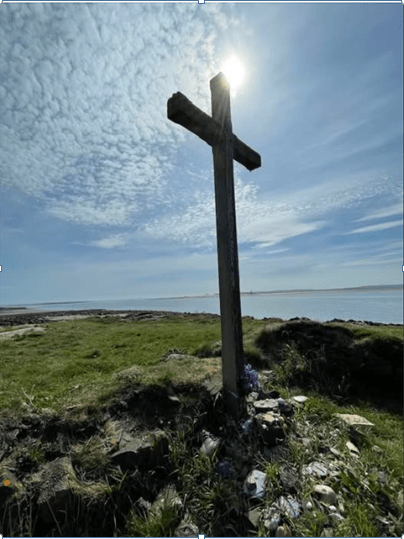
Lindisfarne : The Cross on Cuddy’s Isle .

Piers Northam ponders on the mission of St. Aidan

St Aidan of Lindisfarne, whom the church remembers today, modelled humility. He was active in Northumbria in the 7th Century.  Aidan was of Irish descent and was a monk at the monastery on Iona.  Oswald, who became king of Northumbria in 634, wanted to bring Christianity to his people and the Venerable Bede tells us that he contacted the monastic community on Iona and they sent a bishop called Corman to bring the good news to Oswald’s people.  But Corman didn’t go down well – he was haughty and harsh, and thought the Northumbrians were too stubborn and stupid to be converted.  On his return to Iona, Aidan criticized the way that he had gone about things: “Shouldn’t you have been a little gentler and more patient brother?” Aidan is reported to have asked and, before he knew it, he was being sent off to have a go himself. 

So what was it that differed in Aidan’s approach?  Well, first, he was aware that if he was going to bring a lasting Christian faith to this part of the country he was going to have to have a long-term strategy.  So his first move was to set up his little monastery on the island of Lindisfarne and in it a school that took in local Northumbrian boys.  In doing so, he was valuing the people of Northumbria rather than assuming that they were stupid and stubborn.  He was noticing, valuing and nurturing their potential, because they were to be the very foundation of this local church. 

His next move was to begin to learn the language of the local people so that he could go out into the lanes and farms talking to people and telling them the Gospel stories in a language they could understand.  You have to remember that Aidan would have spoken Old Irish and the Northumbrians Old English – two languages that had no linguistic ties – so this was no mean feat. Thankfully, King Oswald came to his rescue being bilingual. If you think about it, that’s the exact opposite of a colonial approach, where you take your own culture and impose it on another society and culture – again, Aidan saw the value in what was there and approached the task with humility.

In those times, people were in the habit of carrying knives – and not just to cut their meat up – allegiances were fiercely local; foreigners and outsiders generally mistrusted and Aidan, of course, was one such outsider.  Yet Aidan and his followers refused to tuck a knife in their belt – a risky strategy, but a courageous one, for it showed that they were essentially defenceless and meant that they were reliant on people to help them – trusting them to do so.  And, of course, we see the parallels between that and the gospel account of Jesus sending the disciples out in pairs. Whereas Corman, Aidan’s predecessor had ridden around the farms and villages of the area on horseback, gathering people together, preaching to them and then aiming at mass conversions, Aidan’s methods were far more humble: he literally walked thousands of miles, tramping the lanes and pathways, and getting into conversation with those he met.  His was a patient approach: aiming to kindle a curiosity in his listeners so that in time they were drawn into the way of Christ and would ask to be baptised.  His methods did not hinge on mass conversions which had little to back them up, but rather on personal, long-lasting relationships that led to a real desire to learn more about Christ.  He was not talking down to people from the back of a horse, rather, he was encountering them face-to-face – eye-to-eye – on a level: treating them as equals – all valued, beloved and precious to God.

Needless to say, Aidan’s approach found far greater success than Corman’s and Christianity took hold and became deeply rooted in the North East of England.  His humility and the way that he approached and valued people was effective in spreading the Good News of Jesus Christ.

[Extract from a sermon by Piers Northam, preached on St. Aidan’s Day, Sunday 31st August 2025]

Humility

Little flower made by God. Photo Mr. G.

All those who exalt themselves will be humbled and those who humble themselves will be exalted  (Luke 14:11)

In his poem, East Coker (one of the 4 Quartets), T S Eliot said:
“The only wisdom we can hope to acquire is the wisdom of humility. Humility is endless.”

Earlier this week the current writer of the Church of England’s Daily Reflection, Chine McDonald, was reflecting on the passage from St Luke’s Gospel (14: 1-11). The section included a story Jesus told about guest at a dinner who grabbed the superior positions at the table. Jesus suggested that if more important people came, the host might have to  ask the others to take a lower seat. That would not only be embarrassing; it would be humbling.

Humility was the subject of Chine’s reflection and is at the heart of the story Jesus told. The passage ends with the quote above.
My further reflection brought to mind the quotation from Eliot’s poem.
It comes just after Eliot says, Quiet voiced elders have deceived us. Do not let me hear of the wisdom of old men but rather of their folly. The only wisdom we can acquire…is Humility.
Humility  and its practice as humbleness is often mistaken for the kind of grovelling we find in Uriah Heep in Charles Dickens’ novel, David Copperfield. In one episode, Heep was ringing his hands and wiping them on his handkerchief. It was a gesture of how he wished to present himself to David Copperfield as what he described as being “a very umble person” He went on to reiterate. “I am well aware that I am the umblest person going, said Uriah Heep, modestly; “let the other be where he may. My mother is likewise a very umble person. We live in an umble abode…

Taking pride in false lowliness is not what Jesus was speaking about.
Humility before God is not, as is so often presented, about feeling a complete lack of worth. It is not about making us feel bad about ourselves.  It’s actually the reverse. It’s about recognising that all the potential we have, all the gifts we can offer, all the love we can share, all the joy we can bring, all the things we can achieve – owe their origin to God. And we are called to use our lives and all God has given us, in His service.
Humility is about recognising and celebrating that.

Jesus was, however cautioning us against another false trait, opposite of the one taken by Uriah Heep, of thinking ourselves better than others. This leads to a view that some of us have rights and privileges over others. Our view of humanity then becomes warped. It leads, ultimately to nations trying to lord it over others. We do not have to look far to know what I mean but before we sweep our vision towards the Holy Land or Ukraine, let’s not forget to look nearer to home at the boat people, refugees, the poor and homeless.
Chine McDonald in her reflection widens the story Jesus told. She says, “Jesus words reflect the nature of the Kingdom of God. This is a place where the usual rules do not apply. What applies, she says, is humility because we are dealing with the upside-down nature of God’s Kingdom.

By contrast, she says, “We live in a world where we are asked to measure ourselves against others; where we pride ourselves in our achievements and what we have, whether that is family, a great job or great car – are what matters.” 

Jonathan Sacks, the late Chief Rabbi,in his book To Heal a Fractured World,  makes the point that no one ever speaks in praise of someone who died, about the car they drove, the house they owned, the clothes they wore, the exotic holidays they took. He says that  the things we spend most of our time pursuing turn out to be curiously irrelevant when it comes to seeing life as a whole.
After death, he says, “what was important was the kind of life people led; the qualities they showed; the good things they shared in; the responsibilities they took within community life; who they were as people.”

Chine McDonald places this in context by saying that the Kingdom of God is a place “where human wisdom is replaced by divine wisdom. It is a place in which the status quo cannot be assumed. It is a place of newness and wholeness, where we see things as they should be.”
The way to inhabit this Kingdom is to embrace the kind of humility which translates into seeking the well-being of others; of putting service of others before self; of behaving towards others with respect and love, no matter who they are or the circumstances of their life; of encouraging others and being generous towards them; and to be examples of hope and gentleness. Most of all, of course, it is about embracing the Will of God for us and for others.

[Mr G 14th June 2024]