Yesterday, at church in Fakenham, we sang the hymn, For the healing of the Nations, by Fred Kaan. The second line begins, ‘Lord we pray’, a reminder that hymns are musical prayers which begin life as prayer/poems. As such they are an important part of our devotional resource, whether they be as hymns, psalms, anthems of chants. This prayer by Fred Kaan speaks deeply to our human condition which cries out for healing of our brokenness in so many ways.
For the healing of the nations, Lord, we pray with one accord, for a just and equal sharing of the things that earth affords. To a life of love in action help us rise and pledge our word.
Lead us forward into freedom, from despair your world release, that, redeemed from war and hatred, all may come and go in peace. Show us how through care and goodness fear will die and hope increase.
All that kills abundant living, let it from the earth be banned: pride of status, race or schooling, dogmas that obscure your plan. In our common quest for justice may we hallow brief life’s span.
You, Creator God, have written your great name on humankind; for our growing in your likeness bring the life of Christ to mind; that by our response and service earth its destiny may find.
Fred Kaan
Fred Kaan was uniquely placed to offer this poetic insight of a world in need of healing. As a child of the occupation of the Netherlands, he experienced first-hand the horrors of Nazism, His parents were part of the Resistance in Holland and they also sheltered a young Jewish woman who was kept safe for over two years. Fred was doubtless shaped by a global conflict which was also experienced personally. He was filled with a passion for social justice, global peace and a reconciliation between people. When he discovered Christ, this strong desire met the explosive love of the Gospel. His faith was expressed in Christian ministry and a spirituality that found expression in prayer/poems which could be sung powerfully as hymns or quietly as Gospel -based prayers as part of personal devotion. It is offered here as a pinprick of soul-light for our praying. After all, for many, the best action for human justice, freedom and the outpouring of love, is through prayer. Action flows from prayer because it changes us.
To a life of love in action help us rise and pledge our word.
[Mr G]
***for more on Fred Kaan see my blog entry June 29th 2023
On July 14th, in our Church Calendar, we commemorate John Keble, priest and poet, who was born in 1792 and who became a leader of the revival of Anglicanism known as the Oxford Movement.
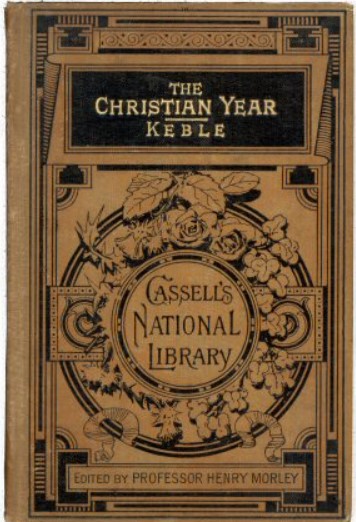
Keble was a scholarly man who became a fellow of Oriel College, Oxford at the age of 19. He was the dutiful son of a country parson. He was a man of deep and constant prayer and after his ordination he was much sought after as a spiritual guide. In 1827 he published a book of poems called The Christian Year which took as its theme the festivals of the Christian year. To date over 158 editions of the book have been published and it has fed the meditations of countless Christians. We sing a number of the poems as hymns including, New every morning is the love and Blest are the pure in heart. One consequence of the book was that he was elected Professor of Poetry in Oxford in 1831
It was in 1833 that he was called upon to preach the Assize Sermon before the Judges in Oxford. It was at the time when the Government of the day had decided to amalgamate Dioceses in Ireland, known as the ‘suppression of the bishoprics.’ Keble objected to the interference of the State in church matters and the subject of his sermon, National Apostasy, became a clarion call not only against the Government but against a church that had grown lax and had lost its way.
John Henry Newman, arriving back from Italy in 1833 after being becalmed in Rome. (His hymn Lead Kindly Light was a result.) He joined forces with Keble and other studious and pious men and the Oxford Movement was born. It was to sweep the nation and it called people back to a purer form of Christianity and Christian practice. Because the means of doing this was through pamphlets, they become known as ‘Tractarians.’ The Tracts ended with Tract 90, and they resulted in a growth of Theological understanding underpinned by scholarly learning.
Later some of the leading lights left the Church of England for the Roman Catholic Church but Keble remained steadfast in his conviction that the Anglican Church offered a better way to God for him and for the people he served. He is a fine example of that high calling which has been the bedrock of the Church of England – the Parochial Ministry. He eschewed the limelight and the controversy of the other leaders and sought nothing more than to serve his Lord and His Lord’s church as a Parson.
In every movement for change and growth, there will always be those to whom it falls to bring the vision to fruition. The leaders were scholars, theologically trained and well versed in Scripture and Church history. Keble was also a poet. The leading lights of the Oxford Movement were great men but as enthusiasm grew there was also divergence of opinion as to how things should grow and transform. The Bishops of the Church of England were hardly welcoming and tried to thwart what the Oxford Movement was trying to achieve. Eventually leaders such as John Henry Newman (recently canonized by the Pope) felt a pull towards the Roman Catholic Church, whilst others stayed in the Anglican Church, such as Dr. Pusey. This moment is sometimes referred to as the parting of friends’, for such it was. Amidst all the turmoil, John Keble, whose words had become the clarion call for the Movement, remained steadfast and true to his roots in Anglicanism.
All Renewal movements in the Church need one vital element to keep them focussed on, and rooted in, God. Through his poetry and his devoted service to the people of his Parish, John Keble provided this. Important and vital changes in the Church always produce exciting ways of growing closer to God but unless these are undergirded, and nourished by prayer, they will inevitably fail. John Keble and the spirituality which ruled his life, expressed in the poems of The Christian Year, provided a focus which took people to the heart of the reason for the Oxford Movement. It enriched the Church by a renewed emphasis on prayer and worship, on God and on His transforming love. It renewed the relationship Christians had with Jesus and it allowed for enlivening inspration by the Holy Spirit. Keble was instrumental in bringing these renewed spiritual insights to the Church.
His was a heart pure with love for God. He was indeed truly blessed and in God’s Name and through God’s love, his life blessed the church.
[Mr G]
From the Dedication of his poetry
DEDICATION.
When in my silent solitary walk, I sought a strain not all unworthy Thee, My heart, still ringing with wild worldly talk, Gave forth no note of holier minstrelsy.
Prayer is the secret, to myself I said, Strong supplication must call down the charm, And thus with untuned heart I feebly prayed, Knocking at Heaven’s gate with earth-palsied arm.
Fountain of Harmony! Thou Spirit blest, By whom the troubled waves of earthly sound Are gathered into order, such as best Some high-souled bard in his enchanted round
May compass, Power divine! Oh, spread Thy wing, Thy dovelike wing that makes confusion fly, Over my dark, void spirit, summoning New worlds of music, strains that may not die.
Oh, happiest who before thine altar wait, With pure hands ever holding up on high The guiding Star of all who seek Thy gate, The undying lamp of heavenly Poesy.
Too weak, too wavering, for such holy task Is my frail arm, O Lord; but I would fain Track to its source the brightness, I would bask In the clear ray that makes Thy pathway plain.
I dare not hope with David’s harp to chase The evil spirit from the troubled breast; Enough for me if I can find such grace To listen to the strain, and be at rest.
One of the great losses that Covid-19 has brought for Christians, and many others, is the ban on singing hymns in Church. This has been part of a huge loss for all who play and sing music and those who simply love to hear it. This has been to the detriment of our lives which need the dimension that comes through music, art, theatre and all forms of culture. There is a search and a longing for the feeding of the spirit (the soul). Yesterday, I was fortunate enough to be at the Gibberd Garden in Harlow (where I volunteer) and there hear live music from Woodwind of Stortford. Just to hear music in the setting of a garden, planned and loved by the late Sir Frederick and Lady Gibberd, was to feel a rising of the spirit. Many have discovered in these very dark times, the place of gardens in lifting us out of the current difficulties of life to a new appreciation of creation and the creativity that gardening can bring. We only have to watch Gardeners’ World on BBC 2 to hear how people are turning to their gardens, allotments, or open spaces to experience something both healing and absorbing. To combine that with music, yesterday, was both joyful and uplifting.
Music plays a huge part in the quest for a deeper appreciation of what life is really about but the Covid-19 virus has wreaked havoc on our ability to play, listen to and experience music ‘in the flesh’ as it were. The BBC, Classic FM and live streaming of concerts of all kinds of music have done as much as possible to keep the echo of music alive in our hearts. But there have been casualties and I ask you to think about those free-lance musicians who simply lost their jobs and livelihoods when Lockdown began in March. Hymn singing has also been a casualty for many. Singers, Organists, other religious music makers are now able to offer a little under Government rules but there is still a huge gap to be filled.
Like all things, however, difficulties and loss often bring new awareness, insights and determination. (I sing far more in the shower than I ever did, without subjecting others!) Also we can think carefully about what hymns mean to us and the spirituality they convey.
So below, my friend Diana Lowry, meditates on one of her favourite hymns. A new insight into ‘And now, O Father, mindful of the Love’
A Favourite Hymn
I am sure we all have favourite hymns and different hymns will speak to us at different times. Sometimes they may be linked to a person in some way and the one I am writing about today does have that connection. Here is the hymn which I have printed in full in case you do not remember all the words:
And now, O Father, mindful of the love which bought us once for all on Calvary’s tree, and having with us Christ who reigns above, we celebrate with joy for all to see that only offering perfect in your eyes: the one true, pure, immortal sacrifice.
Look, Father, look on his anointed face, and only look on us as found in him; look not on our misusings of your grace, our prayer so feeble and our faith so dim; for, set between our sins and their reward, we see the cross of Christ, your Son, our Lord.
And then for those, our dearest and our best, By this prevailing presence we appeal; O fold them closer to thy mercy’s breast, O do thine utmost for their souls’ true weal; From tainting mischief keep them white and clear And crown thy gifts with grace to persevere.
And so we come: O draw us to your feet, most patient Saviour, who can love us still; and by this food, so awesome and so sweet, deliver us from every touch of ill; for your glad service, Master, set us free, and make of us what you would have us be.
William Bright 1824-1901
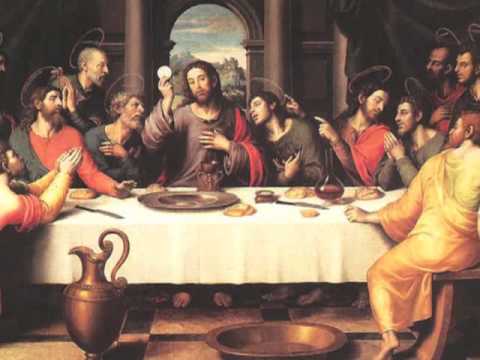
It is usually sung as a communion hymn and to me reminds me of the link of all of Christ’s life, not just his death, with the Eucharist. For instance it speaks of grace, forgiveness, freedom, support and love. It is also special because it was sung at the funeral of a priest whom I thought I knew well but never ceased to surprise me: he gave the impression that his faith was woolly and bendable but in fact it was at its heart very traditional and incredibly important to who he was and how he lived.
Now when I sing this I think of Chris living above, with God, who is Father, Son and Holy Spirit; I am reminded again that the sacrifice on Calvary was pure and true and forever. The hymns acknowledges our languid (indifferent) prayer and our faith that is often so weak, and how we misuse grace, but that all has been redeemed through Christ, that tomorrow is another day when we can do better. And then we bring before God those who we love; we admit that they too have shortcomings, but we pray for them and know that God will protect them and give them the grace to persevere.
The last verse teaches us about the Eucharist, giving thanks for all that our Saviour went through and knowing how special this food is – so aweful (breathtaking) and so sweet (beloved), that renews us and reminds us of our need of God and that we need never be parted from him. The tune (Unde et Memores) fits perfectly with the words: if you do not know the hymn do try the youtube link.
My friend Diana has been musing on our being unable to sing hymns in churches because of the coronavirus pandemic and how many of us are missing them. This is the reflection that she has sent me.
I have just come home from a trip to Cornwall. While I was there I visited several churches, some of which were open. One which I particularly enjoyed was St Just in Roseland, just by a creek. It has a large garden and is lovely and peaceful, even when the gardener was using the strimmer on and off! Even that couldn’t destroy the shalom that we felt as we sat by the water. The church is on the site of a 6th century Celtic chapel, reminding us how important Celtic Christianity was in Cornwall. The present building was built in the thirteenth century; a rector in the 19th century introduced many tropical plants into the garden most of which still flourish today. All along the, quite long, path down from the car park to the church are granite stones on which are written scripture verses, poems and verses from hymns. Apparently as each one was put in place the priest did a service of blessing over it.
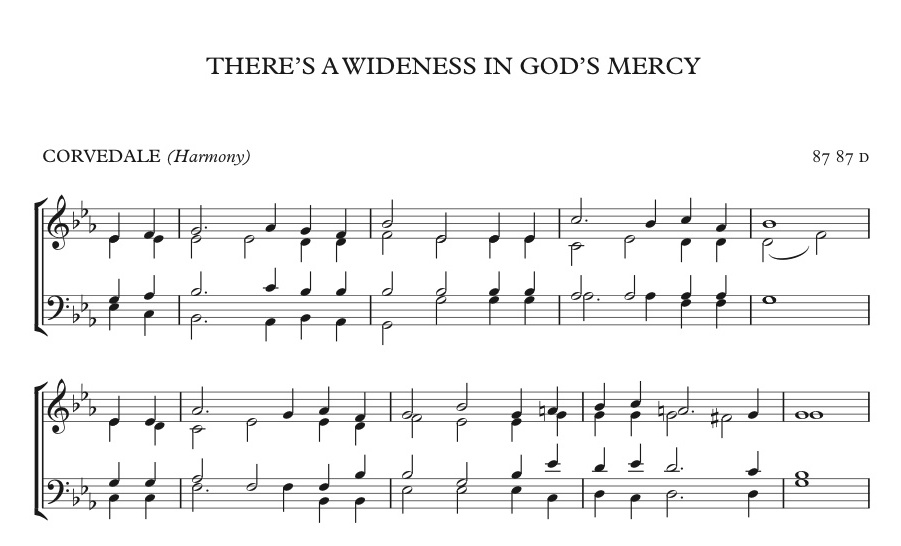
The visit to this church reminded me how much I miss singing hymns in church at the moment. Apart from the joy of singing them I find that there is much in hymns to help us understand theology, and because we are singing them this tends to slow us down and encourage us to think about the words. I have so many hymns that I couldn’t possibly identify just one favourite but ‘There’s a wideness in God’s mercy’ is up there among them. I particularly value the verse: ‘But we make His love too narrow By false limits of our own; And we magnify His strictness With a zeal He will not own’. For many of us I believe, and certainly for me, it is difficult to completely believe in God’s unconditional love: there is nothing we can do to make Him love us more, and nothing we can do to make Him love us less. Perhaps this hymn is just another way of saying Psalm 86:15 ‘But you, O Lord, are a God merciful and gracious, slow to anger and abounding in steadfast love and faithfulness’, but easier to remember.
Although I fear it will be sometime before we are able to sing hymns in church again, there is nothing to stop us singing them at home, remembering always that we are told to make a joyful, not necessarily a tuneful, noise to God! Try singing along with a recording or YouTube video: there is one of this hymn recorded with an orchestra in Maida Vale at: https://www.youtube.com/watch?reload=9&v=vJwfT3SY_PU; or you can hear St Paul’s singing it at: https://www.youtube.com/watch?v=raMn2iV9x2E . If you don’t have access to the computer you can ring Daily Hope on 0800 804 8044. I also recommend that you reconnect with Songs of Praise which is usually on at 1.15pm on BBC1. In addition to hearing, and singing the hymns, there are interviews with all sorts of people about what their faith means to them. Particularly if you are housebound, or only going out very little, it is easy to feel disconnected from other Christians and I hope that you will find that tuning into these different ideas can help you to feel less isolated.


 Mr G's Ponderings