Tag: Josefina de Vasconcellos

Of Angels.

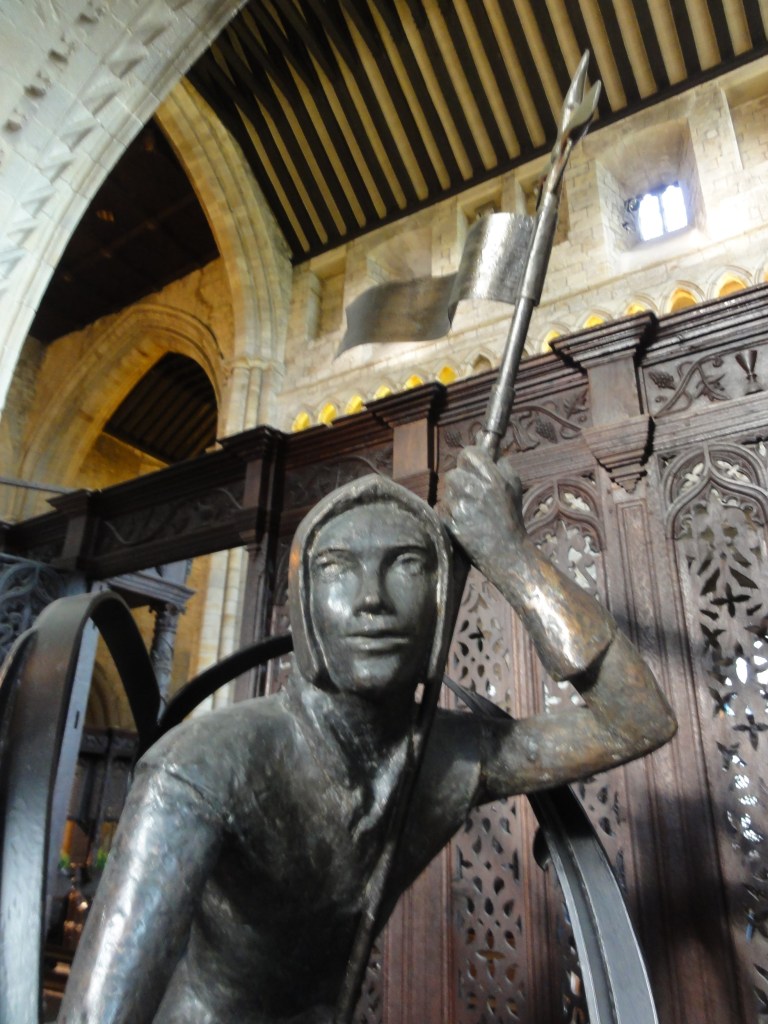
St. Michael ~ detail~ Statue carved by Josefina de Vasconcellos
~ first exhibited in Manchester Cathedral in the winter of 1991
~ now it is on permanent display in Cartmel Priory, in the Lake District.
photo by Mr. G.
Therefore with Angels and Archangels …

At almost every Eucharist Christians pray: “Therefore with angels and archangels and with all the company of heaven, we proclaim your great and glorious name.” The picture is of our being part of a great company, invisible but near, who worship Almighty God without ceasing. At this point in the Eucharist we are at what the Celts call a ‘thin place’ when the barrier between earth and heaven is opened to those who have faith to see it. That can be very helpful when we are missing departed loved ones but we are also reminded that our worship is caught up in a greater praise. We, as it were, plug in to a current of worship which is forever flowing and for ever being proclaimed. But for many, angels belong to myth and one wonders what is going through many Christian minds when they reach that point in the Eucharist. Despite the fact that Holy Scripture is crammed with references to angels and they play a significant part in the Christmas and Easter stories, it is easy to dismiss them.
It is also rather arrogant because it assumes that God who is the great creator of everything on earth, is incapable of creating any other order of being than we can actually see. Yet we continue to explore space for other forms of life—assuming, naturally, that what we will find will be ‘human’ life! As we seem to be making quite a mess of our own planet it might be better if we hoped any life form found might not be human! The writer of Psalm 8 praises creation and puts humanity in its place:

“When I consider your heavens, the work of your fingers,
the moon and the stars that you have ordained,
What are mortals that you should be mindful of them;
mere human beings, that you should seek them out?
You have made them little lower than the angels
and crown them with glory and honour.


Though human beings have dominion (or stewardship) of creation on earth we are ‘lower than’ angels. They have a special place in God’s scheme of things—as Defenders in the cosmic battle between good and evil; as messengers of God’s word to humanity as in the Annunciation; as healers and as guardians. Jesus himself spoke of angels in this way saying that God’s little ones have their Guardian angels and he, himself, knew of their ministrations at the end of his wilderness experience. If Jesus believes in angels, who are we to dispute their existence and their part in God’s plan?

[St Michael’s Day is September 29th]

[Mr G]

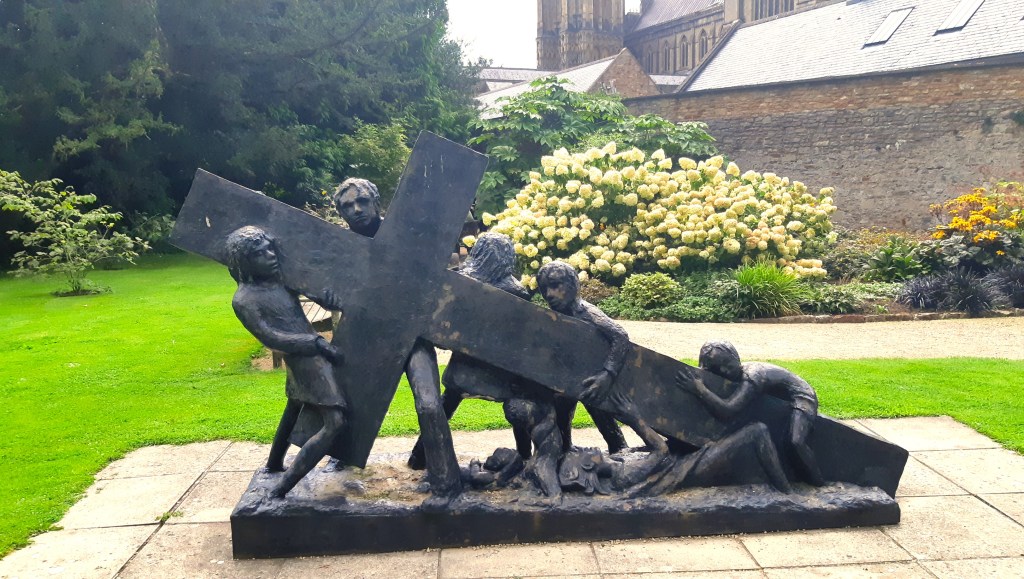
Weight of our Sins ~ Josefina de Vasconcellos

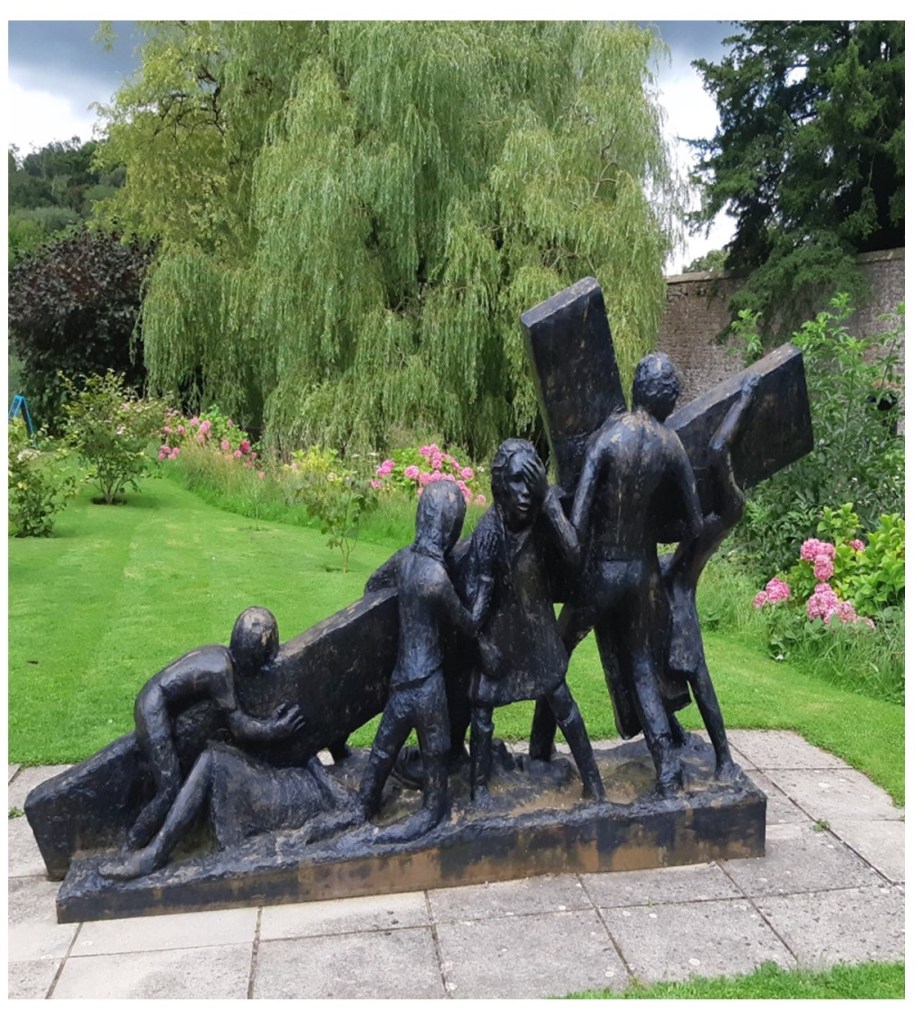
Josefina de Vasconcellos ~ The Weight of our Sins. Bishop’s Garden, Wells Cathedral. Photo by Piers Northam

The Weight of our Sins.

In the Bishop’s Palace Gardens next to Wells Cathedral, there is an amazing and disturbing statue by Josefina de Vasconcellos. It is called, The weight of our Sins. It was carved in 1999.
It centres on a Cross which eight children are holding up. They are bearing its weight and each is symbolic of a crime against children today. There is young person suffering from AIDS; a teenage boy who is a drug addict; a child blinded by a land-mine; another child represents the homeless; a baby who is victim of genocide; a girl is dying after experiencing serial sexual abuse. Poverty, deprivation and pain are also part of the message.
Josefina had a deep compassion for disadvantaged and damaged children.
She was also inspired by her belief that loving God led people to love one another and therefore help build a peaceful world. Josefina’s concern was for so many in our world who suffer because of cruelty and inhumanity. She had a particular sadness and love for the most vulnerable in our society. Unable to have children, she had a special concern for them. Though she died in 2005 the meaning of the statue couldn’t be more pertinent than today.

Children are suffering appalling life conditions and not just in placers like Gaza, the Ukraine, Syria, Yemen and South Sudan.
The tragedy of those forced from their homeland to live as refugees seeking the basic human need of shelter, food, water and warmth is something Josefina’s statue holds before us. Without doubt, one of the children clinging to the Cross would be representative of the boat people in the Mediterranean and the English Channel.
Another would possibly represent the children living in poverty and hunger in our own country. Having been brought up in the post war deprivation era it is hard to think that for many the conditions of that time are also still with us in the 21st century. Food Banks, substandard accommodation, debt and a sense that they don’t matter, is a scandal in a time when the divide between the ‘haves’ and ‘have not’s’ feels closer to Victorian England.
I think Josefina would have wept to see what is happening today.

Her concern for the well-being of children was expressed through her art, but together with her husband, Delmar, she took it further.
Her faith in God and her devotion  to the beauty of art and music, together with Delmar’s involvement as a Lay Reader in the Church of England’s ministry, led them to put their faith into action. They adopted two boys made orphaned by the Blitz on London; they opened their home to borstal boys whom she tried to encourage to express themselves through art and nature; they bought an old trawler and, after renovation and adaptation, moored it off the Cumbrian coast to provide an holiday experience for children coping with physical disability. She also created space, complete with appropriate sculptures for people whose children were stillborn.After her death, an Arts Trust was set up in her name which included the education and care of young people.

She named her Sculpture, The Weight of our Sins.  It is a charge she laid against all who harm and destroy children and childhood, but it is also a plea for a more “ethical reflection on the issues of the modern world, the meaning of childhood and what part we need to have in producing change and as a source of inspiration for word, art and music”
The message is clear in the sculpture in Wells. We cannot ignore our responsibility to change things for the world’s young ones, suffering because of what the so-called adult world is doing to them. It is human sin which is crushing the vulnerable and innocent victims because of what we are doing.
It isn’t enough to say it’s too vast a problem for us to have any effect or change.
Of course it requires international and national solutions but we can all play our part. We can pray and believe that prayer changes things, not least our own perceptions. We can help to relieve poverty. I have friends involved in running Food Banks. All of these Banks need donation of food; The lady who sells me Big Issue  magazine has a baby. Just buying the magazine, perhaps even giving more,  helps her.
Supporting charities such as  the Big Issue Foundation, Abraham’s Children in Crisis, Embrace the Middle East and a host of others is a good place to start. Small things bring big results. As Josefina said, loving God and caring for each other , can bring peace and love.

We can, if we accept our part in all this, move from being part of the burden which weighs down children to become those who help to raise them up with the weight of our love.

[This prayer was written by a group of children]

photo: Piers Northam

Prayer for the Human Race

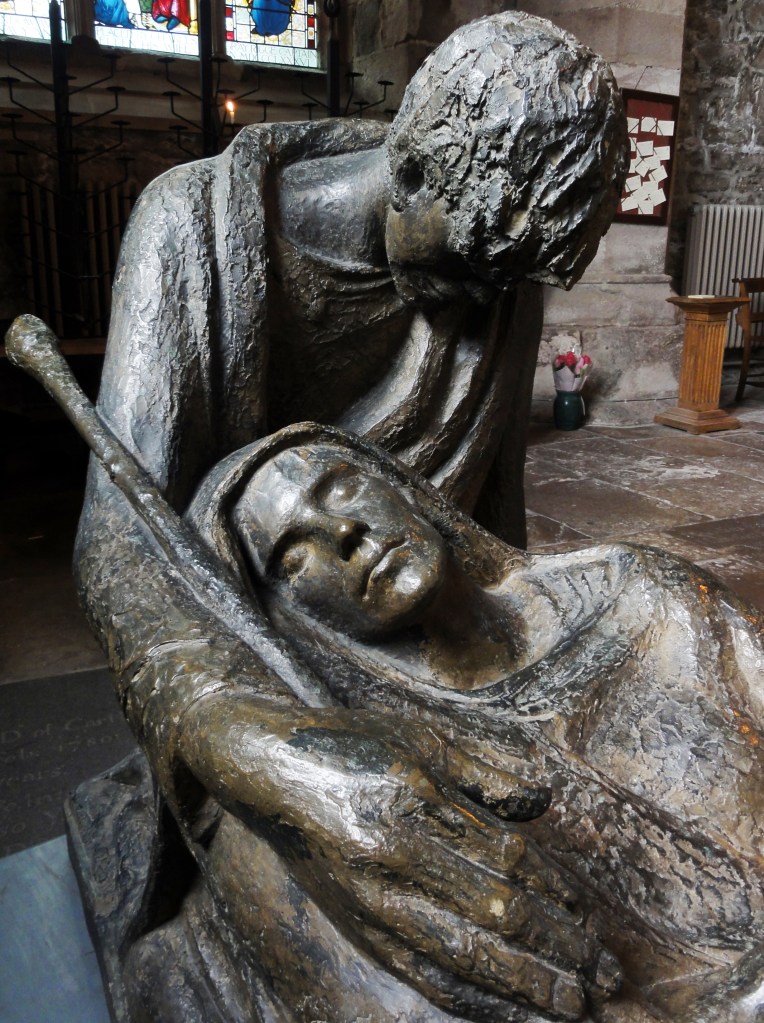
Josefina de Vaconcellos. The fled by night. [detail]
photo by Mr G. Statue is in Cartmel Priory in the Lake District.

A Prayer for the Human Race

This week, the British Parliament has passed the Illegal Immigration Bill (aptly if mistakenly named!).
It seeks to curb refugees from arriving illegally via the English Channel.
The Bill is part of measures aimed at curbing those seeking asylum in the United Kingdom.
Some would see these measures as illegal in themselves and members of the House of Lords sought to amend the Bill to make it more humane. These amendments mostly failed. One of the leaders in seeking such amendments to the Bill was the Archbishop of Canterbury.
What is at stake is how we treat each other. So below is a prayer which applies to the whole human race in our dealings with each other.

The Statue by Josefina is inspired by verses in St Matthew’s Gospel, Chapter 2.
Joseph, Mary and  the infant Jesus  are seeking safety in Egypt . They are escaping the tyranny of King Herod.
He represents the many who followed him throughout history, as tyrants, despots, dictators and destroyers of humanity, not to mention wholesale destruction of creation, and life itself. Herod, seeing a threat to his power, after a visit from the Magi, or Wise Men,determines to seek out Jesus and kill him. In the process he murders all in innocent babies in his land. Despots and seekers of power stop at nothing.
The Holy Family stand as Icons for those who have fled their homelands to seek for safety and welcome. They are a reminder of the  of the vast movement of humanity who, at any one time, are wandering and seeking a home, shelter, love and care as they escape danger imposed on their lives by others.
Most of these journeys are caused by fellow humans who seem incapable of living peaceably with others. Some of these are seekers of power and often rule by force, cruelty and by destroying all opposition.

Our Planet is in a very sorry state right now and almost all that is wrong with it is due to action by the human race. Also, of course, by our inaction, because if we worked together it could be an amazing place to live. Maybe those species who take over from us when we have destroyed ourselves, will do it differently. There is,however, time for us to make a difference but it will demand a complete change of heart and a repentance which will rely on faith, love and a renewal of kindness.

The prayer below reminds us that we are all part of this. None of us is exempt from a duty of care, being seekers of justice, and welcomers of all in need.
With some slight adaption, the prayer can be prayed by people of differing faiths and as a multi-faith intention to work together for our planet’s good.Ultimately, we all belong to each other and to God, however we express that.
Genuine, hearfelt prayer always leads to  deepening of purpose, a bursting forth of love, and a commitment to peace, justice, compassion and dedication to the common good.Out of that journey by the Holy Family to Egypt came an amazing commitment on the part of God to love us all and open us to love in return.
You could say that in fleeing by night the human race fled into universal love under God. It just takes a deep humility to express that!

[Mr G. Prayer is in the public domian]

Man in Background ?

Josefina de Vasconcellos, they fled by night.detail
Cartmel Priory. Photo: Mr G.

St. Joseph’s Day 2021

Josefina de Vasconcellos, the sculptor, was commissioned on a  number of occasions to carve large statues of the Holy Family.  What never fails to strike me is that always Joseph is central to the scene.  He does not lurk in the background or act like some passive kind of bystander.  Josefina shows him as a strong fatherly figure who is a protector of both Mary and Jesus.  It is clear that Josefina had a soft spot for the shadowy figure from the Christmas story and was determined to give him the prominence he deserves.  Perhaps it was because she was graced with the female form of his name.

One particular statue of the Holy Family, which I’ve featured on this blog before, is one that was graphically very different.  It can be seen in Cartmel Priory in the Lake District.  It is called They fled by night and it was inspired by the flight into Egypt taken by the Holy Family to escape the threat of King Herod.

It is a very powerfully real  statue.  Mary is shown to be exhausted with her head leaning backwards as she rests in Joseph’s arms.  Joseph is holding her and looking down with loving compassion. Despite being exhausted himself he was concerned only about her. Meanwhile in the foreground of the composition, Jesus is leaping forward as he embraces the future. 

What I like about Josefina’s portrayal of Joseph is that he is not the shadow figure that we find in the Gospel.  Apart from Matthew’s ‘dream’ sequence when an angel tells Joseph it is God’s will to take Mary as his wife, and an incident when Jesus was 12, Joseph plays no further part in the Gospel story.  There is a reference to him when Jesus is called the carpenter’s son but we are left wondering – what happened to Joseph?

We can invent our own story but I like to think that Joseph was content with his role in making the Incarnation possible.  In a world like ours which celebrates status and fame it isn’t a bad thing to be background people.  Those with a quiet but firm faith are the bedrock of the Church. They seek nothing more than to proclaim Jesus, not necessarily in words or spectacular deeds but with a fidelity towards Him which simply shouts faith in all they do and are.  In Josefina’s statues Joseph comes across as a dependable, caring and protective parent.  If I could choose a guardian angel, it would be like him. 

It is good to think of him as the dependable one who may be in the background but whose care of Jesus and Mary is truly godly.  Joseph, who can be relied upon and sought nothing for himself.  Does that describe you?

[Mr.G.]