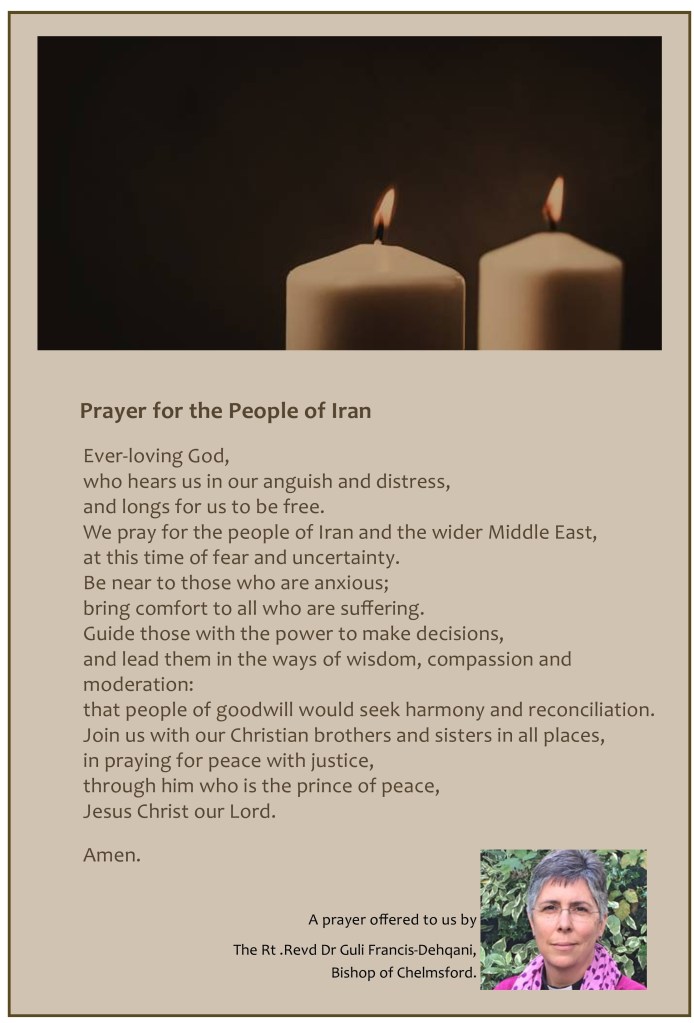
Iran, a prayer
Tag: Justice
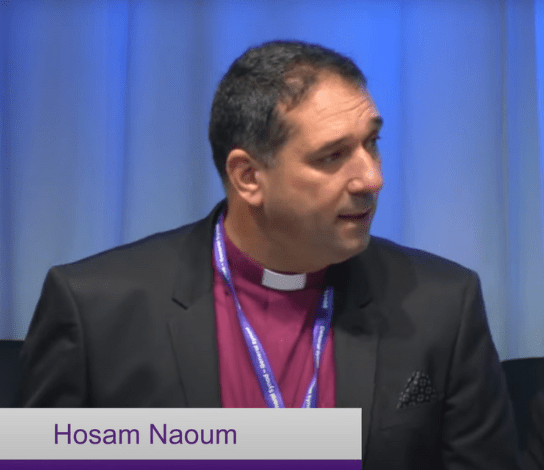
The address given by Archbishop Hosam about the situation in the Holy Land was so moving that the Archbishop received two standing ovations and was held deeply in prayer. This is the Report from the Anglican Commmunion News Service (ACNS) and other sources.
In his address Bishop Naoum said that hospitals continue to be bombed in Gaza, with medical supplies in short supply and a ‘horrifying’ system of food distribution, comparable to the dystopian series The Hunger Games, with three sites open one hour a day for two million people.
Calling for a restoration of humanitarian supplies including food and medicine, under UN supervision, Archbishop Hosam said there should be no targeting of civilians, especially emergency workers and medical staff.
He called for the release of all hostages and captives and a permanent ceasefire for the end of the war and rebuilding of Gaza – ‘not ethnic cleansing that is presently being discussed by the Israeli and US Government.”
As always,the church is committed to peace building and reconciliation – a message that he has repeated ‘time and time again’ – but these are ‘alien terms’ that people across both sides of the divide refuse to talk about or even listen to, he said.
“I realise that as a church we live and embody the gospel and we are not politicians.
However, we need to speak out in the face of injustices and be prophetic for the sake of our people and our calling as Christians.”
“I’m grateful for the (Church of England) House of Bishops’ statements that have been taking our story as Christians in the Middle East and especially in Jerusalem, very seriously.”
Archbishop Hosam spoke of his desire for peace in the region, for the humanitarian aid system to be reformed and for an end to acts which oppose the Geneva Conventions. He stated that, “Medical supplies are in short supply. The food distribution system is horrifying.
“Advocacy is urgently needed for Israel’s adherence to the Geneva Conventions, as its current practices are unacceptable.” He called for “no bombing of hospitals, lifting of the siege, restoration of humanitarian supplies, including food and medicine, under UN supervision, no targeting of civilians, especially emergency workers and medical staff and the release of all hostages and captives.”
In the face of this, Bishop Hosam said that “We are battered and bruised but not crushed.”. As a Church we must be committed to peace and reconciliation and be deeply committed to our Lord’s teaching of Peace and Love. We are called to a ministry of presence and resilience and of support, sustenance and healing. The Church is call to be a source of hope in an hopeless situation, but where a church is wounded and constrained, we need the wider body of Christ to help us to be the church in brutal and damaging times.”
The Most Revd Stephen Cottrell, the Archbishop of York in the Church of England, led a prayer for Archbishop Hosam at the conclusion of his address.
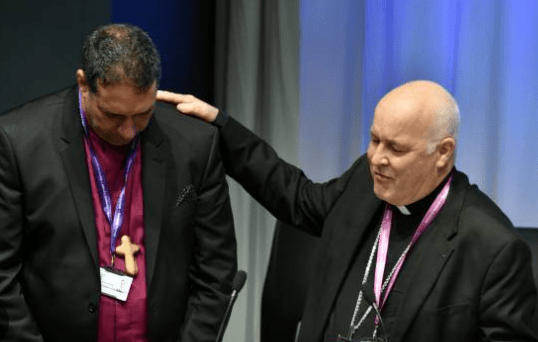
“Father, we pray for the peace of Jerusalem. We thank God for the faithfulness, friendship and ministry of our dear brother Hosam. We cry out to you for peace and justice in our world and especially in Israel, Palestine, in Gaza and in that whole region. We ask for the leading of your spirit, for the peace of your world. We ask this in Jesus’ name.”
In the words of Archbishop Hosam, with people around the world, we pray:
O God of all justice and peace
we cry out to you in the midst of the pain and trauma
of violence and fear which prevails in the Holy Land.
Be with those who need you in these days of suffering;
we pray for people of all faiths – Jews, Muslims and Christians and for all people of the land.
While we pray to you, O Lord, for an end to violence and the establishment of peace,
we also call for you to bring justice and equity to the peoples.
Guide us into your kingdom
where all people are treated with dignity and honour as your children
for, to all of us, you are our Heavenly Father.
In Jesus’ name we pray. Amen.
{}{}{}{}{}{}{}{}{}{}{}{}{}{}{}{}{}{}{}{}{}{}{}{}{}{}
The Most Reverend Hosam Naoum is the 15th Anglican Bishop in Jerusalem, a role he has held since 2021. He was born in Haifa and grew up in Shefa’amr in Galilee.
The Episcopal Diocese of Jerusalem is home to about 7,000 Anglicans worshipping within twenty-eight different congregations. It is also responsible for more than thirty institutions, including hospitals, schools, clinics and rehabilitation centres. The Diocese is scattered across five separate countries or territories: Jordan, Palestine, Lebanon, Syria, and Israel.
[Compiled by Mr G]

Rogation
The days before Ascension Day are known in the Church as Rogation days. The word Rogation comes from the Latin rogare meaning to ask.In the Book of Common Prayer, the Gospel for this Sunday includes the words of Jesus ‘Whatsoever ye shall ask for in my Name, I will give it you’.
Traditionally what is asked for during this period before Ascension Day is for God to bless the crops. It is a religious festival observed these days more in the countryside than in the town but all of us need to give thanks not only for the food we eat but also for those who work to provide it — Farmers and sea fishermen in this country and many others throughout the world. We take so many of these for granted and often care little to know how the food reached the supermarket shelves.
It’s the same, of course, with other goods made cheaply in the Third World. It is only when events like the collapse of a factory in Bangladesh hit the headlines that we begin to question the ethics of slave-labour and inhuman working conditions. Labels saying made in India, made in China, etc are giveaways. Such goods are more than likely made cheaply and using slave-labour. Unless we want a troubled conscience, it’s best not to think of that!
But, Christians are working for a fairer world in which workers are respected, given decent conditions in the workplace, and given a fair wage. We are also at war with the child abuse which sends small children into factories. Historians can remind us that in Victorian times we sent them up chimneys but hopefully we’ve moved on from that. We want other countries to move on too. Which is where agencies like Christian Aid come in. Christian Aid is a charity set up by British Churches who work through the Church communities of the third world. So it’s our Charity and through its agency it does a number of things on our behalf.
First and foremost it helps the world’s poor in pragmatic ways through direct help in fighting poverty, malnutrition and disease. It works through local people in order to help them own the work being done. Christian Aid also challenges Governments including our own. Much that passes for overseas aid is tied aid. It helps our own industry as much as it helps the poor. There are often conditions placed on the aid we give. And, of course, Governments can withdraw such Aid whenever they like, often without discussion. This leaves the country being helped in a desperate plight. So Christian Aid is political though not in the party sense.
It challenges not just Governments but Industry, commerce, and all who make money out of the poor. It is a legitimate part of Christian Aid’s work. It also challenges us as individual Christians and as Church communities. It challenges us to pray for the world’s poor and to be in solidarity with them. It challenges us too to act fairly in the things we buy.
One of the great successes of Christians working with others is the Fair Trade movement. Even the most die-hard supermarkets stock some Fair Trade goods these days. Not more than 10 years ago, you could only buy Fair Trade goods in the Co-op and in the Oxfam shop. Today Fairtrade is more widespread. In Churches, Traidcraft stalls are also more popular and are making a big difference to Third world towns, villages, hamlets. Those making the goods we buy are happier, better provided for and, most of all, they are given human dignity. They can be proud of what they make and we can be both proud and humbled in buying those things.
It is no accident that Christian Aid Week comes usually near to Rogationtide. Those taking out envelopes, distibuting leaflets and those organizing events are asking. They are asking people to share amazing week when ordinary people throughout the land, giving small and large amounts, are really making a difference and changing lives.
Alongside the asking comes the thanking. In asking for justice, mercy and love for the third world we are mindful of the rich and bountiful provision God has made for all who live on Planet Earth. God has also given the means to replenish the land and the sea so that all can be fed, watered, sheltered and fulfilled, The fact that we misuse and abuse this is not God’s fault. If the World Governments willed it, poverty could be ended at a stroke. But it isn’t and whilst we might ask why not, it will be God who will make the final judgement. It has been said that when we meet God the question he will ask each one of us is, How much have you loved? It demands more than words for an answer. Those who withhold what can help others should not be surprised if God is not impressed!
St. Ambrose, long ago, said that when we give to the poor we are merely giving back to them the portion that is rightly theirs. What he said is worth considering at Rogationtide.
It is not from your own possessions that you are bestowing alms on the poor, you are but restoring to them what is theirs by right. For what was given to everyone for the use of all, you have taken for your exclusive use. The earth belongs not to the rich, but to everyone. Thus, far from giving lavishly, you are but paying part of your debt.
St. Ambrose.
Almighty and eternal God, you crown the year with your goodness
and give us the fruits of the earth in their season:
grant that we may use them to your glory;
so that none may hunger,
none may thirst,
and all may cherish the gifts of your creation;
through Jesus Christ, our Lord,
who lives and reigns with you,
in the unity of the Holy Spirit,
one God, world without end.
Amen.
 Mr G's Ponderings