
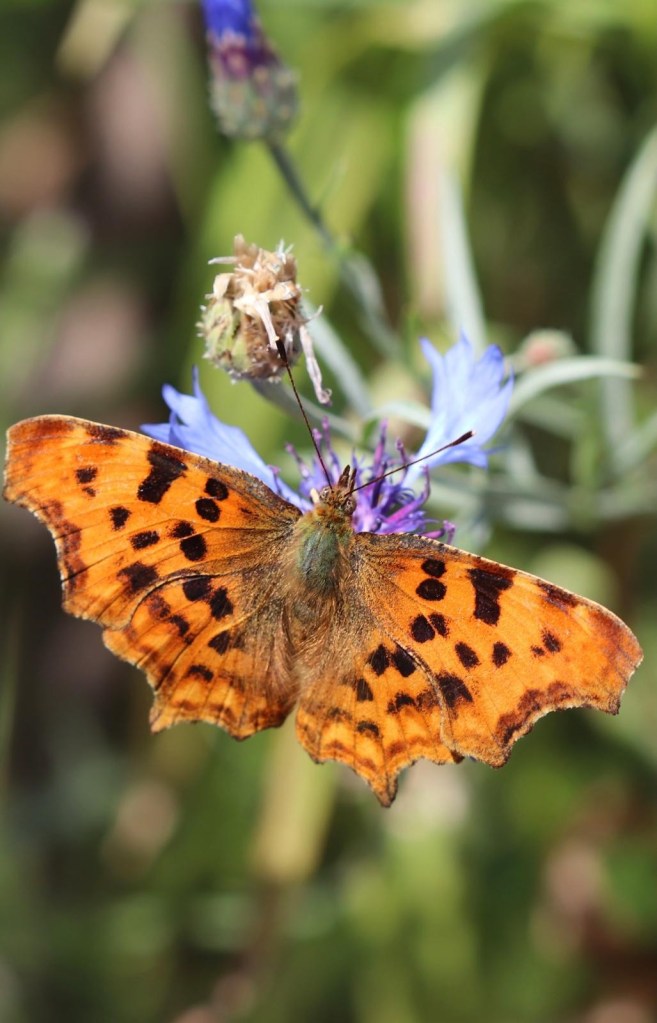
These photos by my friend Lynn Hurry are of the Comma Butterfly.
It is so called because its orange-brown colouring is punctuated on the underwing with a distinctive white comma shape. It has ragged wing edges which, when it is at rest, resembles a dead leaf.
Unlike many butterfly species, which are becoming rarer, it is a success story of Nature, being more prolific and widespread. Some attribute this to global warming. It is commonly found in Britain, Europe, North Africa and Asia.
Spiritually, this butterfly has several meanings including renewal; rebirth; unconditional love; transformation and hope.
Personally, I see in its name ~ comma~ an invitation to pause briefly and for a moment enter into stillness.
A comma links two parts of a sentence and so we can allow a pause to be a link between one kind of activity and another.
The purpose of this brief moment can be to renew our connection with God and with Nature.
The Psalmist of Psalm 46 gives us a picture of a world in turmoil, whether it be of nations; planet earth, or more personal. Throughout this upheaval, God is our refuge and our strength. His voice melts the angry clamour of human voices; of our human spirit. God makes wars to cease, within our hearts leading hopefully to a renewed understanding of God’s presence in our hearts.
So, the Psalmist encourages to Be still and know that I am God.
We can see, therefore, that the grammatical pause in this butterfly’s very being has a purpose and a meaning which calls us to reflection, renewal and transformation. This comes if we pause with God.
Too often, in our daily life we are on the go in frenetic activity. So is the world. It is vitally important then to be still and to form a new connection with the World of Nature, represented by the Comma Butterfly, and appreciate the beauty of God’s world. Only then might we cherish all that God has made and find a new hope and a new beginning. Only so might we become deeper instruments of God’s healing love.
The Comma Butterfly is known as a pollinator, bringing the means of new life to the Natural World. That is a role we can learn from this butterfly in all our dealings with each other.
[Mr G. 9th July 2025]


 Mr G's Ponderings