Tag: Lindisfarne

St. Aidan, meeting God in others.

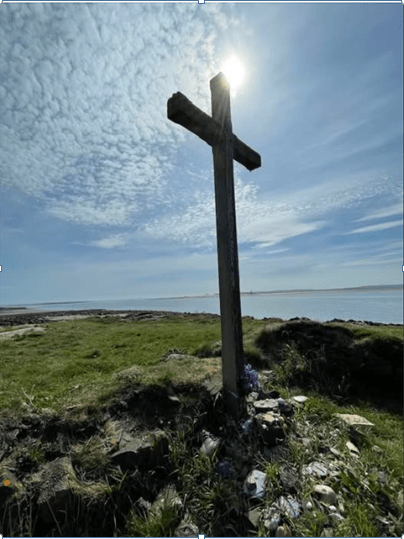
Lindisfarne : The Cross on Cuddy’s Isle .

Piers Northam ponders on the mission of St. Aidan

St Aidan of Lindisfarne, whom the church remembers today, modelled humility. He was active in Northumbria in the 7th Century.  Aidan was of Irish descent and was a monk at the monastery on Iona.  Oswald, who became king of Northumbria in 634, wanted to bring Christianity to his people and the Venerable Bede tells us that he contacted the monastic community on Iona and they sent a bishop called Corman to bring the good news to Oswald’s people.  But Corman didn’t go down well – he was haughty and harsh, and thought the Northumbrians were too stubborn and stupid to be converted.  On his return to Iona, Aidan criticized the way that he had gone about things: “Shouldn’t you have been a little gentler and more patient brother?” Aidan is reported to have asked and, before he knew it, he was being sent off to have a go himself. 

So what was it that differed in Aidan’s approach?  Well, first, he was aware that if he was going to bring a lasting Christian faith to this part of the country he was going to have to have a long-term strategy.  So his first move was to set up his little monastery on the island of Lindisfarne and in it a school that took in local Northumbrian boys.  In doing so, he was valuing the people of Northumbria rather than assuming that they were stupid and stubborn.  He was noticing, valuing and nurturing their potential, because they were to be the very foundation of this local church. 

His next move was to begin to learn the language of the local people so that he could go out into the lanes and farms talking to people and telling them the Gospel stories in a language they could understand.  You have to remember that Aidan would have spoken Old Irish and the Northumbrians Old English – two languages that had no linguistic ties – so this was no mean feat. Thankfully, King Oswald came to his rescue being bilingual. If you think about it, that’s the exact opposite of a colonial approach, where you take your own culture and impose it on another society and culture – again, Aidan saw the value in what was there and approached the task with humility.

In those times, people were in the habit of carrying knives – and not just to cut their meat up – allegiances were fiercely local; foreigners and outsiders generally mistrusted and Aidan, of course, was one such outsider.  Yet Aidan and his followers refused to tuck a knife in their belt – a risky strategy, but a courageous one, for it showed that they were essentially defenceless and meant that they were reliant on people to help them – trusting them to do so.  And, of course, we see the parallels between that and the gospel account of Jesus sending the disciples out in pairs. Whereas Corman, Aidan’s predecessor had ridden around the farms and villages of the area on horseback, gathering people together, preaching to them and then aiming at mass conversions, Aidan’s methods were far more humble: he literally walked thousands of miles, tramping the lanes and pathways, and getting into conversation with those he met.  His was a patient approach: aiming to kindle a curiosity in his listeners so that in time they were drawn into the way of Christ and would ask to be baptised.  His methods did not hinge on mass conversions which had little to back them up, but rather on personal, long-lasting relationships that led to a real desire to learn more about Christ.  He was not talking down to people from the back of a horse, rather, he was encountering them face-to-face – eye-to-eye – on a level: treating them as equals – all valued, beloved and precious to God.

Needless to say, Aidan’s approach found far greater success than Corman’s and Christianity took hold and became deeply rooted in the North East of England.  His humility and the way that he approached and valued people was effective in spreading the Good News of Jesus Christ.

[Extract from a sermon by Piers Northam, preached on St. Aidan’s Day, Sunday 31st August 2025]

Bright star of the North

Cross in the Gospel Garden on the Holy Island of Lindisfarne, carved by Fenwick Lawson.
Photo: Mr G.

St Cuthbert, Praying and Doing

Yesterday, on March 20th, the Church celebrated Saint Cuthbert. Nowhere more so than the North East of England where Cuthbert came to faith, ministered to people during a difficult time in the life of the Church and led people to deepen their love for God and discover more clearly God’s love for them.

His ministry did not end with his birthday in heaven. The Holy Island of Lindisfarne off the North East coast near Bamburgh remains a centre of pilgrimage and prayerful inspiration to this day. The amazing and richly beautiful Lindisfarne Gospels, created in his honour, are still regarded as one of the most stunning illustrated Gospels alongside the Book of Kells. They can still be  seen in the British Library though there is a facsimile in the museum on Holy Island and it’s much more accessible and actually fun to see it in situ. There are of course many printed versions.
The Gospel was the offering of Lindisfarne monks to God as a thanksgiving for all that Cuthbert had illuminated the world with his faith, Gospel love and prayer. Things that he shared with all the people he met.
When the Vikings raised the East Coast of England, the monks took the Gospel alongside other artifacts of Cuthbert to safety on a journey which took a very long time. This was to lead eventually to Durham where the story of Cuthbert continues.

His first journey in faith was very different.

Long before, above the Lammermuir hills bright light in the borders of England and Scotland a light  brightened the night sky and attracted the attention of a young shepherd boy.  A vision came to him of a holy soul being taken by angels to heaven.  Next morning, he heard that the great St Aidan of Lindisfarne had died.  The boy, Cuthbert, was moved to go his local monastery at Melrose and seek instruction in order to become a monk.  the story of one of the greatest English saints was born.  St Cuthbert was to serve God at Melrose, Ripon and Lindisfarne.  He was, for a time, Bishop of Lindisfarne.

Cuthbert’s real fame was amongst ordinary people to whom he took the Gospel.  Travelling with a portable altar he crossed and criss-crossed Northern England from the Solway to the Tyne.  He encouraged Christians in Cumbria, North Yorkshire, Durham and Northumbria.  He was a tireless missionary for God.  He was also a focus of unity when the Church split after an argument about when and how Easter was to be kept (amongst other things).  The Celtic party lost to the Roman one at a Synod of Whitby in 664AD.  Many of the Celtic monks returned to Ireland and the church was in total disarray.  It fell to Cuthbert and his spiritual companion, St Hilda, to hold the broken church in love and prayer and bring healing and a new unity.  Eventually he retreated to the Inner Farne Islands, where on this day, 20th March in the year 687, he died. 

When, after the Viking raids, the Body of St. Cuthbert was carried by the monks of Lindisfarne to safety, the journey was long and arduous. It involved a stay in Chester-le-Street and a journey over the Cleveland Hills now known as the Lyke Wake Walk or Coffin Walk.

An account of the final part of the journey is to be found in a ‘History of the Church in Durham’ by a medieval monk, Symeon.
He describes the arrival of the shrine at a place on the east side of what is now the city of Durham. The vehicle on which it rested could not be moved and the bishop directed his monks “that they should solicit an explanation of this sign from heaven by a fast of three days, which should be spent in watching and prayer, in order that they might discover where they should take their abode along with the holy body of the father”. This was done and Symeon goes on to relate that “a revelation was made to a certain religious person named Eadmer, to the purport that they were required to remove the body to Durham and prepare a suitable resting place for it”. This resting place was found when the monks were led to a place called Dun Cow Hill Durham), where a wooden cathedral was built to house the remains.  This simple church was eventually replaced by the great Norman Cathedral of Durham, where, today, under a simple slab with the word Cuthbertus ,his body still lies.

An active missionary for God, Cuthbert’s strength lay in his personal communion with God.  He was one of those busy saints who, in the words of Cardinal Basil Hume, was always nostalgic for the desert when busy in the market place.  Like the Lord he followed, he would withdraw to be alone with God.  Often this meant that he had to steal away in the middle of the night.  Once, when he stood in the sea near St Abbs Head, a monk spied on him.  all night Cuthbert stood in the Cross position of prayer, arms outstretched as he gazed on God.  In the morning, when he came ashore, sea otters followed him.  They wrapped themselves round his legs and warmed his frozen feet.  Then, after a blessing, they returned to the sea. 

When busy on Lindisfarne, Cuthbert would steal away to a piece of land which was cut of from the main island at high tide. It’s known today as Cuddy’s Isle. A cross stands where a little cell used to be.  For six hours he could enjoy solitude for prayer.   He ended his life as a hermit on the Farne Islands.
His life of busyness and the mission he carried out, were only possible because he forced out time (often against all odds) to be still before God.  Great things in the name of Jesus can only be achieved when they are backed up by real prayer.  Only when we attend to our praying will our ‘doing’ have any effect. 
It’s a lesson worth re-learning.

[Mr G]– with a lot of help from the Venerable Bede,
Simeon of Durham, the spirit of the North East,
the witness of Durham Cathedral and the sanctified knowledge of
Kate Tristram.


Sit Awhile

Photo: Emmanuel Head. This striking structure, built between 1801 and 1810 by Trinity House, is one of the earliest daymarks built in Britain (possibly the earliest one). A daymark is a navigational aid for shipping, and this one stands 35 feet high. A good place to sit awhile. Photo taken by Gill Henwood.

My friend Gill Henwood recently stayed on Lindisfarne (Holy Island), Northumbria. Near the ruins of the Benedictine Monastery, is a cliff top walk along what is known as The Heugh (pronounced ‘Hee-uff’). It is believed that this rock was utilized by the Celtic/Anglo-Saxon monks, as part of the early monastery, built in 635AD when King Oswald, newly reclaiming his father’s kingdom, sent to Iona for a monk to begin the work of bringing the Northumbrian people to the Christian faith. St Aidan set up his monastery on Lindisfarne which becomes an island twice a day. It was near enough to Bamburgh, the King’s castle to allow Aidan free access to the King and yet quiet enough for the young Anglo-Saxon novices to learn the Gospel of Jesus, the prayers, the sacramental life and the lessons of mission.
Because Lindisfarne becomes an Island twice a day, it can welcome tourists and visitors but also it can flow into silence. Both purposes are valid but it is good that sometimes, being still allows the voice of God to enter our hearts, where we are converted by Love for a life of love.

We are invited to Sit Awhile and allow the multi-faceted island re-create us from within.
Gill’s poem below takes its inspiration from this.

Sit Awhile

A place to sit awhile
to listen…

sea splashing as the tide retreats
oystercatchers piping as they fly on the wind
swans overhead in their pair…

to see…
seal heads bob up in the surf
cormorant fishing in the seaweed
ships on the horizon far off
the low silhouette of the Farne Islands.

But nobody here
‘til the causeway opens
and the coaches arrive.

I feel…
wind ruffling my hair
the breeze brushing my cheek
a Presence balming my soul
the Spirit enlivening all.

Lastly …
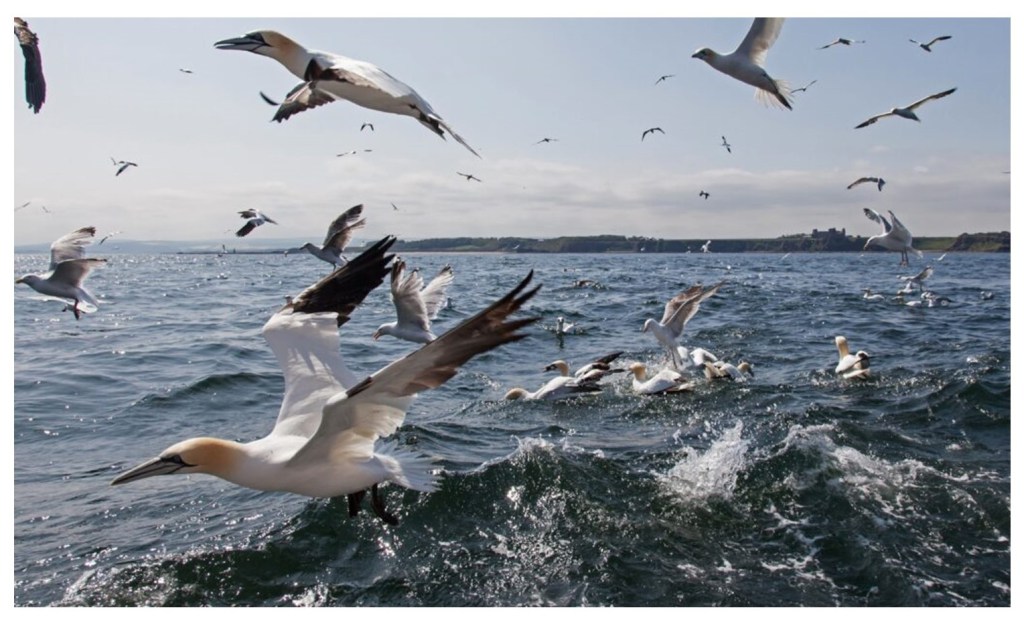
the gannets skimming the waves.
Stunningly beautiful.

Holy Island,
indeed.

Gill Henwood
October 2023

Northumbrian Gannets

Living Manuscripts

A long time ago now, I picked up a copy of St. John’s Gospel which had on the cover: Remember, you may be the only copy of the Gospel someone will ever read.
There is such truth in that.
We receive the Good News of God in many ways, but we learn the story, the ‘adventure of God in Jesus’,often by being introduced to it by someone for whom the words of the Gospel have become ‘real’. As the words above suggest, we are copies of that Gospel.
The New Testament is an open-ended book. We are still writing it with our lives.

Christians are just observing, once again, Holy Week, the time when we refresh our lives with all that Jesus means to us and all the love of God he shows to us. It is also a time of re-offering our own lives back to God so that we can be used in the service of the Gospel.
In that re-offering we are, as it were, taking up our pen of faith and dipping it into the love of God.

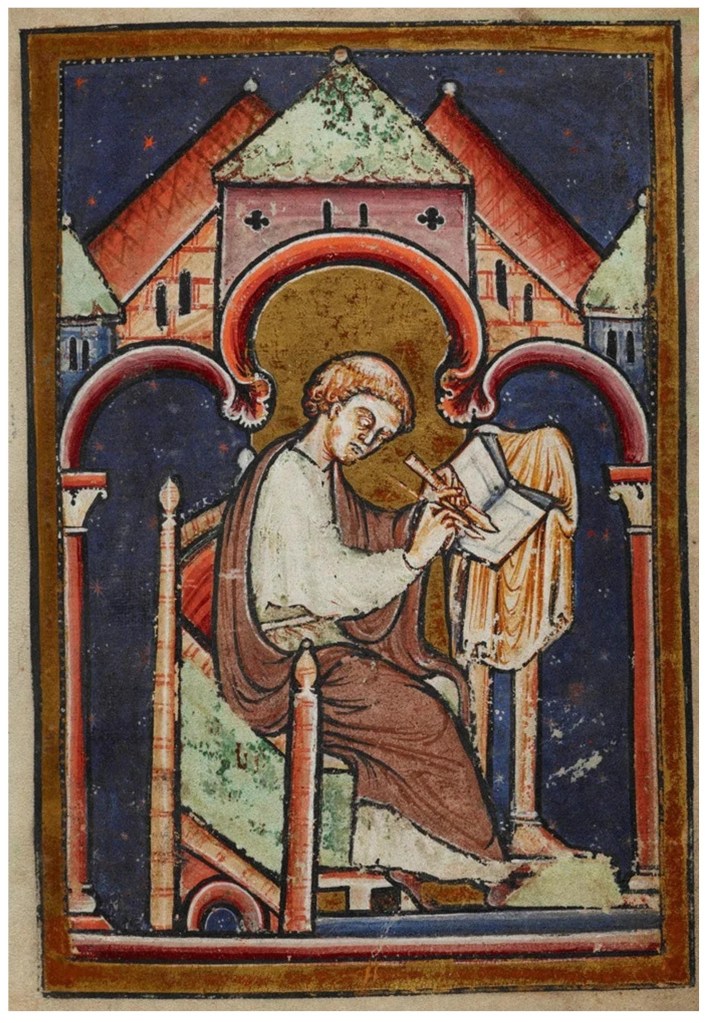
Manuscripts of the Bible, and especially the Gospel accounts were beautifully produced in the early Church. The Book of Kells in Dublin; the Gospel made at Lindisfarne and so many others are examples of how the Good News of Jesus was celebrated in written form. Missionary monks in Britain would usually travel with a copy of the Gospel. This was their preaching book. The more embellished and wonderfully decorated copies were written because of a deep love of a saint. The Lindisfarne Gospel was made in honour of St. Cuthbert. Of course, most of all, they were signs of a deep love for God, for Jesus.
As with Icon writing, (painting), they were deeply instilled with prayer.
Through prayer and skill the manuscripts became expression of the faith of those who made them.
All acts of love for God are truly genuine when we put our whole being into them.

A medieval monk preached a sermon in Durham Cathedral in which he used the tools that are needed to make a manuscript as spiritual aids to help us put ourselves into our witness to God.
This is part of what he said:

“The Parchment on which the manuscripts are written is pure conscience;  The knife that scrapes the skin making it smooth for writing is likened to the love of God, the awe with which we hold him as he, like the knife in the hand of the skilled manuscript writer, scrapes away all that is within us which turns us away from God and prevents us truly loving him.  The pumice that smoothes the skin is the discipline of heavenly desire and the chalk which whitens it signifies an unbroken meditation of holy thoughts.  The ruler for the lines of text is the will of God and the straightedge is devotion to the holy task.  The quill with its end split in two for writing represents the love of God and love of neighbour and the ink is humility itself.  The colours used by the illuminator is a reminder of God’s grace and wisdom which colours our lives. The writing desk is the tranquillity of the heart and the writing place is a contempt of worldly things as the holy work lifts us to a desire for heaven.  The model or exemplar for the work is Jesus Christ.

The monk who wrote this allegory used the everyday things needed to produce a beautiful manuscript for God’s glory as aids for his spiritual journey in copying the Gospel for others to read it.
It is a reminder to us that it is in the ordinary things that we can find God.  Teresa of Avila called this, God walking among the pots and pans.  Making connections between the ordinary things in our lives and Gods  can help us in our praying. 

This prayer written by a lady on a Celtic Retreat I led, makes this connection between the material and spiritual:
 
Vellum, parchment, stone, wood and skin
all marked by the writer to convey the word of God.
Yet God, in mystery, appears to fleshly hearts, made pure,
writing upon these the very word of God,

that they can be read of human –
true icons of Christ.
The Word, made flesh, dwells with us.

The Christian Holy Week pilgrimage brings us closer to the love God shows us through Jesus.
As we pray through our journey we are being invited by God to become living Manuscripts of His love for the World.
It certainly needs to read it.