There is a story about a Vicar who was baptising a baby in a very large font. The baby slipped from his grasp and disappeared under the water. With presence of mind,he thrust his hand into the font and fished around, saying as he did so, “I know he’s in here, somewhere!”
That’s how I sometimes feel about Jesus and the Christmas hype. In the days and weeks before Christmas we get a bit manic and caught up in frantic activity which has very little to do with the real Christmas. Yet, amidst all the trappings of Christmas and all the false trails we are led along by commercialism or fantasy, there is a real message to be discovered. For Christians there is a real Jesus to be found; an Incarnation to celebrate; and a true God to thank for his greatest gift to the human race – the gift of Jesus as a supreme statement of His love for us all. It’s a truth – Jesus is in there, somewhere. We simply have to pause and be still to discover him.
One of the places I discovered him is a little mountain village in Italy called Greccio. Above the village there is a church, built on the site of a very special event which was to have a profound influence on the way we celebrate Christmas and understand its real message.
At Greccio in 1223, St. Francis of Assisi decided that he wanted to celebrate Christmas in a rather special way.
Christmas Day was always a day of special joy to him and in his mind and heart he would relive in spirit the Bethlehem event. It was always a great source of wonder to him that God had taken our likeness and become one of us in Jesus.
At that special Christmas in 1223 Francis spoke to one of the gentleman knights of Greccio and said: “I would like to celebrate the next feast of the Redeemer with you. I would like to recall his birth in Bethlehem in order to see all the poverty he endured from his birth to save us sinners.”
The knight wondered how he would be able to help St Francis to do this and Francis explained: “I want you to put a manger filled with hay in the cave you own on the mountain and I would like you to bring an ox and an ass exactly as at Bethlehem. On Christmas night, I will come up there and, together, we will pray in the cave.”
The knight did as Francis asked and as Christmas Day approached, a great procession made its way up the mountain track. The Franciscan friars were joined by the villagers, shepherds from the surrounding hills and local farmers. Their torches punctuated the darkness with light and the air was filled with song as the friars sang a special hymn which Francis had composed:
“God is our strength. The great and holy Lord sent from the heavens above, his Son born of the Virgin Mary. A chosen Child has been given us and placed in a manger.”
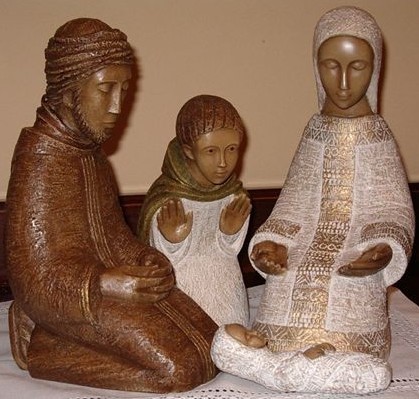
Reaching the cave they were greeted by a crib scene – no longer a distant scene in historic Bethlehem brought to their lives by a biblical text. It was there before them. It was as if, that year, Bethlehem was brought to the top of the mountain of Greccio and they were as much a part of it as those Shepherds long ago. The Eucharist was celebrated on a small altar and Francis explained the Christmas Gospel – and then, he took a small child from amongst those gathered and laid him gently in the hay. There before them a defenceless child symbolized a vulnerable God who chose to become involved in our lives as one of us in order to bring to birth his love in our hearts.
As the Eucharist was celebrated so they each came forward to receive the sacrament of Holy Communion and their involvement was complete.
Jesus who had come to the world at Bethlehem came into their lives under the form of a piece of bread – vulnerably he placed himself into their hands, as defenceless as he had been in the manger – and it was their hands cupped to receive him which became the crib. Behind all this they discovered the profound truth of Christmas – that love had come to them; they were deeply loved.
The farmers and shepherds and villagers returned home full of joy. It is said that the night was glittering so bright that there was no longer need for their torches to light the way. Each of them was aglow with Christmas light and hope.
They had all been touched by God and had been caught up into heaven as they discovered in the simplest yet most profound way possible the truth that in the birth of the Christ-child they had been drawn into the life of the :
Great little one whose all-embracing birth
Brings earth to heaven, stoops heaven to earth.
Of course, what happened in 1223 in Greccio was just a beginning. As a result of what Francis did cribs are to be found in almost every Christian church, many city, town and village centres and all places where Christ’s birth is celebrated.
Children gaze in wonder; adults are reduced to awe; prayers are said and hopes and longings find a focus; sadnesses are poured out and joys are celebrated. The image of the Christ child in swaddling clothes and lying in a manger draws people to contemplate the mystery of God born in our midst in so fragile an environment, so vulnerable a birth. And each one of us who celebrate Christmas is drawn into an involvement with the real Christmas.
Like the villagers, farmers and shepherds in central Italy long ago, we have been invited to discover that God really does love us. In our dark and vulnerable world of today we do need to hear and believe that!
This has not been the easiest year for the human race and so many are left feeling unprotected and fragile. We are less secure and less certain; Ours is a much darker world than it was last Christmas.
In Bethlehem today, as in many places of the world, there is not the stillness of that much loved Carol, Silent Night.
The Archbishop of York, Stephen Cottrell, in his Christmas message from Bethlehem, spoke of a silence of those feeling abandoned,living in tension, fear, turmoil. He spoke, too, of the people in Gaza and the West Bank and the pain and difficulties of their lives. Archbishop Stephen urged us all to pray, “as never before for peace in the Holy Land.”
A meaningful peace is formed in hearts of love. It’s needed also in the Ukraine, the Sudan, Syria and so many areas of global conflict where there is struggle between human beings fighting each other in the name of ideologies which bring conflict. Bethlehem has become synonymous of all that is not pure and lovely in humanity and all that is wrong in the human heart. For many, the answer has been to live for themselves but we are all involved with each other.
We need to hear that we are loved and valued and of infinite worth. We need to feel secure enough to reach out in love to others.
The crib of Christ offers us that security, albeit from the most vulnerable place imaginable – the innocent heart of a babe born in the very margins of society and in the most inauspicious of circumstances.
Yet from the crib, Godly love pours out to us drawing from us awe and wonder of a God who is prepared to risk everything and who is prepared to love us despite what we do to him and to each other. In our own need and vulnerability, we should rediscover this.
Here are words of the late Mother Jane SLG, a nun whom I had the privilege of knowing personally and whose wisdom lives on for us.
“If we have the courage to admit the reality of our situation, that we can rely only on God, we are open to receive the glory which will shine in every corner of our lives and ourselves, showing up the shadows more starkly, but inflaming us with a delight in God that keeps our perspective right and helps us to accept and transcend our own and other peoples’ shortcomings because the love of God is so much more important.”
The Love of God is so much more important – because of Christmas he is in our lives somewhere. May we discover that He is in our hearts. It will make all the difference.
[Mr G. Christmas Eve 2025]


 Mr G's Ponderings