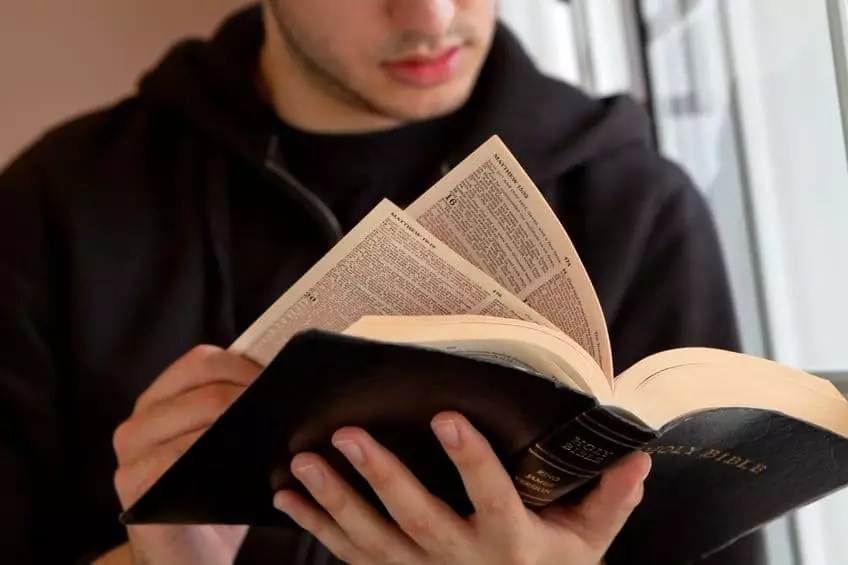
When I was at Junior School I remember John Garnett telling our teacher that he had just completed a reading of the entire Bible. He was quite smug about it and I suppose for an eleven year old boy it was quite an achievement. Not to be outdone, I decided that I also would read the Bible from cover to cover. I set off eagerly through the pages of Genesis and Exodus and all went well until I got to Leviticus when, sadly, I abandoned the project. Trying to read the Bible from cover to cover as a way of beating John Garnett rather missed the point of why we read the Bible. I know that now!
When we read the Bible and especially when we pray its pages we enter into a loving relationship with God. As Christians, we are part God’s story and it remains a continuous story of God’s Love Affair with His people – with us! We don’t read the Bible in order to chuck quotes at others, still less to prove some argument or opinion we hold – though sadly the Bible has been used and continues to be used by people in just such a way.
The Orthodox spiritual leader, Kallistos Ware, wrote that: The real purpose of Bible Study is to feed our love for Christ, to kindle our hearts into prayer and to provide us with guidance for our personal life. The study of words should give place to an immediate dialogue with the living Word himself – with God, with Jesus Christ.
To be reminded that the sacred words of the Bible lead us into an encounter with Christ is very important. We are in relationship with a Living God, and not just a book. An Orthodox Saint, St Tikhon, said that Whenever you read the Gospel, Christ himself is speaking to you. And while you read, you are praying and talking to him. This conversation must never be rushed.
A friend of mine once said that we should read the Bible in digestible bits rather than indigestible chunks! Modern translations of the Bible helpfully divide the text up into sections rather than chapters and one section at a time can be enough to feed our praying..
Today, we keep Bible Sunday and it is a reminder of how very important the Word of God revealed in Scripture is for our life of faith. How can we tell God’s story and be part of that story if we neglect the Bible? I love this quotation from Richard Carter, Associate Vicar for Mission at St. Martins-in-the-Fields, London. I offer it as a little Ponder Point.
“Sometimes, you just have to read the Bible with your heart. It’s not a theory, it’s not an argument, it’s not a weapon, it’s not words. It’s the Word made flesh. It’s God’s love deeper and wider and more expansive than your dreams.”
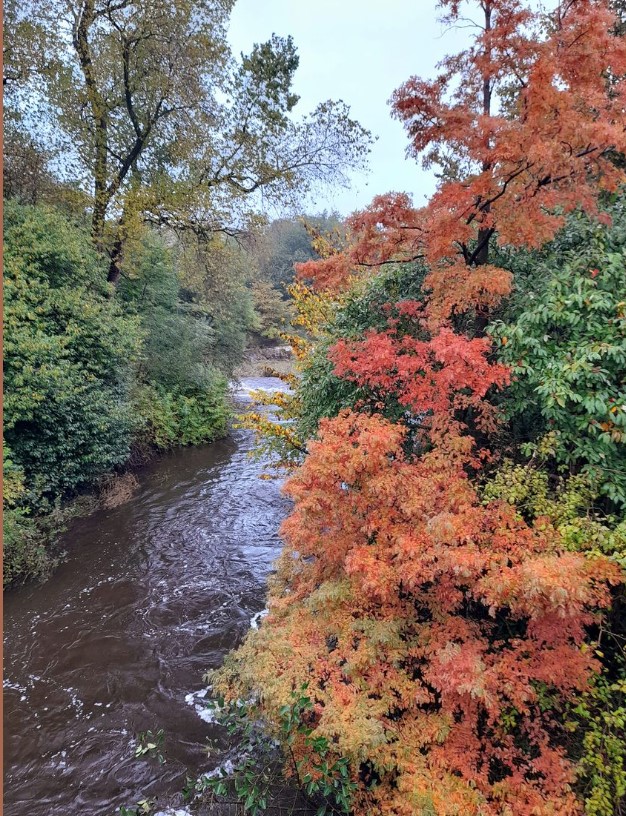
Autumn at Auld Bridge, North Ayrshire photograph by my friend Heather Upfield.
Holy Ground
Sometimes it feels like our world is simply falling apart, or to be truthful, humanity is proving to be a big threat to the earth God made and of which we are supposedly stewards. Ukraine, for example, is where the demonic, in the shape of Mr Putin, is threatening to destroy a land which doesn’t belong to him and a people who, for the most part are innocent. There is little that most of us can do about that. Some of us feel powerless to change things for the better. Meanwhile, we in England are spectators to a different kind of power struggle which is, nevertheless, upsetting. Our ruling party in Parliament is engaged in what can be described as in-fighting, warfare, and a pitiful attacking of each other. What they are not doing, it seems, is actually governing. It has been going on for months and there is no clear end in sight. Meanwhile many of us feel powerless at the futility of it all.
So, I was pleased that my friend Heather sent me the above photo of an autumn scene in North Ayrshire. It gave me a different perspective. I was reminded that there is a different view of the world, and creation provides it. Whilst there is much to do and hearts and minds to change about the care of creation, the world continues to move through the seasons showing us beauty and freshness and hopefully joy. Autumn is such a definite season of both dying and rebirth. As the autumn coloured leaves drop silently to the ground, they leave behind a space for new buds to form and new life to burst forth in due season. Some in the animal kingdom hibernate or slow their pace at this time of year. Would that humanity might imitate! We might do less damage!
All of us are looking expectantly towards the movement of Autumn into the Christmas light of the Christ-Child, once again illuminating darkness – Diwali for the Hindu people on Monday, Hanukkah for the Jewish people in December, (Eid – Al-Hada for Muslims at a variable time). Light penetrates darkness and reminds us of our dependence on the Sun. Also, perhaps, we may re-discover the importance of the delicate balance of the Cosmos as well as of our own Planet.
Seasons are good moments to repent – to turn away from all the things we are doing wrong to Creation, the world of Nature and to ourselves. A time to turn back to God and look forward to better things; to do better; to be better people. A time to try to be more Godly and to remind ourselves that all life is gift and that we are given, also, a planet to care for, including each other, and therefore we are on God’s Holy Ground.
I came across this prayer recently and I share it with you. It deserves to be prayed with joyful repentance.
Loving God, We praise you for the miracle of life and growth: for the smell of flowers, fresh vegetables and an autumn morning, for the taste of crunchy apples and warm porridge, for the sound of running streams, Mozart and a school playground, for the feel of warm soup, smooth velvet and loving arms.
Particularly, today, we thank you for trees: for the beauty of their shape and form, for the freshness and life they bring to our streets, for their essential contribution to the cycle of nature.
Loving God, forgive us: when we don’t notice this wonderful world in which we live, when we don’t think about the impact of some of the things we do, when we deliberately contribute to the destruction of your world. Let us remember; that the ground we stand upon is holy ground let us keep it, guard it, care for it, for it keeps us, guards us, cares for us.
Backlit cloud frames the swirling darkness where anxieties stumble against uncertainties. These are futile times. confusing, bewildering, painful: it seems too much to bear. Burdens collide in a nonsense world of emptiness, selfishness and lies – forces beyond our control.
Backlit cloud shows us to turn and look another way opening a new direction. The light comes from within – divine light from God who dwells in us where the Kingdom begins, and calls us to turn our gaze outwards.
We are to edge darkness with light, conquering despair with hope; called to embrace and heal the world, drenching all with love – ourselves the back light given by God.
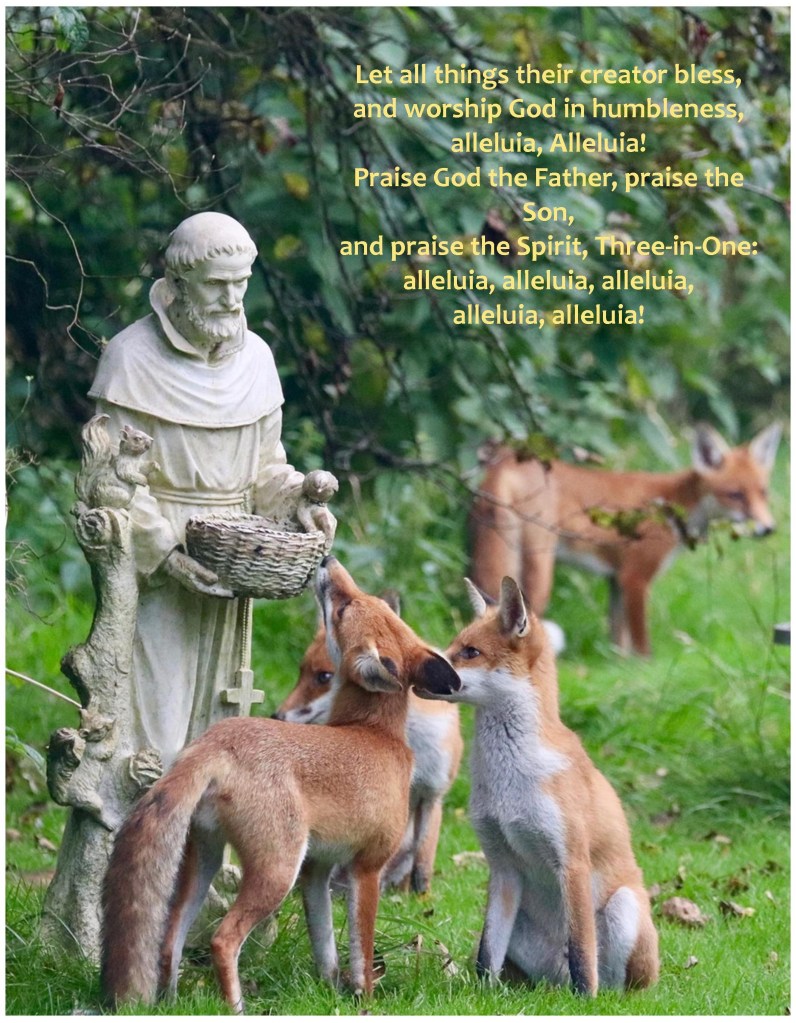
Latton foxes gather around St Francis. Photo by The Revd Lynn Hurry
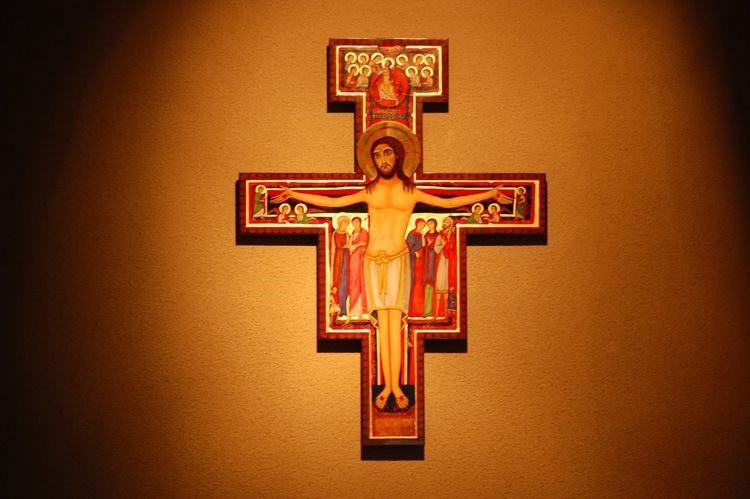
When St Francis gave up his life as a kind of lad-about in Assisi – when he turned away from drinking, fighting, leading a pack of rebels, it was because he had been brought up sharp by Jesus. Not for the first time or the last, God had visited the soul of one whose life was going in entirely the wrong direction. Francis’s soul was sick and needed healing. So God drew him away to a derelict church of St. Damiano on the edge of Assisi. There he knelt in prayer and looked at the faded crucifix still hanging over the altar. Francis insists that the voice of Christ came to him from that crucifix, at that moment. The words he heard were: Francis, rebuild my church, which you see is falling down. The derelict Church certainly needed repairing, just as Francis’s soul needed rebuilding. Francis was about to begin his ministry and service for God.
First, though, he had to get to know the One who called him to this service and to know the love of God flowing into him and through him to others. Francis opened his heart to God in Holy conversation. As he knelt in that place of meeting with Jesus, the first prayer he said was one that was to remain with him throughout the rest of his life.
The Prayer before the Crucifix
Most High, glorious God, enlighten the darkness of my heart and give me true faith, certain hope, and perfect charity, sense and knowledge, Lord, that I may carry out Your holy and true command
Another prayer is this which was to become food for his soul, in which he prays that the love of the Lord Jesus should enter his heart and absorb him with its fire and sweetness. It is known as the Absorbeat because God’s loving Spirit possesses him.
May the power of your love, Lord Christ, fiery and sweet as honey, so absorb our hearts as to withdraw them from all that is under heaven. Grant that we may be ready to die for love of your love, as you died for love of our love. Amen
Francis certainly used this prayer often , and it is characteristic of his spirituality.
A simple, yet deeply profound prayer was one that he is said to have dictated as he lay dying. It was a prayer which he had used often and wasn’t original, but it was so important to him that it was his deathbed prayer. Many will know it in some form.
We adore you, most holy Lord Jesus Christ, here, and in all your churches throughout all the world; and we bless you, because, by your holy cross, you have redeemed the world.
Francis grew quickly and deeply in love with God and this spurred on his eagerness and zeal to serve others in God’s Name.
Richard Rohr, a much loved Franciscan brother who lives in America and teaches Franciscan spirituality wrote this week that the only way we can truly know how to love God is to love what God loves. Only then do we love with divine love and allow it to flow through us.
It is not always easy to do that because such love has to be stripped of anything that makes demands or is tinged with our desire for them to be what we want. A Franciscan theologian, Duns Scotus, put it this way.
“we are to love things in and as themselves, to love things for what they are, not for what they do for us. That’s when we really begin to love our spouses, our children, our neighbours, and others. When we free them from our agendas, then we can truly love them without concern for what they do for us, or how they make us look, or what they can get us. We begin to love them in themselves and for themselves, as living images of God. Now that takes real work!”
Through Prayer and especially time alone with and for God, this spirituality of loving what God loves, simply because God does so, became central to St Francis’s own spirituality and way of life. It became the driving force for his work with the poor, the sick, the lepers, animals, birds and all of nature. It was how he came to love and honour God.
So he came to Praise God above all else. This he expressed in another Prayer poem
Praises of God.
You alone are holy, you who work wonders!. You are strong, you are great, you are the Most High, you are the almighty King, you, holy Father, King of heaven and earth.
Lord God: you are Three and you are One, you are goodness, all goodness, you are the highest Good, Lord God, living and true.
You are love and charity, you are wisdom, you are humility, you are patience, you are beauty, you are sweetness, you are safety, you are rest, you are joy, you are our hope and our delight, you are justice, you are moderation you are all our wealth and riches overflowing.
You are beauty, you are gentleness, you are our shelter, our guard and our defender, you are strength, you are refreshment, you are our hope. you are our faith. you are our love, you are our complete consolation, you are our life everlasting, great and wonderful Lord, all powerful God, merciful Saviour!
Amen.
Of course, we are probably all familiar with the poem/song Make me a channel of your peace. It is known as the Prayer of St. Francis but it was not written by him. Indeed in was probably written in the 1920’s but who could read, pray or sing it, without acknowledging that it is marinated in St. Francis’s own spirituality.
There is so much in his sayings, these prayers, and canticles I haven’t referred to, but if we are to understand the witness and service of St. Francis, these prayers above are a good place to start.


 Mr G's Ponderings