Tag: Mr G

Mellow Fruitfulness

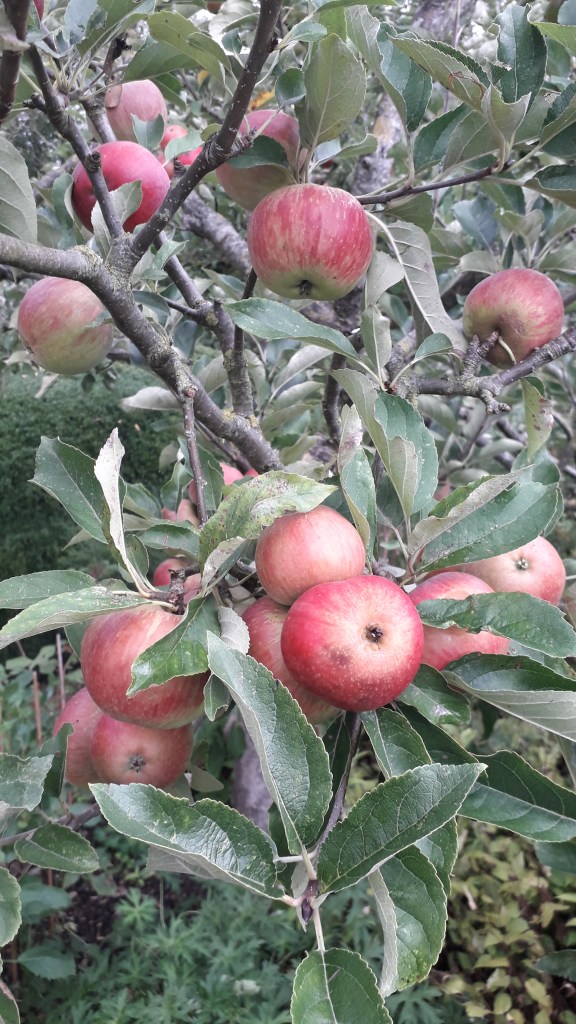
{Autumn apples at Charleston. photograph Mr. G}

On the last day of September, some thoughts naturally turn to Autumn. This was true this morning as I took a companion to the local railway station. As tends to happen on such occasions, this led to poetry!

Of all the poems about Autumn, the one most well known is probably Ode to Autumn, beginning with the words, Season of mists  and mellow fruitfulness …
It was composed by the English Romantic Poet, John Keats, in 1819 and published first in 1820.
Many can quote the beginning and others know it by heart. Some may know snatches and others simply are just aware of it. For some it may be time to remake its acquaintance!
This beginning of Autumn could be a good time for this. It is such a beautifully descriptive poem which draws people into the depth of its richness and to a delightful meaning.
Though many have written and reflected about this, it really doesn’t need a commentary. Just a walk in the countryside, woods, park or any place where nature reveals herself.

Let the poem quietly and even thrillingly, soak into your being.
My hope is then you will come to appreciate Creation more wonderfully and, of course, that it will lead you to a more thankful blessing of your Creator God in all his loveliness and providence.

[Mr]

Season of mists and mellow fruitfulness,
    Close bosom-friend of the maturing sun;
Conspiring with him how to load and bless
    With fruit the vines that round the thatch-eves run;
To bend with apples the moss’d cottage-trees,
    And fill all fruit with ripeness to the core;
        To swell the gourd, and plump the hazel shells
    With a sweet kernel; to set budding more,
And still more, later flowers for the bees,
Until they think warm days will never cease,
        For Summer has o’er-brimm’d their clammy cells.

Who hath not seen thee oft amid thy store?
    Sometimes whoever seeks abroad may find
Thee sitting careless on a granary floor,
    Thy hair soft-lifted by the winnowing wind;
Or on a half-reap’d furrow sound asleep,
    Drows’d with the fume of poppies, while thy hook
        Spares the next swath and all its twined flowers:
And sometimes like a gleaner thou dost keep
    Steady thy laden head across a brook;
    Or by a cyder-press, with patient look,
        Thou watchest the last oozings hours by hours.

Where are the songs of Spring? Ay, where are they?
    Think not of them, thou hast thy music too,—
While barred clouds bloom the soft-dying day,
    And touch the stubble-plains with rosy hue;
Then in a wailful choir the small gnats mourn
    Among the river sallows, borne aloft
        Or sinking as the light wind lives or dies;
And full-grown lambs loud bleat from hilly bourn;
    Hedge-crickets sing; and now with treble soft
    The red-breast whistles from a garden-croft;
        And gathering swallows twitter in the skies.
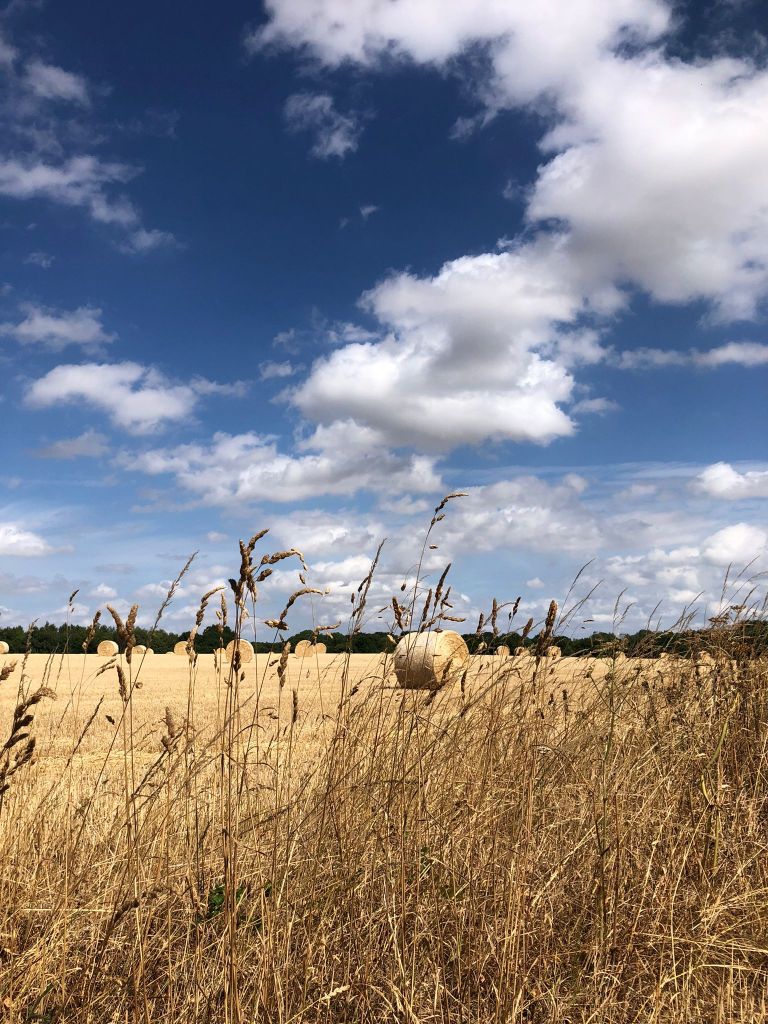
Photo: Julia Sheffield

[Mr G]

Scudding

scudding cloud over Newhall. Photo Mr. G.

SCUDDING

I have always had a delight
in the word,
‘scudding’.

So it pleased me, this morning,
to see the wispy, untamed,
wind – driven clouds,
‘scudding’ across the sky,
pure white
against sun-kissed blue.

Quite free in movement
and progress,
requesting, nor requiring,
any action of mine.
Shape-changers in a cosmic dance;
reminder that this world  is not mine
to control.

God waves merrily as he passes by.

Mr.G.
17th September 2022

A Red Admiral calls

Photo of Red Admiral Butterfly resting on Cedum. (by Gill Henwood)

My friend Gill has sent me the lovely photo of a Red Admiral Butterfly basking on a pink sedum plant.
The Cedum is noted for the bountiful provision of nectar, hence the attraction.  Or is it just that?

A few years ago, a very dear friend died and within a very short period, a Peacock Butterfly had made its way into the home. It wasn’t the most seasonal time of year for such a butterfly but it stayed around.

There is a view in folklore that when someone special dies, a butterfly will come quietly to the home.  It is as if the butterfly touches you with some kind of assurance that your Loved one are OK. It is usually someone who has brought passion or deep love into your life. I’ve read that such a person is often someone who knew how to live life deeply.

This fits in with the colour red. Both the Peacock butterfly and the Red Admiral have touches of Red, though to be accurate, most of the Red Admiral is black and some of the colour splashes are orange.

Because, quite often, the Read Admiral and the Peacock fly close to and even on you, people sometimes talk about being blessed. You are certainly unlikely to miss them with their striking colours! It might be also that thinking about how the Butterfly flight is linked with someone who has died, then there may well be a message to contemplate.

There is a Christian interpretation about the colour red which links life here with life in heaven. Red is the colour the Church uses to convey the dynamism of the Holy Spirit. The tongues of flames at Pentecost are, like flame itself, tinged deeply with red. This is also the colour of love and God pours His love abundantly and freely upon us. This is particularly special when we are hurting and bereft. Red also is the colour of ‘martyrdom’ , witness. That the kind of ‘witness’ that draws its strength from the sacrifice of Jesus Christ on the Cross.

Two of  the things many have been doing over the past week since Our Gracious Sovereign Lady, Queen Elizabeth died is to ‘reflect’ on her guiding principles, faith and character as we ‘give gratitude’ for her life.
It is partly those two things which encourage us to pray for King Charles and all who will share with him in the true leadership of our United Kingdom and Commonwealth.

As we form our hopes for the future so we now entrust Queen Elizabeth into God’s hands,
in the certain hope that she will receive the gift of Eternal Life. That’s the kind of assurance God likes to give so maybe the Butterfly has a calling card to leave!

[Mr.G.]

Special places, Special people

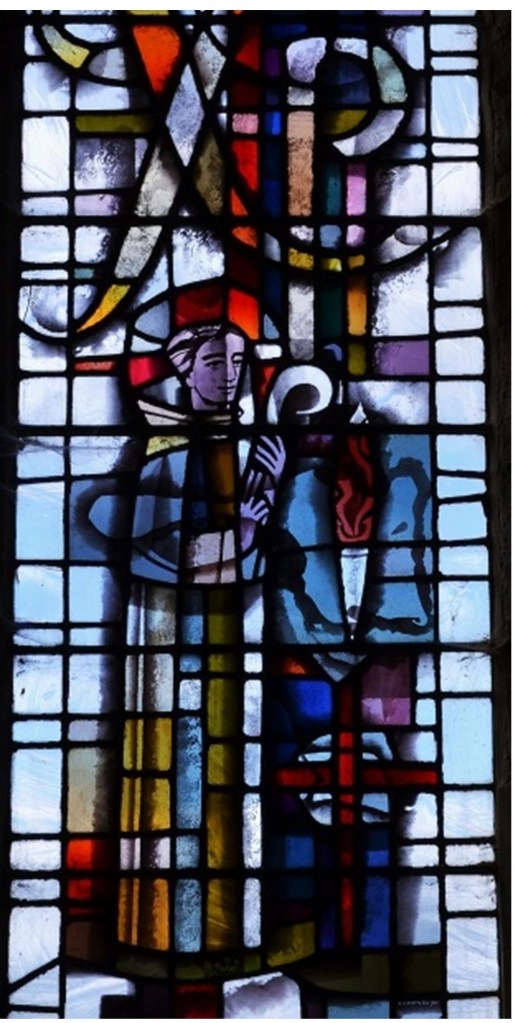
St Aidan window on Holy Island Church (St Mary the Virgin) detail.

In many journeys of faith there are special places that have spoken to us vividly about God.
The Celtic Christians called these the ‘thin places’ where the membrane which separates our world
from the world of heaven is so thin that it is easy for heaven’s spirit to burst through,
catching us up in a breathtaking experience of God’s nearness.
For me one very special ‘thin’ place will always be the Holy Island of Lindisfarne,
off the Northumbrian coast  between Bamburgh and Berwick-upon-Tweed.

It was to this island that St. Aidan came in 635AD.

He nearly didn’t come at all!
When King Oswald won back his Kingdom from the pagan king of Mercia,

he immediately sent to Iona for a monk to teach his people Christianity.
Oswald had spent many years in exile on Iona and there embraced the Christian faith.

His desire was that his people would also find a love for Christ.

The Abbot of Iona sent a monk who soon fell foul of the local people whom he branded as barbarians
and un-teachable. Returning to Iona he told his brethren what he thought and a gentle monk admonished him.
“I think, brother, that you gave them the meat of the gospel when what they needed first was milk.”

 Wise words but as so often happens, those who criticise (however gently) must be prepared to serve!  
Aidan was sent to Northumbria! There he set up his base in the place which, twice a day became an island—Lindisfarne.

Here he built a monastery and founded a school in which he taught 12 boys amongst whom
was the future St Chad, and his brother, St. Cedd as well as their two other brothers.

From this island a great mission began which was to take the Christian Gospel throughout the North and the Midlands and to Essex.

Because, initially, Aidan couldn’t speak the language, King Oswald went with him on his missionary journeys
to act as interpreter. One of the earliest examples of the co-operation between Church and State.

Lindisfarne remained a Christian centre until Viking raids led to the withdrawal of the monks.
Today it is once again a centre both of pilgrimage and prayer.

The local Church set up a Christian house for pilgrims known as Marygate House and it was here, in 1974 that I first came across Aidan and the spirit of the Celtic saints.
I have returned many times since and more than once I have experienced the sense of God’s nearness and presence. It truly is a ‘thin’ place.

Some, reading this will know exactly what I mean and will have their own ‘thin’ or special places (associated often with special holy Christians).
They are places where faith comes alive in a unique and special way. Such experiences carry us through the more mundane parts of our Christian journey.

What marks such places is that they are, in the words of the poet T.S.Eliot, places ‘where prayer has been valid’ – where prayer has consecrated them to God.

It strikes me that we should not have to travel far to find such places.

It is often the sincere prayer of ordinary Christians which makes a place holy.

One of my personal criteria when I visit, or worship in, a church is whether I can find God easily there.

A place where God can be found is a holy place, a thin place. It certainly needn’t be a church nor a place of special pilgrimage.

One of the holy and thin places I discovered is a slight bend in the rough hewn road which leads down from the Parish Church on Holy Island
to the shore which is opposite the crossing to Cuddy’s isles.

One day, when the island was clothed in a mist, I walked down this road and quite suddenly and totally unexpected, I found I had a companion.
I knew that it was St. Aidan whose simple presence touched me.

I knew at that moment I was on holy ground. I was at the thin place which is extraordinarily the meeting point between earth and heaven.
I can’t (and don’t want to) explain it in any other way.

Yet, whilst people like St. Aidan seem to be extra-holy, he would probably argue that he did nothing that all Christians can do,
which is to allow God to love them until they are on fire with God’s love.
That can be true for all of us and where it is then we become the ‘thin’ place where others can find God.

Photo: Gill Henwood

Aidan

You came on the flow tide
blown in, full of hope and zeal.
You carried the milk of the Gospel
but in your satchel, the firm, solid Good News waited to be heard.

The waves revealed the pilgrim way to Lindisfarne,
for its first journeying companion of Christ.

Those waves, a sign of what your Lord achieved through you:
first, lapping the hearts of those aspiring to know God,
then rushing in, hurrying to swamp the land with love:
a sea boiling with joy and hope and message.

Milk, then meat.
Quiet ripples, then mighty waters of God’s love and grace.

You were sent, Apostle to the North.
You came: a gentle breeze inspiring others,
awakening in them the wind of the Spirit.
Because of you, they stormed the Gospel message,
opening others to grace and truth,

to joy and love.

Mr G. | St Aidan’s Day, 2020