When I was in infant school I starred in a small thespian production. My role was that of ‘Clerk of the Weather’ over which Ihad total control and I wore a top hat to prove it!. I was able to command thunderbolts, raindrops, wind, sunshine and so much more.
Last week in France, the dry spell, as in England, was interrupted by thunderstorms. Flooding followed before hot spells returned.
Inspired by my memories of that wonderful few moments of power, I wrote this little poem..
The Clerk of the weather has heard the peoples’ cry! from his well stocked store house he scrabbles around throwing thunderbolts over his shoulder followed by a splendid light show of forked beauty illuminating the indigo sky, crackling like witches! His generosity knows no bounds as he adds thunderbolts and whirling winds. Deluge after deluge of pooling rain deliciously kisses the ground. The orchestra of thunderous drums beats across the sky accompanied by a light show of immense power.
The Clerk laughs gleefully, loving this reckless cacophany reaching down to crash upon the earth, soaking into parched and thirsty ground. But as the water floods across the baked soil the people cry; Enough!, Too much! Never satisfied.
The Clerk of the Weather draws breath and blows a wind so violent, it drowns their protesting voices and buffets them into submission. The Clerk thus reminds them just who is in charge.
This poem, by my friend Piers Northam, takes its inspiration from a Pilgrimage to the Shrine of St James in Santiago de Compostela. The poem is written at the beginning of the Anglican Lambeth Conference. The Conference gathers Bishops and others from member churches of the Anglican Communion. It is a diverse group with differing opinions on many issues. It can be viewed as a ‘scattered family’ which gets together to celebrate a fellowship which is best described as Koinonia – a fellowship with each other brought together by the Holy Spirit and held by that same Spirit in a Communion with each other.
Sometimes, because of its diversity, there is disagreement and some heart-searching as a compromise is sought. Sometimes because of our separate cultures, it isn’t always possible to agree, at least not at present. The member churches seek to listen and keep talking and praying together under God’s guidance until a new understanding is reached.
Another way of seeing things is as a Pilgrimage to God’s Kingdom which we approach from differing directions – as with the Camino where pilgrims walk from many different places. Conversations, prayers and walking together produces many experiences as we share in the common adventure. Finally each of these ‘ways’ converge. The Camino symbol, tracing the cockle shell (emblem of St. James the fisherman) shows us the paths converging to the same point.
Piers reflects on this as he thinks of what is the nature of the Anglican Communion. There are parallels to be discovered between the Camino and the Anglican Communion. Might it, therefore, be possible to see a positive way forward, not just for Anglicans, but also for Christians of all denominations. Could we be even more brave and see some way forward for inter-faith friendship.
The Anglican mystic and teacher of prayer, Evelyn Underhill, had a belief that our differing views and beliefs are as Chapels in the Cathedral of the Holy Spirit. It is both a lovely and dynamic thought !
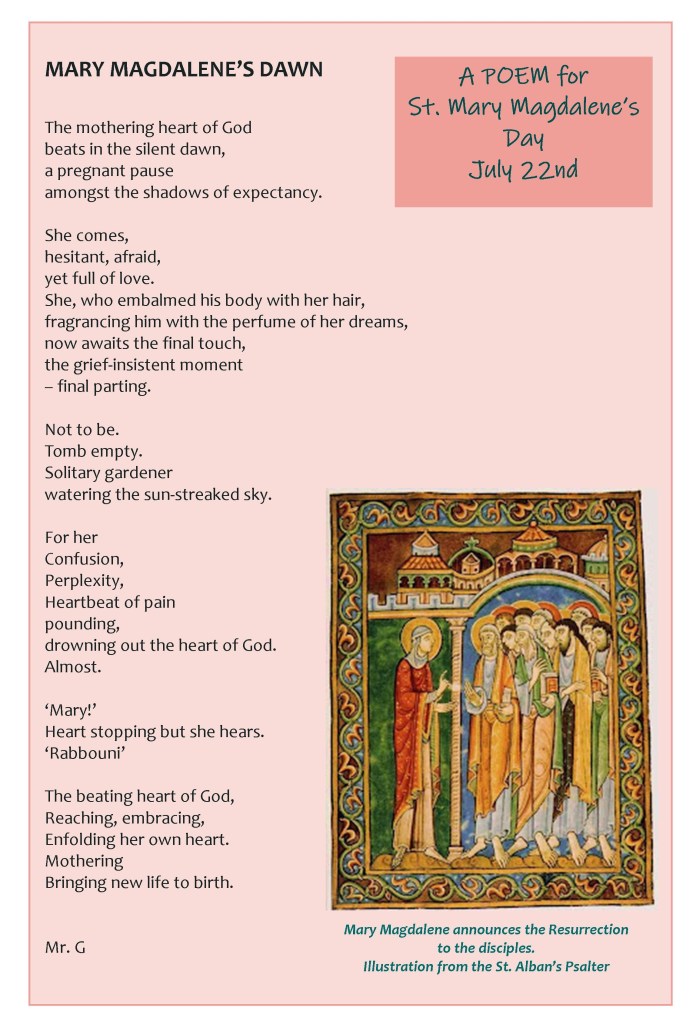
The mothering heart of God beats in the silent dawn, a pregnant pause amongst the shadows of expectancy.
She comes, hesitant, afraid, yet full of love. She, who embalmed his body with her hair, fragrancing him with the perfume of her dreams, now awaits the final touch, the grief-insistent moment – final parting.
Not to be. Tomb empty. Solitary gardener watering the sun-streaked sky.
For her Confusion, Perplexity, Heartbeat of pain pounding, drowning out the heart of God. Almost.
‘Mary!’ Heart stopping but she hears. ‘Rabbouni’
The beating heart of God, Reaching, embracing, Enfolding her own heart. Mothering Bringing new life to birth.
My friend Gill Henwood sent me a thought to ponder over. It was about how the light of God’s love wraps itself around both the dark places of our world and also the darkness which afflicts most of us from time to time. This is what she wrote:
“Secular leadership techniques and management may have led the churches astray from the pastoral care and self-emptying service of the gospels’ witness to Jesus. The presence of God’s Spirit may have been squeezed out by our institutions – yet is still searching our hearts and calling people to God’s Love given in Jesus. I wonder if the world’s gathering darkness will be a time of deep testing and eventually renewal – when through hardships we remember God is Love and turn from our human preoccupations with power and competition… Just a thought, but maybe a recognition that in the darkness Gods light burns clearly, bringing hope, calling us to love and filling us with the Spirit’s power in our human frailty.“
After reading what Gill had written, I was in conversation with another friend, Sister Rosemary SLG . She suggested that when we find difficulty sensing the presence of God because we are in a dark place, that is when, often, God is nearer to us than ever.
This reminded me that, hopefully, this applies to the dark situations in our world at present. It may not be easy to see God’s love at work in the darkness of Ukraine, or Yemen, Afghanistan, the Holy Land and so many other places but it is a truth to which we should cling. That can be hard to do. I don’t doubt God’s existence but in the face of all the demonic wickedness in our world , it is easy to feel a sense of futility; of powerlessness, darkness, emptiness. And it hurts because I love God and I am loved by God but I also wonder whether God is letting us down somehow.
Where is God in all this?
It’s a question to which I have found an answer from an unusual source but which is, for me, very helpful. It comes in a book by Elie Wiesel. Many know of him and of his story. He managed to survive Auschwitz but not without the marks of the trauma remaining with him all his life. He wrote a book which he named Night. A clear reference to both the outer and inner darkness which the Nazi’s created in everyone held captive by them, not least the Jews, Gays and Gypsies.
In his book, Elie Wiesel told of a day when some prisoners had tried to escape. Though they were recaptured, reprisals took place. A group of men and a boy about Elie’s age, were strung up on Cross-like gallows. All the camp were forced to watch as the men died before them. And the boy? He was too light for the rope to end his agony and he hung there a long time. The question was murmured around the camp – Where is God? Where is God?
Where was God as this dreadful agony unfolded before them?
Elie Weisel, just a boy himself, then pointed at the child. He said movingly, Where is God? He is there, hanging on the Cross with that boy!
It was a deep and insightful answer. For Christians it has a profound meaning and Elie was a Jew. Francois Mauriac, the French novelist, wrote in his introduction that when Elie came to him with his manuscript, he wanted to draw out the similarity between the child and the young Jew who, as a demonstration and sign of the love of God, died on a cross. But all he could do was to embrace Elie, weeping. As we try to come to some kind of meaning about all the things that are afflicting our world, it isn’t always easy to see much hope. However, the story Elie Weisel told contains a truth which I want to hold on to. God’s love will never leave us and is embedded in our souls as we struggle, either personally or globally.
Where is God?
He is in each one of us. He suffers with us and yet he also transforms that suffering with costly, self-sacrificial love.
The Lord will light my candle so That it shall shine full bright; The Lord for me shall also turn My darkness into light



 Mr G's Ponderings