Thank you to my friend Gill Henwood who has sent me this photo of a Rowan Tree in the Lake District. There are a number of legends associated with the Rowan. They are are known as Mountain Ash because they often take root in mountainous areas, but they are unrelated to Ash Trees. The Rowan was cited by Plato, the pre-Christian Greek Philosopher who mentions it in in his Symposium They have a place in Celtic mythology and were sacred to Druids who saw them as portals between death and rebirth. It was often planted near homes because ancient belief associated it with the qualities of courage, wisdom and protection, which they treasured. Early Welsh Christianity refers to it as the Tree of Life because it was thought that the Cross of Christ was carved from the wood of the Rowan, the blood red berries being symbolic of the blood of Christ. This thought leads me to offer this little Pondering.
ROWAN.
There are those who say your berries, rich and red, remind them of Jesus’s blood falling as deep droplets; beckoning us to the Cross and drawing us into the immensity of God’s Love for us.
Others, though, see the berries as baubles on the Tree of Incarnation; decorating the Manger, drawing us to the Child who sparkles for us, beaming with the immensity of God’s Love for us.
Both are right!
[Mr G. 17th September 2024] Photo by Gill Henwood.
Marking the 80th anniversary of D-Day, the ‘Standing with Giants’ installation featuring 1,475 silhouettes of soldiers, soldiers and airmen, as well as two female nurses, is coming to an end. The installation was completed in mid-April, and will be removed from 1 September. It is a dramatic depiction of the D Day Landings.(Photo by Piers Northam)
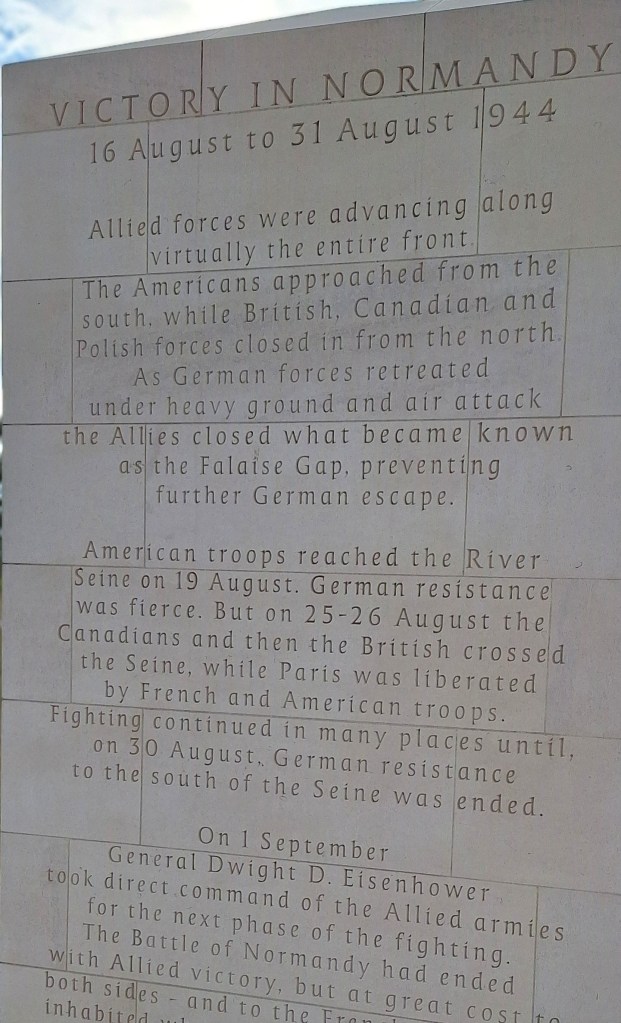
Last week, whilst staying with a friend in Falaise, I was able to share in the commemorations of the 80th Anniversary of the Battle of Normandy. Known locally as the ‘Battle for the Falaise Gap.’ or ‘in military terms, the ‘Falaise pocket’. Just outside the town over 20,000 German soldiers made a final stand. On August 17th when Falaise was fully liberated by Canadian, British and Polish troops they were able to move on to the decisive battle in the Normandy campaign. It had taken since D Day on the 6th June to reach Falaise. By the evening of 21st August the German army was surrounded. About 50,000 managed to escape but an estimated 50,000 were trapped. These all died. It had been a costly battle with heavy losses on the Allied side. By August 30, just a few days later, Paris was liberated and the remnants of the German Army retreated across the Seine.
D Day memorial at the recently opened British Normandy Memorial, a joint commemoration with the people of France.
Normandy Beaches.
You came as shooting stars discharging fury from your boats, intent on our death. We defended land which was not ours, uncertain of our rights, but fear consumed us; made us fight back.
We no longer fought for an ideology, nor for the immortality of a band of evil despots. We no longer cared for that, as we showed the whites of our blinkered eyes. We might yet win but all around us death claimed our emptying souls.
And yet, we killed easily at first. You were wading up mud-soggy beaches. Your dying bodies filled with our shrapnel , wept blood into the earth. And then, we too began to die, our blood mingling with yours – the earth also claiming us in that moment of killing.
We stopped being enemies; not yet friends, but lesson-bearers certainly – for goodness, honour, freedom, hope and peace – dare we say, love? United in a vital task.
Send our message to Russia, Ukraine, Israel, Gaza, to Iran, America, China – to all the traumatized places where they need the humility of liberation.
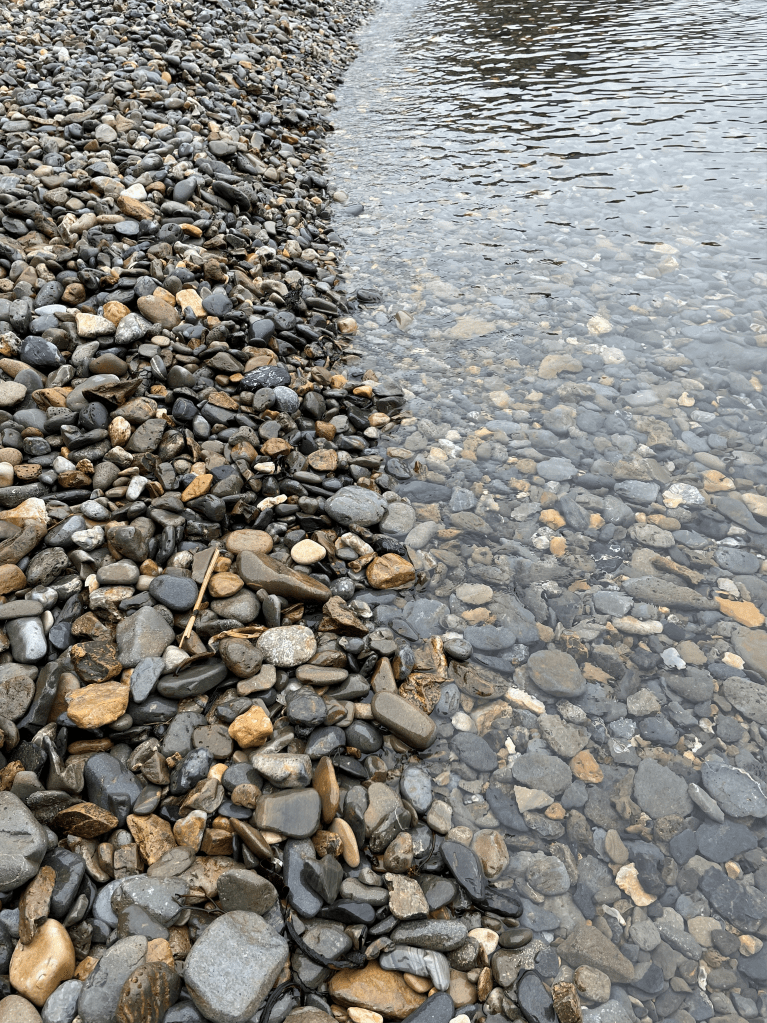
Porthsychan Cove, Pembrokeshire Coastal Path. Photo by Gill Henwood
Waves lapping on the shore, caressing pebbles, Stroking backwards and forwards, a rhythm of serenity and quiet pause, contradicting the rush and the frantic lifestyle which often overwhelms that inner search for peace; for stillness.
We are advised to search for the still, small voice which Elijah heard after the frenzy of earthquake, wind and fire.
The thing is that he did not seek it. The voice sought him. All he did was stand uncertain of what was happening. His world was crashing around him. Confusion reigned. But God waited and came quietly, speaking words Elijah needed to hear.
And so for us Like the waves, God’s grace flows across the pebbles of our life as clear, pure water, bathing us with His love. He seeks us out and refreshes our life with new hope.
Sense the movement of the waves and listen. You may just find that there is a message for you which you need to hear.
[Mr G 8th August 2024]
“after immense Activity one passes into a phase where passivity is the only way. I pray that you may be finding this passivity as the way in which the soul serves God, not by doing this or that but by passively receiving the great stream of His love and compassion.
Rural Britain has a number of festivals which in earlier times were celebrated much more fully than is the case today. Lammas which falls on the 1st August is one of these. Lammas is derived from an Anglo-Saxon word, hlafmæsse, which means loaf-mass and from the 9th century a church festival was celebrated in which a newly baked loaf was presented in church for use at the Mass or Eucharist.
Rural Festivals take us back to our roots and help us to remember the close affinity we have with nature and the earth, on which we depend for our sustenance. In these days of supermarkets and fast-food shops it is easy to forget this dependence though nature has ways of reminding us. Many are bemoaning the apparent absence of summer or rather of warm sunshine, this year. Our weather is much more erratic and less seasonal. Some, including myself would cite ‘global warming’ for this. We might easily blame humanity for the way we have exploited creation and taken for granted those with whom we share this volatile earth – the animals, birds, sea creatures and Nature generally. We certainly bear a lot of responsibility for that. Add to that the devastating wars and violence at present which suggests we are not at ease with ourselves let alone with the natural world, or with God.
So we need to get back in touch with the delicate balance of our planet which God has ordered so magnificently. We play with this balance at our peril. The planet is a volatile ball floating in a vast universe. Humanity occupies such a small part of this and if we stand in a clear spot on a dark night and look at the stars we realise our smallness in the midst of such vastness. Our forebears understood this and lived in healthy respect of nature’s force. They also remembered that the author of creation, God, is to be thanked and praised. That is why the Agricultural Year was punctuated with festivals such as Lammas. It would do us no harm to follow their example.
In the modern Lammas Church Service, there is a bidding which is made as a new loaf is presented to God. Brothers and sisters in Christ, the people of God in ancient times presented to the Lord an offering of first-fruits as a sign of their dependence upon God for their daily bread… and this is followed by a Prayer which roots our lives back into both God and His Creation.
Blessed are you, Lord God of all creation; you bring forth bread from the fields and give us the fruits of the earth in their seasons. Accept this loaf, which we bring before you, made from the harvest of your goodness. Let it be for us a sign of your Godly care. Blessed are you, Lord our God, worthy of our thanksgiving and praise. Saying this prayer as we are about to eat bread would remind us of God’s goodness to and help us to respect and celebrate Creation.
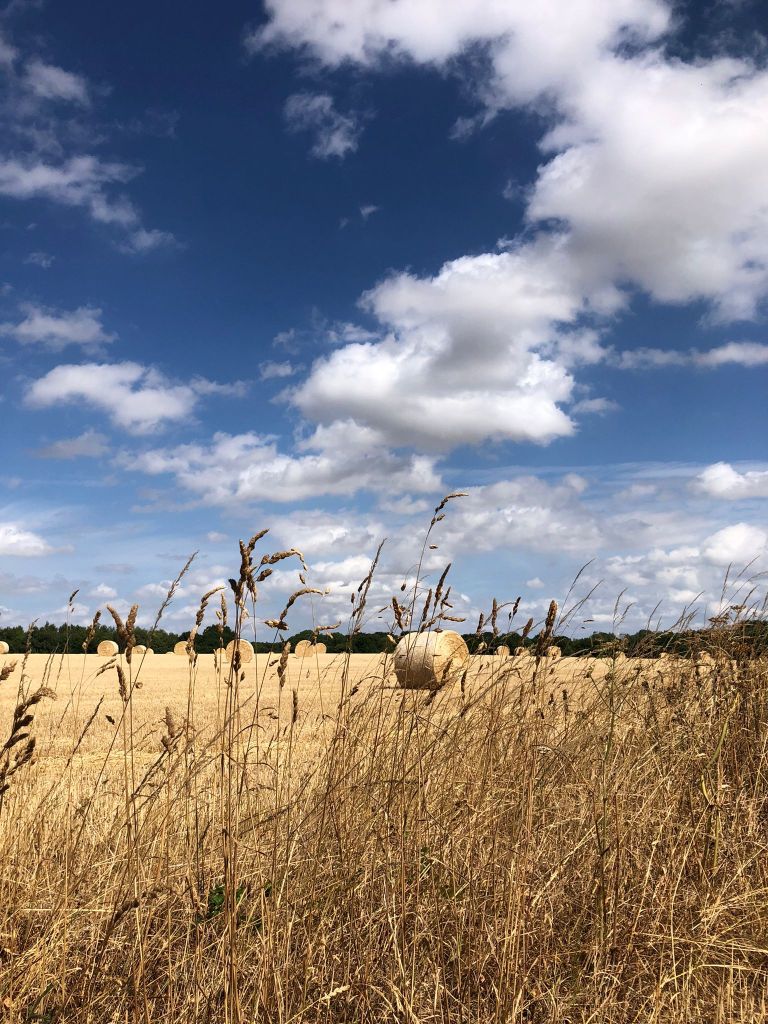
Hay bales in Norfolk. Julia Sheffield
A little while ago, I wrote this poem which has become my homage to Real Bread!
Mr Deakin’s Bread
The oven door opens in Mr Deakin’s bakery. Wafts of delicious, tantalizing aromas fill the air, tempting the nostrils with the unmistakable freshly baked bread. Sacks of flour wait quietly for their turn. Mr Deakin knows the Miller who lives near the farmer, who gathers the crop dancing in the breeze of his own fields. We take home the bread still warm. Crusty yet yielding if pressed, giving off a rich enticing smell, whetting the appetite. Held in trembling hands of expectation, we break off a little, raise a morsel to our lips. And another. Real bread!




 Mr G's Ponderings