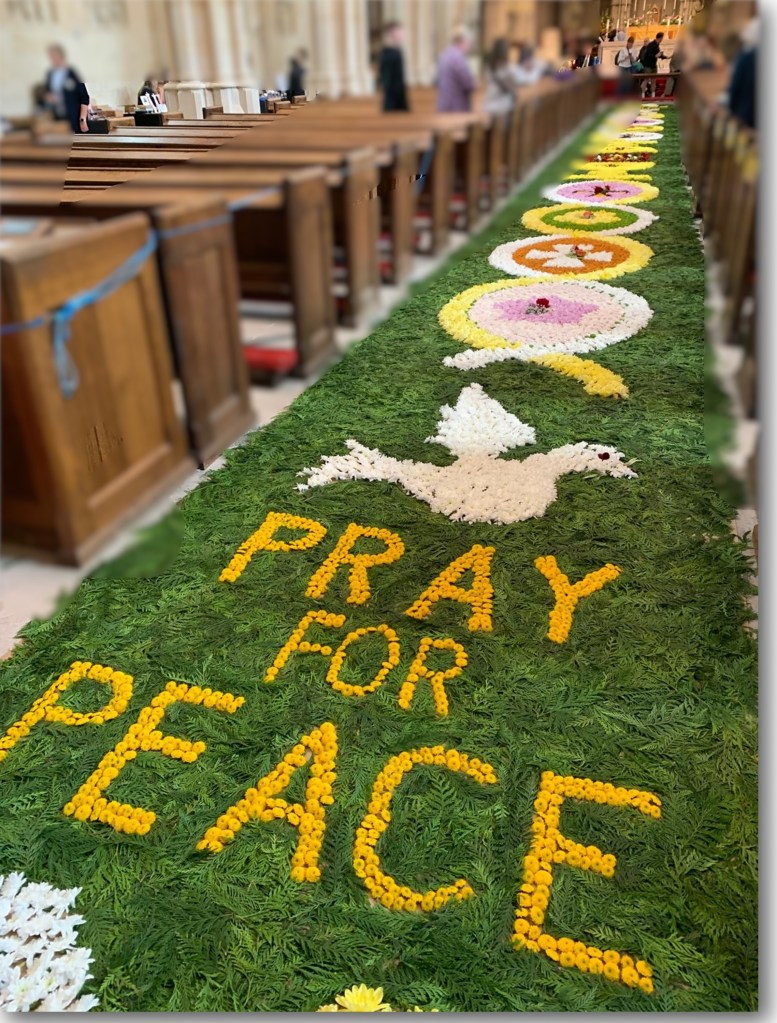
Photo of the Carpet of flowers, Arundel Cathedral – sent to me by my friends, Emma & Nathan Pope
Carpet of Flowers – Every Corpus Christi, the Roman Catholic Cathedral at Arundel hold a Festival, the highlight of which is the world famous Carpet of Flowers. It has been an annual event for 140 years. It began when the 15th Duke of Norfolk, Henry Fitzalan Howard. visited the village of Sutri just outside Rome. There he saw a carpet of flowers and this inspired him to introduce a similar festival in the church he had founded in Arundel – Our Lady and St Philip Neri. This was later to become the RC Cathedral. Each year there is a focal message in flowers and greenery. This year, as you see, it is Pray for Peace. Inspired by this, I wrote this little poem.
A Message from the Earth
You destroy the earth with your lust for power, control; the selfish bolstering of your ego. Yet, you cry for peace.!
Your words and actions are empty. So we must speak, for we are the world which you tread on with your heavy boots of rhetoric, falsehood, self-centredness and greed.
Therefore, we have chosen to send you a message in flowers and branches, in beauty and in love. This is our voice to your heart, the cry of the earth. Become Peace! Listen to us, please and act.
There is a saying in the North of England (some say it originates in Lancashire, others Yorkshire but I know where my money is!) – it’s neither nowt nor summat. For the benefit of those not familiar with northern English dialect, it means that it is ‘neither one thing nor the other’.
It is very tempting to say this is what it feels like after Ascension which the Christian Church celebrated last Thursday. At the feast of the Ascension We were led to the end of the Gospel of St Matthew when Jesus gave his last instructions and final blessing to his followers. Then, before their very eyes, he disappeared into the heavens. Jesus had told them that they were his witnesses and the task before them was to proclaim His Good News to all Nations. (Matthew 28: 16-end) In the nowt nor summat time they were to wait until they have been clothed with power from on high (Luke 24: 49). Jesus was, of course, referring to Pentecost when the power of God’s Spirit came upon them in the dramatic way Christians will remember next Sunday.
So we are between the Ascension and Pentecost. We are caught up in what I call a mathematical moment . From Easter Day to Ascension Day is 40 days. The same length as Lent. But Easter is the great Festival time of the Church so it must be the longest season, the ‘jubilee’ season of great rejoicing. So it has been given 50 days. The extra 10 days are those between last Thursday and next Sunday. So we are still in Eastertide! So this is not quite the negative time I’m suggesting.
According to the New Testament the disciples, together with the women who were special to Jesus, returned from Mount Olivet to the upper room where they devoted themselves to prayer. They also attended to the matter of choosing a successor to Judas. Matthias (whose feast day is May 14th – today) was chosen by lot. When I was younger I used to read in the Acts of the Apostles that the lot fell on Matthias! Not being familiar with this form of voting, I wondered, Did it hurt?
Through this sacred vote the disciples were thus ‘complete’ in the number of those who were destined to lead the infant Christian Church. (The sacred number 12 equating to the 12 tribes of Israel in the Old Testament.) The ‘ordination’ for this Leadership—their setting apart for the task, would come at Pentecost. For now they ‘waited’ and they prayed. Those being ordained to the Church’s ministry today go into ‘retreat’ just before they are commissioned by the Holy Spirit. The ‘nowt nor summat’ period is a time of getting oneself prepared. It is an inner activity in which God pours out his blessing. The importance of prayer as a time of being prepared by God for some work in His name cannot be over-emphasized. It is a time not of nowt nor summat but of expectant waiting. If God is to act through us, he needs us to be receptive to his Will, his plan. Which is why waiting in prayer is an important part of bringing a new and loving vision to a world (and a Church!) in great need.
I think in such moments of the lovely prayer of St. Teresa of Avila.
Christ has no body now on earth but yours; no hands but yours; no feet but yours. Yours are the eyes through which the compassion of Christ must look out on the world. Yours are the feet with which He is to go about doing good. Yours are the hands with which He is to bless His people.
Christ has no body now on earth but ours….
[Mr G]
PS>
There are a few versions of the prayer on YouTube under the title Christ has no body now but yours. The one by the Exultate Singers is rather beautiful and there an interesting one featuring Josh Garrels.
The photograph above was sent by my friend Gill who received it from her friend Kate. It is a picture taken at the Marsden Cuckoo Festival which was held last weekend.
Marsden is in West Yorkshire near Huddersfield and the Cuckoo is welcomed back after its time of hibernation in warmer climes. Marsden is a village set in the steep-sided Pennine valley. It is within the National Trust’s Marsden Moor Estate. The Festival includes a colourful procession, craft fair, Maypole and Morris dancing. There is even duck races. The highlight is the Cuckoo Parade which by tradition takes place on the last Saturday of April. Local residents walk in procession down the high street waving coloured ribbons and handmade puppets. The parade is accompanied by musicians and dancers. It’s a unique experience!
The model of the Cuckoo in the photo is part of the welcome to the Cuckoo returning to us as a herald of Spring.
The story of the reason for the Festival is part of Marsden’s folklore.
Signs of Spring chasing away a long harsh winter has always been important for people living in the Pennine hills. As I spent my childhood and teenage years on the other side of the Pennine Hills from Marsden I can remember the difficult winters all too well. When the snowdrops, crocuses and daffodils appeared, then we knew Spring had arrived. Another sign, of course, is the sound of the first Cuckoo. In the Marsden story, a cuckoo took up residence in a field, or in other versions, in a tree or even down a chimney. Whatever version is correct, the result involved residents in trying to capture the bird so that Spring would remain. The field wall was built higher, or a circle of stone was built around the tree or extra height was built onto the chimney! Whatever, the bird escaped anyway, mocking them all with its call – which was proof that this herald of Spring was still doing its job. Other stories were invented in other places and nearby Austwick claims to be the first to tell the tale. Rural rivalry in these matters is very strong! The Festival continues to celebrate the event. Of course, Marsden was not alone in celebrating the ‘first’ cuckoo of Spring. There is a custom that people who think they heard the first cuckoo in Spring every year, send a letter to the Times Newspaper. This is duly printed and the readers breathe a sigh of relief that Spring is now officially here.
Historically, the sound of the first Cuckoo is attributed to St. Tiburtius who was a Christian Martyr in Rome and who was beheaded about 286AD. His feast day was April 14th (now moved to August). St Tiburtius doesn’t seem to have anything to do with a cuckoo. It’s just that tradition has it that in England the bird dutifully arrives on his feast day having made the journey from North Africa. A little rhyme was penned by Rudyard Kipling to note this: Cuckoo, bring your song here! Warrant, Act and Summons, please, For Spring to pass along here!
The arrival of the Cuckoo is usually first in the Channel Islands and then there is a northward flight. Whilst Marsden keep its important festivity, there are other places with their own traditions southward.
It’s stay in England is at least until St. John the Baptist’s day on June 24th but other dates are later including into August. A rhyme about this is:
In April I open my bill In May I sing night and day In June I change my tune In July far far I fly In August away I must
A sidelight to this is that the rhyme inspired Paul Simon to use it in what is the shortest song on the album he wrote with Art Garfunkel, The Sound of Silence. The song is April Come she will, and it is believed that Paul Simon was influenced by a girl he met in England in 1964, who recited the song. He thought that this song of Nature was a useful metaphor for the changing moods of a girlfriend. The lyrics can work the other way and tell us something of the Cuckoo’s life.
April, come she will When streams are ripe and swelled with rain May, she will stay Resting in my arms again June, she’ll change her tune In restless walks she’ll prowl the night
July, she will fly And give no warning to her flight August, die she must The autumn winds blow chilly and cold September, I remember A love once new has now grown old
It is possible that the Cuckoo has no idea of the role we have given it as herald of Spring but then we should remember that it is a creature of God’s own making and maybe, just maybe, God has given it a special role to help his poor humans cheer up as the season of new growth and life and love shows itself. It is after all, Eastertide.
[Mr G ]
Cuckoo in flight going out to sea (Photo from bird forum)
#There is a rather beautiful poem, The Cuckoo, by the 19th century poet, John Clare.
#Thanks to the people of Marsden for information about their unique festival.
#P.S. Don’t forget to plant your potatoes! If you discover why send me a note on geoffrey_connor@priest.com. You never know, I might send you a bag of crisps.
Lambs discovering the joy of sunbathing! Photo from the Lake District from my friend Gill Henwood
The Church of England commemorates Christina Rossetti today. She is known particularly as a poet and probably more popularly as the author of the Christmas carol, In the bleak Mid-winter. Tunes by Gustav Holst and Harold Darke have helped to build its reputation. No Christmas carol service would be complete without it though it has a somewhat fanciful beginning. In the bleak-midwinter, frosty winds made moan, earth was hard as iron, water like a stone and then follows a reference to snow falling on snow. That doesn’t quite fit in with the birth of Jesus at Bethlehem in the warmer climes of the Middle East but the carol was written for people who live in the Northern Hemisphere. In these parts the idea of a cold winter is not difficult to imagine though the hope for snow may remain just that! The carol raises other questions but it is probably the final verse which has the greatest appeal, for both children and adults.
What can I give Him, Poor as I am? — If I were a Shepherd I would bring a lamb; If I were a Wise Man I would do my part, — Yet what I can I give Him, — Give my heart.
The idea of giving oneself to God at Christmas, who gave Himself to us in the Incarnation, is, after all, a response to an amazing action of God to bring salvation to His world. Christina recognizes this action of God as an act of pure Love. In another Christmas Carol, Love came down at Christmas, she ponders on this theme of Love in a deeper, spiritual way.
Love came down at Christmas, Love all lovely, love divine; Love was born at Christmas, Star and angels gave the sign.
Worship we the Godhead, Love incarnate, love divine; Worship we our Jesus: But wherewith for sacred sign?
Love shall be our token, Love shall be yours and love be mine, Love to God and to all men, Love for plea and gift and sign.
It is not as well-known as In the bleak midwinter, though the poem was set as the text for the BBC Radio 3 Carol Competition in 2022 and so got a lot of air time on the Radio. The winning tune was, to my mind, both memorable and beautiful. I think Christina, with a life steeped in a loving experience of God expressed in poetry, might have approved.
She was born in 1830 and died at the age of 64. Her brother was the Pre-Raphaelite painter, Dante Gabriel Rosetti and she became steeped in the theological movement which was associated with this – the Anglo-Catholic expression of worship and prayer. This had led her on a journey from Evangelicalism. Her elder sister took this a bit further by becoming an Anglican nun! Many of her poems were mainly religious though some were born out of sadness of love that was never quite fulfilled in human terms. She did, however, compose poems for children, including a very popular one, Goblin Market, about two sisters who were tempted by forbidden fruit sold by Goblin merchants and what follows as a result! Christina denied this was a poem for children and, indeed, many modern commentators point out adult themes to which it alludes. She did, however, write genuine poems for children. She also wrote a book, Called to be Saints, which she subtitled ‘the Minor Festivals Devotionally Studied, which explored those saints in the Anglican calendar which were overlooked at the time. She provided a devotional reflection on each one in a poetic way which reflected the depth of her faith.
Today she has her own place in the Anglican Calendar and a greater recognition of someone who in her lifetime dealt with unrequited love and quite debilitating illness and yet with faith. She gave us poetic reflections for our own life’s journey which also reflect a love of God that produced a rich harvest.
Some of her poetry celebrated the world around her and the photo by Gill Henwood of lambs taking their ease in the Lake District, which heads this article, drew me to a verse in one of Christina’s poems, The Milking Maid …
The year stood at its equinox, And bluff the North was blowing. A bleat of lambs came from the flocks, Green hardy things were growing. I met a maid with shining locks, Where milky kine were lowing.
[MrG 27th April 2024]
Good Lord, I ask much of Thee, But most I ask to love Thee; Kind Lord, be mindful of me, Love me, and make me love Thee.




 Mr G's Ponderings