Tag: Mr G

The Sun Dances

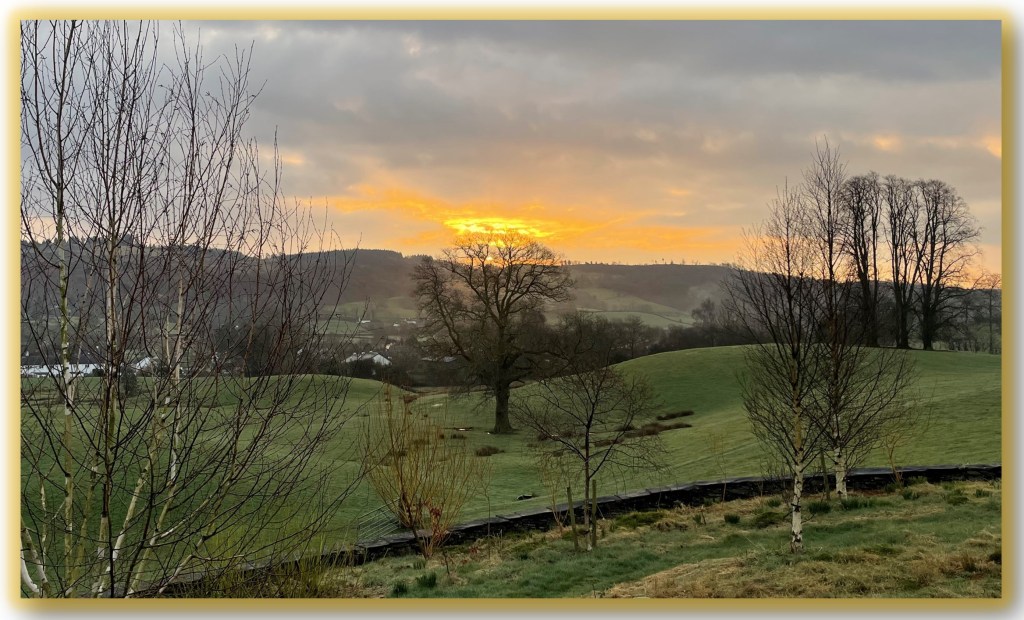
Sunrise on Easter Morning in the Lake District. Photographed by my friend, Gill Henwood.

The dancing Sun on Easter Morn
Some while ago, I came across a film made by an English visual artist, Tacita Dean. It was of a sunset filmed off the coast of Madagascar. It’s purpose was to catch the final ray of the sun as it disappeared over the horizon. The final ray is not red or orange but green and it lasts for less than a second. It has been described as a green flash, which occurs more commonly at sunset is a phenomenon in which part of the sun can be observed suddenly and briefly changing colour. It usually lasts only a second or two — which is why it is referred a flash — as the sun changes from red or orange at sunset, for example. The green flash is viewable because refraction bends the light of the sun. 

Tacita Dean managed to capture this moment and the flash is just visible. Mostly it has eluded her attempts to film it but then, just once, she was rewarded. She described the filming as an act of looking. It’s about faith and belief in what you see.

Remembering the film and what Tacita said, brought to mind the story of the sun’s action on another occasion at the other end of the day—the dawn on Easter morning.

There is an old Irish and Gaelic belief that when the Sun rises on Easter morning, it dances with joy that the Saviour has risen.
A version of this was recorded by Andrew Carmichael in his monumental work Carmina Gadelica. A woman, he met, in the Outer Hebrides, Barbara Macphie, describes her experience: She tells of climbing the highest hill on Easter morn and seeing the sun dancing in delight:
“The glorious gold-bright sun was rising on the crests of the great hills, and it was changing colour—green, purple, red, blood-red, intense white, and gold-white, like the glory of the God of the elements to the children of men. It was dancing up and down in exultation at the joyous resurrection of the beloved Saviour of victory. To be thus privileged, a person must ascend to the top of the highest hill before sunrise and believe that the God who makes the small blade of grass to grow is the same God who makes the large, massive sun to move.”

This belief is widely held in Ireland but it is a much wider custom than that.
In the Middle Ages it was held that at the hour of sunrise, this legend was fulfilled when the sun was said to make ‘Three cheerful jumps” as it rose from the sky. This was said to be in honour of Christ’s Resurrection. Some even suggested that the rays penetrating the clouds were the angels, dancing for joy.
I read somewhere that some people would put a pan of water in the east window and so watch the dancing sun mirrored in it.

Sir John Suckling. An English poet of the 17th century refers to this in his Ballad upon a Wedding.
In a very long poem, one stanza reads:

Her feet beneath her petticoat,
Like little mice, stole in and out,
As if they fear’d the light:
But oh! she dances such a way
No sun upon an Easter-day
Is half so fine a sight.

Resurrection morning customs are still common in parts of Europe, America and until this year, in Bethlehem.
No doubt some so-called rational thinking people may suggest that this is fanciful but we need to remember that God communicates Himself to us in many ways and through many mediums. 
We just have to have faith and belief in what we see.

Closing our minds and our hearts to such religious insights and experiences might well result in our missing the many splendoured thing which God wants to show us if we but look with the eyes of faith.
As Frances Thompson puts it in a cautionary note in his poem, In no strange land;

The angels keep their ancient places;—
Turn but a stone and start a wing!
’Tis ye, ’tis your estrangèd faces,
That miss the many-splendoured thing.

[Mr G]

++ The versions of the two poems are those by the Poetry Society.
Barbara Macphies’ words are those recorded by Alexander Carmichael in his Carmina Gadelica

[I haven’t quite mastered receiving comments except from WordPress subscribers. I’ll get there eventually!
Meanwhile please feel free to use my email address: geoffrey_connor@priest.com.
stay,watch,dazzle

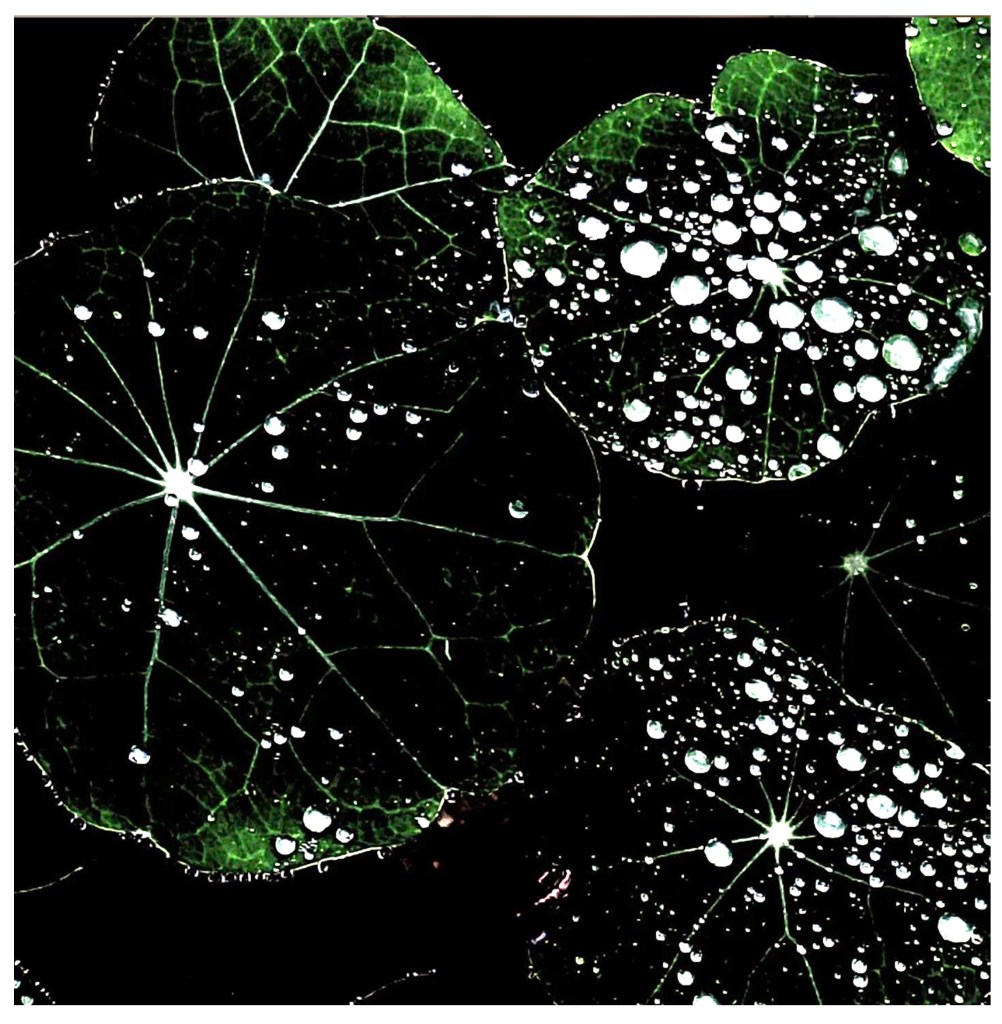
Rainwater dazzling on dark leaves – photo composition by Mr G.

Last night I was at a vigil of prayer led by my friend Julia Sheffield. A group of us gathered in a small, intimate chapel which was a symbol of Gethsemane, the Garden where Jesus took his disciples before his arrest. We were the modern day disciples gathered with Jesus in contemplation of Good Friday about to dawn once again. Julia led us sensitively and beautifully with prose, music and silence in a three hour meditation.
As ever, in a confined space we become aware of our friends praying with us. Silence is rarely easy, especially when tired but atmosphere can work wonders. Even so, I found myself shuffling a little, so I thought about this and wrote these words.

Reflective thoughts on Gethsemane.

Lord, you asked us to stay,
to wait,
to watch.
Be still…

Language of vigil.

Attentiveness,
companionship.
Faithful believers invited
to devoted watchfulness.

Is that us Lord?
Is our fidgeting,
our drooping eyes,
shuffling feet,
punctuated snores,
stifled coughs,
wandering thoughts,
enough?

You said,
Watch and pray.
You also say,
I will love you and whatever you bring,
it is enough.

Your faith, however dim you think it is,
lightens the darkest of nights.
Together we cannot be quenched,
diminished, dimmed.
in a world in need,
We dazzle!

Mr. G. [Good Friday. 2024]

Bright star of the North

Cross in the Gospel Garden on the Holy Island of Lindisfarne, carved by Fenwick Lawson.
Photo: Mr G.

St Cuthbert, Praying and Doing

Yesterday, on March 20th, the Church celebrated Saint Cuthbert. Nowhere more so than the North East of England where Cuthbert came to faith, ministered to people during a difficult time in the life of the Church and led people to deepen their love for God and discover more clearly God’s love for them.

His ministry did not end with his birthday in heaven. The Holy Island of Lindisfarne off the North East coast near Bamburgh remains a centre of pilgrimage and prayerful inspiration to this day. The amazing and richly beautiful Lindisfarne Gospels, created in his honour, are still regarded as one of the most stunning illustrated Gospels alongside the Book of Kells. They can still be  seen in the British Library though there is a facsimile in the museum on Holy Island and it’s much more accessible and actually fun to see it in situ. There are of course many printed versions.
The Gospel was the offering of Lindisfarne monks to God as a thanksgiving for all that Cuthbert had illuminated the world with his faith, Gospel love and prayer. Things that he shared with all the people he met.
When the Vikings raised the East Coast of England, the monks took the Gospel alongside other artifacts of Cuthbert to safety on a journey which took a very long time. This was to lead eventually to Durham where the story of Cuthbert continues.

His first journey in faith was very different.

Long before, above the Lammermuir hills bright light in the borders of England and Scotland a light  brightened the night sky and attracted the attention of a young shepherd boy.  A vision came to him of a holy soul being taken by angels to heaven.  Next morning, he heard that the great St Aidan of Lindisfarne had died.  The boy, Cuthbert, was moved to go his local monastery at Melrose and seek instruction in order to become a monk.  the story of one of the greatest English saints was born.  St Cuthbert was to serve God at Melrose, Ripon and Lindisfarne.  He was, for a time, Bishop of Lindisfarne.

Cuthbert’s real fame was amongst ordinary people to whom he took the Gospel.  Travelling with a portable altar he crossed and criss-crossed Northern England from the Solway to the Tyne.  He encouraged Christians in Cumbria, North Yorkshire, Durham and Northumbria.  He was a tireless missionary for God.  He was also a focus of unity when the Church split after an argument about when and how Easter was to be kept (amongst other things).  The Celtic party lost to the Roman one at a Synod of Whitby in 664AD.  Many of the Celtic monks returned to Ireland and the church was in total disarray.  It fell to Cuthbert and his spiritual companion, St Hilda, to hold the broken church in love and prayer and bring healing and a new unity.  Eventually he retreated to the Inner Farne Islands, where on this day, 20th March in the year 687, he died. 

When, after the Viking raids, the Body of St. Cuthbert was carried by the monks of Lindisfarne to safety, the journey was long and arduous. It involved a stay in Chester-le-Street and a journey over the Cleveland Hills now known as the Lyke Wake Walk or Coffin Walk.

An account of the final part of the journey is to be found in a ‘History of the Church in Durham’ by a medieval monk, Symeon.
He describes the arrival of the shrine at a place on the east side of what is now the city of Durham. The vehicle on which it rested could not be moved and the bishop directed his monks “that they should solicit an explanation of this sign from heaven by a fast of three days, which should be spent in watching and prayer, in order that they might discover where they should take their abode along with the holy body of the father”. This was done and Symeon goes on to relate that “a revelation was made to a certain religious person named Eadmer, to the purport that they were required to remove the body to Durham and prepare a suitable resting place for it”. This resting place was found when the monks were led to a place called Dun Cow Hill Durham), where a wooden cathedral was built to house the remains.  This simple church was eventually replaced by the great Norman Cathedral of Durham, where, today, under a simple slab with the word Cuthbertus ,his body still lies.

An active missionary for God, Cuthbert’s strength lay in his personal communion with God.  He was one of those busy saints who, in the words of Cardinal Basil Hume, was always nostalgic for the desert when busy in the market place.  Like the Lord he followed, he would withdraw to be alone with God.  Often this meant that he had to steal away in the middle of the night.  Once, when he stood in the sea near St Abbs Head, a monk spied on him.  all night Cuthbert stood in the Cross position of prayer, arms outstretched as he gazed on God.  In the morning, when he came ashore, sea otters followed him.  They wrapped themselves round his legs and warmed his frozen feet.  Then, after a blessing, they returned to the sea. 

When busy on Lindisfarne, Cuthbert would steal away to a piece of land which was cut of from the main island at high tide. It’s known today as Cuddy’s Isle. A cross stands where a little cell used to be.  For six hours he could enjoy solitude for prayer.   He ended his life as a hermit on the Farne Islands.
His life of busyness and the mission he carried out, were only possible because he forced out time (often against all odds) to be still before God.  Great things in the name of Jesus can only be achieved when they are backed up by real prayer.  Only when we attend to our praying will our ‘doing’ have any effect. 
It’s a lesson worth re-learning.

[Mr G]– with a lot of help from the Venerable Bede,
Simeon of Durham, the spirit of the North East,
the witness of Durham Cathedral and the sanctified knowledge of
Kate Tristram.