One of my special saints is St. John Vianney, known more often as the Curé D’Ars. He was a faithful parish priest in the village of Ars, France, for many years. He was almost not ordained because he couldn’t pass exams but his Bishop saw beyond that into his soul and he ordained him. For the rest of his life and ministry he devoted himself to helping people to move that one more step towards God. After his death he was acclaimed a saint and is regarded as the Patron Saint of Parish Priests. Every priest should aim to have a ministry like his. However, he wasn’t just concerned with the spiritual journey of individual Christians. He had a yearning for the journey of the Christian Church to be a holy one—one which embraced others and built up a community of faith based on praying together.He said: Private Prayer is like straw scattered here and there. If you set it on fire it makes a lot of little flames, but gather these straws into a bundle and light them and you get a mighty fire rising like a column in the sky..”
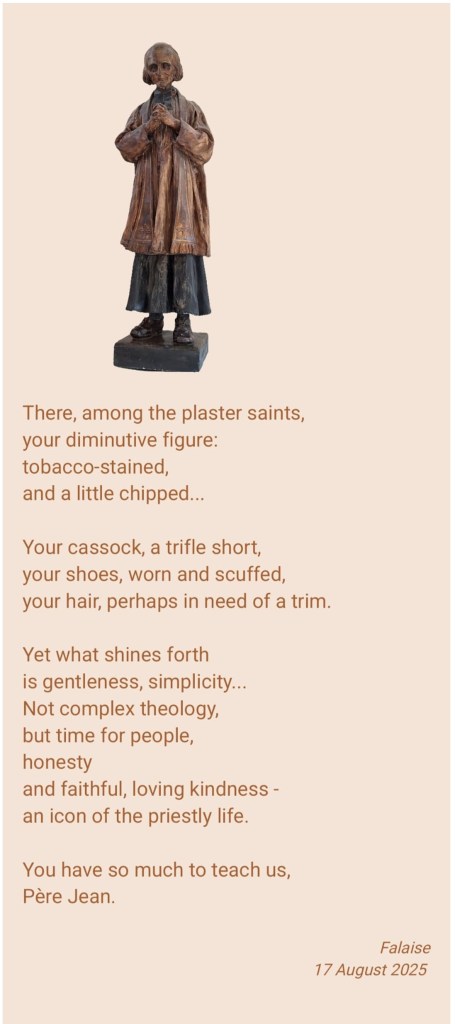
Here is a reflective poem by Piers Northam, inspired by the statue of the Curé d’Ars in the Church of the Holy Trinity in Falaise, Normandy. It is also inspired by his forthcoming ordination to the priesthood on September 27th.
The With-ness of God, a reflection on Luke 2:41-52, by The Revd Piers Northam.
The phrase that particularly strikes me in Luke’s account of Jesus, as a 12-year-old, in the Temple is: His mother treasured all these things in her heart. It’s a phrase we hear at Christmas, when the shepherds come to Bethlehem and find Jesus lying in the manger: When they saw this, they made known what had been told them about this child; and all who heard it were amazed at what the shepherds told them. But Mary treasured all these words and pondered them in her heart. I love the way that Mary takes these words and events and turns them over, treasuring them and pondering on them. There is the sense that she is slowly piecing together the real importance of her son. Before his birth, she was told by the Angel Gabriel that her son, conceived by the Holy Spirit, was himself to be holy and to be the Son of God – but of course that’s still a lot to fully comprehend. When Jesus is born, the shepherds arrive and tell his parents about the angels appearing to them on the hillside outside Bethlehem; later, Mary and Joseph will present their son at the Temple, and Simeon and Anna will speak strange words about him; then the Magi will come with their peculiar gifts – all these words and events hinting at the life her son will lead. And now, in this scene in the Temple when Jesus is twelve years old, we see him speaking strange words himself: sitting with the teachers and referring to the Temple as ‘my Father’s house’ – and so, by implication, specifically referring to God as his Father. More mysterious things for Mary to take to her heart, to treasure and to ponder over…
Another word – or rather the name – that we hear at Christmas is Emmanuel. In Matthew’s account of Jesus’ birth we hear him quoting the prophet Isaiah: All this took place to fulfil what had been spoken by the Lord through the prophet: ‘Look, the virgin shall conceive and bear a son, and they shall name him Emmanuel’, which means, ‘God is with us.’
God-with-us. That’s the extraordinary and particular thing about the Christian faith. Where other religions worship a god or gods who are other; who are distant and out there, far away, we believe that God who came to earth for us; and ‘lived on earth and went about among us’ to use that familiar phrase. God – in Jesus – became human and so understands our lived experience intimately; and, in the Holy Spirit, continues to live with and in us. That name Emmanuel is hugely important since it encapsulates what lies at the very heart of our relationship with God.
Ali’s story
Last week, a friend shared an article which reflects on the experience of Emmanuel / God with us. It’s written by Ali Kendall, a nurse living in Hampshire who shares her family’s story and what she refers to as God’s With-ness – God’s being with them. Things haven’t been easy for Ali and her family. She spent years nursing in London at the Royal Marsden before moving to Hampshire to start a family. Initially, this was hard for them, but she and her husband Matt did have a first son, Joseph and all seemed well. Then her husband started to have a series of what were to become regular seizures, which stopped his work as a teacher and completely changed their lives. At the same time, they had tried for another baby and Zachary was born – along with the unexpected news that he had Downs Syndrome. She writes:
I remember thinking ‘we were already meandering off script, but we are well and truly off-piste now’. Life’s going to look different. Very different. It’s just gone from hard to harder. My husband has a chronic illness and disability and now I have a newborn whose challenges are not yet known to me, but likely to be significant.’ A few years later Zachary was diagnosed with autism.
Ali then goes on to say: Life is beautiful and life is hard. Beautiful-hard. They both co-exist, like dancers, weaving themselves in and out of our lives. The joy is that God is with us and others have joined in. […] Our day to day is transformed by withness; when friends come along side us, and travel with us for a while at the slower pace that we’ve been forced to go, navigating the hurdles and the curve balls.
Matt’s seizures are debilitating. The daily grind of a chronic illness is often lived in secret, behind closed doors, in the hidden places. Parenting a child with special needs, while trying to be everything you want to be to your other child, is exhausting and can feel lonely. On a bad day it can all feel crushingly hard, but on a good day it can feel like you are in on the most beautiful secret of watching your family do life differently with our challenges and unique way of being.
What strikes me the most about Ali’s account is the way that she has discovered those secret moments – moments that she has been pondering in her own heart – where she notices the beauty (even in the midst of the difficulty and the challenge); where she notices the withness of God… She goes on to say:
Being with someone who is not finding life easy or is trying to live in a world not set up for them can take you to what I now call the “secret places”. The places you might never have chosen to be in. […] Coaxing a child with autism to watch a Christmas show you have paid good money to enjoy. Our seats, surrounded by people and lots of noise, make it all too overwhelming for Zachary. So we sit in the quiet, on the stairs, where no-one pays to sit, watching the show from our secret place. We hug and cuddle quietly as the show goes on and it feels somehow almost a sacred moment. These secret hidden moments are where the gold is really forged. Where the love grows deep. Withness blesses the person being held and the person holding.
Withness, as she puts it, blesses both the person who is being accompanied and the person who is sitting with them or holding them or offering their support. Because in doing so, they are being Emmanuel to them. And Ali fully acknowledges that this is hard and costly – but ultimately, but it’s a cost that is worth it:
[…] it’s hard. Beautiful and hard. But being with people mattered enough for Jesus to come to earth to embody “Emmanuel”. And you get taken to those secret places you might not have ever seen had it not been for the journey the other takes you on.
‘Being with’ takes you to those secret moments which become sacred.
Paul, in his letter to the Colossians, says, ‘Let the Word of Christ dwell in you richly.’ He’s inviting us to treasure Christ’s words and ponder them in our hearts, for living them out brings unexpected riches and secret joys. As I reflected on the 12-year-old Jesus, sitting with the teachers in the Temple, holding his own with a wisdom beyond his years, I was struck by the final part of Ali’s story:
[Joseph,] my eleven-year-old, has heard me say so many times “we are with you” to Matt as his body shakes into another seizure. Matt is usually unable to speak, often he looks afraid, and his usually strong body is jerking with such strength we need to keep him safe. But “I am with you” has become what I say. And I mean it. It’s all I can offer in those moments. I can’t take it away, but I can sit with him in the pain and disappointment of another disrupted plan, another unfinished conversation, another fun trip cut short, another day where we watch the world bustle on as we crumple to the floor.
My Joseph has learnt the art of being with. He will often silently take my husband’s hand, and my heart melts when I hear the strength and tenderness in his words,“I am with you Daddy. We are here.” As Jesus showed his Emmanuel to me, and the beauty and peace that brings, we can show it to each other.
‘I am with you…’ Young Joseph has heard those words and they now dwell in him… Richly…
Ali’s story has moved me profoundly – I find my thoughts returning to her and her family and I sense they will continue to do so. Above all, it is the way that she has pondered on her experiences and has noticed Emmanuel / God-with-us in both the joyous times and the hard ones. She has found those secret moments and treasured them in her heart. It’s something that God invites us all to do, so I pray that we will all take time to ponder and to notice Emmanuel/ God-with-us in our own lives – and at times to respond to the call to be God-with-us to others… God is always with us – but we have to take the time to notice where – and in whom – He is to be found…
A Reflection from Piers Northamon Remembrance Sunday
The beginning of St Mark’s Gospel tells of Jesus walking along the beach at the Sea of Galilee, calling his disciples, the fishermen Peter and Andrew, James and John. Calling them to follow him and calling them to a life of service. Ultimately, for many of his disciples, it would turn out to be service that would cost them their lives.
And on this Remembrance Sunday morning we remember those who have answered another call to service – in this case the service of their country – and who have given their lives in that service.
As I’ve reflected, this week, on what I might say on this Remembrance Sunday morning, I’ve been pondering on the difference between ‘memory’ and ‘remembrance’, and I wonder if we might take ‘remembrance’ to be the shared calling to mind and recounting of events or people that we don’t necessarily directly remember ourselves? Certainly, if we take the Second World War, there is a sense that it is receding into history and that fewer and fewer people remember it first-hand and with that comes the danger that it will seem less and less ‘real’, less and less affecting. And, of course, there have been many other conflicts since, that British forces have been involved in – Aden, Korea, the Falklands, Kosovo, Iraq, Afghanistan – all of which will be remembered by those who served and were involved, but which otherwise can also seem increasingly distant and less relevant.
Yet on Remembrance Sunday each year we gather as a nation to remember; to recount the stories of war and the cost of war; to remember and give thanks for the sacrifice of those who gave their lives – or who had their lives irrevocably altered – hopefully, in the pursuit of peace and stability. Remembrance and the wearing of poppies is also bound up in our sense of identity – one of the rare times in the year when so many of us, from all walks of life, are drawn together collectively to reflect and to remind ourselves of the horrors of war; of the ways that we can, as humans, descend so quickly into conflict and of the urgent and constant need to work for peace and never to be complacent.
Currently, as we look around the world, it seems as though the vital lessons of war and conflict have been entirely forgotten in some places. Mr Putin blithely sends thousands of men to their deaths in an attempt to grab land and territory from the Ukrainian people; Mr Netanyahu – despite the historic imperative for remembrance of the horrors of the Jewish experience in the Second World War – rains bombs and missiles on thousands of defenceless civilians in Gaza and now in Lebanon. It seems that, all too easily, we forget the human cost of war – or we forget what it was like to be on the receiving end of such aggression and begin to entertain the notion of meting it out on others.
All of which underlines the importance of gathering together to remember. Of looking the cost of war in the eye and striving all the more conscientiously and urgently for peace.
Remembrance is important.
In our Tuesday housegroup, we’re currently doing a series of sessions where we’ve begun looking at and comparing readings from the Old and New Testament to see what they help us to understand about Jesus. This last week we looked at the first Passover in Egypt when the Israelites, who had been living in slavery under the Egyptians, were given specific instructions about killing and eating an unblemished, year-old lamb and using its blood to mark the doorposts and lintels of their dwellings so that, when the Angel of Death came over the land in the final plague on Pharaoh and the Egyptian people, it would pass over their houses and the Israelites would be spared death – and subsequently would be able to flee the country and the years of slavery they had endured and so set out on their very long journey to the Promised Land.
The book of Exodus sets out the very particular instructions that the Lord gives to Moses and Aaron for the people and the Lord also says:
‘This day shall be a day of remembrance for you. You shall celebrate it as a festival to the Lord; throughout your generations you shall observe it as a perpetual ordinance.’
And, of course, that is what the Jewish people have done ever since – they have gathered around the family table each year to keep the Passover and to tell the story: to recount how, through the goodness and faithfulness of God, they were spared death and set free from their years of bondage and slavery. The Passover story is a huge part of Jewish identity – a story that all Jews brought up in the faith will know. A story that teaches them about the nature and the goodness of God.
And on Tuesday night we discovered some of the strong parallels between what happened at the Passover in Egypt and the story of Jesus’ Passion in Jerusalem. Because of course, at the Last Supper, Jesus and his disciples were keeping Passover – they had gathered around the table in the upper room to remember; to recount their story and to share food for the journey and, in a new twist, Jesus gave them just that. Not the traditional food of the Passover meal, but bread and wine: the body and blood of Jesus, the Lamb of God. And what does Jesus say as he gives them the broken bread and the cup of wine?
The details of the ancient Passover were fulfilled in Jesus – he was the perfect, unblemished Lamb. And the next day, as he was crucified, his blood was shed for us, marking not the posts and lintels of the Israelites’ doors but the wooden upright and crossbeam of the cross. It was his blood that set us free from the slavery of sin and opened us up to everlasting life. And so, we became a pilgrim people: the people of the Way – Christians from all over the world and down the ages, travelling towards God’s Kingdom.
So, in a sense, for us as Christians, every Sunday is Remembrance Sunday; every Sunday is a family Passover where we gather to remember what Jesus did for us on the cross. In the eucharistic prayer that we will hear in a moment and in the creed that we say collectively, we recount the story of God’s saving and redeeming love for us in Jesus – of how he set us free from the limitation and slavery of sin and how he spared us from death and opened the gate of glory – the way to everlasting life. And every Sunday we share the family meal – the food for the journey – the bread and the wine that we take in remembrance of Jesus, to nourish and sustain us. And then we are sent out into the world – ‘to love and serve the Lord’ and to help the world to make its way into God’s Kingdom; to bring His Kingdom in…
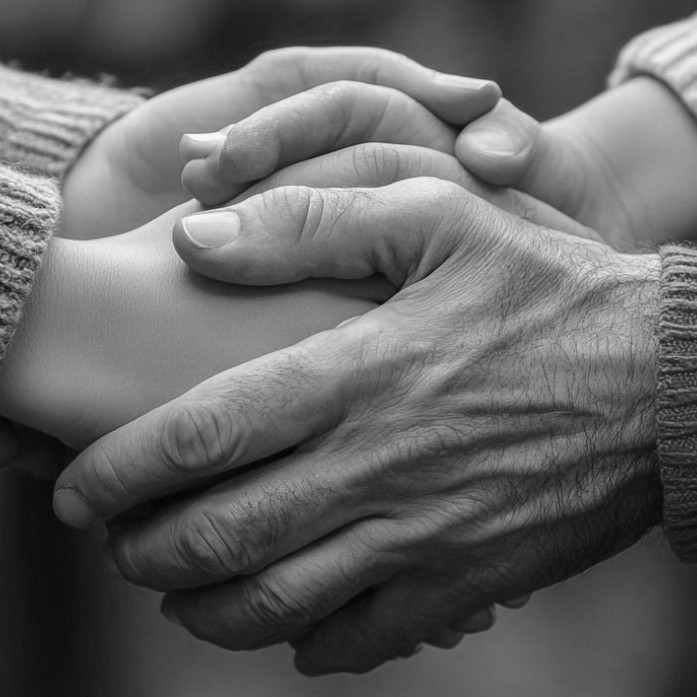
In the cradle of Your hand there is safety, intimacy, trust…
And there I find my name: “See, I have engraved you on the palms of my hands.”
There, my name is scored, etched into Your flesh: tattooed in love, blood-red.
The pain of that etching reveals the depth of that love. The marks indelible, everlasting…
Piers Northam 6 September 2024 Deacons’ Retreat in response to a ‘Word Friend’ – Isaiah 49:16 ~ See, I have inscribed you on the palms of my hands.(NRSV)



 Mr G's Ponderings