My friend Piers sent me this poem and reflectiondrawing on the Rule of Saint Benedict and its relevance to the Lambeth Conference of the worldwide Anglican Church.
I was drawn to dwell on hospitality by recent events surrounding the Anglican Lambeth Conference which began on 26 July 2022. Anglican Bishops and their spouses from around the world have been invited to Canterbury to worship and pray together and to explore a range of topics. I was saddened that partners and spouses of gay and lesbian bishops were not invited and this set me thinking about what true hospitality looks like. St Benedict writes about hospitality in his Rule: in Chapter 53 he says,
‘All guests who present themselves are to be welcomed as Christ, for he himself will say: I was a stranger and you welcomed me (Matt 25:35). Proper honour must be shown to all, especially to those who share our faith (Gal 6:10) and to pilgrims. Once a guest has been announced, the superior and the brothers are to meet him with all the courtesy of love.’
I also found this useful commentary by Jerome Kodell, OSB in which it becomes clear that, for St Benedict at least, there is a lack of pre-judgement and a defencelessness about true Christian hospitality. So my poem comes not as a rebuke, but as a plea – that we welcome others with true generosity so that all may feel settled and at ease. Only then can we feel safe enough to speak and to explore together.
My prayers are with all involved in the Lambeth Conference over the next few days.
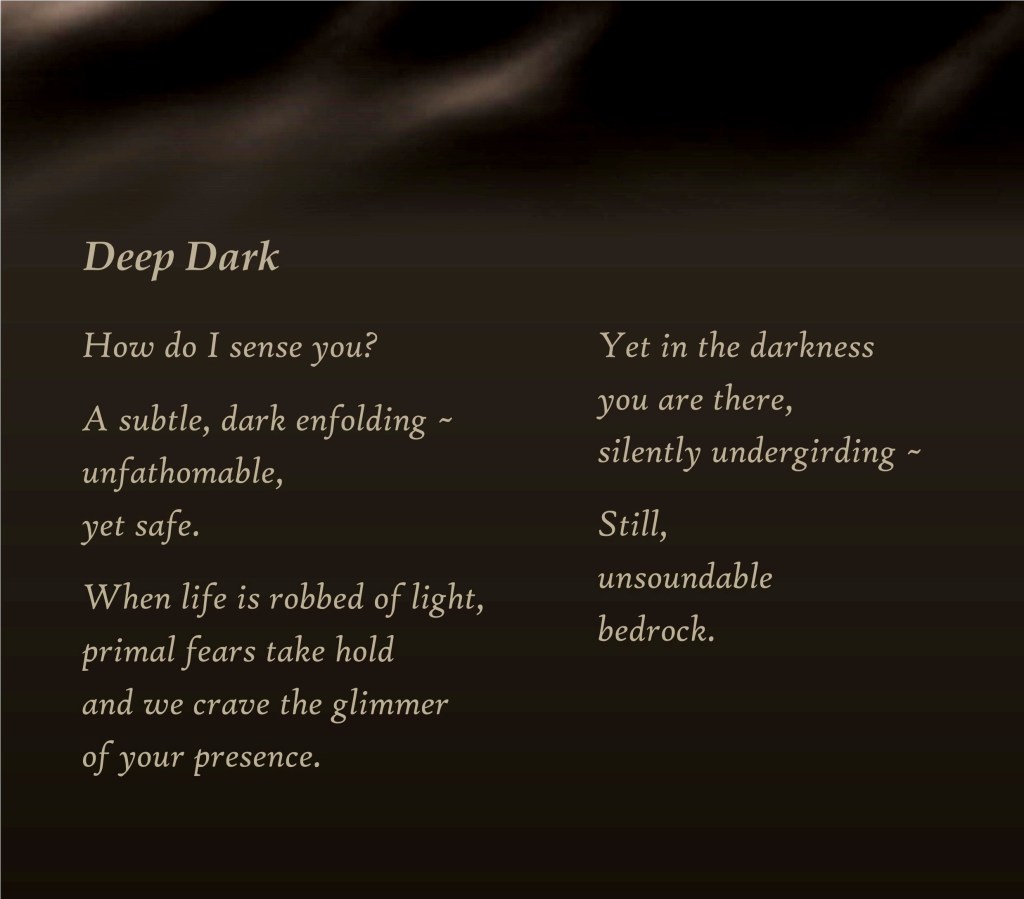
In response to Mr G’s earlier piece, Dispelling darkness with light came this. When asked how I imagine God, the sensation that always forms within me is of deep, rich, velvety darkness – an enfolding – and a profound sense of safety. There’s something a bit imperceptible about it: neither warm nor cool, but at blood heat, meaning that at times you have to pay attention to notice God’s presence. A bit like a second skin…. It’s strange in a way that this image or feeling should have formed for me because as a child I was scared of the dark – but maybe that’s telling too – something about trust, perhaps.
And at times, when things seem bleak and dark and starved of light, it feels as though God might be absent too. That primal fear of the dark night and what it might contain surfaces in us and leaves us feeling alone and anxious.
So much of our language revolves around the notion of light countering the darkness. Yet it was God who said ‘Let there be light’ – God, who existed before the light came into being. So seek and know God in the darkness too…
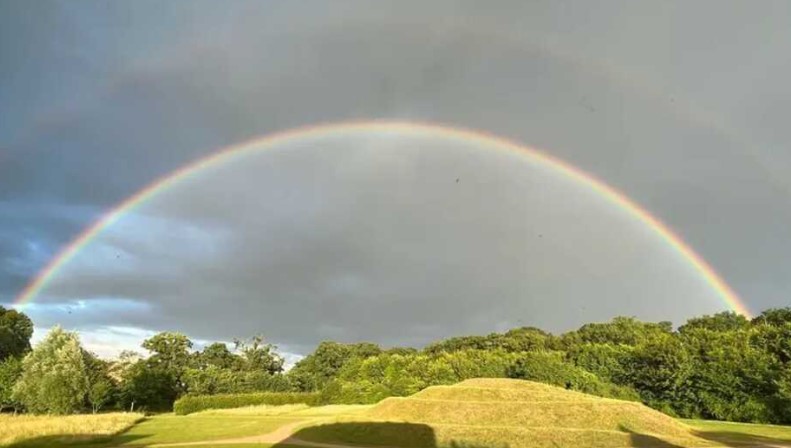
Rainbow over Telly Tubby Hill Newhall, Harlow. posted by Steve Townsend on his Facebook page.
Pride
After the rain we trooped with rainbow flags past buildings spotlit by the sun against the dark smudge of loaded clouds.
A straggling, motley bunch, we gathered in solidarity to share, to encourage and to remember.
As we listened to rallying words of inclusion and love and the diversity of creation, a seven-hued arc flamed against the charcoal sky – each colour distinct, yet joined in song, without need of borders or hard edges.
Making our song, against the dark clouds of hate and menace, more vivid and more resolute.
poem by Piers Northam after a gathering in Harlow to mark the end of Pride month 30 June 2022
And so we come to the morning of the third day and the third part of our unfolding story.
On Friday we witnessed the horrors and anguish of Jesus’ trial and sentence; the violence and agony of the cross and the very human sense of desolation and abandonment that Jesus experiences as he hangs there. And yet, in the midst of the torture, Jesus is still seeking to heal and forgive; still promising hope, relief and restoration as he speaks of Paradise to the repentant thief; still thinking of his friends and followers as he entrusts Mary, his mother and John to each other – creating new ties and bonds: new families. And then, as the agony intensifies, all else drops away and he is held in the eye of the pain and yields all to his Father – ‘it is finished, it is done’ he cries as he commends himself to his Father and gives up his spirit.
And why? Because of the fathomless, bottomless depth of his and his Father’s love for humankind and for the world. The intensity of the agony he goes through only speaks of the sheer intensity of the love that held him there for us.
And then that day of limbo – at least for the disciples and to some extent for us. Holy Saturday: that in-between day of waiting. For Jesus’ friends and followers a day of enforced inaction as they mark the Sabbath. But for Jesus, a day when he descends into Hell to do battle with Death. And a day too, when, as Bishop Jack Nicholls always says, ‘he is looking for his friend, Judas’.
And so we come to the morning of the third day. I love this resurrection story. I love it because it is touching and personal: Mary’s journey from empty despair to bewilderment to joy and excitement. I love it for the setting and the imagery: we begin in the darkness, early in the morning, the light is grey and colourless and there’s a chill in the air. Had Jesus’ friends and disciples spent the Sabbath together? Or had they all dispersed to different houses? Whichever way, unable to do anything to distract themselves, they’d had hours with their thoughts. Quite possibly they’d forced themselves through the celebration of Passover – the food ashen in their mouths as they dwelt on what they’d witnessed – or avoided – at Calvary.
And now, Mary creeps out, in the twilight, desperate to be with her friend and teacher. Desperate to do the last kindnesses to prepare Jesus’ body properly. She steals into the garden, threading her way through the graves to find the tomb where she saw him laid two nights before. And there, she finds the great stone that sealed the tomb rolled away. You can just feel that icy rush of dread as she sees this – confused thoughts rushing through her mind and rising panic that his body has been stolen. And then she’s rushing headlong back to find Peter, to tell him and John what she’s seen, hoping that there might be some explanation.
When they’ve heard what she has to say, they run to the tomb and find it empty – and some sort of realisation comes to them (not that they appear to share this with Mary). But where John and Peter simply see the folded graveclothes, Mary is given more: for once they are gone, she gets to meet the Risen Jesus. I love the detail here: it’s as if Jesus has planned it out carefully and roped in the angels to play along. As Mary looks into the tomb and sees the two of them, they ask (all innocent and butter wouldn’t melt) ‘Why are you weeping?’ and when she has explained, she turns and there’s Jesus, standing at the entrance to the tomb, ready to surprise her. He too plays along a little – ‘Why are you weeping? Who are you looking for?’ he asks. And still she doesn’t recognise him – is this because of her tears? Or is it that he is somehow transformed – that he looks different? Or maybe the possibility of his being alive is just too much to compute…
And then there’s that moment. That moment when he says her name. ‘Mary’. It gets me every time. Here’s the Risen Lord, who went through the agony of the cross for love of all humanity; the one whose now scarred hands flung stars into space at the dawn of time – simply saying her name. He might look different, but that familiar voice – that particular way he has of saying her name – proves it. He’s alive! And all she wants to do is cling to him.
But, this isn’t the time to be lingering at the tomb. It’s a time to rush out and to share the Good News – to tell the others what’s happened. Mary is stepping into a new phase in her calling as a friend and follower of Jesus: the faithful, loving, heart-led Mary becomes Mary the Apostle, bearing the ‘Word of risen hope and new life’ to the other disciples. This moment of resurrection is also, for her, a moment of new creation and transformation: a moment when her gifts of love and faithfulness are put to a new use by Jesus. Because resurrection is all about new creation – not a bringing back to life, but a stepping into new life.
During Lent we ran a series of sessions on Zoom where we looked at works of art that spoke to us of hope and restoration. At one of these sessions, Julia told us about the Japanese art of Kintsugi – which literally translates as a ‘joining with gold’. Kintsugi practitioners take broken pottery – often tea bowls or saki bowls – and put them back together again using a lacquer called urushi. The very visible join lines are then carefully gilded: this is not about an invisible mend, but about celebrating the story and the journey that the bowl has been on; about making whole; about creating a new thing which is useful once more and which has a unique strength and beauty. These bowls have been through a resurrection and – just like Jesus, they have the ‘glorious scars’ to prove it.
And the same can be said of us: we come to God in our brokenness and we are pieced together again, the gold of God’s forgiveness and grace transforming regret and guilt into strength and unique beauty. This is a new creation where we are born into new life.
Someone who understood this was Peter, who we also heard of in our reading from Acts. There he was speaking of forgiveness – of the fresh start and the slate wiped clean – that is offered in Jesus. And he should know. When we last met him, he was weeping bitterly, for the cock had just crowed on Friday morning after he had denied knowing Jesus a third time. Peter’s moment of resurrection came days later on the beach, when Jesus asked him ‘do you love me?’ Jesus, almost painfully, asks him three times, but in so doing, he exorcises those three denials, setting Peter free, softening his sharp edges and making him whole again with the gilded urushi of forgiveness. He then entrusts Peter with spreading the Good News and caring for his flock. Peter’s moment of resurrection is a moment of new creation. His denials could have meant an end to his relationship with Jesus, but instead, this moment of resurrection marks a new beginning. Not so much ‘it is finished’ as ‘it is newly begun.’
Because it seems to me, that that’s what resurrection is. There is, of course, the joyous BOOM! of the Resurrection of Jesus, on that first day of the week, two thousand and twenty-two years ago, but since then, there have been countless, countless individual resurrections. Countless moments of being released into new life: of new creation. Moments of grace and forgiveness; moments of sacrament; moments of calling and moments of responding to those calls.
We are Easter people, called to live resurrection lives. And that’s not going to be a one-off thing. We may well experience important moments of resurrection when we are particularly released into new things, but if we keep ourselves alive to God working in our lives, we’ll notice many of those moments where we encounter Jesus; where we are encouraged anew; where we are healed with gilded urushi and our brokenness is transformed into a new creation; or where Jesus simply speaks our name in that particular way he has… And each of those resurrections deserves its own Alleluia!
One last thought. As I pondered on this morning’s story of Mary and Jesus, an image formed of her, once she’d returned to the disciples to share the good news, taking herself out into the morning sun, for a moment alone, to process all that had happened to her. It struck me that there’s a soundtrack to this – if you can imagine Mary sounding a little like Nina Simone:
Birds flying high – you know how I feel. Sun in the sky – you know how I feel. Breeze driftin’ on by – you know how I feel.
It’s a new dawn, It’s a new day, It’s a new life for me… And I’m feeling good!
Go out and live His risen life!
Alleluia!
Piers Northam sermon preached on Easter Day in St. Mary-at Latton.


 Mr G's Ponderings