Ardnamurchan Lighthouse, Ardnamurchan Point, Kilchoan, Argylle & Bute. Photo: Mr G.
LIGHTHOUSE
I was built only to serve; to warn; to guide; reassure; prevent.
I was built on rock. I am stability in a shifting world of uncertainty and fragility; reliability in a sea of change.
I can withstand wind and wave, crashing storms, skies rent asunder with electric light. I can be drenched with wild rain; withstand angry skies; resist swirling mist; be brave in deepest dark.
I can wave at stars, bathe in the sun; befriend the moon.
You may take me for granted, even find me beautiful, solid but slender; be at peace because I am there.
I am a lighthouse; keeping mariners safe, focused and at the beck and call of all who sail by.
(Inspired by the Hundredth Anniversary of the BBC Shipping Forecast July 4th 2025)
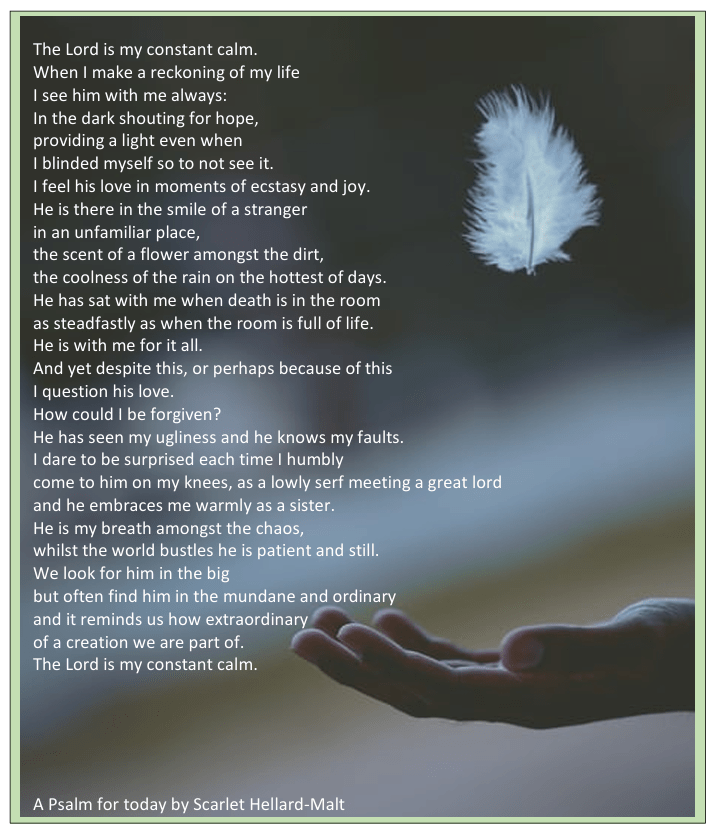
At a recent study Group, there was a discussion about the nature of Psalms and about how they can be used in our own praying. Psalms bring us close to the praying of Jesus and were his own ‘prayer book.’ We can approach the Psalms in whatever state of mind or being we are and there find comfort, love, challenge and a response to our own feelings and thoughts. In the Psalms we find honesty and a sense that whatever we are going through, good, bad and indifferent, we shall find God.
The study group leader suggested that the members might try to write their own version of a Psalm as a way of growing in understanding of both God and of self. The ‘Psalm’ which is offered here is one such response. It was Scarlet’s first offering of a ‘song to God’ from the centre of her heart.
There are echoes of Psalm 23, Psalm 138, and Psalm 8. The real echo comes from the hearing of God’s voice in a listening which needs silence for it to make the deepest impact on life, as it did, of course, to the writers of the Psalms in Old Testament times.
[photo from Gill Henwood – of the area near the Black Mountains, Bhutan]
Jesus prays in Gethsemane
On the night of his betrayal, Jesus took his disciples to the Garden of Gethsemane, near the Mount of Olives. He asked them to pray for themselves and then went to a place by himself. He prayed to his Father that he might be released from the trial and crucifixion ahead of him. But he also prayed that his Father’s will should prevail. The humanity of Jesus cried out and his anguish caused his sweat to fall like drops of blood. An angel from heaven came to strengthen him. His disciples were fast asleep. Then the Roman soldiers came to the garden to arrest him…. (St Luke’s Gospel Chapter 22: 39-53)
Gethsemane
This is his Passion. Darkness wraps around his very being, not a warming cloak but a shroud. Silence, punctured by friends snoring off the wellbeing of food, minds sloshed with wine. Alone with the shivers of the night, everything in him protests.
Sometimes, when we know our destiny, our minds close. Not this! No! Never! But our hearts are our undoing: our resolve begins; ends there. So he battles with his need to say ‘Yes’, for himself, for others, for us. How else can the world know what it is to be loved?
Kneeling on the damp ground, tense, numb, scared, uncertain, he waits. And the Father waits too as demons and angels whirl, stirring up the black air, a vortex of cosmic battle. Below them, sweat drops as blood. And still the Father waits, listening expectantly, daring to hope…
God wrestling desperately with God with everything – just everything – at stake. This really is the Passion. He sighs, deeply, calm descends. “Yes, let it be.”
The Father wraps his love around him – and so too around us.
Wild daffodils in the Lake District photographed by my friend Gill Henwood
In this coming week, we who live in the earth’s Northern Hemisphere, move from the season of Winter to that of Spring. The Spring equinox is often known as the ‘Astronomical’ Spring to differentiate it from the ‘Meteorological’ Spring which is used by weather forecasters and is always on March 1st. The season of Spring generally falls on either March 20th or 21st (19th in a Leap Year) This year it is on March 20th. Nature, however, prefers to set its own time and has already begun showing growth from the earth; songs from the birds and a gentle ‘greening’ of the leaves as trees create a dusting of new life.
One of the most important signs is the arrival of spring flowers, especially the Daffodil which symbolises re-birth and hope. The poet, Cecil Day-Lewis, calls the ‘full-throated’ daffodil, “our trumpeters of gold” which “call resurrection from the ground.” This association with Easter has also led to daffodils being called ‘Lenten Lilies’ because they tend to flower in the period between Ash Wednesday and Easter Sunday. (Sometimes they naughtily come too early for church flower displays when Easter Day is late!)
The most famous poem about the Daffodil begins with the words, “I wandered lonely as a cloud” which begins the Daffodil poem by William Wordsworth. It drew its inspiration from his sister, Dorothy, with whom he took a walk around the Lake District on the 15th April, 1802. We know the exact date and the detail of the journey from Dorothy’s diary, published later as her ‘Grasmere Journal’. Intrepid walkers, Dorothy wrote that the weather was threatening, misty but mild’, though the wind was ‘furious’. She described the walk in great detail including avoiding some cows! She noted the flowers they saw along the way – wood sorrel, anemone, scentless violets and a starry yellow flower known locally as pile wort. When they got to woods beyond Gowbarrow they saw a few wild daffodils close to the water-side and Dorothy then wrote in her journal:
“as we went along there were more and yet more; and at last, under the boughs of the trees, we saw that there was a long belt of them along the shore, about the breadth of a country turnpike road. I never saw daffodils so beautiful. They grew among the mossy stones about and above them; some rested their heads upon these stones, as on a pillow, for weariness; and the rest tossed and reeled and danced, and seemed as if they verily laughed with the wind, that blew upon them over the lake; they looked so gay, ever glancing, ever changing.
It has been suggested that it was these words which inspired her brother, William, to write his own poem in praise of daffodils. The sentiments and imagery expressed by Dorothy are certainly traceable in his poem. William became famous and eventually Poet Laureate whilst Dorothy was all but forgotten at the time but there are some who would suggest that his daffodil poem might constitute plagiarism! What can be certainly said is that between them they helped to make the Daffodil become a joyful sign of Spring and of Resurrection. [Mr G]
photo GH
I wandered lonely as a cloud That floats on high o’er vales and hills, When all at once I saw a crowd, A host, of golden daffodils; Beside the lake, beneath the trees, Fluttering and dancing in the breeze.
Continuous as the stars that shine And twinkle on the milky way, They stretched in never-ending line Along the margin of a bay: Ten thousand saw I at a glance, Tossing their heads in sprightly dance.
The waves beside them danced; but they Out-did the sparkling waves in glee: A poet could not but be gay, In such a jocund company: I gazed—and gazed—but little thought What wealth the show to me had brought:
For oft, when on my couch I lie In vacant or in pensive mood, They flash upon that inward eye Which is the bliss of solitude; And then my heart with pleasure fills, And dances with the daffodils.