Tag: Poetry

Mr Deakins’ Bread

Thaxted Mill. Photo Cambridge News

Rural Britain has a number of festivals which in earlier times were celebrated much more fully than is the case today.  Lammas which falls on the 1st August is one of these.
Lammas is derived from an Anglo-Saxon word, hlafmæsse, which means loaf-mass and from the 9th century a church festival was celebrated in which a newly baked loaf was presented in church for use at the Mass or Eucharist.

Rural Festivals take us back to our roots and help us to remember the close affinity we have with nature and the earth, on which we depend for our sustenance. In these days of supermarkets and fast-food shops it is easy to forget this dependence though nature has ways of reminding us.
Many are bemoaning the apparent absence of summer or rather of warm sunshine, this year. Our weather is much more erratic and less seasonal. Some, including myself would cite ‘global warming’ for this. We might easily blame humanity for the way we have exploited creation and taken for granted those with whom we share this volatile earth – the animals, birds, sea creatures and Nature generally. We certainly bear a lot of responsibility for that. Add to that the devastating wars and violence at present which suggests we are not at ease with ourselves let alone with the natural world, or with God. 

So we need to get back in touch with the delicate balance of our planet which God has ordered so magnificently. We play with this balance at our peril. The planet is a volatile ball floating in a vast universe. Humanity occupies such a small part of this and if we stand in a clear spot on a dark night and look at the stars we realise our smallness in the midst of such vastness.
Our forebears understood this and lived in healthy respect of nature’s force. They also remembered that the author of creation, God, is to be thanked and praised. That is why the Agricultural Year was punctuated with festivals such as Lammas. It would do us no harm to follow their example.

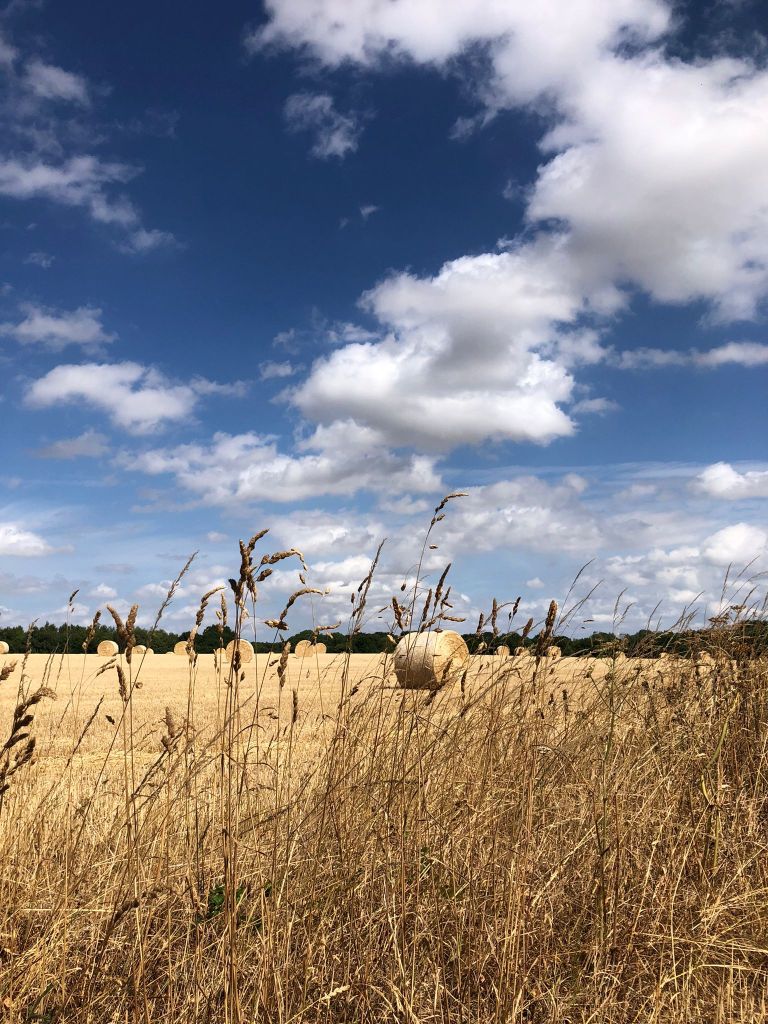
Hay bales in Norfolk. Julia Sheffield

A little while ago, I wrote this poem which has become my homage to Real Bread!

[Mr G]

Like children playing.

Cartoon courtesy of cute fly free clipart

Breath. (Ruach)

photo: Sharon Tate Soberon

‘How do we know God?’ She asks.
‘We feel it inside us.’ says the child.
‘And what does it feel like?’
‘It feels like breath…’

It feels like breath:
the engendering, enlivening breath,
the rushing wind,
the gift of life…

This child,
just four years old,
speaks an ancient truth –
a truth not learnt
but lived.

She knows the One
who knit her together
in her mother’s womb:
recognises in a way
that can’t be taught.

Knows herself beloved.


Love came down (Christina Rossetti)

Lambs discovering the joy of sunbathing! Photo from the Lake District from my friend Gill Henwood

The Church of England commemorates Christina Rossetti today.
She is known particularly as a poet and probably more popularly as the author of the Christmas carol, In the bleak Mid-winter. Tunes by Gustav Holst and Harold Darke have helped to build its reputation. No Christmas carol service would be complete without it though it has a somewhat fanciful beginning. In the bleak-midwinter, frosty winds made moan, earth was hard as iron, water like a stone  and then follows a reference to snow falling on snow.
That doesn’t quite fit in with the birth of Jesus at Bethlehem in the warmer climes of the Middle East but the carol was written for people who live in the Northern Hemisphere. In these parts the idea of a cold winter is not difficult to imagine though the hope for snow may remain just that!
The carol raises other questions but it is probably the final verse which has the greatest appeal, for both children and adults.

What can I give Him,
Poor as I am? —
If I were a Shepherd
I would bring a lamb;
If I were a Wise Man
I would do my part, —
Yet what I can I give Him, —
Give my heart.

The idea of giving oneself to God at Christmas, who gave Himself to us in the Incarnation, is, after all, a response to an amazing action of God to bring salvation to His world.
Christina recognizes this action of God as an act of pure Love.
In another Christmas Carol, Love came down at Christmas, she ponders on this theme of Love in a deeper, spiritual way.

Love came down at Christmas,
Love all lovely, love divine;
Love was born at Christmas,
Star and angels gave the sign.

Worship we the Godhead,
Love incarnate, love divine;
Worship we our Jesus:
But wherewith for sacred sign?

Love shall be our token,
Love shall be yours and love be mine,
Love to God and to all men,
Love for plea and gift and sign.

It is not as well-known as In the bleak midwinter, though the poem was set as the text for the BBC Radio 3 Carol Competition in 2022 and so got a lot of air time on the Radio. The winning tune was, to my mind, both memorable and beautiful. I think Christina, with a life steeped in a loving experience of God expressed in poetry, might have approved.

She was born in 1830 and died at the age of 64. Her brother was the Pre-Raphaelite painter, Dante Gabriel Rosetti and she became steeped in the theological movement which was associated with this – the Anglo-Catholic expression of worship and prayer. This had led her on a journey from Evangelicalism. Her elder sister took this a bit further by becoming an Anglican nun!
Many of her poems were mainly religious though some were born out of sadness of love that was never quite fulfilled in human terms. She did, however, compose poems for children, including a very popular one, Goblin Market, about two sisters who were tempted by forbidden fruit sold by Goblin merchants and what follows as a result!  Christina denied this was a poem for children and, indeed, many modern commentators point out adult themes to which it alludes. She did, however, write genuine poems for children.
She also wrote a book, Called to be Saints, which she subtitled ‘the Minor Festivals Devotionally Studied, which explored those saints in the Anglican calendar which were overlooked  at the time. She provided a devotional reflection on each one in a poetic way which reflected the depth of her faith.

Today she has her own place in the Anglican Calendar and a greater recognition of someone who in her lifetime dealt with unrequited love and quite debilitating illness and yet with faith. She gave us poetic reflections for our own life’s journey which also reflect a love of God that produced a rich harvest.

Some of her poetry celebrated the world around her and the photo by Gill Henwood of lambs taking their ease in the Lake District, which heads this article, drew me to a verse in one of Christina’s poems, The Milking Maid …

The year stood at its equinox,
  And bluff the North was blowing.
A bleat of lambs came from the flocks,
  Green hardy things were growing.
I met a maid with shining locks,
  Where milky kine were lowing.

[MrG 27th April 2024]

Good Lord, I ask much of Thee,
But most I ask to love Thee;
Kind Lord, be mindful of me,
Love me, and make me love Thee.

(Christina Rossetti from Jesus,do I love thee?)