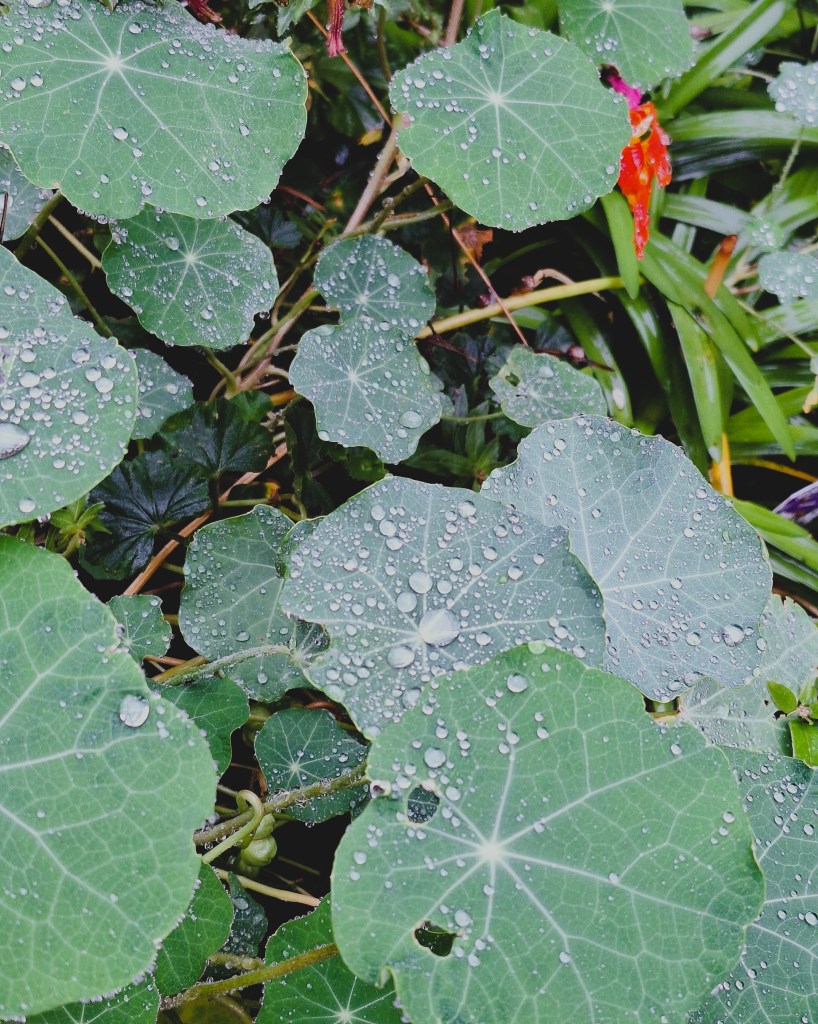
Wistfully gazing out of my window, Cyclamen, Helleborus niger, claim their winter birth, as salvias, pelargoniums, hydrangeas reaching old age, slip into hibernation, and late-flowering nasturtiums hide beneath dishes of protective leaves. Jack Frost will come soon, blowing his crystal dust, a winter overcoat under which plants will gently slumber.
There will be colour still. God will always leave his mark, painted in brushstrokes of nature’s Green.
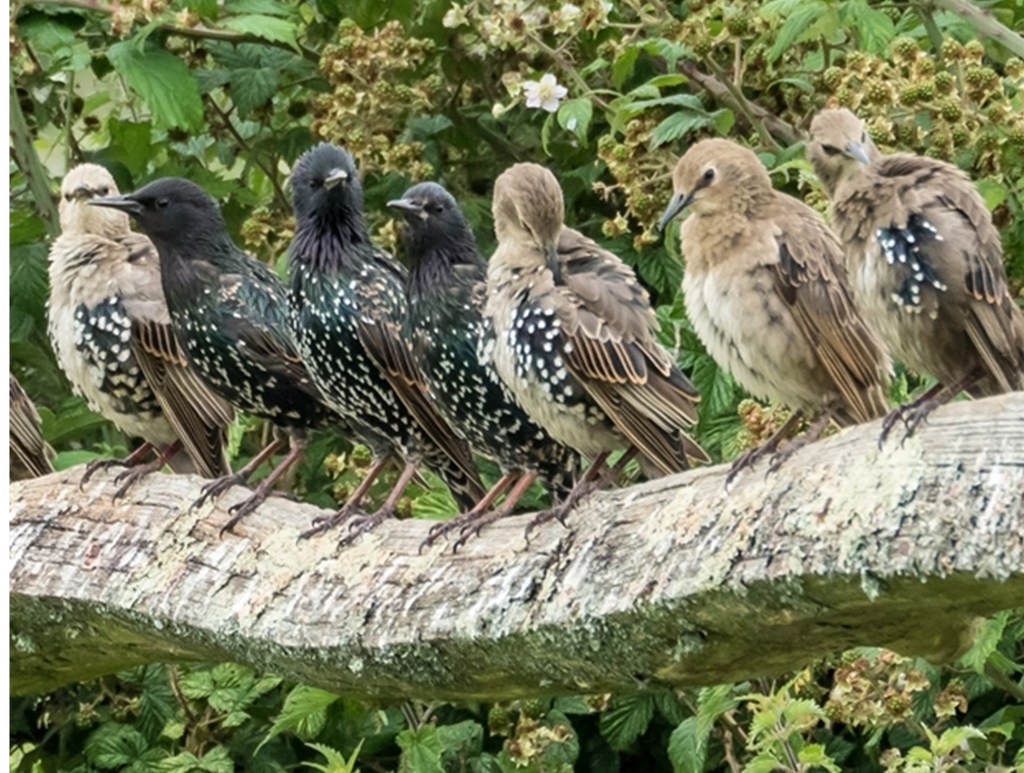
Starlings on Snettisham Beach, North Norfolk.copyright RSPB
Snettisham beach in North Norfolk, near Sandringham Royal Estate, is a good place to witness a phenomenon known as murmuration. Usually at sunset, large groups of Starlings occupy the sky alongside the Wash as they swoop and swirl in packs, ducking and diving as they twist and turn across the sky. They make beautiful shape-shifting formations which are spellbinding and fascinating to watch. It is sheer poetry in motion.
The word murmuration which describes this activity is derived from the noise the birds make by the flapping of wings of so many birds in flight.This tends to happen during the Autumn and Winter months, often from October to March, though sometimes earlier. It tends to peak in December to January when native birds are joined by more birds from all over Europe
At sunset, large groups of starlings take to the sky, swooping and swirling into spheres, planes and waves. The phenomenon is called a murmuration, and it’s named after the noise that is made by the many flapping wings of a group of starlings in flight. Being together offers safety in numbers – predators such as peregrine falcons find it hard to target one bird in the middle of a hypnotizing flock of thousands. They also gather to keep warm at night and to exchange information, such as good feeding areas.
Here’s a poem inspired by wading birds at Snettisham, a reminder of Murmuration of Starlings, by my friend Piers Northam
Myriad waders ribbon the foreshore, crisply backlit as they needle the sands.
Kettled by tidewater, they lift and resettle until, rising together, they skein like wind-rippled silk; billowing into clouded bee-swarm; funnelling and shoaling as they scud across the skies.
My friend, Gill Henwood, has sent me a poem she has written about House Martin’s. I want to share it with you.
The house martin is a small bird with glossy blue-black upper parts and pure white under parts. It has a distinctive white rump with a forked tail and, on close inspection, white feathers covering its legs and toes. It spends much of its time on the wing collecting insect prey. The bird’s mud nest is usually sited below the eaves of buildings. They are summer migrants and spend their winters in Africa. Although still numerous and widespread, recent moderate declines earn them a place on the Red List.
To find out more go to the website of the RSPB (Royal Society for the Protection of Birds) and the website of : House Martin Conservation UK & Ireland.
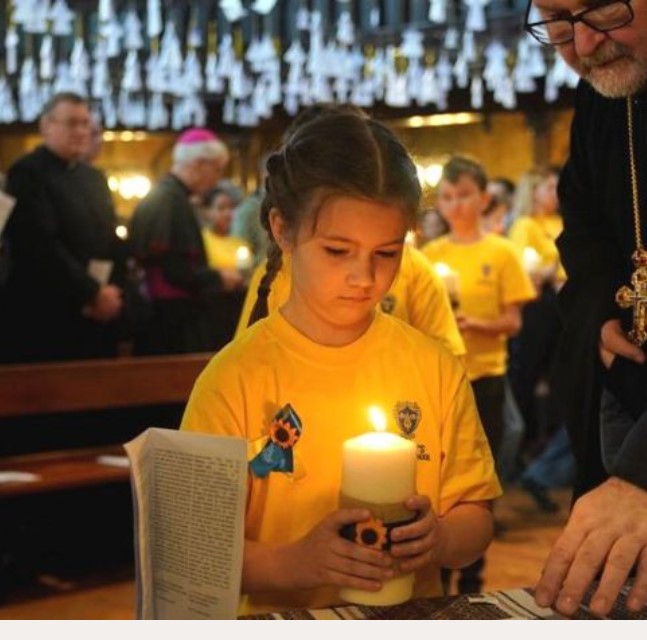
A candle for Ukraine, lit in the Ukrainian Catholic Cathedral in London on Friday February 24th.
Take Only What Is Most Important
Take only what is most important. Take the letters. Take only what you can carry. Take the icons and the embroidery, take the silver, Take the wooden crucifix and the golden replicas.
Take some bread, the vegetables from the garden, then leave. We will never return again. We will never see our city again. Take the letters, all of them, every last piece of bad news.
We will never see our corner store again. We will never drink from that dry well again. We will never see familiar faces again. We are refugees. We’ll run all night.
We will run past fields of sunflowers. We will run from dogs, rest with cows. We’ll scoop up water with our bare hands, sit waiting in camps, annoying the dragons of war.
You will not return and friends will never come back. There will be no smoky kitchens, no usual jobs, There will be no dreamy lights in sleepy towns, no green valleys, no suburban wastelands.
The sun will be a smudge on the window of a cheap train, rushing past cholera pits covered with lime. There will be blood on women’s heels, tired guards on borderlands covered with snow,
a postman with empty bags shot down, a priest with a hapless smile hung by his ribs, the quiet of a cemetery, the noise of a command post, and unedited lists of the dead,
so long that there won’t be enough time to check them for your own name.
Serhiy Zhadan
Translated from the Ukrainian by Virlana Tkacz and Wanda Phipps
This poem by Serhiy Zhadan, an internationally acclaimed poet and novelist, from Ukraine, was read by actress, Dame Helen Mirren, at a Vigil in London. She ended her recitation with tears in her eyes and calling for ‘Freedom ‘ for Ukraine. The poem was written in 2015. It details the turmoil of war and the plight of refugees. Zhadan makes a reference to sunflowers, the national symbol of the Ukraine. Totally relevant to what has been the experience of so many in the present war in the Ukraine, it speaks powerfully about what being driven from ones homeland means. Maybe it will also move the hearts who have a negative view of what receiving refugees is really about.
for I was hugry and you did not feed me, thirsty and you gave me nothing to drink……




 Mr G's Ponderings